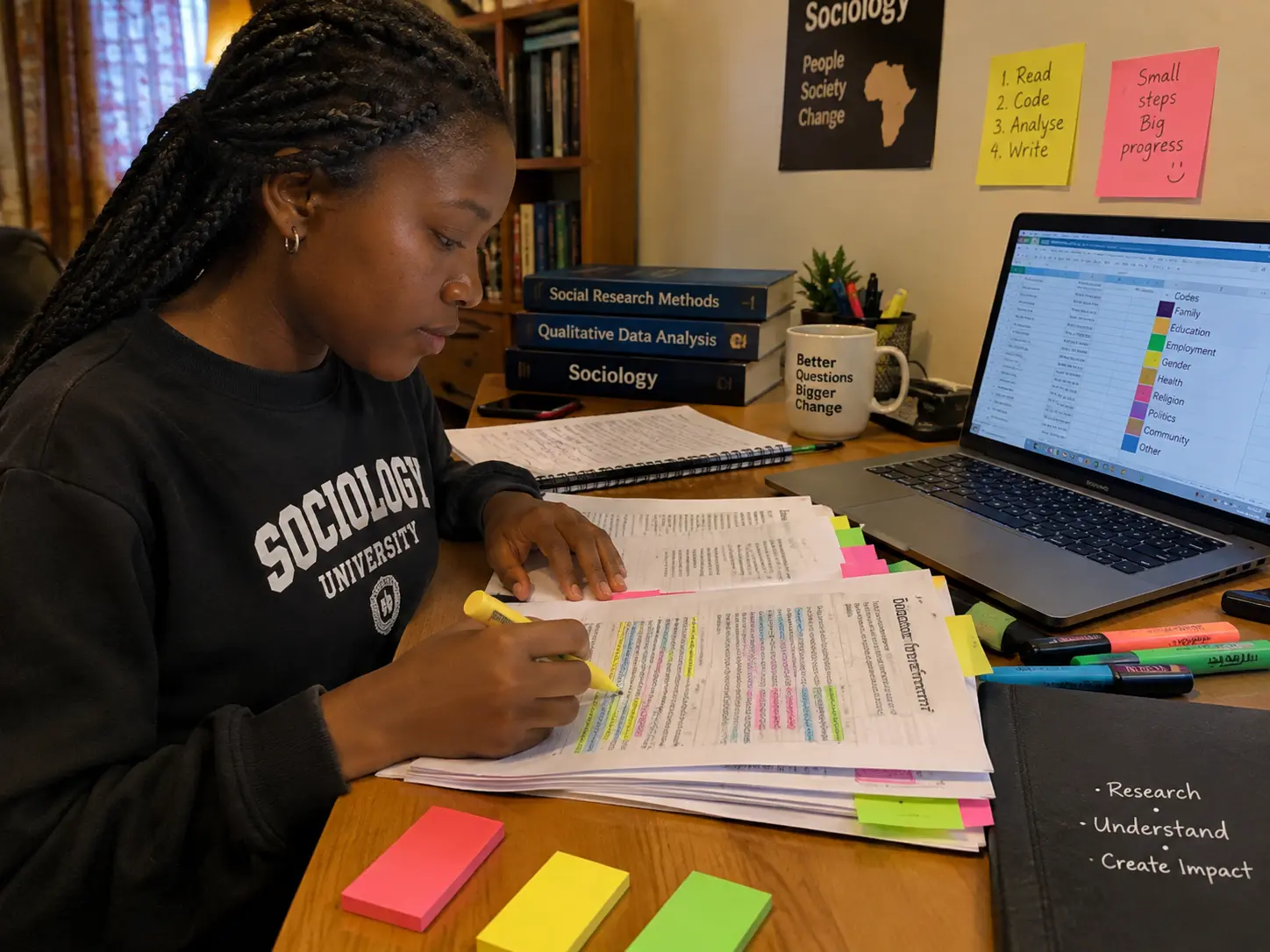
Thematic analysis takes the interview or focus-group transcripts you collected with your sociology project’s interview guide and turns them into named, evidenced themes that answer your research questions. This guide walks through Braun and Clarke’s six-phase method step by step, with a fully worked, labelled illustrative example built around interview excerpts on internal migration among young adults in Lagos.
What Is Thematic Analysis, and When Should a Sociology Project Use It?
Thematic analysis is a method for identifying, analysing and reporting patterns (themes) across a qualitative dataset — most commonly interview or focus-group transcripts. It suits sociology projects built around lived experience, social processes or meaning-making (migration, informal work, kinship networks, community coping strategies) where the goal is to describe and interpret patterns across participants’ accounts, rather than to test a hypothesis with a fixed coding scheme decided in advance. The most widely used version in student work is Braun and Clarke’s six-phase framework, first published in 2006 and still the standard reference cited in qualitative methods sections. This is a distinct step from building your interview or focus group guide, which happens before data collection — thematic analysis is what you do with the transcripts once collection is complete.
Step 1: Familiarise Yourself With the Data
Transcribe every interview or focus group in full (verbatim, including hesitations if your analysis is discourse-sensitive; cleaned-up verbatim is acceptable for most sociology topics), then read the full set of transcripts at least twice before coding anything. Note early, informal observations in a research journal as you read — these often become the seeds of later themes, and a supervisor may well ask you to show evidence of this familiarisation stage rather than jumping straight to coding.
Step 2: Generate Initial Codes
Work through the transcripts line by line, labelling any segment of text that says something relevant to your research questions with a short code (a few words capturing what is being said). Code systematically across the entire dataset, not just the interviews that seem most interesting, and code the same segment under more than one label if it speaks to more than one idea. At this stage you are producing a long list of codes, not yet themes — a typical undergraduate dataset of eight to twelve interviews commonly generates several dozen initial codes before any grouping happens.
Step 3: Search for Themes
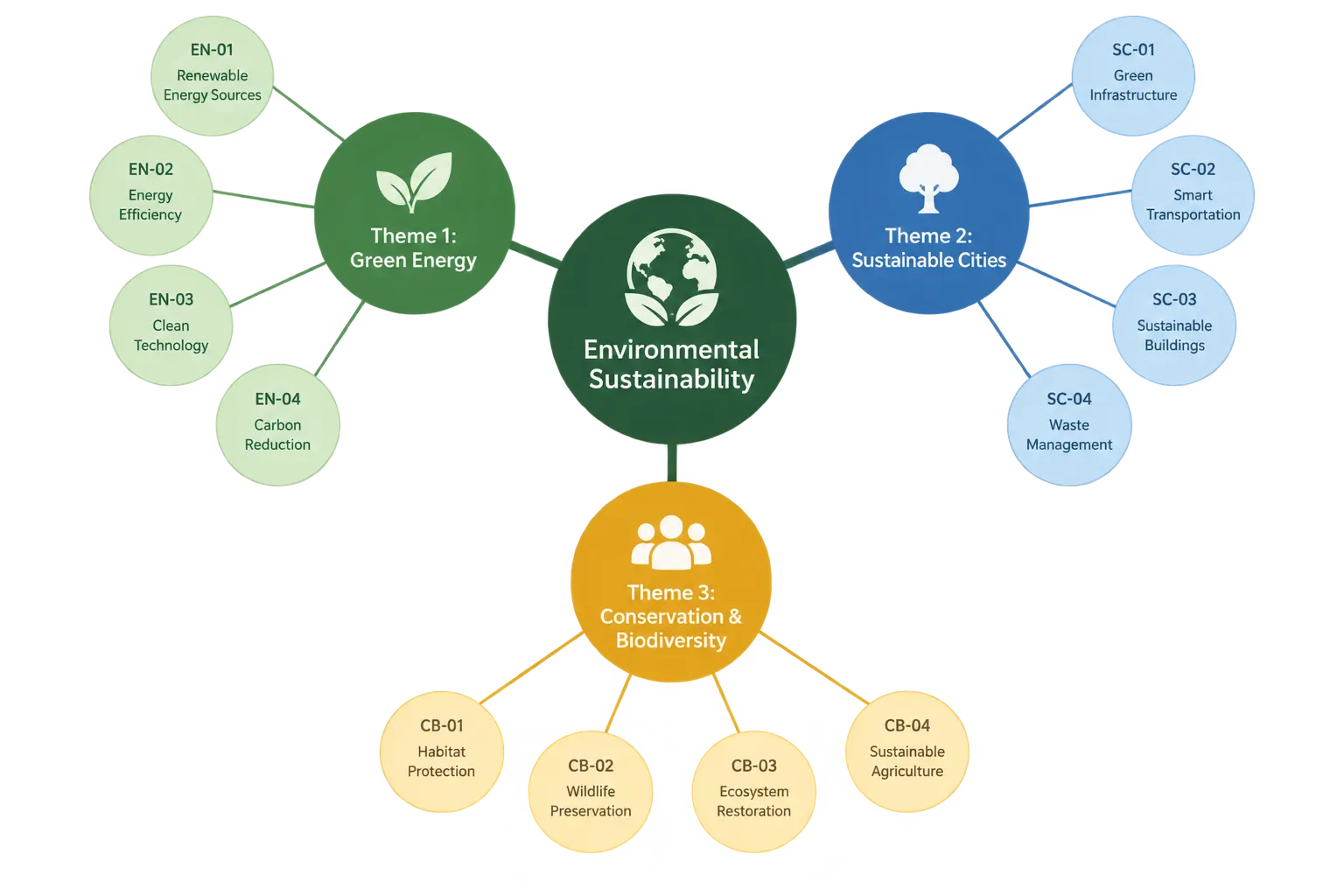
Group related codes into candidate themes and sub-themes, using a table or a visual thematic map to see how codes cluster. A theme is not just a repeated topic — it is a pattern that captures something meaningful about your research question, supported by enough coded extracts across enough participants to be more than one person’s isolated comment.
Step 4: Review the Themes
Check each candidate theme against two levels: first, do the coded extracts within a theme actually form a coherent pattern (or should the theme split into two, or a weak theme be dropped or merged)? Second, does the full set of themes work together to represent the whole dataset accurately, not just the parts you found easiest to code? This two-level review is the step students skip most often, and it is the one an examiner is most likely to probe: be ready to explain why a theme survived review and another did not.
Step 5: Define and Name the Themes
For each surviving theme, write a clear definition of what it captures and what it does not, and give it a short, descriptive name (not a vague label like “Theme 1” — a name that tells the reader what the theme is about, such as “Family expectation as a migration trigger”). Identify one or two sub-themes per theme if the pattern has internal structure worth showing separately.
Step 6: Produce the Report
Write up each theme with a short narrative explaining what it shows, illustrated with verbatim quoted extracts from at least two or three different participants (never just one), and connect the theme explicitly back to your research question and to the literature discussed in Chapter Two. Order your themes deliberately rather than in the sequence you happened to find them — leading with the theme most central to your research question, then the ones that add nuance or complication, is generally more persuasive than a list ordered by how many participants mentioned each one. This is the section that becomes the bulk of your Chapter Four, and it is usually the longest single section in the whole document once every theme has its narrative, its quotes and its link back to the literature.
A Worked Example: Coding Interview Data on Internal Migration (Illustrative)

The excerpts, codes and themes below are entirely fictitious and illustrative — built to show the shape of the method, not to be copied as real findings.
Illustrative interview excerpt (Participant 4): “My parents kept saying there was nothing for me to do back home, that everyone who wanted a better life had already left for Lagos. I did not really want to go, but staying felt like I was disappointing them.”
| Coded segment | Initial code | Candidate theme |
|---|---|---|
| “everyone who wanted a better life had already left” | Peer/community migration norm | Family expectation as a migration trigger |
| “staying felt like I was disappointing them” | Obligation to family expectation | Family expectation as a migration trigger |
| “I did not really want to go” | Reluctant or ambivalent migration decision | Ambivalence beneath an outwardly voluntary move |
Illustrative interview excerpt (Participant 7): “Nobody forced me, but when your younger cousins are already sending money home and you are still there, it starts to feel like your own choice was made for you before you even made it.”
| Coded segment | Initial code | Candidate theme |
|---|---|---|
| “nobody forced me” | Outwardly voluntary framing | Ambivalence beneath an outwardly voluntary move |
| “your own choice was made for you before you even made it” | Perceived inevitability of migration | Family expectation as a migration trigger |
Theme definition (illustrative): “Family expectation as a migration trigger — captures accounts where participants describe migrating primarily in response to a felt family or community expectation, rather than a fully self-directed choice, even when the move is outwardly presented as voluntary.” Because this pattern recurs across Participant 4 and Participant 7 with a similar underlying logic, expressed in different words, it has moved from a single person’s anecdote to a candidate theme — the test a real dataset applies at Phase 3, scaled up across however many interviews the pattern actually appears in, not just two.
How Do You Show Rigour Without a Reliability Statistic?
Because thematic analysis does not use a numeric inter-rater reliability score the way structured content analysis does, a sociology project needs to show rigour a different way, and you should expect to be asked about it at your defence. Three commonly accepted approaches, any one of which is usually sufficient for undergraduate work: keeping a research journal that records coding decisions and why a candidate theme was kept, split or dropped; a peer debrief, where a coursemate or supervisor reviews a sample of your coded transcripts and challenges your interpretation; and member checking, where you share a summary of your themes with one or two participants to confirm the interpretation resonates with their experience (not always feasible on a tight deadline, but worth attempting for at least a subset). State clearly in your method section which of these you used and be ready to describe a concrete example from your own coding process, not just the general principle.
Common Faults That Get a Thematic-Analysis Chapter Sent Back
| Fault | Fix |
|---|---|
| Themes that are really just topics (“Education”, “Family”) with no analytic claim | State what pattern or claim the theme makes about the topic, not just that the topic came up |
| A theme supported by only one participant’s quote | Show the theme recurs across multiple participants, or reframe it as a case-specific observation |
| Coding and theming done in one pass with no review step | Explicitly show Phase 4’s review — which candidate themes were merged, split or dropped, and why |
| No connection between the theme and the literature review | Every theme in Chapter Four should be discussed against at least one source from Chapter Two |
| Claiming inter-rater reliability statistics for a method that does not use them | Thematic analysis is interpretive; reliability is usually addressed through a research journal, peer debrief or an audit trail, not a numeric reliability coefficient |
Frequently Asked Questions
Do I need special software to do thematic analysis?
No — thematic analysis can be done by hand with highlighters and a spreadsheet for a small dataset, though qualitative software can speed up organising codes across many transcripts. See the coding tools comparison linked below for what is actually worth paying for at student scale.
How many interviews do I need before I can identify a theme?
There is no fixed number in Braun and Clarke’s original method — what matters is that a theme recurs meaningfully across your specific sample, not that it hits a numeric threshold. See the qualitative sample-size article linked below for how to justify your total number of participants.
Is thematic analysis the same as content analysis?
No. Content analysis (as used for coding media content) typically applies a more fixed, often quantifiable coding scheme, sometimes checked for inter-coder reliability; thematic analysis is more interpretive and the coding scheme develops from the data itself rather than being fixed in advance.
Can I use thematic analysis on focus group data as well as one-on-one interviews?
Yes — the six phases apply to focus-group transcripts the same way, though you should also note in your method section how group dynamics (participants influencing each other’s answers) might shape what themes emerge.
Do I need to report how many participants mentioned each theme?
Reporting an exact count is optional and some qualitative traditions actively discourage it, since thematic analysis is not about frequency; what is expected is a clear statement of whether a theme was widespread, common, or present in a smaller but analytically significant subset of your sample.
What do I put in my Chapter Three method section if I am using thematic analysis?
State that you used Braun and Clarke’s six-phase thematic analysis, name your unit of analysis (interview transcripts, focus-group transcripts), and briefly describe how you will manage rigour (a research journal, peer debriefing, or an audit trail of how codes became themes).
Can two students in the same department both use thematic analysis on different topics?
Yes — thematic analysis is a general method, not tied to one topic, so any number of students can use it as long as each applies it to their own dataset and research questions.
Coding transcripts, tracking which codes merge into which themes, and writing up each theme with the right quoted evidence is the kind of structured chapter work Tesify is built to support. More than 9,000 students have used Tesify to write over 15,000 chapters, and every one is 100% written by you: the codes, the themes and the interpretation stay your own. Start your project with Tesify and approach your qualitative analysis with a clear structure.
Before you analyse your data, check whether you have enough respondents for a qualitative project, compare coding tools for structured content analysis if your project needs a more fixed coding scheme instead, and see the tools for transcribing and coding interview data before you start Phase 1. Every theme you write up should engage the sources in your Chapter Two literature review, and if your project involves human participants, confirm what ethics approval your data collection needs — the process is close to what other human-subject projects require.