Your Supervisor Returned Chapter Two Again: How to Break the Correction Loop
Fourth submission. Same chapter. More red ink than last time, and some of it contradicts what you were told in round two. You are now genuinely unsure whether you are getting closer or further away, and the defence date has not moved.
Rebuild your chapter with Tesify

Why the loop keeps going
Because you are fixing the comments. That sounds like exactly the right thing to do, and it is the reason the chapter keeps coming back.
When you address forty comments one at a time, you produce a document that has answered forty small objections and still has the same underlying problem it had in round one. The supervisor reads it, sees the same structural fault, and writes forty new comments — often on different sentences, because the old ones are gone. From your side it looks like the goalposts moved. From theirs, the chapter still does not work.
The loop breaks when you stop treating the comments as a task list and start treating them as symptoms.
The three kinds of correction
Before you change a single line, read every comment and sort it into one of three buckets. Do this on paper or in a separate document, not in the chapter itself.
1. Structural corrections — the ones that matter
“This is a summary, not a review.” “Where is the gap?” “You have not connected this to your objectives.” “This is descriptive.” These are not comments about paragraphs. They are one comment about the whole chapter, written in four places.
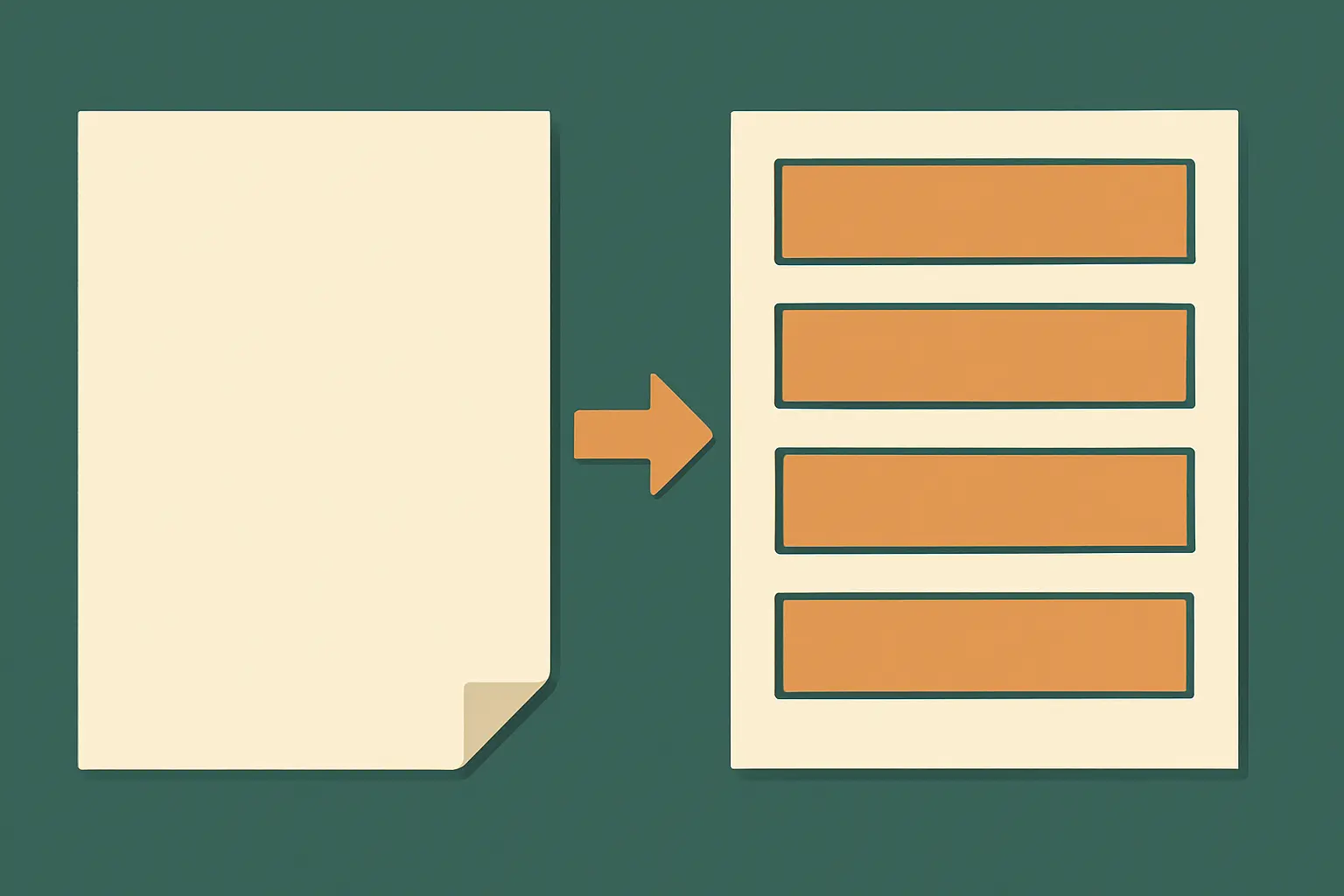
Response: restructure, do not edit. If your literature review is organised author by author — Author A said this, Author B said that — no amount of sentence-level fixing will satisfy a supervisor who wants it organised by theme with a gap emerging at the end. Rewriting the chapter around themes is faster than three more rounds of patching.
2. Evidential corrections
“Source?” “Too old.” “Says who?” “This is not what that study found.” These are about the relationship between your claims and your sources.
Response: go back to the sources, and be honest about the ones you have not actually read. A citation you inherited from another project’s reference list is the most common origin of “this is not what that study found”, and it is the correction most damaging to your credibility with a supervisor.
3. Presentational corrections
Formatting, referencing style, spelling, table numbering, heading levels. Real, but trivial.
Response: fix them all in one pass at the end, mechanically. Never let these consume the attention that the structural bucket needs — and note that presentational corrections repeating across rounds often mean you are formatting to the wrong referencing style entirely, which is worth confirming rather than re-fixing.

Why sorting works when fixing does not
The sort is not an organisational nicety. It changes what you are looking at.
Forty scattered comments feel like forty problems, which is overwhelming and gives you no way to decide what to do first. The same forty comments sorted into buckets usually turn out to be three structural problems, eight evidential ones and twenty-nine presentational ones. That is a completely different and far more tractable situation, and you can see immediately that the twenty-nine are not why the chapter keeps coming back.
It also tells you whether you are actually making progress. If round three had five structural comments and round four has one, the chapter is converging even though the total count barely moved. If round four still has five, nothing you did addressed the real fault, and doing more of it will not help. That is a diagnosis you cannot get from a raw comment count, and it is the difference between a student who feels the loop is endless and one who can see it closing.
What a supervisor is actually checking in Chapter Two
Published university guidelines are clearer about this than most departmental briefings are. Obafemi Awolowo University’s postgraduate guidelines specify that the main body of a thesis must contain an introduction, a literature review, methodology, results or findings, a conclusion, and a contribution to knowledge.
Notice that the literature review sits between the problem you stated and the method you chose. That is its job. It is not a display of how much you read. It exists to show that the gap named in Chapter One is real, and to justify the method you are about to use in Chapter Three.
Judge your own chapter against that test before resubmitting. If a reader finishes it without being convinced the gap exists, the chapter has not done its work regardless of how many sources it contains — and that is what “this is descriptive” means.
How to make the next submission the last one
- Sort every outstanding comment into the three buckets before changing anything.
- Count the structural bucket. If it has more than two entries, plan a rewrite rather than an edit.
- Ask one clarifying question, in writing, before you start. Not “any thoughts?” but “Should the review be organised by theme or by variable?” A specific question is answerable in one line; a vague one gets no reply.
- Rewrite the structure first, with the argument running from broad field to your specific gap, and every theme ending in what remains unknown.
- Then fix the evidential bucket, opening each source you cite. Remove anything you cannot verify rather than defending it.
- Then do one presentational pass, all of it at once.
- Send it with a short covering note listing what you changed structurally. A supervisor who can see you understood the main point reads the chapter differently.
- Do not stop working while you wait. Draft Chapter Three. Feedback on Two is not a prerequisite for starting Three; it is a prerequisite for finalising Two.
When the corrections contradict each other
This happens, and it is not always a mistake on your supervisor’s part. Round two asked for more detail because the section was thin; round four asks for less because the added detail buried the argument. Both comments were right about the draft in front of them.
Say so plainly and without accusation: “In the earlier draft you asked me to expand the theoretical section; in this one it reads as too long. Should I keep the expanded version and cut the descriptive parts, or return to the shorter version?” You will get a decision, and you will have it in writing.
Where two supervisors genuinely disagree, do not adjudicate between them and do not quietly follow one. Put the conflict to both in the same message and ask them to settle it. Choosing a side privately is how a student ends up defending a chapter that one of their own examiners rejected.
Where Tesify helps
Restructuring is the correct response to a structural correction and also the most daunting, because it means dismantling something you have already rewritten three times.
- Rebuild the chapter around a thematic outline rather than reordering paragraphs by hand, so the argument, not the paragraph order, drives the structure.
- Keep every source attached to the claim it supports as you rewrite, which is what stops the evidential bucket refilling in the next round.
- Hold the whole five-chapter shape in one place, so a change in Chapter Two does not silently break its link to the objectives you set in Chapter One.
- Keep referencing consistent across rewrites, which is where mixed formatting usually creeps in — and where a similarity report later picks up passages that lost their citation during restructuring.
The analysis and the argument stay yours: 100% written by you, alongside 9,000+ students and 15,000+ chapters. What changes is that a rewrite stops being a week of dread.
Frequently asked questions
How many rounds of corrections is normal?
There is no standard figure. What matters is whether the comments are getting smaller. Structural comments in round four mean the chapter has not yet been restructured.
My supervisor’s comments are just “expand this”. What do I do?
Ask a specific question in writing — which section, and in what direction. Guessing produces another round.
Is it rude to ask my supervisor to clarify?
No. A precise question takes them ten seconds and saves you a fortnight. Vague resubmissions cost them far more time than questions do.
Should I rewrite the whole chapter or edit it?
Count the structural corrections. More than two, rewrite. Editing around a structural fault is what keeps the loop running.
Can I skip to Chapter Three while waiting?
Yes, and you should. Waiting turns a supervisor’s slow fortnight into your lost month.
What if I disagree with a correction?
Say so once, briefly, with a reason — and then follow the instruction if it stands. Your supervisor knows the examiners.
My two supervisors contradict each other. What now?
Put the conflict to both in the same message and ask them to resolve it. Do not choose privately.
How do I know when Chapter Two is finished?
When a reader who has not seen your topic before finishes it convinced the gap is real and that your method follows from it.
Should I start over from a downloaded project?
No. Beyond the integrity risk, it imports someone else’s structure into a chapter your supervisor is judging against your own Chapter One.
The chapter is closer than it feels
A chapter returned four times feels like failure and is usually the opposite — it means a supervisor is still engaging with it. Sort the comments, fix the structure once, and the loop closes. Most students are one honest rewrite away from approval, spending it instead on a fifth round of patching.
If you are also still trying to get a first chapter written at all, start there and come back to this.