The most-defined terms in Nigerian public health and nursing projects are measured, so every one needs two sentences: a conceptual definition from a body that defines it, and an operational definition that says how you measured it. The World Health Organization (WHO) defines most of them. Below are twenty terms with the WHO wording where WHO gives one, and an illustrative operational version for you to adapt to your own instrument.
Why Do Health Projects Define Terms Differently From Other Fields?
A health term often has a numeric threshold, and a panel will ask which one you used. Hypertension, overweight, stunting and antenatal care coverage are all defined by cut-offs or counts, and a different cut-off gives a different prevalence. Your Chapter One must therefore name the source of the cut-off and your Chapter Three must show that the instrument applies it. For the general method of writing both kinds of definition, start with our guide to the definition of terms in a Nigerian project, then use the table below for the health terms.
Every conceptual definition in the table comes from a WHO page or WHO indicator record. The operational wordings are illustrative. They show the style and must be rewritten to match the instrument, the respondents and the period of your own study.
Which Twenty Terms Can You Define From WHO Sources?
| # | Term | WHO conceptual definition | Illustrative operational definition |
|---|---|---|---|
| 1 | Health | “A state of complete physical, mental and social well-being and not merely the absence of disease or infirmity” (WHO Constitution, in force since 7 April 1948) | Self-rated general health on the questionnaire item with four response options |
| 2 | Maternal death | The annual number of female deaths from any cause related to or aggravated by pregnancy or its management, excluding accidental or incidental causes, during pregnancy and childbirth or within 42 days of termination of pregnancy (ICD-10, as given in the WHO indicator record) | Deaths of women recorded in the facility register within 42 days of delivery during the study year |
| 3 | Maternal mortality ratio (MMR) | The number of maternal deaths during a given time period per 100,000 live births during the same time period | Maternal deaths in the study facility in the year divided by live births in the same year, multiplied by 100,000 |
| 4 | Newborn (neonatal) period | The first 28 days of life | Deaths of infants aged 0 to 28 days in the facility register |
| 5 | Neonatal mortality rate | Deaths in the first 28 days, expressed per 1,000 live births | Neonatal deaths in the year divided by live births in the year, multiplied by 1,000 |
| 6 | Hypertension | Blood pressure of 140/90 mmHg or higher; diagnosed when readings on two different days show systolic of 140 mmHg or more and/or diastolic of 90 mmHg or more | Mean of two readings taken by the researcher with the same validated device, at or above 140/90 mmHg, or a record of treatment for hypertension |
| 7 | Body mass index (BMI) | Weight in kilograms divided by height in metres squared | BMI calculated from weight and height measured by the researcher on the day of data collection |
| 8 | Overweight (adults) | A BMI greater than or equal to 25 | An adult respondent whose measured BMI is 25.0 or above but below 30.0 |
| 9 | Obesity (adults) | A BMI greater than or equal to 30 | An adult respondent whose measured BMI is 30.0 or above |
| 10 | Overweight (children 5–19 years) | BMI-for-age greater than 1 standard deviation above the WHO Growth Reference median | A pupil whose BMI-for-age z-score is above 1 on the WHO reference |
| 11 | Overweight (children under 5 years) | Weight-for-height greater than 2 standard deviations above the WHO Child Growth Standards median | A child whose weight-for-height z-score is above 2 on the WHO standard |
| 12 | Malnutrition | Three broad groups of conditions: undernutrition (wasting, stunting, underweight), micronutrient-related malnutrition and overweight, obesity and diet-related noncommunicable diseases | The presence of any of the three conditions your study measures, named and measured separately |
| 13 | Stunting | Low height-for-age | A child whose height-for-age z-score falls below the cut-off you state, using the WHO Child Growth Standards |
| 14 | Wasting | Low weight-for-height | A child whose weight-for-height z-score falls below the cut-off you state |
| 15 | Underweight | Low weight-for-age | A child whose weight-for-age z-score falls below the cut-off you state |
| 16 | Exclusive breastfeeding | Infants fed only breast milk for the first 6 months of life, as recommended by WHO and UNICEF | A mother who reports that her infant of six months or younger received nothing but breast milk in the previous 24 hours |
| 17 | Primary health care | “A whole-of-society approach to health that aims at ensuring the highest possible level of health and well-being and their equitable distribution”, focusing on people’s needs from health promotion to palliative care and as close as feasible to people’s everyday environment | Services delivered at the primary health centres included in the study sample |
| 18 | Universal health coverage | All people have access to the full range of quality health services they need, when and where they need them, without financial hardship | The proportion of respondents who report needing a service and being unable to pay for it in the past year |
| 19 | Antenatal care coverage (at least four visits) | A WHO Global Health Observatory indicator: antenatal care coverage, at least four visits (%) | Women whose antenatal card shows four or more recorded visits, as a percentage of respondents |
| 20 | Births attended by skilled health personnel | A WHO Global Health Observatory indicator: births attended by skilled health personnel (%) | Births in the respondent group attended by a doctor, nurse or midwife, as a percentage of births |
Two cautions. First, the WHO wording above is what the page says; use the source’s own words in quotation marks and cite the page you opened, with its date. Second, WHO updates its pages and indicator records, so check the current version before you cite it. Where a row gives only a threshold phrase such as “the cut-off you state”, the choice is yours to justify in the methods chapter, so name the standard and the cut-off you use.
How Do You Turn a WHO Definition Into an Operational One?
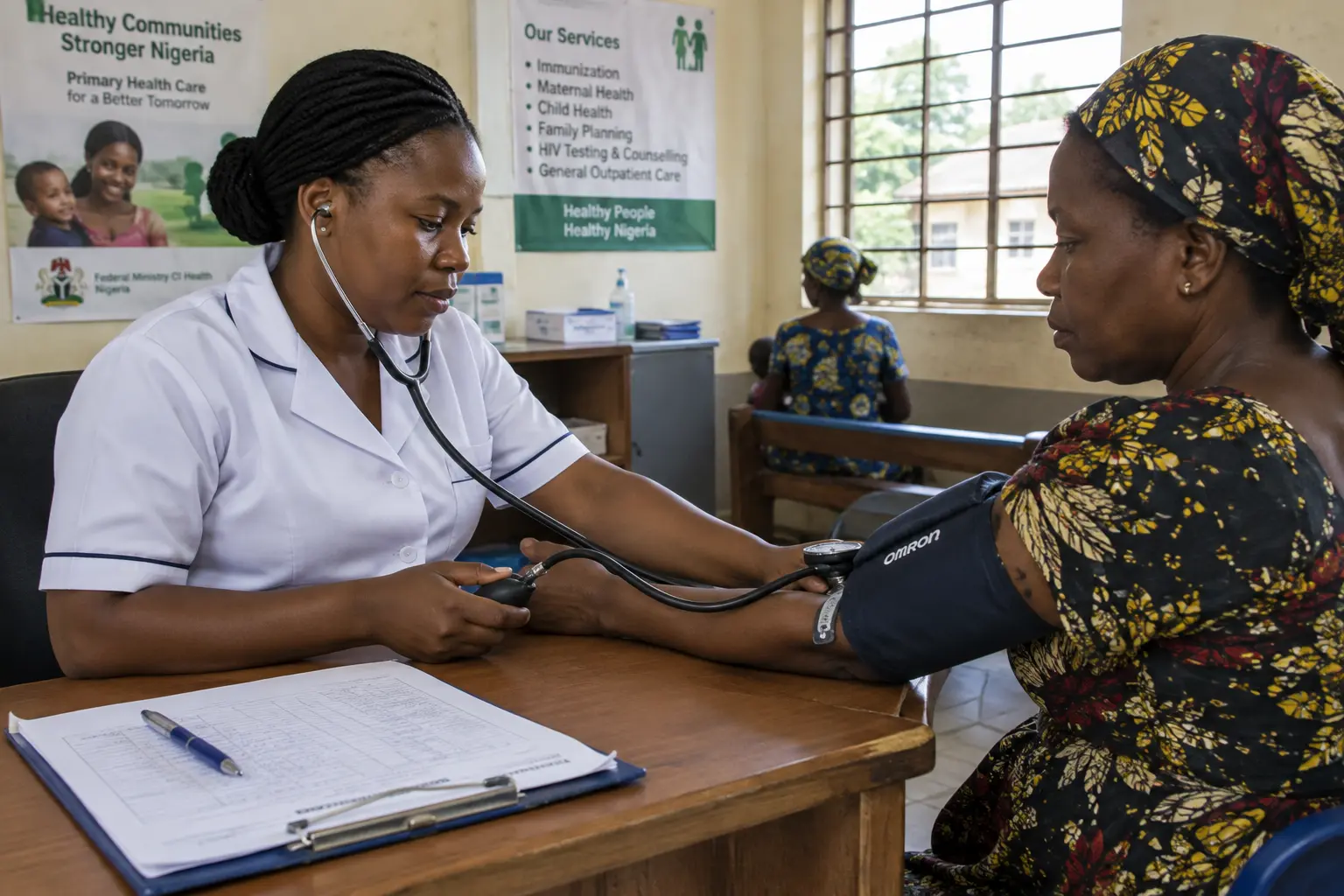
Use the same four parts every time: the variable, the indicator, the instrument and the scoring rule. Hypertension shows the pattern. The variable is hypertension. The indicator is blood pressure. The instrument is a validated device used under stated conditions. The scoring rule is the cut-off, here 140/90 mmHg or higher on the readings you take. WHO’s own diagnostic definition requires readings on two different days, so if your design allows only one visit you must say that your measure identifies elevated blood pressure at one visit and is not a clinical diagnosis. Stating this limit in Chapter One saves you a question at the defence.
The same logic applies to BMI. WHO calculates it as weight in kilograms divided by height in metres squared, and the categories vary by age and gender for adults, adolescents, children and infants, so you must state which category table you applied to which respondents. Our article on the population and sample size of a nursing project shows how the respondent group you define also decides which standard you use.
Which Terms Are Often Confused?
- Maternal death and maternal mortality ratio. A maternal death is an event; the ratio is the number of such deaths per 100,000 live births in the same period. Do not report a count as a ratio.
- Neonatal period and infancy. The newborn period is the first 28 days, while infancy is longer. Name the age range you study.
- Wasting, stunting and underweight. They use three different pairs of measurements (weight-for-height, height-for-age and weight-for-age), so a child can fall in one group and not another.
- Overweight and obesity. The thresholds differ for adults, children aged 5 to 19 years and children under 5, so a single cut-off cannot be applied to every respondent.
- Primary health care and primary care. WHO’s definition of primary health care is a whole-of-society approach, which is broader than the clinical services of a primary care centre. If you mean the services of the centre, say that in your operational definition.
Where Do Nigerian Projects Use the National Survey?
Many public health projects compare their results with the Nigeria Demographic and Health Survey. The DHS Program lists a Nigeria Standard DHS for 2018 and one for 2024. If you quote a national indicator, open the report you cite, give its year and use the survey’s own definition of the indicator, because a survey definition (for example, the reference period for antenatal visits) may differ from the WHO wording or from your own. Say which definition each figure uses, and never put a survey figure beside your own without noting the difference. Our guide to how to design and validate a questionnaire for a public health project explains how to write the items that apply these definitions.
How Many Terms Should a Health Project Define?
Define the terms in your title, objectives and hypotheses, plus any measured variable and any abbreviation your panel might not know. For most health projects that is between five and fifteen terms, so choose from the table rather than copying all twenty. A project on hypertension among market traders might define health, hypertension, BMI, overweight, obesity and primary health care, and stop there. Keep each entry to the conceptual definition with its citation and one operational sentence. If your department’s format asks for the definition of terms in Chapter One, the ethics approval guide for a nursing project and the full written example in a complete nursing final year project show where it sits among the other sections.
A Short Checklist for Health Terms
- Each conceptual definition quotes or paraphrases a source you opened, with the page name and date.
- Each threshold (140/90, 25, 30, a z-score cut-off) names its source.
- Each operational definition names the instrument, the measurement conditions and the scoring rule.
- Age groups are stated, because many definitions change with age.
- The definition matches what your questionnaire or checklist actually records.
- Any difference between your definition and a national survey’s definition is stated.
Tesify helps you structure and organise your project, and the text is 100% written by you. Start your project with Tesify — 9,000+ students have written 15,000+ chapters with Tesify.
Frequently asked questions
Which organisation should I cite for health definitions?
Cite the body whose job it is to define the term. For most global health terms that is the World Health Organization. Cite the page or indicator record you actually opened, with its date.
What is the WHO definition of hypertension?
WHO describes hypertension as blood pressure of 140/90 mmHg or higher, and says it is diagnosed when readings on two different days show systolic of 140 mmHg or more and/or diastolic of 90 mmHg or more.
How is the maternal mortality ratio defined?
As the number of maternal deaths during a given period per 100,000 live births during the same period.
What BMI counts as overweight and obese in adults?
WHO defines overweight in adults as a BMI greater than or equal to 25 and obesity as a BMI greater than or equal to 30. Different thresholds apply to children.
What is the difference between stunting, wasting and underweight?
Stunting is low height-for-age, wasting is low weight-for-height and underweight is low weight-for-age. Each uses a different pair of measurements.
Do I need an operational definition for every term?
No. Give both a conceptual and an operational definition for the variables you measure, and a single clear sentence for background terms and abbreviations.
Can I use the WHO definition word for word?
Yes, in quotation marks with a citation, and you should add your own operational sentence to say how you measured the term in your study.
What if my study cannot take two blood pressure readings on different days?
State in your definition and limitations that your measure identifies elevated blood pressure at the visit and is not a clinical diagnosis, and describe the readings you took.
Where do I put the definition of terms in a nursing project?
Often at the end of Chapter One, but formats differ. Follow your department’s guide or a recently approved project from your department.