
This is a complete, annotated model of a Nigerian nursing final year project, built section by section from title to recommendations, with a note after each part explaining what makes it pass a departmental panel. It is an illustrative example, not a real submitted project — adapt the structure to your own topic, population and data rather than copying any wording.
The worked topic this example follows
To keep every chapter consistent, this model follows one invented topic throughout: “Knowledge and Practice of Standard Precautions Against Healthcare-Associated Infections Among Nurses in a Nigerian Teaching Hospital.” It is a realistic, approvable BNSc-level topic — a named population (nurses at one facility), a measurable variable (knowledge and self-reported practice), and data reachable through a questionnaire rather than a hospital records request. Swap in your own facility, population and infection-prevention focus; the section-by-section logic stays the same.
Chapter One: Introduction — the annotated model
Background of the study (annotated): Opens with the global burden of healthcare-associated infections, narrows to the Nigerian teaching hospital context, then narrows again to standard precautions as the nurse-level intervention that prevents them. Three sentences, three levels of zoom — global, national, local — is the shape a panel expects, not a single-level restatement of the topic.
Statement of the problem (annotated): States the specific gap: infection rates remain high despite documented precaution guidelines, and it is not established whether Nigerian teaching-hospital nurses’ knowledge translates into consistent practice. The problem statement names the gap between knowledge and practice explicitly — this is the sentence a panel underlines, because it is what your whole study exists to test.
Objectives (annotated): (1) Assess nurses’ knowledge of standard precautions. (2) Assess nurses’ self-reported practice of standard precautions. (3) Determine the relationship between knowledge and practice. (4) Identify barriers nurses report to consistent practice. Four objectives, each answerable by one section of your questionnaire and one section of Chapter Four — an objective your instrument cannot answer is a flaw, not a virtue.
Research questions and hypothesis (annotated): One research question per objective, plus a testable null hypothesis for objective three: “There is no significant relationship between nurses’ knowledge and practice of standard precautions.” State the hypothesis in the null form your statistical test will actually evaluate, not as a prediction of what you expect to find.
Significance and scope (annotated): Significance names who benefits and how — hospital infection-control committees, nursing education, policy — in two or three sentences, not a paragraph per beneficiary. Scope states the facility, the cadre of nurses covered, and the time frame, and explicitly states what is excluded (this model excludes patient-level infection outcomes, which would need records access this design does not have).
Chapter Two: Literature review — the annotated model
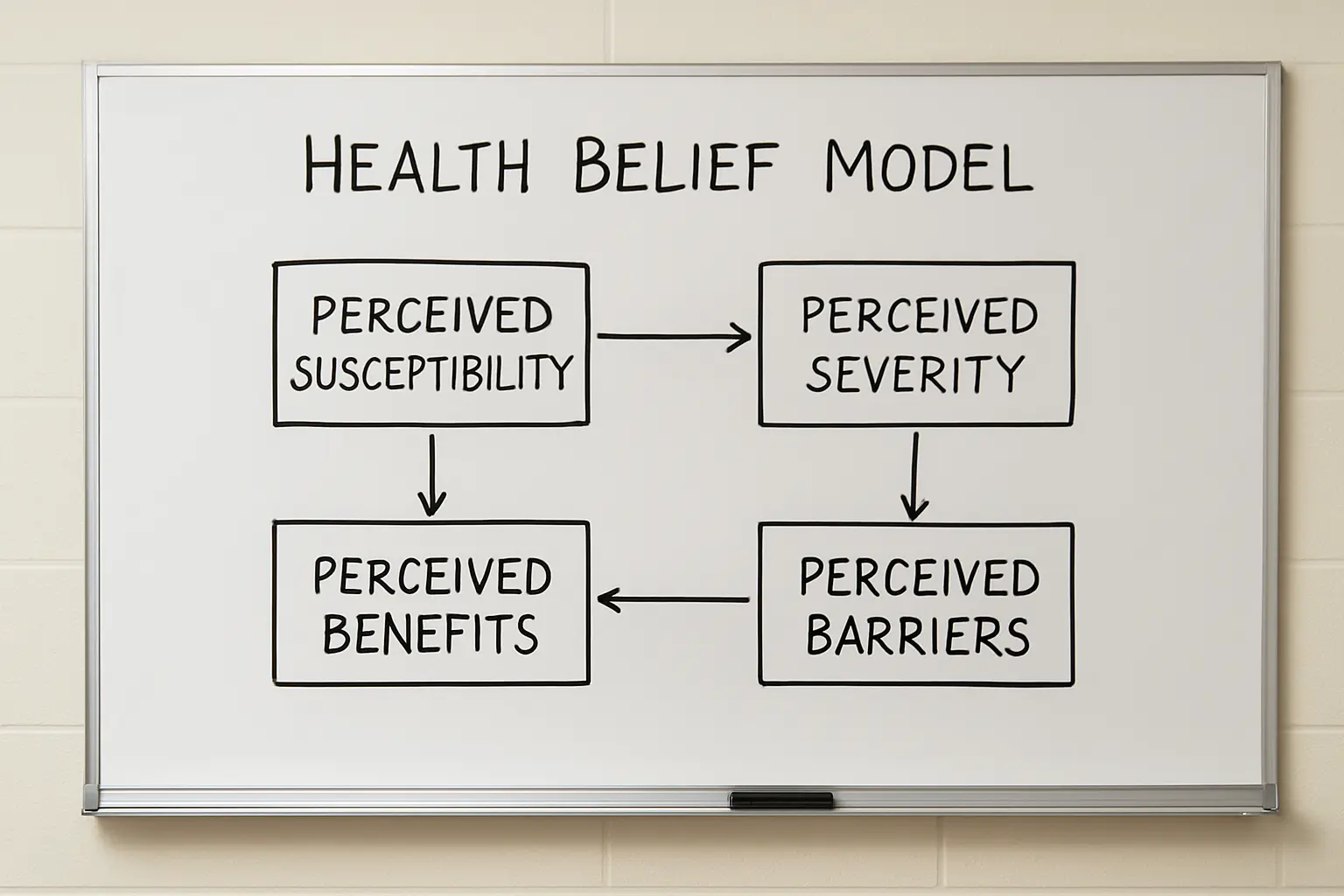
A passing Chapter Two moves through three named sub-sections, in order: conceptual review (defines standard precautions, healthcare-associated infection, and knowledge-practice gap as constructs, each with a cited definition), theoretical framework (this model adopts the Health Belief Model, because it explains why a nurse who knows a precaution may still not practise it — perceived susceptibility, perceived severity, perceived benefits and barriers map directly onto objective four), and empirical review (five to eight prior Nigerian and West African studies on the same or a closely related topic, each summarised in one paragraph stating its design, sample, and finding, not just its title). The chapter closes with a summary of literature and gap statement — one paragraph naming exactly what the empirical review did not yet establish for this facility, which is the sentence your Chapter One problem statement should echo.
Chapter Three: Methodology — the annotated model
This model uses a descriptive cross-sectional survey design, the standard design for a knowledge-and-practice study at undergraduate level. Population: all registered nurses at the named teaching hospital’s relevant wards (state the number from the hospital’s nursing department). Sample size: calculated with the Taro Yamane formula against that population figure, at the standard 0.05 margin of error. Sampling technique: stratified random sampling across wards, so no single unit dominates the sample. Instrument: a structured, self-administered questionnaire in three sections — demographics, a knowledge scale (multiple-choice items scored right/wrong), and a practice scale (a Likert-type self-report frequency scale) — adapted from a named prior instrument rather than invented from nothing, with the adaptation and source stated. Validity: content validity confirmed by two or three nursing lecturers, who check that each item measures what it claims to. Reliability: a pilot test with 10% of the sample size, analysed for internal consistency with Cronbach’s alpha, reporting the actual figure obtained. Method of data analysis: descriptive statistics (frequencies, percentages, means) for objectives one and two, and a chi-square or Pearson correlation test for the null hypothesis in objective three, chosen because it matches two categorical or continuous variables respectively — our guide to choosing the right statistical test covers this decision in general.
Chapter Four: Results and data analysis — the annotated model
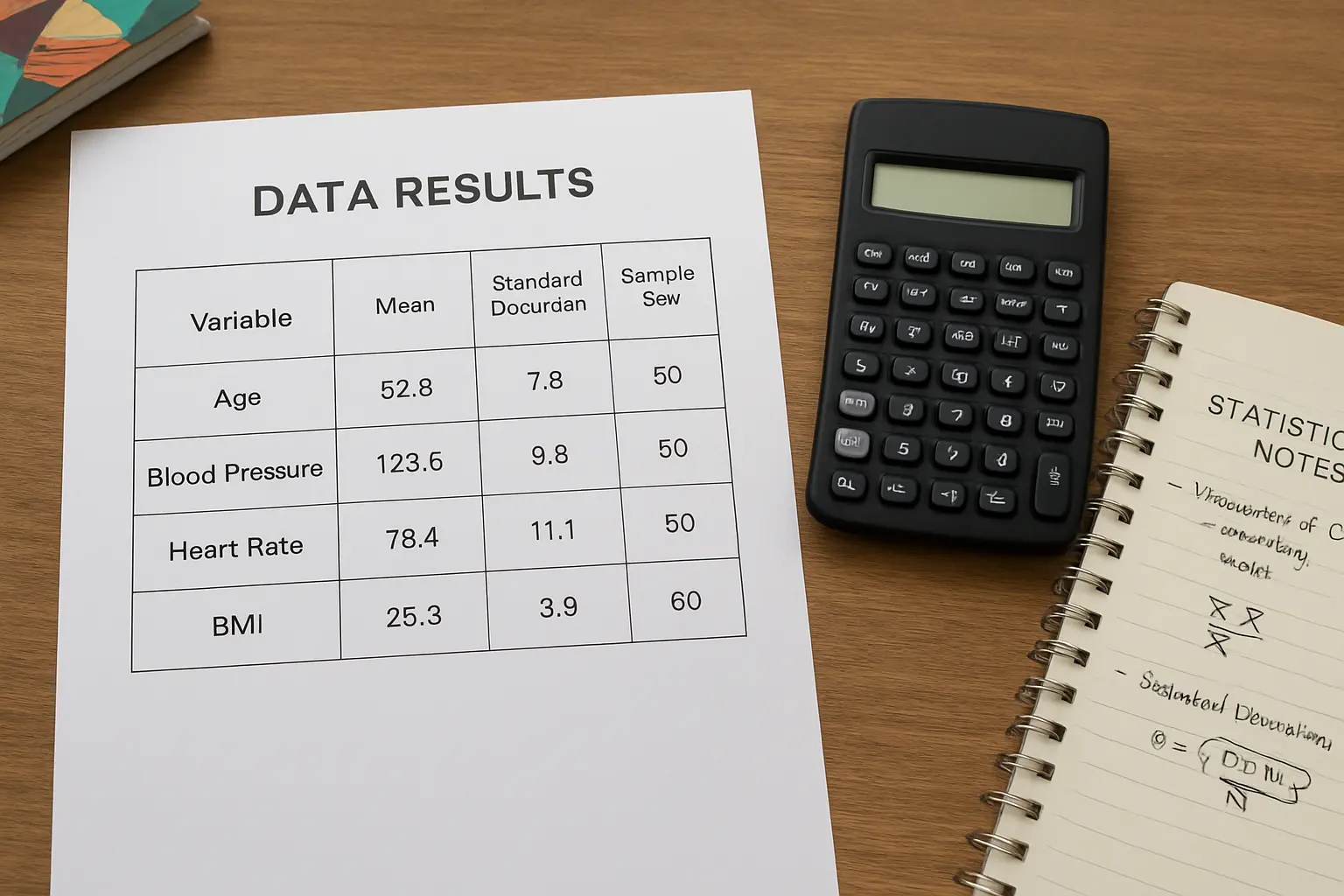
Chapter Four opens with a response rate sentence (“Of 150 questionnaires distributed, 138 were returned and usable, a 92% response rate”) before any findings, because a panel wants to know the denominator before the percentages. It then presents results in the order of the objectives, each with one table and one interpreting sentence — never a table with no sentence, and never a paragraph repeating the table without adding an interpretation. A worked, invented-but-labelled example: “Table 4.3 shows that 61.2% of respondents scored ‘adequate’ on the knowledge scale, while only 38.4% scored ‘adequate’ on the practice scale — a 22.8-percentage-point knowledge-practice gap.” That single sentence does three things a panel rewards: states the finding, states the gap the whole study exists to describe, and sets up the discussion in Chapter Five. The hypothesis test result follows in its own sub-section, stated as accept or reject against the stated significance level, not as a vague “there was a relationship.”
Chapter Five: Discussion, conclusion and recommendations — the annotated model
Discussion reads each major finding against the empirical review from Chapter Two — does this facility’s knowledge-practice gap match, exceed, or fall below what similar Nigerian or West African studies found, and what from the Health Belief Model explains the direction of that difference. Conclusion states, in one paragraph per research question, what the study found — no new information here, only a compression of Chapter Four’s findings into plain sentences. Recommendations are addressed to named bodies, not “the government”: the hospital’s infection-control committee (refresher training), nursing education (curriculum emphasis), and future researchers (an observational design that checks practice directly rather than relying on self-report, which this model’s own limitations section should already flag as a validity concern). Contribution to knowledge closes the chapter with one sentence stating what this study adds that did not exist before it, specific to this facility and this population.
What ties all five chapters together
A model that passes is not five independent essays; it is one argument carried through five chapters. The knowledge-practice gap named in the problem statement is the same gap measured in Chapter Four and explained in Chapter Five. The Health Belief Model named in Chapter Two is the same framework used to interpret barriers in Chapter Five. Every objective in Chapter One has exactly one matching result in Chapter Four and one matching conclusion paragraph in Chapter Five — draw that three-column table (objective, result, conclusion) for your own project before you submit it, and any row with a gap is a chapter that needs another look. Our guides to writing the statement of the problem and to how strongly to state your findings in Chapter Five go deeper into the two sections most often written too loosely.
Where to find a real project repository to compare against
Your own department’s project repository — the library or departmental archive of past approved projects — is the only source you should compare your work against for local formatting and depth norms, because national conventions vary by institution and by session. Ask your department’s librarian or your level adviser where that repository is kept before you rely on anything found through a general web search, since downloaded “sample projects” sold online are frequently reused across many students and carry a real plagiarism risk at your defence — our guide to what downloaded project materials are actually good for sets out that risk plainly.
Common faults that turn a good structure into a rejected chapter
Five faults recur even when a student follows the right chapter structure. An objective in Chapter One with no matching table in Chapter Four — every objective must be traceable to a result. A literature review that summarises titles instead of findings, so a reader cannot tell what each cited study actually concluded. A theoretical framework named in Chapter Two but never mentioned again in Chapter Five, where it should do the work of explaining a finding. A sample size stated with no population figure or formula shown, so the number looks invented even when it is not. And a discussion chapter that restates Chapter Four’s numbers instead of explaining them against the literature — restating is not discussing, and a panel notices the difference immediately.
Before choosing your own version of this topic, check our list of approvable nursing project topics for other knowledge-practice and clinical-area angles your department is likely to accept, and run the same duplication check every student should before submitting three ranked choices: has your topic already been studied in your department in recent sessions.
Frequently asked questions
Can I use this exact topic for my own nursing project?
You can use it as a starting point, but check first whether a version of it has already been done in your department recently, and adapt the facility, population or infection-prevention focus so your topic is genuinely your own — our guide to checking whether a topic has already been studied covers how to do that search.
How long should each chapter be in a real nursing project?
This varies by department, but Chapter One is typically the shortest (introducing the study), Chapter Two the longest (the literature base), and Chapters Three through Five roughly similar in length to each other. Confirm your department’s expected page counts with your supervisor rather than assuming a fixed ratio.
Do I need a theoretical framework for every nursing project?
Most Nigerian nursing departments expect one, and the framework should be chosen because its constructs genuinely explain your variables — as the Health Belief Model does for a knowledge-practice gap — not selected because it is the most commonly cited theory in the department.
What if my results contradict my hypothesis?
Report the actual result honestly and discuss why it may have occurred against the literature — a rejected hypothesis with a well-reasoned discussion is a stronger Chapter Five than a confirmed hypothesis with no discussion at all.
Should my Chapter Four have raw questionnaire data attached?
Most departments expect a blank copy of your questionnaire as an appendix, not the raw completed responses. Confirm what your department’s binding requirements ask for in the appendices before submission.
Is a descriptive cross-sectional design the only option for a nursing project?
No — it is simply the most common at undergraduate level because it is achievable within one semester. Experimental, case-study and qualitative designs are all used in Nigerian nursing departments where the topic and access genuinely call for them.
Tesify builds each chapter of your own project against your own objectives and your own data, section by section — not a copy of anyone else’s work, including this model.