
A related studies section that only lists authors will come back marked up, because the panel is asking one question: what do the studies together tell us, and what is left for your project to answer? The fix is to organise the studies by the variable they study, the level of education they cover and the design they use, then write a comparison, not a catalogue. Below is the method, with three real Nigerian studies on social media and academic performance written up as entries and combined into a synthesis.
What Does the Related Studies Section Do in an Education Project?
In many Nigerian education departments the empirical part of Chapter Two is called review of related studies or empirical review. Its job is threefold: to show that your topic has been studied and how, to compare the findings, methods and settings of the studies, and to arrive at the gap that justifies your own study. Where this section sits among the other parts of Chapter Two, such as the conceptual review and the theoretical framework, is explained in our Chapter Two guide, and written examples of each part are in the article on conceptual, theoretical and empirical review examples.
If your project is in nursing or public health, the same method with three antenatal care studies is in our guide to the empirical review for a nursing or public health project. This guide uses education examples and adds three decisions that matter in education: the level of schooling, the type of respondent and the source of the performance data.
How Do You Choose What to Review?
Start from your title. Suppose it is “Social media use and academic performance of senior secondary school students in a local government area”. The review must cover three things: studies of social media use and academic performance together, studies of each variable separately where they help define it, and studies in similar settings. Search with groups of keywords such as social media, academic performance and Nigeria, and keep a log of the databases and the dates. The search sources and how to read a record are covered in our guide to where to find past projects and theses in Nigeria. For education studies, the ERIC database of education research is a useful addition: its records show the journal, the year and whether the source is marked as peer reviewed, which helps you separate journal articles from other submissions.
Choose studies that are close to yours in at least one way: the same variable, the same level, the same kind of respondents or the same design. Include Nigerian studies first, and add studies from other countries where they give you a definition, a theory or a method that the Nigerian studies lack.
What Do Three Real Entries Look Like?
The entries below use only what each study’s published abstract reports. Open the full paper before you cite any study in your own project, check every number, and add the volume and page details from the journal itself.
Entry 1: university students, business education. Nwazor and Godwin-Maduike (2015), writing in the Journal of Education and Practice, analysed the effects of social media on the academic performance of business education students in south-east Nigeria. They sent a questionnaire to four universities, distributing 600 copies; 520 were completely filled and returned. They analysed the data with frequencies and percentages and reported that the students used Facebook more than any other social networking site, mostly to keep in touch with each other.
Entry 2: university students, library and information studies. Okoroma and Okafor (2018), in the African Educational Research Journal, 6(3), 114–119, examined the impact of social media on Library and Information Studies students at the University of Ibadan. They distributed 100 questionnaires, 99 were returned, and the analysis was descriptive. They reported that WhatsApp was the most preferred platform and that students spent 7 hours each day on social media for general activities against 5 hours for course work, which the authors said affects their performance. DOI: 10.30918/aerj.63.18.039.
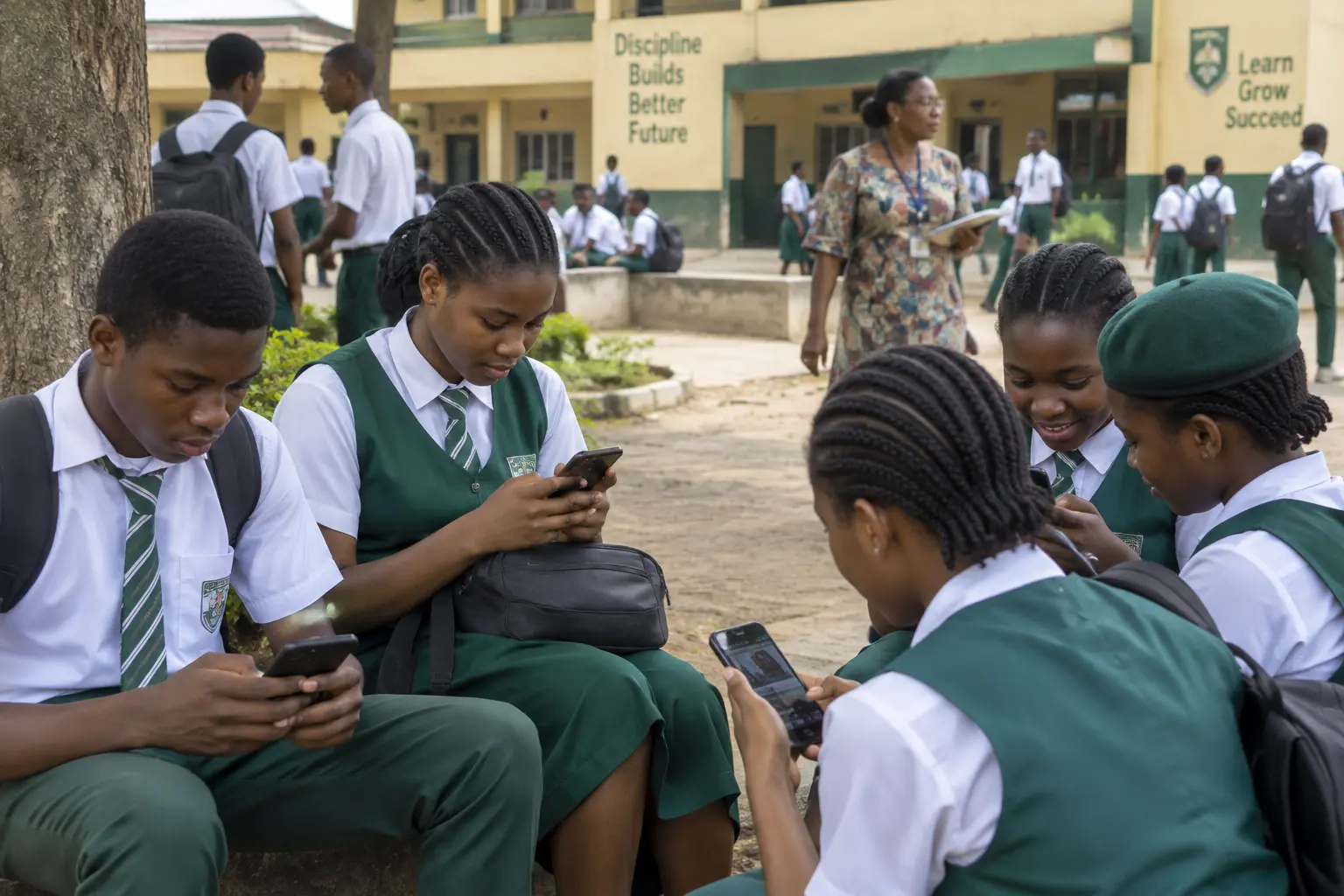
Entry 3: senior secondary students. Akpadaka and Akpadaka (2026), in the Asian Journal of Contemporary Education, 10(1), 60–71, studied digital distractions and study discipline among senior secondary school students in Rumuokwurusi Local Government Area, Rivers State, using an ex post facto design. A sample of 117 students was drawn from three public secondary schools. Study habits, sleep and digital use were collected by questionnaire, while academic performance was taken from school records. The authors reported that study hours and sleep duration significantly enhanced academic performance, that social media use significantly reduced it, and that gender did not significantly predict outcomes once behavioural factors were controlled. DOI: 10.55493/5052.v10i1.5862.
How Do You Compare Them?
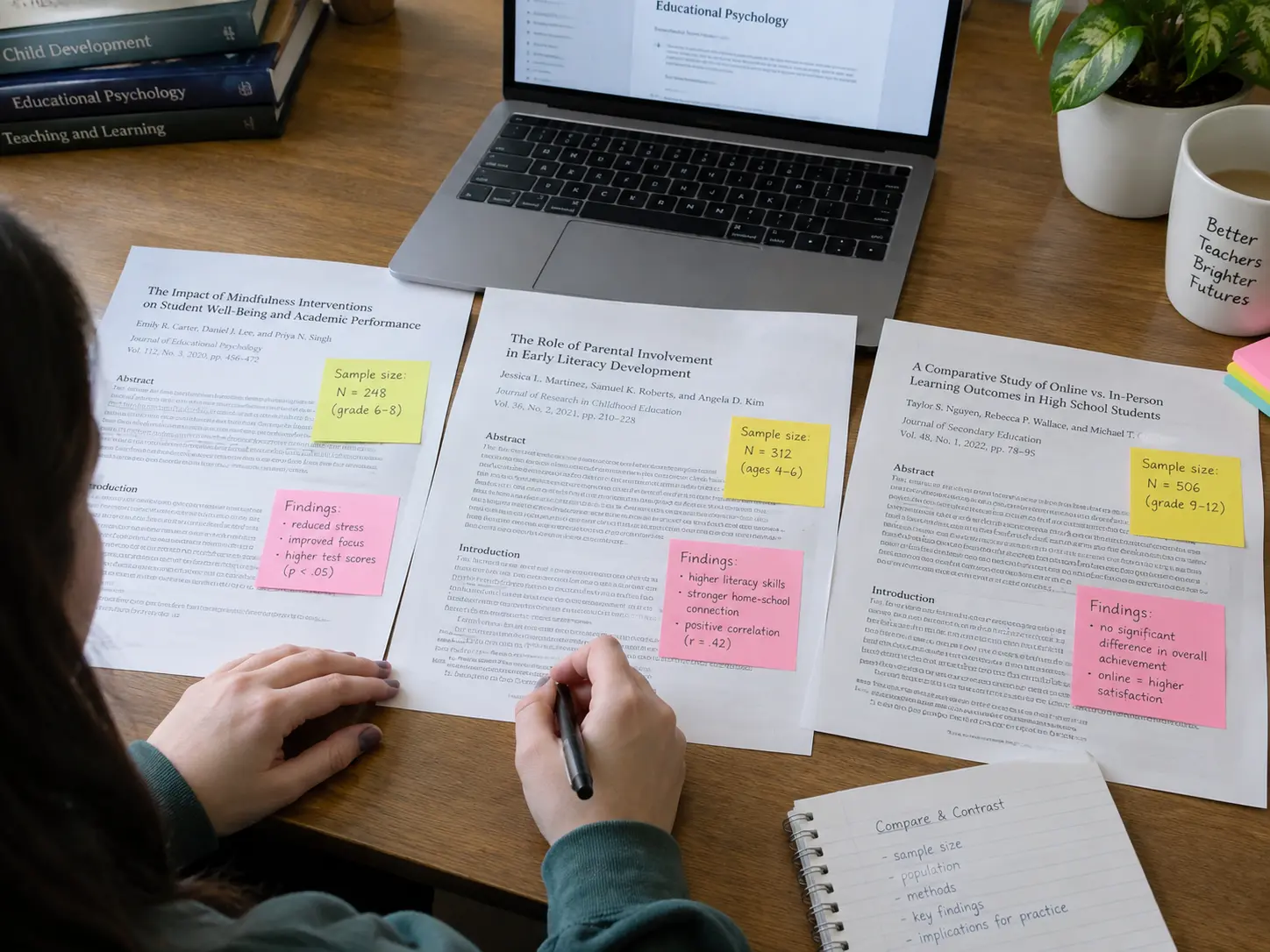
Put the entries in a table before you write the paragraphs.
| Feature | Nwazor and Godwin-Maduike (2015) | Okoroma and Okafor (2018) | Akpadaka and Akpadaka (2026) |
|---|---|---|---|
| Respondents | Business education students in four universities in the south-east | Library and Information Studies students at one university | Senior secondary students in three public schools in one local government area |
| Instrument | Questionnaire | Questionnaire | Structured behavioural questionnaire plus school records for performance |
| Questionnaires returned | 520 of 600 | 99 of 100 | Sample of 117 students |
| Analysis | Frequencies and percentages | Descriptive statistics | Descriptive statistics, correlation and multiple regression |
| Main reported result | Facebook was the most used site | WhatsApp was the most preferred; more hours on general activities than on course work | Social media use reduced performance; study hours and sleep raised it |
Look at what the table shows. The two university studies describe which platforms students use and for how long, while the secondary school study tests whether use predicts performance using records, not self-report. That is a difference in design, and it limits what the first two can say about performance. A good review states it.
Also check the arithmetic of every figure you report. In Entry 1, 520 returned out of 600 distributed is 520 / 600 = 0.867, or 86.7 per cent, while the abstract states a return rate of 89 per cent. When a published figure does not match its own numbers, report the counts (520 of 600), say nothing that depends on the percentage and note the discrepancy in your working notes. Entry 2 checks out: 99 / 100 = 99 per cent.
How Do You Write the Synthesis?
Write one paragraph per theme, in the order claim, evidence, comparison, limit. An illustrative paragraph for the first theme, how students use social media, reads:
“Studies of Nigerian students agree that social media use is widespread and mostly social. Nwazor and Godwin-Maduike (2015) found that business education students in four south-east universities used Facebook more than any other site, mostly to keep in touch with each other, while Okoroma and Okafor (2018) reported that library and information studies students at the University of Ibadan preferred WhatsApp and spent more hours on general activities than on course work. The two studies differ in platform and in setting, and both rely on self-reported questionnaires, so neither shows how use relates to measured performance.”
And for the second theme, the link with performance:
“Evidence on performance itself is thinner. Akpadaka and Akpadaka (2026) used school records for performance among 117 senior secondary students in one local government area and reported that social media use significantly reduced performance while study hours and sleep raised it. Their sample comes from three public schools in one area, so the finding cannot be assumed to hold for other settings, which leaves room for a study in a different area or school type.”
The closing sentence of the second paragraph is the start of the gap, which the next section develops.
How Do You Arrive at the Gap?
List what the studies leave out, then choose the one that your study fills. In this example the studies cover university students’ platform use, and secondary school performance in one area. A gap could be “no study found for junior secondary students in the area”, or “no study that combines measured hours of use with performance from school records for this group”. Do not write a gap you have not checked. Search the repositories and databases again for your exact variable, level and place, and write the gap only if the search supports it. Then connect it to your objectives so that the review ends where your study begins, and reference the topics on our education project topics with research questions list for ways to frame the question.
How Many Studies and How Old?
There is no national rule for either. Ask your department what it expects, read a recently approved project from your department and plan enough studies to support each theme. Many supervisors prefer recent work, but classic studies and definitions can be older. Make sure each study you cite is one you have read in full, and that each reference is complete and in your department’s style. When you describe what a study found, the verb you choose signals how strong the finding is, and our article on reporting verbs in a literature review shows how to pick one.
Mistakes That Bring the Section Back
- A catalogue of studies with no comparison.
- Mixing levels without saying whether respondents were secondary pupils or university students.
- Treating self-reported use as measured performance. Say where each study got its performance data.
- Quoting a figure without checking it against the counts in the paper.
- Citing from a repository abstract without reading the paper.
- An unchecked gap. Search before you claim that nothing exists.
- No link to the objectives. The last paragraph should lead to them.
A Four-Day Plan
- Day 1: collect eight to ten studies and fill in the comparison table for each.
- Day 2: group them into three themes and decide the order of the paragraphs.
- Day 3: write the paragraphs, the opening that previews them and the gap paragraph.
- Day 4: check every number, citation and reference against the paper, then send it to your supervisor.
Tesify helps you structure and organise your project, and the text is 100% written by you. Start your project with Tesify — 9,000+ students have written 15,000+ chapters with Tesify.
Frequently asked questions
What is the difference between related studies and a literature review?
The literature review is the whole of Chapter Two. The related studies, or empirical review, is the part that reports and compares the findings of earlier research studies.
How do I organise related studies?
By theme, not by author. Group studies by the variable, the level of education and the design, and write one paragraph per theme that compares them.
How many related studies do I need?
There is no national number. Ask your department, look at a recently approved project and include enough studies to support each theme.
Should I include studies from other countries?
Yes, where they add a definition, theory or method the Nigerian studies lack. Include Nigerian studies first and group by theme.
Can I rely on the abstract?
An abstract helps you decide what to read, but you should read the full paper before you cite a finding or a number from it.
What if a published percentage does not match its numbers?
Report the counts, avoid claims that depend on the percentage and check the full paper. Recomputing figures before you quote them is part of good practice.
How do I know a study is peer reviewed?
Check the journal’s own site and the record in a database such as ERIC, which flags whether a source is peer reviewed. Prefer peer-reviewed sources where they exist.
How do I write the research gap?
State what the studies do not cover, such as a level, an area, a measure or a design, after you have searched to confirm it, and link it to your objectives.
Do I need a table of studies in the chapter?
It is not always required, but building one for yourself makes the themes and the gap visible and makes the paragraphs easier to write.