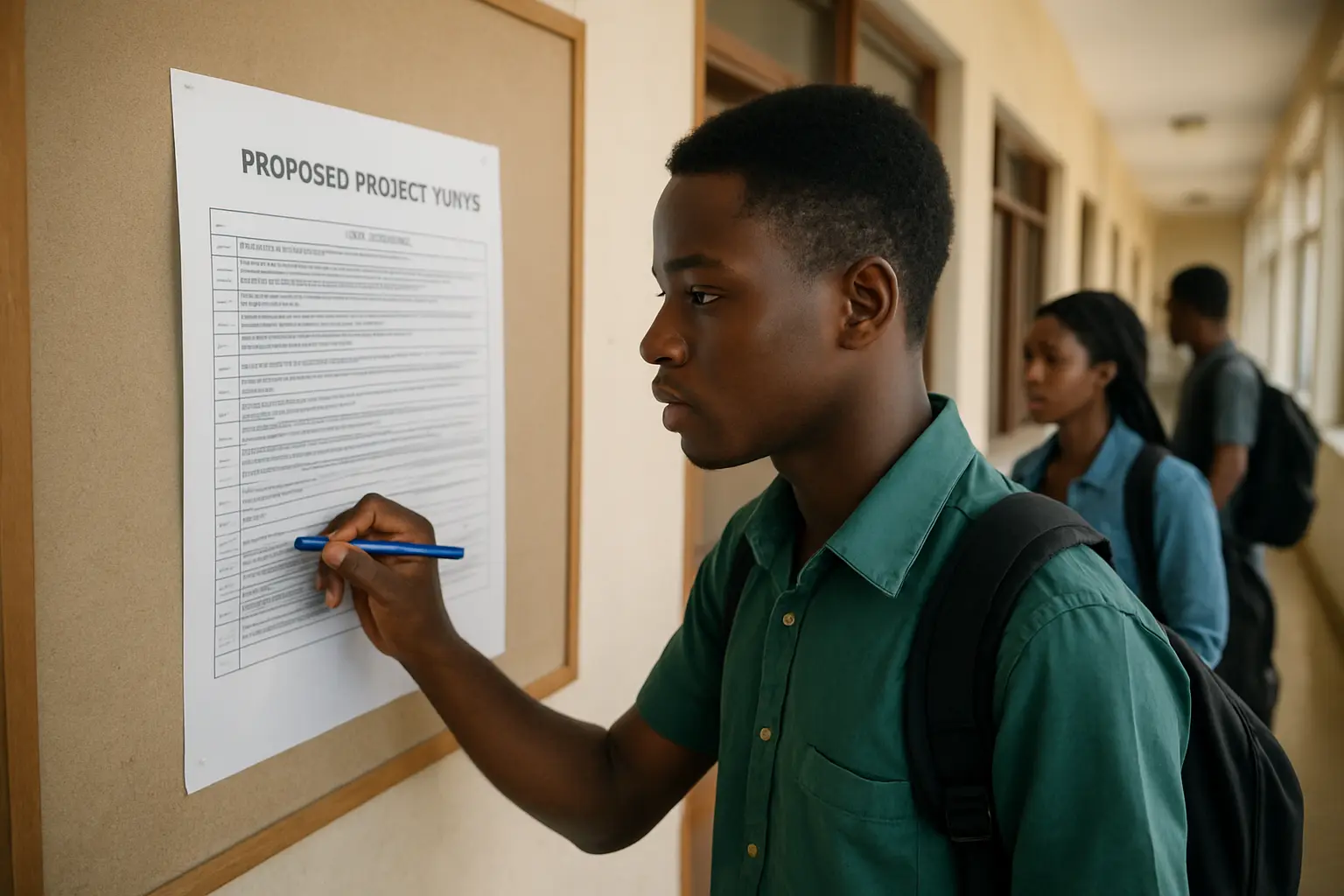
An education topic fails for one of two reasons: somebody has already done it in your department, or you cannot get permission to collect the data in time. This list is organised around the second problem, because it is the one nobody warns you about until you are standing in a principal’s office in week eight.
Every topic below carries its research question and the permission gate it has to clear. Read the gate column before you fall in love with a title. Our guide to what to do when a supervisor rejects your topic covers the first problem, and checking whether your topic has already been studied should be the hour you spend before you submit anything.
The four permission gates in Nigerian education research
| Gate | Who says yes | Typical wait | What it unlocks |
|---|---|---|---|
| A. Department only | Your supervisor and HOD, via a letter of introduction | Days | University students and staff, published documents, public data |
| B. School level | The principal or head teacher of each school | One to three weeks per school | Teachers, school records, classroom observation |
| C. Authority level | The LGEA, SUBEB or state ministry of education, then the school | Several weeks, and it can fail | Pupils as respondents, multiple public schools, official records |
| D. Authority plus parental consent | As C, plus signed parental or guardian consent | Longest, and the most likely to collapse | Data from minors: tests, interviews, anything identifying a pupil |
Two consequences follow, and they decide most projects. A gate-A or gate-B topic can be finished on your own timetable. A gate-D topic cannot, and if your session has ten weeks left, it is the wrong choice however good the question is. If you are already short of time, pick from the gate-A and gate-B sections below.

Gate A: topics you can start this week
Respondents are university students or staff, or the data is already published.
- Study habits and academic performance among education undergraduates in [named faculty]. RQ: What is the relationship between study habit patterns and cumulative grade point average among education undergraduates in [faculty]?
- Teaching practice supervision as experienced by student teachers. RQ: How do student teachers describe the frequency, focus and usefulness of supervision received during teaching practice?
- Choice of education as a course of study: motivations of first-choice and second-choice entrants. RQ: What reasons do education undergraduates give for studying education, and do they differ between those who chose it first and those placed into it?
- Use of smartphones for academic work among education undergraduates. RQ: For what academic purposes do education undergraduates use smartphones, and what constrains that use?
- Perceived preparedness for classroom teaching among final year education students. RQ: How prepared do final year education students feel across named teaching competences, and what predicts that perception?
- Lecturer feedback practices and student revision behaviour in [named department]. RQ: What forms of feedback do students report receiving, and how do they act on each form?
- Attrition and course-switching among education undergraduates, from departmental records. RQ: What proportion of entrants to [named programme] completed it within the minimum duration over [years]?
- Analysis of examination question papers against curriculum objectives in [named subject]. RQ: To what extent do the cognitive levels of past examination questions match the stated curriculum objectives?
- Availability and currency of education holdings in [named university library]. RQ: What is the age profile of the education collection, and how does it align with current curriculum requirements?
- Student teachers’ attitudes towards teaching as a career, before and after teaching practice. RQ: Do student teachers’ career intentions change after teaching practice, and in which direction?
Gate B: topics needing one principal’s approval
Teachers are the respondents. You need the school’s permission, not the pupils’.
- Instructional use of continuous assessment records by secondary school teachers. RQ: To what extent do teachers use assessment records in subsequent instructional decisions, and what constrains that use?
- Teachers’ preparedness to teach [named subject] outside their area of specialisation. RQ: What proportion of teachers teach subjects outside their specialisation, and how do they describe their preparedness?
- Classroom management strategies used by teachers in large classes. RQ: Which strategies do teachers report using as class size increases, and which do they judge effective?
- Improvisation of instructional materials by science teachers. RQ: What materials do teachers improvise, for which topics, and what determines whether they do so?
- Teachers’ use of the revised curriculum documents in lesson planning. RQ: How do teachers use curriculum documents when planning, and how accessible are those documents to them?
- Record-keeping practices and administrative burden among secondary school teachers. RQ: How much time do teachers report spending on statutory records, and what effect do they report on instruction?
- Head teachers’ supervision of instruction in public primary schools. RQ: How frequently do head teachers supervise lessons, what do they focus on, and what feedback follows?
- Teachers’ attitudes towards inclusive education in mainstream classrooms. RQ: What attitudes do teachers hold towards including learners with disabilities, and what training have they received?
- In-service training attendance and reported classroom change. RQ: What in-service training have teachers attended, and what classroom changes do they attribute to it?
- Teacher motivation and intention to remain in the teaching profession. RQ: Which factors do teachers name as most affecting their intention to stay, and how do these vary by experience?
- Use of continuous assessment scores in promoting pupils to the next class. RQ: What weight do schools give assessment scores in promotion decisions, and how consistently is it applied?
- Availability and use of school libraries in [named LGA] secondary schools. RQ: What library provision exists, and how do teachers report using it in instruction?
- Teachers’ assessment of the adequacy of laboratory facilities for practical work. RQ: What facilities exist, what practicals are prescribed, and what is actually carried out?
- Guidance and counselling provision in secondary schools. RQ: What counselling provision exists, who delivers it, and what referrals do teachers make?
- ICT integration in teaching: what teachers do, and what stops them. RQ: Which ICT tools do teachers use in instruction, and what are the reported barriers?

Gate C: topics needing an education authority
Several schools, or official records, or both. Start the letters before you write your proposal.
- Pupil-teacher ratio and its relationship with school-level performance in [named LGA]. RQ: What is the distribution of pupil-teacher ratio across public schools in the area, and how does it relate to school-level results?
- Distribution of qualified teachers across urban and rural schools in [named LGA]. RQ: How does teacher qualification profile differ between urban and rural public schools in the area?
- Implementation of the basic education curriculum across schools in [named LGA]. RQ: To what extent are prescribed subjects and periods actually delivered, and what explains any shortfall?
- School infrastructure provision and its relationship with enrolment trends. RQ: How has enrolment moved in relation to classroom and facility provision over [years]?
- Transition rate from primary six to junior secondary in [named LGA]. RQ: What proportion of pupils transitioned over [years], and how does it differ by school and by sex?
- Teacher deployment and staffing gaps against establishment. RQ: What proportion of approved teaching posts is filled, and how does the shortfall distribute across subjects?
- School feeding or intervention programme implementation and attendance. RQ: How is the programme implemented in sampled schools, and what attendance pattern accompanies it?
- Monitoring and inspection of public schools by the education authority. RQ: How frequently are schools inspected, what is inspected, and what follow-up occurs?
- Repetition and dropout patterns in public primary schools. RQ: What are the repetition and dropout rates over [years], and how do they differ by sex and by class level?
- Adequacy of instructional materials supplied to public schools. RQ: What materials were supplied over [years], and how does supply compare with enrolment?
Gate D: topics involving pupils directly
These are the strongest education studies and the slowest. Choose one only if you have a full session and a supervisor who will chase the letters with you. Every one needs authority approval and parental or guardian consent, and your instrument and consent forms must be ready before you apply, not after.
- Effect of a named teaching strategy on pupil achievement in [named subject]. RQ: Is there a significant difference in achievement between pupils taught with [strategy] and those taught conventionally? Quasi-experimental, needs intact classes and a validated achievement test.
- Pupils’ attitudes towards [named subject] and their relationship with achievement. RQ: What attitudes do pupils hold, and how do these relate to their achievement scores?
- Reading comprehension levels among junior secondary pupils. RQ: What comprehension levels do pupils demonstrate on a standardised passage, and how do they differ by school type?
- Mathematics anxiety among senior secondary pupils. RQ: What levels of mathematics anxiety do pupils report, and how do these relate to performance?
- Pupils’ perception of teacher feedback and its effect on revision behaviour. RQ: How do pupils describe the feedback they receive, and what do they report doing with it?
How to narrow any of these into an approvable topic
A topic from a list is a direction, not a title. Four decisions turn it into one:
- Name the place. One LGA, one school type, one institution. A topic covering a state is not an undergraduate project.
- Name the population. Teachers of which subjects, at which level, in which school category.
- Name the period. One academic session, or a stated range of years for records-based work.
- Fix the verb. Determine, examine, compare, or examine the relationship between — and accept the design it commits you to. Our guide to objectives, significance and scope has the verb table.
Then write the statement of the problem before you submit the topic for approval. A topic that arrives with a problem statement attached is approved faster, because your supervisor can see immediately that the study is answerable.
Where the data actually lives
Education topics fail on sourcing more often than on design. The national and state bodies that publish education figures, and what each one has, are set out in our guide to where education students in Nigeria find project data. For the theory side, the theoretical framework of an education project covers what a Nigerian education panel expects you to anchor on, and which validated instrument to use covers whether you should build your own tool or adopt one.
Six topics to avoid, and why
- “Impact of the COVID-19 pandemic on education.” Saturated in nearly every Nigerian education department, and the data window has closed.
- “Effect of motivation on academic performance.” Too broad to operationalise, and done repeatedly. Narrow to one motivational construct and one subject.
- Anything requiring national data you cannot obtain. If the figure exists only in a report you cannot open, the study cannot be written.
- Comparative studies across states. Two permission chains, two travel budgets, one semester.
- A gate-D experiment started after mid-session. The consent chain alone will outlast your time.
- A topic whose title you found on a project-selling site. Your supervisor has seen it, and our guide to what downloaded project materials are actually good for explains the rest of the risk.
Once the topic is approved, the writing is the bottleneck. Tesify drafts alongside your own thinking, keeps your objectives and research questions aligned, and builds the reference list as you go — 100% written by you, alongside 9,000+ students and 15,000+ chapters.
Turn your approved topic into a draft
Frequently asked questions
How do I choose an education project topic in Nigeria?
Start from what you can actually collect. Decide which permission gate you can clear in the time you have, pick a topic from that gate, then narrow it by place, population and period before you submit it.
Do I need approval from the ministry of education to collect data in schools?
It depends on scope. One school with teachers as respondents usually needs the principal’s approval on the strength of your departmental letter. Several public schools, official records, or pupils as respondents generally require the local or state education authority first.
Do I need parental consent to collect data from pupils?
For anything identifying a pupil or administered to them directly, treat parental or guardian consent as required and confirm the exact requirement with your department before you design the study. Consent cannot be obtained retrospectively.
How many topics should I submit for approval?
Three, ranked, each with a one-line research question and a note on where the data comes from. Submitting one gives your supervisor nothing to choose between; submitting six suggests you have not thought about any of them.
Can two students in my class do the same topic?
Not in the same setting and period. If the topic is close, separate on population, on location or on the measure used, and state the difference explicitly in your proposal.
How many research questions should an education project have?
Three to five, each matching one specific objective in number and order. Every research question needs its own analysis and its own table in Chapter Four.
Is a quasi-experimental design too ambitious for an undergraduate project?
Not in itself, but the permission chain usually is. If you want one, secure the intact classes and the consents before writing the proposal, and have a survey fallback ready.
Can I use secondary data only?
Yes, where your department allows it. Records-based topics such as transition rates or staffing gaps are genuinely useful, avoid the consent problem entirely, and are often the best choice for a short session.
What if my chosen topic has already been done in my department?
Change one dimension rather than the whole topic: a different population, a different setting, a different measure, or a different period. Then say in your problem statement how yours differs from the existing work.
How specific should the title be?
Specific enough that a reader knows the population, the place and the period without reading further. Long titles are normal in Nigerian education departments and are usually better than vague short ones.