
The comment in red ink says “this is a list, not a review”, and Chapter Two goes back for the third time. The cause is almost always the same: each paragraph summarises one study, then the next paragraph summarises another, and nothing connects them. An empirical review is the part of Chapter Two where you show what earlier studies found, compare them and arrive at the gap your study fills. This guide shows how to write each entry, how to combine entries by theme, and how to do it with three real studies on antenatal care in Nigeria.
What Is the Difference Between a Summary and a Review?
A summary says what one author did. A review says what a body of studies shows, where they agree, where they differ and why, and what is still unknown. Compare the two styles on the same material.
| Summary style (what supervisors reject) | Review style (what supervisors accept) |
|---|---|
| Author A (2018) studied antenatal care in Nigeria and found it was underused. Author B (2020) studied antenatal care and found low coverage. Author C (2018) studied primary health care. | National analyses of Demographic and Health Survey data report low antenatal use whichever threshold is applied, and rural residence is associated with lower use, while a community study in one state points to distance, cost and quality of care as the reasons women give. |
| One study per paragraph, in the order you found them. | One idea per paragraph, with the studies that support it grouped together. |
| Ends with the last study. | Ends with what the studies together leave unanswered, which leads to your objectives. |
If this is the comment you keep receiving, read our article on how to break the Chapter Two correction loop, then use the steps below to fix the review itself. The general architecture of the chapter, with the conceptual, theoretical and empirical sections, is in the Chapter Two guide.
How Do You Write One Entry?
Every entry follows the same short formula, and an entry is usually two to four sentences. Collect these six facts for each study before you write.
- Who and when: the authors and the year.
- Where and who: the country or area and the participants.
- How: the design and the sample size.
- What they found: the main result, with the number if the study gives one.
- The limit or the contrast: something the study did not do, or a result that differs from another study.
- Why it matters to you: one clause linking it to your topic.
Use a reporting verb that matches how strong the finding is. Our guide to reporting verbs in a literature review explains why “found” and “suggested” are not interchangeable, and a finding from a cross-sectional survey should rarely be written as “proved”.
What Do Three Real Entries Look Like?
The topic for this worked example is antenatal care uptake in Nigeria. The three studies below were located through Europe PMC and each entry uses only what the study’s abstract reports. Open and read the full paper for any study you cite in your own project.
Entry 1. Adewuyi and colleagues (2018) analysed the 2013 Nigeria Demographic and Health Survey to compare underuse of antenatal care in rural and urban areas, taking four visits as the recommended minimum. They reported underuse in 46.5 per cent of women nationally, 61.1 per cent in rural areas and 22.4 per cent in urban areas, with the North-West region highest at 69.3 per cent overall. Reference: Adewuyi, E. O., Auta, A., Khanal, V., Bamidele, O. D., Akuoko, C. P., Adefemi, K., Tapshak, S. J., & Zhao, Y. (2018). Prevalence and factors associated with underutilization of antenatal care services in Nigeria: A comparative study of rural and urban residences based on the 2013 Nigeria demographic and health survey. PLOS ONE, 13(5), e0197324. https://doi.org/10.1371/journal.pone.0197324
Entry 2. Ekholuenetale, Benebo and Idebolo (2020) used the 2018 Nigeria Demographic and Health Survey, with a sample of 7,936 women, to study eight or more antenatal care contacts. They reported a prevalence of about 17.4 per cent, found that women with at least secondary education were 2.46 times as likely to have eight or more contacts as women with no formal education, and found that rural women had a 60 per cent reduction in the odds. Reference: Ekholuenetale, M., Benebo, F. O., & Idebolo, A. F. (2020). Individual-, household-, and community-level factors associated with eight or more antenatal care contacts in Nigeria: Evidence from Demographic and Health Survey. PLOS ONE, 15(9), e0239855. https://doi.org/10.1371/journal.pone.0239855
Entry 3. Okonofua and colleagues (2018) interviewed 1,408 randomly selected women of reproductive age in households in two local government areas of Edo State, Esan South East and Etsako East. They reported an antenatal attendance rate of 62.1 per cent among currently pregnant women at primary health centres, skilled delivery of 46.6 per cent at those centres among recently delivered women and 25 per cent delivering at home or with traditional birth attendants, and the women’s reasons for non-use related to distance, cost and poor quality of care. Reference: Okonofua, F., Ntoimo, L., Ogungbangbe, J., Anjorin, S., Imongan, W., & Yaya, S. (2018). Predictors of women’s utilization of primary health care for skilled pregnancy care in rural Nigeria. BMC Pregnancy and Childbirth, 18(1), 106. https://doi.org/10.1186/s12884-018-1730-4
Notice what each entry carries: the data, the setting, a number and a link to the topic. None of them is more than three sentences, because the work happens in the next step.
How Do You Turn Entries Into a Synthesis?
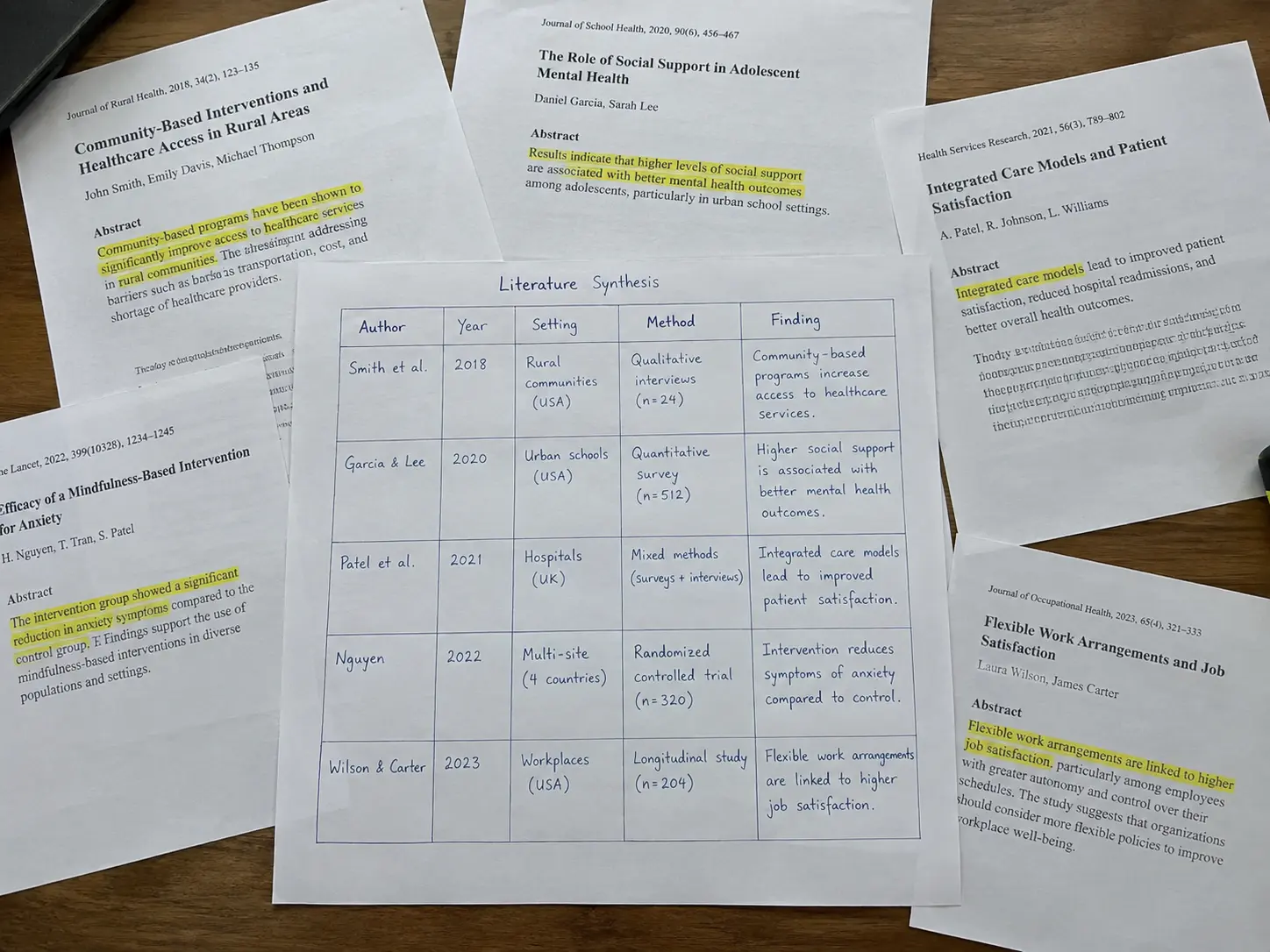
Put the studies in a table first. One row per study and one column per feature will show you the themes before you write a word.
| Study | Data and setting | How antenatal care was measured | Main finding |
|---|---|---|---|
| Adewuyi et al. (2018) | 2013 Nigeria Demographic and Health Survey, national | Underuse against a minimum of four visits | Underuse was 46.5% nationally, 61.1% rural and 22.4% urban |
| Ekholuenetale et al. (2020) | 2018 Nigeria Demographic and Health Survey, 7,936 women, national | Eight or more contacts | About 17.4% had eight or more; rural residence lowered the odds by 60% |
| Okonofua et al. (2018) | Household survey of 1,408 women, two local government areas in Edo State | Attendance at primary health centres | 62.1% attendance among currently pregnant women; reasons for non-use were distance, cost and quality |
Three themes appear. First, coverage is low or uneven in the national data. Second, rural residence is associated with lower use in both national analyses. Third, women’s own reasons point to access and quality in the local study. One more point needs saying: the first two studies use different thresholds (four visits and eight contacts) and different survey years, so their percentages cannot be compared directly. A good review says this out loud.
An illustrative synthesis paragraph for the first two themes reads: “Analyses of national survey data show that antenatal care is underused, but the size of the problem depends on the standard applied. Adewuyi et al. (2018) reported that 46.5 per cent of women fell short of four visits in the 2013 survey, while Ekholuenetale et al. (2020) reported that about 17.4 per cent reached eight or more contacts in the 2018 survey; the two figures use different thresholds and years and are not directly comparable. Both studies, however, associated rural residence with lower use, with underuse of 61.1 per cent in rural areas against 22.4 per cent in urban areas in the first and a 60 per cent reduction in the odds of eight or more contacts in rural areas in the second.”
The paragraph opens with a claim, cites the studies that support it, compares them, notes a limitation and ends on the pattern. That is the structure to copy for every theme.
How Do You Reach the Research Gap?
The last paragraph of the empirical review should state what the studies leave unanswered. For this example, an honest gap is that the national analyses describe patterns across the country while the local study covers two local government areas of one state, so a student studying a particular area, facility or group has to say what is known there. A gap statement can read: “Although national survey analyses document low and uneven antenatal care use, and a community study in Edo State identifies distance, cost and quality as barriers, little is reported on antenatal attendance and its reasons among women in the area this study covers. This study addresses that gap.” In your own version, name the area, the facility or the group instead of saying “the area this study covers”, and make sure that the gap is true by searching before you claim it. Our guide on where to find past projects and theses in Nigeria shows how to search repositories and Google Scholar for studies in your own area.

How Many Studies and How Recent?
There is no national rule on the number of studies in an empirical review. It depends on your topic, your department and your supervisor, so ask what your department expects and look at a recently approved project in your department for a guide. Many supervisors prefer studies from the last ten years unless a study is a classic in your field, so confirm what yours prefers. Whatever the number, include Nigerian studies and, where your topic needs them, studies from other countries, and arrange them by theme rather than by place. Make sure each cited study is one you have actually read, not one you have seen quoted in another review.
Where Do You Find Studies for a Health Topic?
- Europe PMC and PubMed for biomedical and public health literature, searchable by topic and country.
- African Journals Online for Nigerian and African journals.
- Google Scholar for repository theses and for the “Cited by” trail.
- Your university library and repository for theses in your department.
When you search, use two or three keyword groups: the topic, the population and the place. For this example the groups were antenatal care, utilisation and Nigeria. Keep a log of every search and every study, which you will need when your supervisor asks how you found them. The definitions that your review relies on, such as antenatal care coverage and primary health care, belong in your definition of terms, and our definition of terms for a public health or nursing project gives WHO-based wording for twenty of them.
Mistakes That Bring a Review Back Marked Up
- One study per paragraph. Group by theme instead.
- Comparing figures that are not comparable. Say when thresholds, years or populations differ.
- Quoting numbers you did not check. Verify each number in the full paper.
- Overstating cross-sectional findings. An association is not a cause.
- No gap at the end. The review must lead to your objectives.
- Old studies only, or foreign studies only.
- Citing a study you have not read. Read it or cite the source you did read.
A Seven-Day Plan to Fix the Review
- Day 1: list your studies in a table with the six facts for each.
- Day 2: mark each row with the theme it supports and merge themes to three or four.
- Day 3: write one paragraph per theme in the claim, evidence, comparison, limit pattern.
- Day 4: add the sentences that connect the themes and the opening paragraph that previews them.
- Day 5: write the gap paragraph and check it against your objectives.
- Day 6: check every number and citation against the paper, and every reference-list entry against the text.
- Day 7: read it aloud and cut anything that is a summary without a point.
Tesify helps you structure and organise your project, and the text is 100% written by you. Start your project with Tesify — 9,000+ students have written 15,000+ chapters with Tesify.
Frequently asked questions
What is an empirical review?
It is the section of Chapter Two that reports what earlier studies found on your topic, compares them and leads to the gap your study fills.
What is the difference between an empirical review and a conceptual review?
A conceptual review discusses the concepts in your study and how they have been defined. An empirical review reports the findings of earlier research studies.
How many studies should I review?
There is no national number. Ask your department what it expects, look at a recently approved project and choose enough studies to support each theme.
Should I review foreign studies?
Include Nigerian studies first, and add studies from other countries where they help your topic, grouped by theme rather than by country.
How old can the studies be?
Many supervisors prefer recent studies, but a classic study in your field can be older. Check what your supervisor prefers.
How long should each entry be?
Two to four sentences with the authors, year, setting, design, main finding and its link to your topic, and then a synthesis paragraph for each theme.
Can I use findings from a study abstract only?
Read the full paper for any study you cite. An abstract is a guide to what to read, not a substitute for reading it.
How do I find the research gap?
Group the studies, then ask what they leave out: a population, an area, a period, a measure or a method. Search to confirm that the gap is real before you state it.
Do I need a table of studies?
It is not always required in the chapter, but building one for yourself makes the themes visible and makes the review much easier to write.