
| Source | What it actually holds | How you search it | Best for |
|---|---|---|---|
| University of Ibadan repository (repository.ui.edu.ng) | A DSpace repository organised into communities by faculty and department, such as Computer Science, Civil Engineering, Economics, Community Medicine and Guidance and Counselling. Departmental collections are named “Scholarly works”. Items include records typed as thesis. | Keyword search, or browse the community for your department | Seeing how a department at a large Nigerian university structures a thesis and what it cites |
| University of Lagos repository (ir.unilag.edu.ng) | The University of Lagos Research Repository, arranged by 24 academic faculties and institutes, with items labelled open access | Keyword search, browse by faculty, recent submissions, statistics page | Seeing the scholarly output of a faculty, including Education, Law, Pharmacy, Management Sciences and Social Sciences |
| Google Scholar | By its own description, “articles, theses, books, abstracts and court opinions, from academic publishers, professional societies, online repositories, universities and other web sites” | One search box with a “Cited by” link and library links | Finding repository theses you did not know existed, and checking how often a source has been cited |
| NDLTD Global ETD Search | NDLTD promotes electronic theses and dissertations; its Global ETD Search aggregates them from many institutions and repositories worldwide | One search across participating repositories | International theses on your topic for comparison with Nigerian ones |
| African Journals Online (AJOL) | A non-profit platform for African journals. It is a journals platform, not a general repository, so it will not hold your department’s past projects | Search by subject, journal or keyword | The published articles that grew out of Nigerian theses |
| Your own university library and department | Whatever your institution keeps: bound copies, a local repository or both | Ask the librarian or project coordinator | Past projects from your own department, in the format your panel expects |
Which Source Should You Start With?
Start with the repository of the university whose department matches yours, and search it by department rather than by keyword alone. The University of Ibadan and University of Lagos repositories are open to read and cover many departments, so they are useful starting points even if your own institution does not publish its projects online. Use Google Scholar second, because it searches across repositories and journals and shows who has cited a source. The runner-up is the NDLTD Global ETD Search, which helps when you want to compare how a topic is handled in theses abroad.
Notice what the table does not promise. A repository holds only what its university has chosen to deposit, so your department’s undergraduate projects may exist only as bound copies in the library or the department rather than as online records. If a past project you want is not online, the project coordinator or the librarian is the only person who can show it to you, and that is a good reason to ask early.
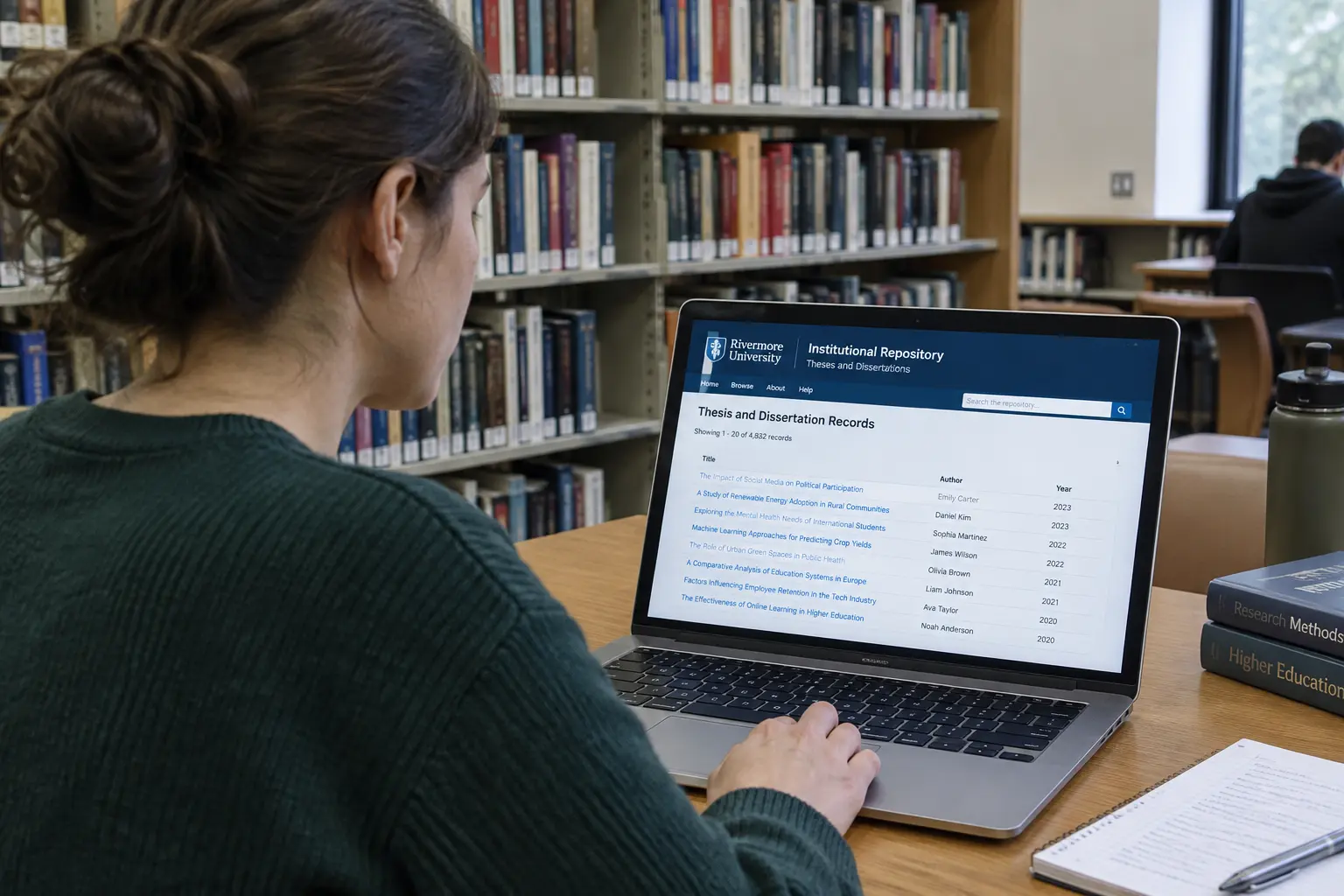
How Do You Search the University of Ibadan Repository?
The repository is organised into communities, and the list of communities is long: it includes departments such as Computer Science, Civil Engineering, Economics, Community Medicine, Guidance and Counselling, Educational Management and Social Work, as well as faculties and centres. Some departments appear under two spellings or in two places, for example in capitals and in ordinary case, so if you browse one community and find little, check the other spelling before you decide nothing exists.
Inside a community, the collection is usually called “Scholarly works”, and its records carry a type such as thesis or article. When you search, add the type to your keywords or filter by it, because a department’s collection mixes staff articles with student theses. Open the record and look at the year, the author, the supervisor if shown and the abstract before you spend time on the full text.
How Do You Search the University of Lagos Repository?
The University of Lagos repository is divided by faculty and institute, 24 in all, and offers keyword search, browsing by faculty, a list of recent submissions and a statistics page. Start from the faculty that matches your department and then narrow with keywords. Check each record’s document type and year, because a faculty collection can include articles and conference papers as well as theses. The repository labels items as open access, but the access terms for a specific record are shown on that record, so read them before you rely on the full text.
How Should You Use Google Scholar for Past Theses?
Google Scholar searches theses along with articles, books and abstracts, so it often surfaces repository theses from universities whose own sites you have never visited. Three habits make it work for a thesis search. First, search with the exact phrase of your topic in quotation marks, for example the construct and the setting. Second, add the word “thesis” or “dissertation” and the name of the university to narrow the results. Third, use the “Cited by” link on a promising source to see later work that built on it. Results can lead to a repository page that shows only an abstract, so keep a note of which sources you could read in full and which you could not.
What About AJOL?
African Journals Online is a non-profit platform that hosts African journals and provides access to abstracts and full-text articles. It does not host theses or past student projects, so do not expect to find your department’s bound projects there. Its value is different: many Nigerian theses produce journal articles, and the article version is easier to cite than the thesis. If you are doing a subject-specific search, our article on the journals and databases a dentistry project can cite shows how AJOL fits next to PubMed and Google Scholar for one field, and the same approach works for your own.
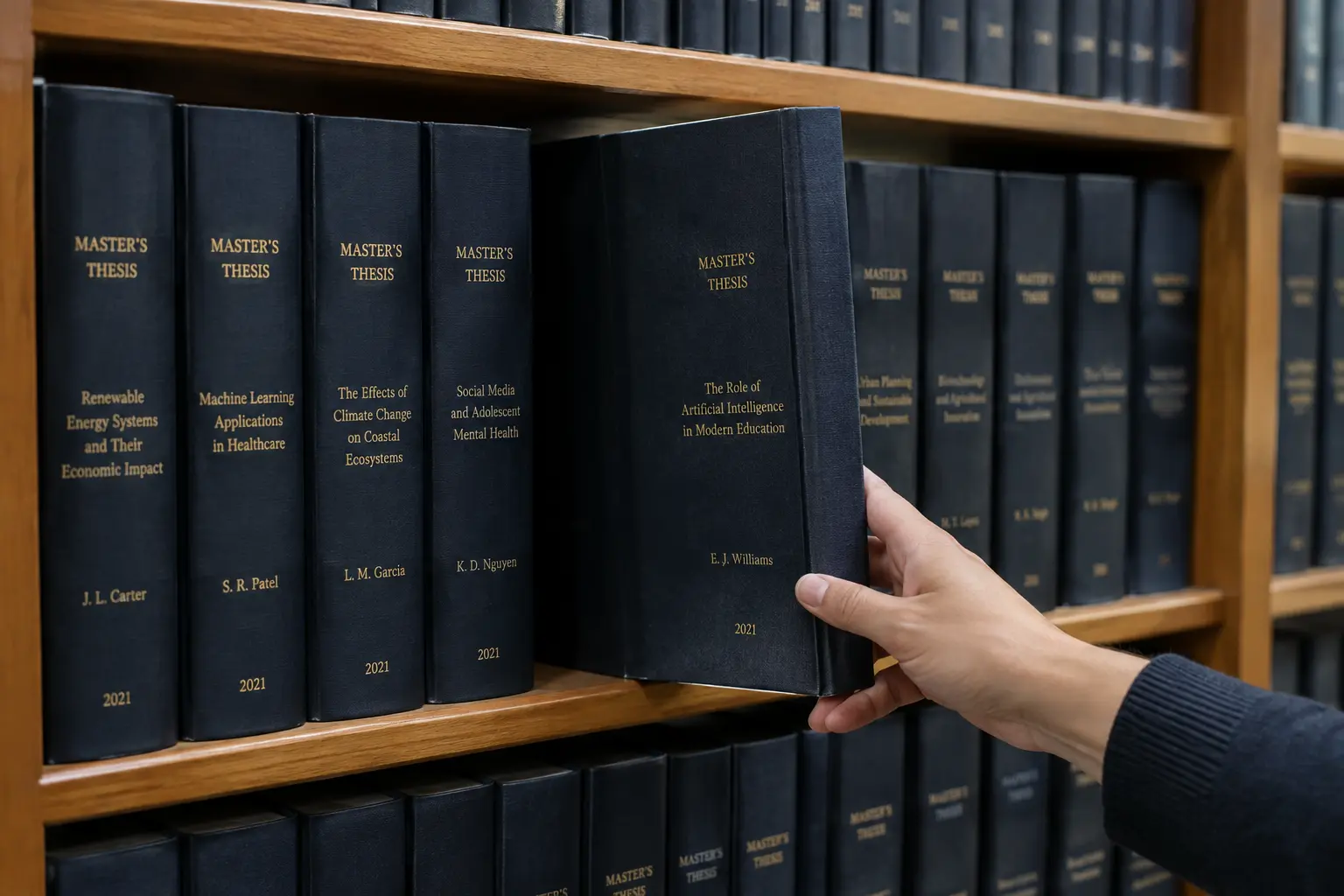
What Does a Repository Record Tell You Before You Open the Full Text?
Every record carries a few fields that save you hours. The title and abstract tell you whether the topic overlaps with yours. The year tells you whether the literature is current or whether you must update it. The document type tells you whether you are looking at a thesis, a journal article or a conference paper, which matters because you cite each differently. The author and, where shown, the supervisor tell you whose work you are reading and who might have written related papers. Keywords show how the author described the study, which is useful when you are choosing your own search terms. If a record shows only an abstract and a link, note that you have not seen the full text, and do not cite findings you have not read.
What Should You Look For in a Past Project?
A past thesis is most useful as a model of structure and as a map to the literature. Read it with a checklist.
- The structure. How many chapters, what each is called and how long each is, so you can match your department’s format.
- The research problem and objectives. How they are written and how each objective links to a question or hypothesis.
- The instrument. What was used, how it was validated and how reliability was reported.
- The sample and method. How the population was defined, how the sample was chosen and how the number was justified.
- The results chapter. How tables and figures are presented and how findings are discussed.
- The reference list. The best part of a past thesis is the list of sources, which you can trace and read in the original.
Our guide on how to count whether your topic has already been studied shows how to use these searches to judge whether your title is too crowded or genuinely new.
How Do You Cite a Thesis You Found in a Repository?
Cite it like any other source, in the referencing style your department requires. In APA 7 the pattern for a thesis from a repository is: author, year in brackets, title in italics, a bracketed description such as doctoral dissertation or master’s thesis with the university, then the repository name and the web address. For a thesis that is not published, the bracketed description says so. Adapt the pattern to your faculty’s style, and read our guide to which referencing style Nigerian universities require to confirm which one applies to you. Cite a thesis only for what you actually read in it, and prefer the published journal article when the thesis has produced one on the same finding.
How Do You Use Past Projects Without Plagiarising Them?
There is a clear line between using a past project and copying it. Using it means reading it to understand the structure, following its references to the original sources, comparing its method with yours and citing it where you rely on it. Copying means lifting its sentences, tables, instrument items or literature review and rewriting only a few words. The second is plagiarism, and a supervisor who has read the earlier project will recognise it. Sites that sell ready-made projects are a particular risk because the same text is sold to many students; our article on what you are actually buying from project topics and materials sites explains why.
A safer routine is to treat every past project as a source of questions. What did they ask, what did they miss, what would change if you used a different population or a newer period? The answers go into your own research gap, which is where your project becomes new. When you are ready to write Chapter Two from the literature you collected, the Chapter Two guide shows how to organise it.
A Short Search Routine You Can Repeat
- Write your title as two or three keyword phrases: the construct, the population and the place.
- Search your own department’s collection first, in your university’s repository or at the library.
- Search the University of Ibadan and University of Lagos repositories by department and by keyword.
- Search Google Scholar with the exact phrases and the word thesis, then use “Cited by” on the best hits.
- Search AJOL for the journal articles in your area.
- Keep a log of each source, where you found it, whether you read it in full and what you took from it.
Tesify helps you structure and organise your project, and the text is 100% written by you. Start your project with Tesify — 9,000+ students have written 15,000+ chapters with Tesify.
Frequently asked questions
Where can I find past final year projects in Nigeria?
Start with your own department and library, then university repositories such as those of the University of Ibadan and the University of Lagos, then Google Scholar. Many undergraduate projects are held only in the department or library.
Does AJOL have past student projects?
No. African Journals Online hosts journals. It is useful for the published articles that come out of theses, but not for bound student projects.
Are repository theses open to read?
Many are, and some repositories label items as open access, but the terms for a specific record are shown on that record. Some results show only an abstract, so check what you can read in full.
Can I cite a past project in my own project?
Yes, as long as you cite it in your required style and cite it only for what you read in it. Prefer a published article on the same finding where one exists.
Is it plagiarism to use a past project as a guide?
Reading it for structure and following its references to the original sources is normal practice. Copying its sentences, tables, items or literature review is plagiarism.
How do I search by department in a repository?
Open the repository’s list of communities or faculties, choose your department and search inside it. If a department appears more than once under slightly different names, check each.
What is NDLTD?
The Networked Digital Library of Theses and Dissertations is an international organisation that promotes electronic theses and dissertations. Its Global ETD Search aggregates theses from many institutions.
How many past projects should I read?
There is no national number. Read enough to understand the structure, the method and the literature around your topic, and keep a log of what you took from each.
What if my university has no online repository?
Ask the library or project coordinator which past projects are available, and use other universities’ repositories and Google Scholar for the structure and the references.