
Chapter Two is where most Nigerian final year projects silently lose their marks: not because students cannot find literature, but because they stack summaries instead of building an argument. This guide takes you through the chapter the way Nigerian departments structure it — conceptual review, theoretical framework, empirical review, and the gap — with worked examples of the actual sentences you would write. Confirm the exact section names with your department; the architecture below is the common convention, not a universal law.
How to write Chapter Two of a final year project, step by step
Step 1: Read your Chapter One again before you read anything else
Chapter Two exists to serve the problem you stated in Chapter One — every source you review must connect to your objectives and research questions. Re-read your statement of the problem and objectives, and write one sentence: “This review must establish what is known about [topic] and show that [my specific question] has not been answered for [my context].” If Chapter One itself is still shaky, fix it first with our section-by-section Chapter One guide — a literature review built on a vague problem statement reviews everything and proves nothing. Expected output: your review’s mission sentence, pinned above your desk.
Step 2: Plan the chapter’s skeleton the Nigerian way
Most Nigerian departments expect Chapter Two in some version of this order — confirm yours against the departmental format, the same way you confirmed the five-chapter structure:
- 2.1 Conceptual Review / Conceptual Framework — defines and discusses the key concepts in your topic, one by one.
- 2.2 Theoretical Framework — the named theory (or theories) your study stands on, and why it fits.
- 2.3 Empirical Review — previous studies on your question: what they did, found, and where.
- 2.4 Summary of Literature / Gap in Literature — what the reviewed work leaves unanswered, which is your project’s justification.
Expected output: your chapter outline with the section numbers your department uses, each section holding a one-line description of what it must achieve.
Step 3: Search deliberately, and record how you searched
Use Google Scholar and your library’s databases; add Nigerian university repositories for recent projects and theses on your topic, and Nigerian journals for local empirical studies — your empirical review is far stronger when it contains Nigerian studies your panel members may know. Record your search terms and the years you covered. Two warnings from hard experience: never take a reference from a blog or “project materials” site without opening the original source, and never let an AI chatbot supply references — both routes feed fabricated or wrong citations into your chapter, and the panel checks. Expected output: a folder of sources you actually opened, each captured with full reference details into a reference manager — our Mendeley vs Zotero comparison helps you pick one in ten minutes.
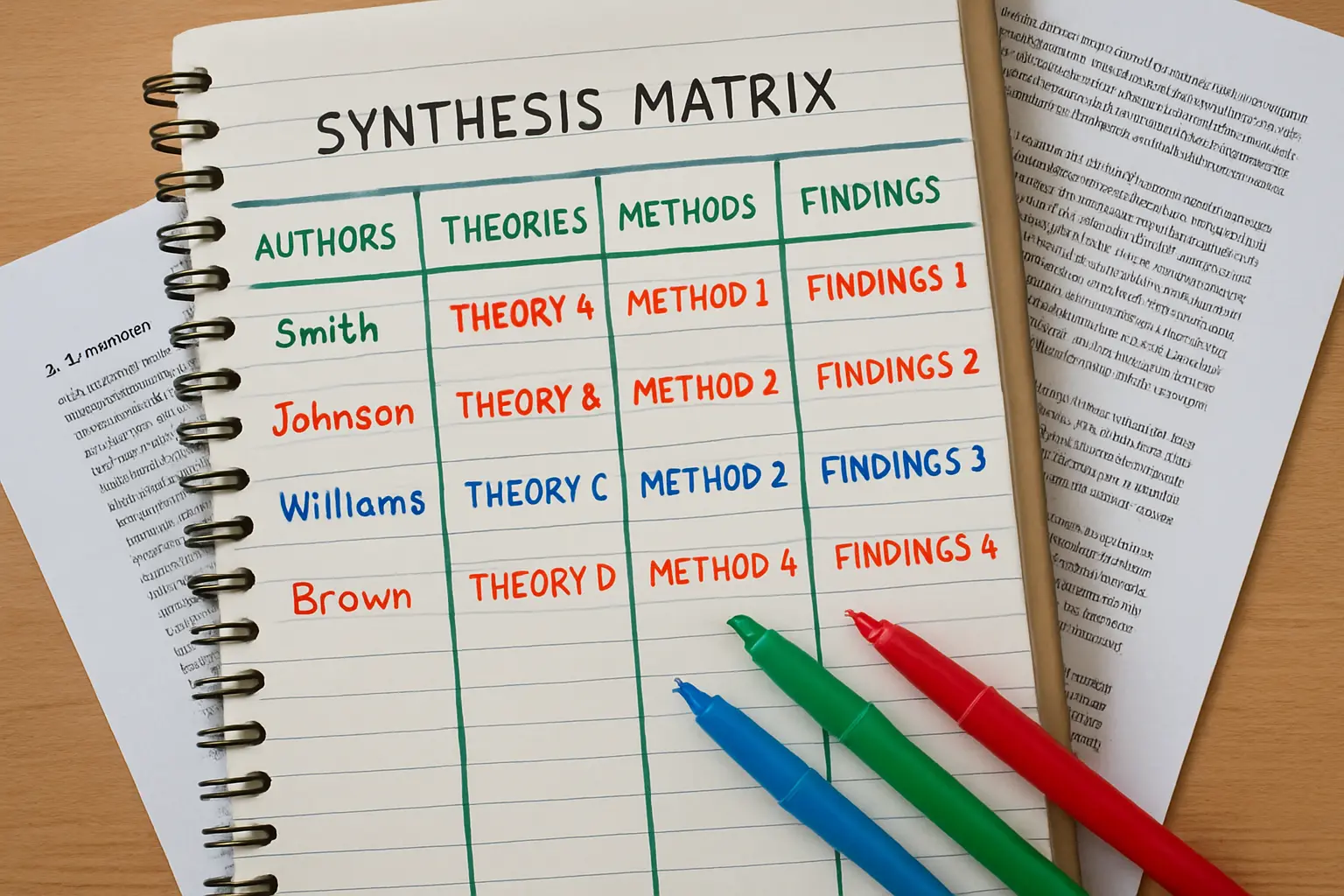
Step 4: Build a synthesis table before writing a single paragraph
One row per source: author and year, where the study was done, method and sample, key finding, limitation, and which of your sections (2.1, 2.2, 2.3) it feeds. Twenty minutes of table-filling per reading session converts a pile of PDFs into a chapter plan — and it is the difference between synthesis and the summary-stacking that examiners punish. The tell of a weak Chapter Two is paragraph after paragraph shaped “Adeyemi (2021) said… Okafor (2022) said…”. The tell of a strong one is sentences like this worked example:
“Studies of cashless policy adoption in Lagos and Abuja report high awareness but persistent cash preference (Adeyemi, 2021; Musa, 2023), while the only rural study reviewed found awareness itself to be the constraint (Okafor, 2022) — suggesting that findings from urban samples cannot be generalised to rural users, which is the gap this study addresses.”
One sentence, three sources, one argument. Expected output: a synthesis table whose “theme” column already reads like your section plan.
Step 5: Write the conceptual review as definitions with a spine
Take each key concept from your topic, define it from the literature, contrast definitions where authors disagree, and state which definition your study adopts and why. The worked pattern: “Financial inclusion has been defined as access to formal financial services (CBN, 2019) and, more broadly, as sustained usage of such services (World Bank, 2021). This study adopts the usage-based definition because access without usage cannot produce the welfare effects under investigation.” That final move — adopting a definition with a reason — is what separates a review from a glossary. Expected output: 2.1 drafted, every concept ending with an adopted position.
Step 6: Choose and justify your theory — do not just name it
The theoretical framework fails when it is decoration: a theory summarised in three paragraphs and never mentioned again. Pick the theory that actually explains the relationship in your objectives, present its author, year and core claims, then write the justification sentence: “This study is anchored on [theory] because [its central mechanism] directly explains the relationship between [your variables].” Then make sure the theory reappears in Chapter Four when you interpret your findings — panels ask exactly this. Expected output: 2.2 drafted with an explicit anchoring sentence.
Step 7: Write the empirical review to expose the gap
Organise previous studies by theme or by variable — not by date — and for each study report the method, context and finding, because the gap usually lives in one of those three: nobody has used your method, studied your population, or examined your variable combination. Close the section with the gap statement, in plain words: “Reviewed studies have examined X in banks and SMEs, predominantly in urban centres. None has examined X among [your population] in [your area], which is the gap this study fills.” Expected output: 2.3 and 2.4 drafted; your gap statement should read as the mirror image of your Chapter One problem statement.
Step 8: Cite as you write, and reconcile before you print
Every author-year mention in the chapter must appear in your reference list, formatted the way your department requires — and departmental requirements genuinely differ, as our guide to Nigerian referencing requirements documents. The cheap habit: cite from your reference manager as you draft, then run one reconciliation pass — text against list, list against text — before submitting the chapter to your supervisor. A Chapter Two that comes back for referencing corrections wastes a full supervision cycle you cannot afford. Tesify holds the chapter structure, your drafts and your citations in one project and generates the reference list from what you actually cited — which removes the reconciliation problem entirely. Expected output: a submitted Chapter Two whose corrections, when they come, are about substance rather than formatting.
The reading rhythm that fits around a real timetable
Chapter Two fails more often from rhythm than from ability. The workable pattern for a student juggling lectures, industrial training or a job: one source per sitting, processed completely — read, three-sentence summary in your own words, row added to the synthesis table, reference captured — rather than ten PDFs skimmed and abandoned. Fifteen properly processed sources beat forty half-read ones, because processed sources convert directly into paragraphs while skimmed ones convert into panic. Batch your downloading separately from your reading: collect on campus Wi-Fi, read offline, and the data cost of a literature review drops to almost nothing.
How long should Chapter Two be?
Follow your department’s format; where none is stated, proportion is the guide — Chapter Two is typically the longest chapter of a five-chapter project, but a review that dwarfs your data chapters signals stacking rather than selecting. Ask your supervisor for two recent passed projects from your department and calibrate against those. What matters to the panel is not the page count but whether the chapter ends having proven that your study needed to happen.
FAQ
What is the difference between conceptual and empirical review?
The conceptual review discusses the ideas and definitions in your topic; the empirical review discusses actual previous studies — their methods, samples and findings. Concepts first, then evidence.
How many sources do I need for Chapter Two?
Enough to cover each concept, anchor a theory and review the empirical work relevant to your questions — quality and recency beat raw counts, and your department may state a minimum. Padding with sources you never opened is visible at defence.
How recent should my literature be?
Lean on the last five to ten years for the empirical review, plus the foundational works behind your theory. A review whose newest source is a decade old tells the panel your search stopped early.
Can I cite other students’ projects?
Completed, approved theses in university repositories are citable — and for Nigerian topics they are often the closest prior work. Blog-hosted “project materials” are not citable sources; find and cite what they copied from.
Do I need both a theoretical and a conceptual framework?
Departments differ: some require both sections, some merge them. Follow your departmental format, and where both exist, keep them distinct — concepts are what you study, theory is why the relationships should hold.
Can AI write my literature review?
It must not write it — machine-generated review text presented as yours is misconduct, and chatbots fabricate references. Where AI legitimately helps is structure, feedback on your own drafts and citation management; our guide to AI rules for Nigerian projects draws the exact line.
My topic has almost no Nigerian studies. What do I do?
Say so, with your search as evidence — then review regional and international studies for the conceptual and theoretical work. A genuine local gap strengthens your justification; an unsearched one embarrasses you at defence.
What does the summary of literature section actually contain?
Three or four paragraphs: what the literature agrees on, where it conflicts, what remains unstudied — ending in your gap statement. It is the bridge from everyone else’s work to yours.