
The definition of terms is a short list, usually in Chapter One, that tells your panel exactly what each key word in your title and objectives means in your study. Each term gets a conceptual definition (what scholars say it means, cited) and, for measurable variables, an operational definition (how you will measure it, using your own instrument). Confirm the exact placement with your department.
What Is the Definition of Terms Section and Where Does It Go?
A project can use the same word in three different senses, and a panel cannot guess which one you mean. “Performance” might be sales growth, an examination score or a supervisor’s rating. The definition of terms removes that doubt before Chapter Two begins. It is a glossary of the words your title, objectives, research questions and hypotheses depend on, written so that a reader who has never met your topic can follow the rest of the work.
In many Nigerian project formats the section sits at the end of Chapter One, after the scope and limitations of the study and before Chapter Two. Some departments ask for it as a separate preliminary item, and others do not ask for it at all and expect the same work inside the conceptual review or in Chapter Three. There is no single national rule, so open your department’s project guide or a recently approved project from your own department and copy its placement. Our guide to writing Chapter One section by section shows where the definition of terms fits among the other sections.
What Is the Difference Between a Conceptual and an Operational Definition?
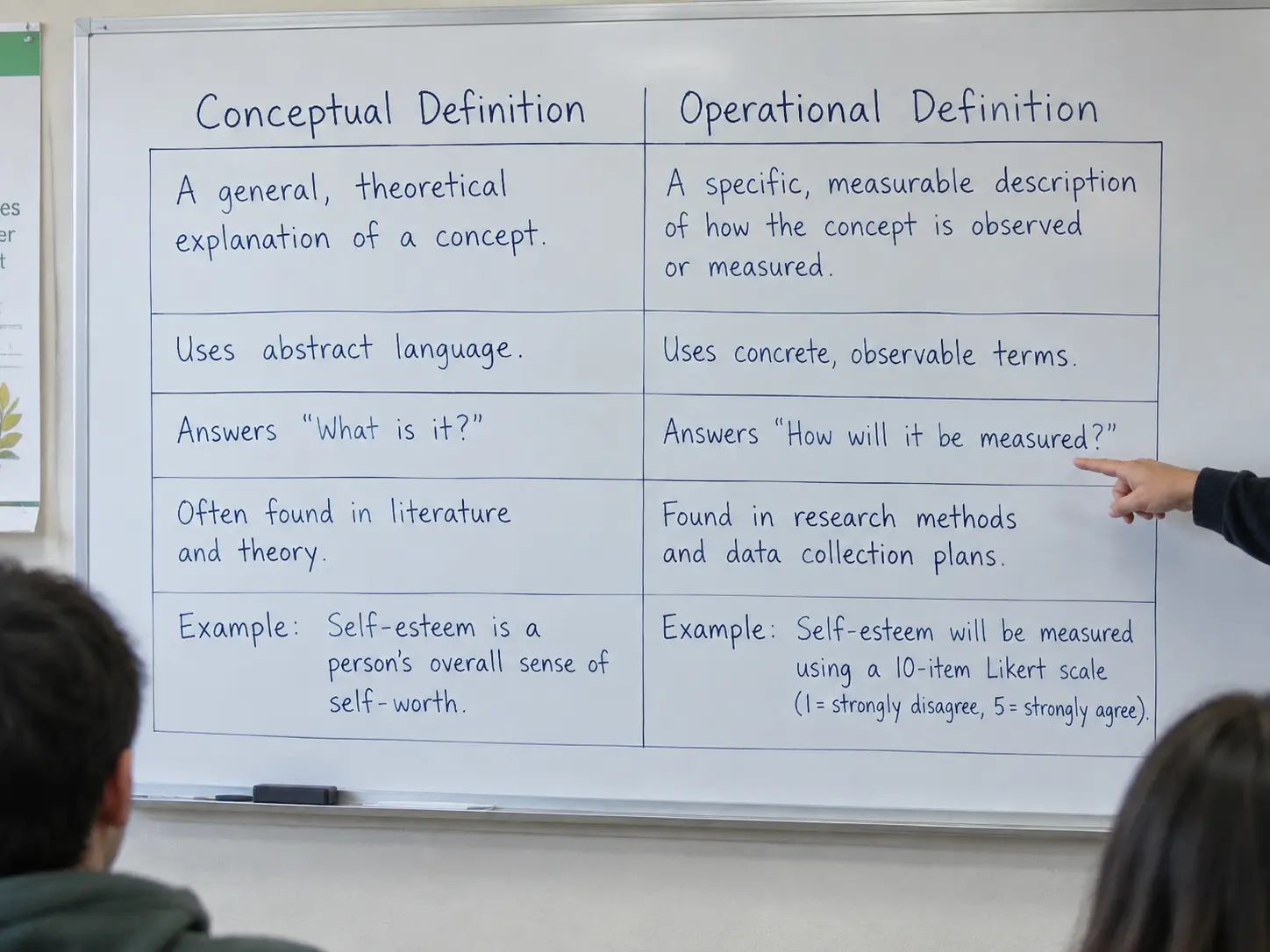
This is the distinction examiners test most often, so be exact about it.
- A conceptual definition says what a term means in the scholarly literature. It is general, it is borrowed from an author or an institution, and it carries a citation.
- An operational definition says what the term means in your study, in terms you can observe or measure. It names the indicator, the instrument and, where relevant, the way the score is calculated.
The World Health Organization’s constitution gives a good conceptual definition: “Health is a state of complete physical, mental and social well-being and not merely the absence of disease or infirmity.” The constitution was adopted on 22 July 1946 and entered into force on 7 April 1948. That sentence is perfect for a literature review, but you cannot put a patient in front of it and take a reading. A student studying the health of market traders would therefore add an operational definition, for example: “In this study, self-rated health means the respondent’s answer to the question on the questionnaire asking them to rate their general health as poor, fair, good or very good.” The first definition frames the idea, the second tells the panel what you actually did.
A useful test: if a stranger could take your operational definition and your questionnaire and reproduce your measurement, it is operational. If they would still have to ask “but how do you measure that?”, it is still conceptual.

Which Terms Should You Define?
Do not define the whole dictionary. A short, well-chosen list of between five and fifteen terms is easier to defend than a long one, and the right number depends on your topic and your department. Use these four filters, in order.
- Every variable in your title. If the title says “the effect of staff training on employee productivity”, then staff training and employee productivity are both defined.
- Every variable in your objectives and hypotheses. A word that appears in an objective but not in the title still needs a meaning.
- Terms with more than one accepted meaning. Empowerment, performance, quality, satisfaction, adoption, literacy and sustainability all fall here.
- Abbreviations, institutions and technical terms that a lecturer from another department might not recognise, such as NDHS, SIWES, ROA, ANC or SME.
Do not define ordinary words such as “student” or “school” unless you are giving them a narrower meaning than usual (for example, “student” meaning only 300-level students in the faculty you sampled).
How Do You Write a Conceptual Definition?
Pick one or two authoritative sources, paraphrase or quote them, and cite author, year and page for a direct quotation. The sources can be a standard textbook, a well-cited journal article, or an official body whose job it is to define the term (a regulator, a professional council or an international organisation). Then add a closing sentence that fixes the meaning for your study.
A workable pattern is: term + according to author (year) + the definition in one sentence + “This study adopts that meaning.” An illustrative example for a business administration project reads: “Employee motivation refers to the internal and external forces that direct, energise and sustain a worker’s effort towards organisational goals (author, year). This study adopts that meaning.” Replace the author and year with a real source you have opened and read; do not cite a definition you have only seen quoted in someone else’s work without saying so.
Avoid starting with “According to the dictionary”. A general dictionary tells the panel you did not read the literature of your own field. Use the field’s own sources, and follow the referencing style your department requires, which our guide to which referencing style Nigerian universities use explains.
How Do You Write an Operational Definition?
An operational definition is built from four parts, and a good one names all four.
- The variable being defined.
- The indicator, which is the observable sign of the variable.
- The instrument that records the indicator (a questionnaire section, a test, a checklist, a company record).
- The scoring rule, which says how the raw answers become a value.
Illustrative example: “In this study, employee productivity is the number of customer accounts a bank officer opened per month, taken from the branch monthly returns for January to June.” The variable is employee productivity, the indicator is accounts opened, the instrument is the branch return and the scoring rule is a monthly count. A second illustration for an education project: “Academic performance is the student’s cumulative grade point average at the end of the 2024/2025 session, as recorded by the faculty examination office.”
Notice what ties the two together. The operational definition in Chapter One must match the instrument you describe in Chapter Three. If Chapter One says productivity is accounts opened but your questionnaire asks staff to rate their own effort, a panel will notice the mismatch at once. Our guide to writing Chapter Three covers the instrument section these definitions must agree with.
What Does a Definition of Terms Look Like for Different Departments?
The table below shows illustrative pairs for four fields. The operational wordings are examples of the style, not rules; yours must describe your own instrument.
| Field | Term | Illustrative conceptual meaning | Illustrative operational meaning |
|---|---|---|---|
| Education | Teacher motivation | The drive that leads a teacher to put sustained effort into teaching | The total score on the ten-item teacher motivation section of the questionnaire, each item rated 1 to 5 |
| Education | Academic performance | The level of achievement a learner reaches in formal study | The cumulative grade point average recorded by the examination office at the end of the session |
| Nursing | Antenatal care uptake | A pregnant woman’s use of health services during pregnancy | Attendance at four or more antenatal visits, as reported by the respondent and checked against her antenatal card |
| Nursing | Knowledge of hypertension | Awareness of the causes, signs and control of high blood pressure | The number of correct answers out of the twelve knowledge items on the questionnaire |
| Accounting | Return on assets | A measure of how profitably a firm uses its assets | Profit after tax divided by total assets, taken from each firm’s published annual report for the study years |
| Accounting | Internal control | The policies and procedures an organisation uses to protect assets and keep records reliable | The mean score on the internal control items of the questionnaire completed by finance staff |
| Marketing | Customer loyalty | A customer’s commitment to keep buying from the same provider | The mean of three items on repurchase intention and recommendation, rated 1 to 5 |
| Marketing | Social media advertising | Paid promotion delivered through social platforms | The number of the listed platforms on which the respondent recalls seeing the brand’s adverts in the past month |
| Business administration | Employee turnover | The rate at which employees leave an organisation and are replaced | The number of staff who left in the year divided by the average staff strength, from the human resources register |
| Business administration | Small and medium enterprise | A business within a defined size band of employees and assets | A business with fewer than 200 employees that the sampling frame lists as registered in the study area |
Check that every operational meaning you borrow like this matches a threshold you can justify. For example, the size band for a small or medium enterprise comes from an official source, and our article on projects on small and medium enterprises shows where that classification is published.
How Should You Lay Out the Section?
Most students list the terms alphabetically, which makes the section easy to scan and easy to mark. A second, equally acceptable order follows the order in which the terms appear in the title and objectives. Pick one and keep to it. Within each entry, use the same internal order every time, for example: term in bold, conceptual definition with citation, then “Operationally, in this study, …”.
Some departments want one combined definition per term, and some want two clearly labelled parts. A mixed layout, where one term has two parts and the next has one, looks careless. If your department’s guide does not say, use two labelled parts for your main variables and a single sentence for abbreviations and background terms.
Keep the section to about one page. If you need more, you are probably defining words that do not need it, or you are repeating material that belongs in the conceptual review of Chapter Two. When a term has a long debate behind it, give the one definition you adopt and discuss the debate in the review.
What Mistakes Do Examiners Flag in a Definition of Terms?
- Dictionary definitions only. They show no engagement with the literature of the field.
- No citation. A conceptual definition without an author and year looks invented.
- No operational definition for a measured variable. If you measure it, you must say how.
- An operational definition that does not match the instrument. This is the mismatch that costs the most marks.
- Defining terms you never use again. Every defined term should appear in the study.
- Using a term differently later. If you define “performance” as grade point average, do not slip into discussing performance as classroom behaviour in Chapter Four.
- Copying the list from an older project. A past project’s terms belong to its own topic and a supervisor will recognise them.
The same checks apply to the objectives, significance and scope of the study, which come just before the definition of terms in most formats. If your objectives are loose, your definitions will be too, so fix them first. For psychology and other measurement-heavy fields, the variables and operationalisation table takes the same idea further, with every variable tied to an instrument item.
A Quick Checklist Before You Submit
- Every variable in the title, objectives and hypotheses has an entry.
- Every conceptual definition carries an author, a year and, for a quotation, a page.
- Every measured variable has an operational definition naming indicator, instrument and scoring.
- Operational definitions match the instrument described in Chapter Three.
- Entries follow one layout and one order throughout.
- Abbreviations that a reader from another department may not know are explained once.
- The section is about a page long and sits where your department’s guide puts it.
If you are writing this section now, use the checklist as a live editing pass on your own draft. Tesify helps you structure and organise your project, and the text is 100% written by you. Start your project with Tesify — 9,000+ students have written 15,000+ chapters with Tesify.
Frequently asked questions
Is the definition of terms compulsory in a Nigerian final year project?
It depends on your department. Many project formats include it in Chapter One, some place it in the preliminary pages and some do not require it at all. Check your department’s project guide or a recently approved project from your department.
How many terms should I define?
There is no national number. A short list of the terms in your title, objectives and hypotheses, plus a few abbreviations, is easier to defend than a long one, and most students end up with a handful to a dozen.
What is the difference between a conceptual and an operational definition?
A conceptual definition says what a term means in the scholarly literature and carries a citation. An operational definition says how you measure or observe that term in your study, naming the indicator, the instrument and the scoring.
Do I need both for every term?
No. Give both for the variables you measure. For abbreviations, institutions and background terms, one clear sentence is enough.
Where do I get conceptual definitions from?
From standard textbooks in your field, well-cited journal articles and official bodies whose role is to define the term, such as a regulator, a professional council or an international organisation. Cite the source you actually read.
Can I use a dictionary definition?
Only as a starting point for an everyday word. For a variable in your study, use a source from your own field, because the panel expects the literature, not a dictionary, to shape your meaning.
Is the operational definition the same as the variables section in Chapter Three?
They must agree but need not be identical. Chapter One gives the short meaning; Chapter Three describes the instrument and scoring in detail. If the two disagree, the panel will question your instrument.
Should the terms be listed alphabetically?
Alphabetical order is the most common and easiest to mark. Following the order of the title and objectives is also acceptable. Choose one order and use it throughout.
Can I copy the definition of terms from a past project?
No. Each list belongs to its own topic and instrument, and supervisors who have seen the earlier project will recognise the copy. Use past projects to see the layout, then write your own definitions from sources you have read.