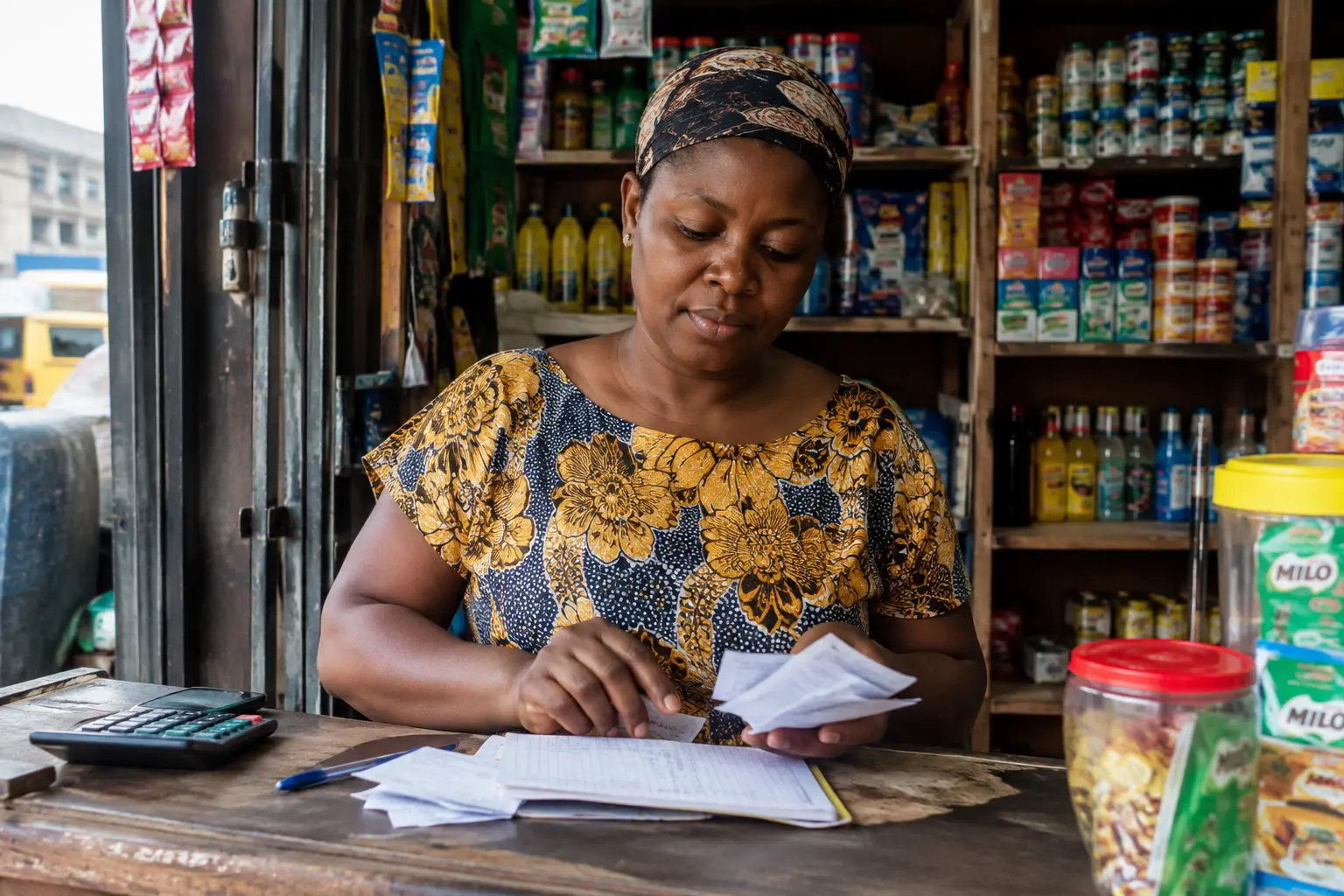
A final year project on small and medium enterprises (SMEs) needs four things settled before Chapter One: a working definition of what counts as an SME so your population is defensible, a sampling plan that survives the fact that no complete list of SMEs in your state exists, an instrument an owner can complete in ten minutes between customers, and a consent approach that fits a one-person shop rather than an institution with a records office.
What Counts as a Small or Medium Enterprise in Nigeria?
The Small and Medium Enterprises Development Agency of Nigeria (SMEDAN), in the National Policy on Micro, Small and Medium Enterprises, defines the category on a dual criterion of employment and assets, excluding land and buildings, with employment taking precedence whenever the two disagree. Read directly from SMEDAN’s 2010 National MSME Collaborative Survey with the National Bureau of Statistics: a micro enterprise employs fewer than 10 persons, a small enterprise employs 10 to 49 persons, and a medium enterprise employs 50 to 199 persons. If an enterprise has assets that would place it in one band but a workforce that would place it in another — the survey’s own example is a business with seven million naira in assets but only seven employees — the employment count wins and the business is classified by its staff size, not its balance sheet.
This matters for your project because “SME” is not one population. A Chapter One that studies “SMEs in Lagos State” without saying which band, or bands, it means is the first thing a supervisor will send back. Decide early whether your project studies micro enterprises (the informal roadside and market businesses that dominate by count), small and medium enterprises as SMEDAN defines the formal end of the sector, or a named sub-sector across all three bands — and say so in your title and your delimitation. Our accounting and business administration project topics list has research-question examples across published, survey and firm-access data tiers if you have not yet settled on a topic within the SME space.
Which Sub-Sectors Do Most SME Projects in Nigeria Study?
Within business administration, marketing and accounting departments, SME projects cluster around a handful of sub-sectors that are easy to access and easy to defend: retail and trading (market stalls, provision stores, boutiques), food and hospitality (restaurants, catering, small hotels), fashion and garment production, agro-processing (small-scale milling, packaging, food preservation), and services (salons, repair shops, logistics and delivery operators). A narrower sub-sector gives you a cleaner population to sample and a literature review that does not have to stretch across unrelated business types in the same paragraph.
What Research Problem Can You Actually Defend on an SME Population?
Supervisors commonly send SME proposals back for one of two reasons: the problem is stated at a scale the student cannot study (national policy, an entire state’s economy), or the outcome variable cannot be measured from what an SME owner will actually disclose (exact profit figures, tax records). Problems that survive both objections are narrower and behaviourally measurable: access to finance and loan uptake, adoption of a specific technology (point-of-sale terminals, social media marketing, mobile money), record-keeping practices and their relationship to a measurable outcome such as business survival or growth in staff count, the effect of a named government or NGO intervention on a defined group of beneficiaries, or succession and ownership-transition practices in family-owned SMEs.
How Do You Design the Study: Case Study, Cross-Sectional Survey, or Comparative?
Three designs cover almost every SME project. A single case study examines one SME in depth — useful when you have real access to one business’s owner and staff and want to study a process (how they price, how they market, how they keep records) rather than compare across a population; our guide to running a company case-study project covers how to secure and document that access, including the access letter and what a business will and will not release. A cross-sectional survey samples a defined population of SMEs at one point in time — the standard design for questions about adoption, practice or perception across many businesses. A comparative design contrasts two groups (SMEs that adopted a practice against those that did not, or two sub-sectors) on the same measured outcome. Choose the case study when your access is to one business; choose the survey or comparative design when your access is to a market, an association, or a cluster of businesses you can approach individually.
How Do You Sample a Population of SMEs You Cannot Fully List?
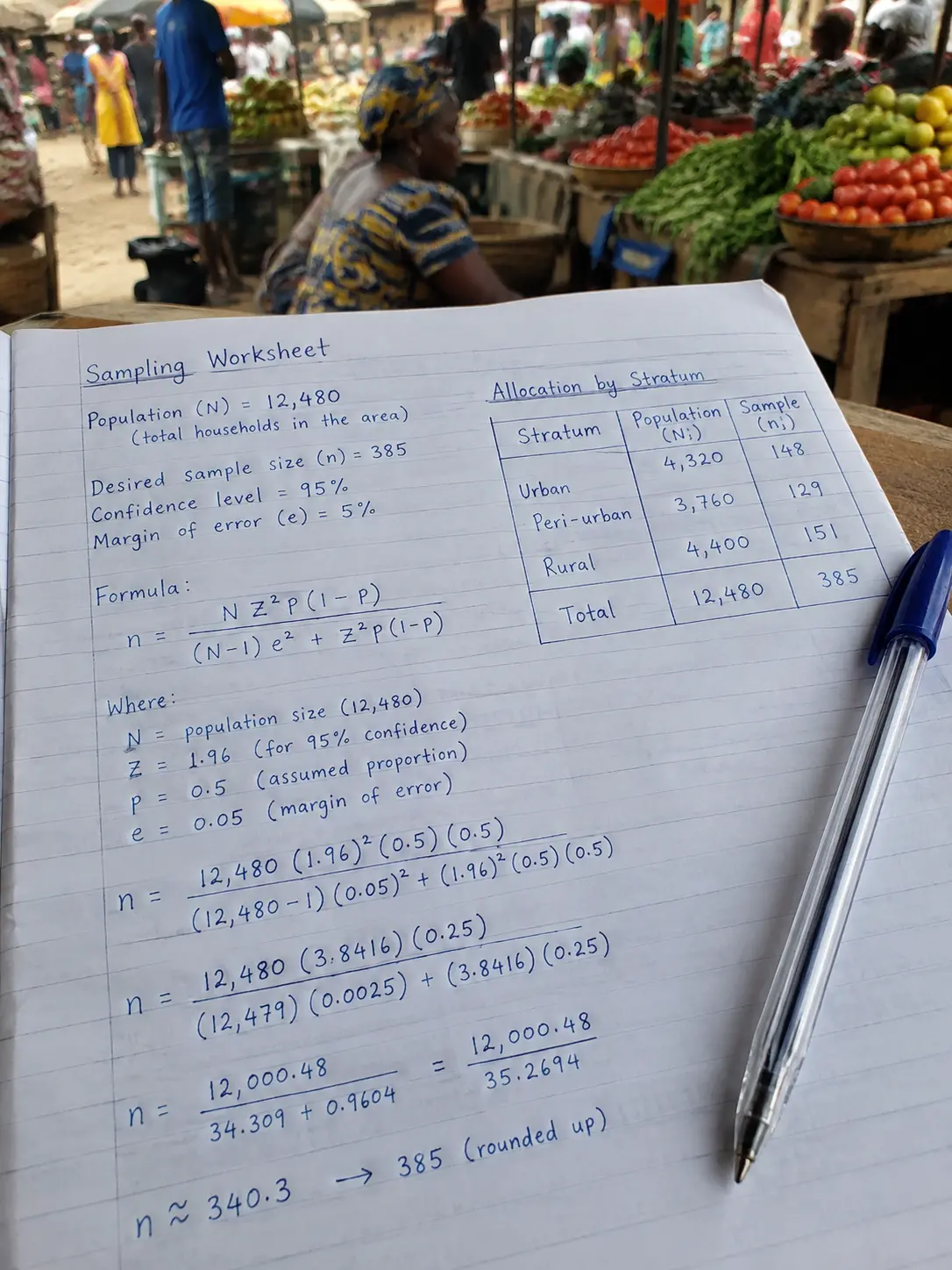
No single national or state register lists every SME with a current address and phone number, which is the sampling problem every SME project runs into in Chapter Three. Two honest routes exist. If your population is bounded and countable — every registered member of one market traders’ association, every shop on one identified street, every business registered with one local government’s revenue office in the period you specify — you can obtain or construct that list and apply a formula such as Taro Yamane to a known population size; our worked Taro Yamane sampling example shows the full calculation and the proportional allocation across sub-groups for a finite, countable population, and the same arithmetic applies whether the population is farmers or registered traders. If your population is open and effectively unlistable — “SMEs in Lagos State” with no single register — say so explicitly, and use purposive or quota sampling against a stated set of inclusion criteria (sub-sector, size band by SMEDAN’s own definition, minimum years in operation) rather than presenting an invented population figure as if it were a sampling frame. A panel will accept an honestly bounded population far more readily than an unbounded one dressed up with a precise-looking sample size.
What Instrument Fits an SME Owner With Ten Minutes Between Customers?
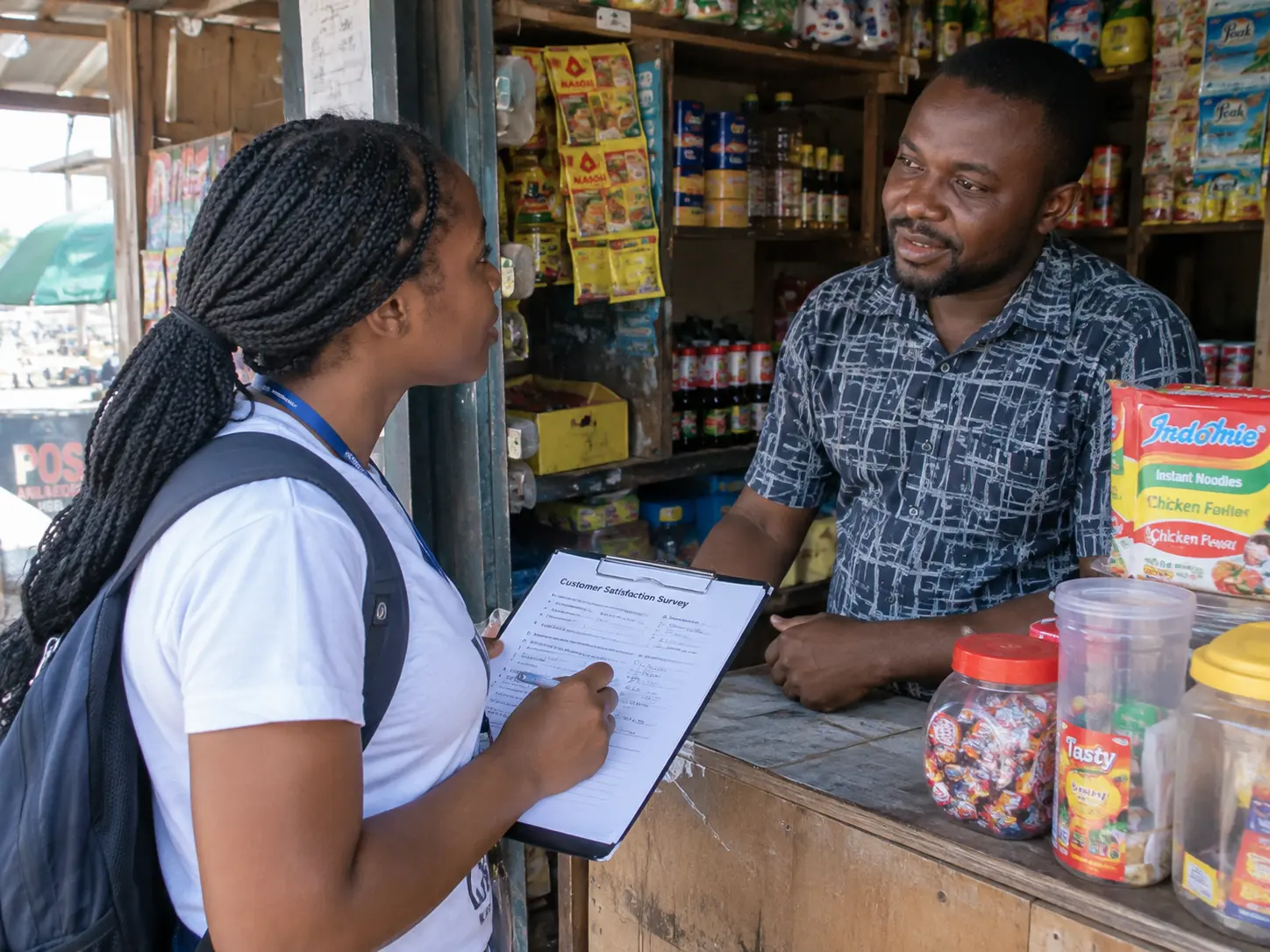
The instrument has to survive being administered standing at a counter or in a five-minute gap in trading. That rules out long Likert batteries and favours a short structured questionnaire: a demographic and firm-characteristics section (sub-sector, years in operation, number of employees — which also lets you confirm the SMEDAN size band from your own data rather than the owner’s self-report), a small number of closed items on the specific practice or outcome your objectives name, and at most one or two open items for context. Where the research question is about a process rather than a measurable outcome, a short semi-structured interview with the owner, recorded with permission or captured in detailed field notes, usually produces richer material than a questionnaire an owner rushes through. Pilot the instrument on two or three businesses outside your sample first — SME owners are candid about which questions confuse them, and that feedback is cheap to get and expensive to skip. Once you know your objectives and hypotheses, our guide to choosing the right statistical test helps you match the analysis to what your instrument actually produces before you draft Chapter Three.
What Access and Consent Does an SME Owner Need From You?
Unlike a hospital department or a school, most SMEs have no gatekeeper beyond the owner, which makes access faster but also makes informed consent entirely your responsibility rather than an institution’s. Before you approach anyone: prepare a one-page information sheet in plain language stating who you are, what the study is for, that participation is voluntary, and how the business will be identified in your write-up (by pseudonym or by sub-sector and location only, never by name unless the owner explicitly agrees and you have that agreement in writing). Where a single business is your case study rather than one respondent among many, treat that written agreement as seriously as any institutional access letter — it is the document that lets you name what the business does and quote what its owner told you.
Writing the Population Section Without Inventing a National Figure
A common fault in Chapter One is a sentence like “there are over X million SMEs in Nigeria” attached to a source the student never opened. SMEDAN and the National Bureau of Statistics publish national MSME survey reports, and the 2010 survey quoted above is only one of them — but a figure you have not personally read from the source it came from does not belong in your project with a citation attached to it. If you want a national context figure, open the most recent SMEDAN/NBS survey report yourself, quote its exact wording and dated year, and never round or restate a number you saw only in a summary of the survey rather than the survey itself. It is safer, and just as defensible to a panel, to state your own study’s bounded population (the association, market or cluster you actually sampled) and note that national-level figures were beyond this study’s scope. If your proposal is still at the planning stage, our worked business administration proposal example shows how a population section like this reads when written in the future tense for a proposal defence.
Once your population, design, instrument and access are settled, Tesify keeps the four decisions above consistent across every chapter of the draft it helps you write — the same size-band definition, the same sampling frame and the same consent language, chapter after chapter, rather than a Chapter One that says one thing and a Chapter Three that quietly says another. Start your SME project with Tesify — over 9,000 students and 15,000+ chapters written, 100% written by you.
Frequently asked questions
Is an SME project the same as a company case study project?
Not always. A company case study project studies one named business in depth; an SME project more often samples across a population of businesses. The two overlap only when your case study business happens to fall inside SMEDAN’s SME size bands, which many single-business case studies do.
Can I study “small businesses” without using SMEDAN’s exact size bands?
You can define your own inclusion criteria, but you should still state them explicitly and explain why you departed from the national definition, since a panel familiar with SMEDAN’s classification will ask why your “small business” population does not match it.
What sample size is normal for an SME survey project?
There is no fixed national number. It depends entirely on whether your population is finite and known (apply a formula such as Taro Yamane to that known size) or open and unlistable (justify your sample size by saturation, resource limits, or a stated minimum per sub-group rather than by a formula that needs a population figure you do not have).
Do I need ethics committee approval to survey SME owners?
Business administration, marketing and accounting departments in Nigeria do not typically route SME survey projects through a formal institutional ethics committee the way health-related research is routed through one, but you still need informed consent from every respondent and, for a named case-study business, written permission to use and publish what you observe.
Can I use a business’s real name in my project?
Only with the owner’s explicit written agreement. Without it, identify the business by pseudonym, or by sub-sector and general location only.
Where do I find SMEs willing to participate?
Market traders’ associations, local government revenue or business-registration offices, trade fairs, and small-business support programmes run by banks or NGOs are the most reliable entry points — approaching individual shops cold has a much lower response rate than going through an association that can introduce you.
Is a quantitative or qualitative approach better for an SME project?
It depends on your research question, not on which is “easier.” A question about adoption rates or the relationship between two measurable variables across many businesses needs a quantitative survey; a question about how or why owners make a specific decision needs a qualitative interview or case-study approach.
What if my target market association will not give me a member list?
Ask for an introduction instead of a list — most associations will let you attend a meeting or accompany an official on a round of visits, which gets you access without requiring them to hand over member data they may not be authorised to share.
Can I combine two sub-sectors, like retail and food service, in one project?
You can, but only if your research question genuinely requires comparing them; otherwise a mixed sub-sector population weakens both your literature review and your discussion, since the practices and constraints that matter for a boutique are not the same ones that matter for a restaurant.
How many SME businesses should a case-study project include?
One, if your design is a genuine single case study. Adding a second or third business without a comparative research question turns your case study into an under-sampled survey, which is a different design with different sampling requirements.