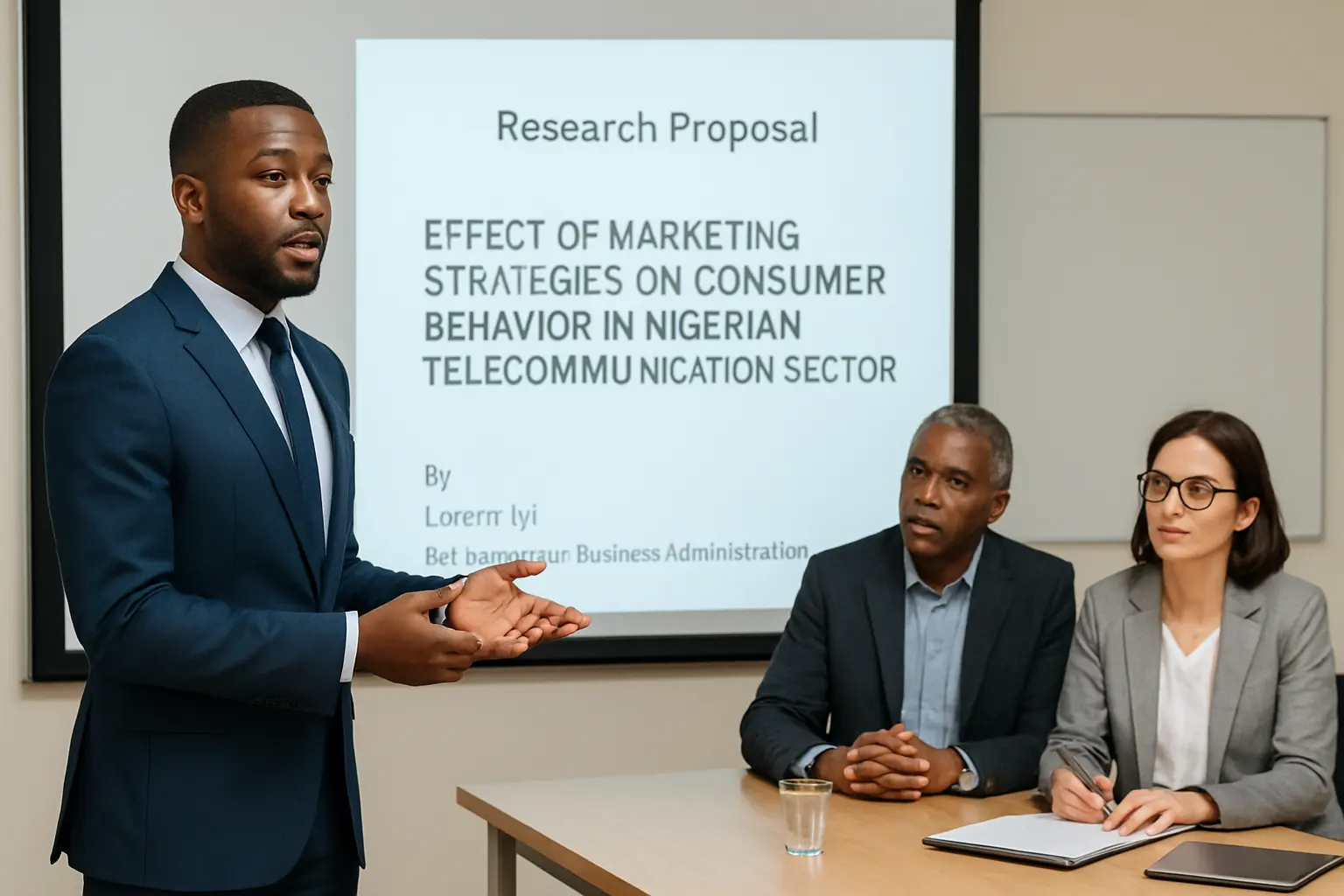
A business administration research proposal is Chapters One to Three of your eventual project, written in the future tense and defended at a seminar before you collect a single questionnaire — the panel is approving a plan, not marking a finished study, so every section states what you will do, not what you found. This example works through one full proposal on a named, approvable business administration topic, section by section.
The worked topic this example follows
This proposal follows one invented topic throughout: “Leadership Style and Employee Job Satisfaction: A Study of [Named Deposit Money Bank] Branch Staff in [City].” It is a realistic business administration topic because the population is reachable (bank branch staff, not head-office executives who rarely grant access), the variables are measurable with an existing scale rather than one you would need to invent, and the design is a straightforward correlational survey achievable within one semester. Our general guide to writing a research proposal section by section covers the tense rule and what changes after approval; this example applies that structure to one worked business administration case.
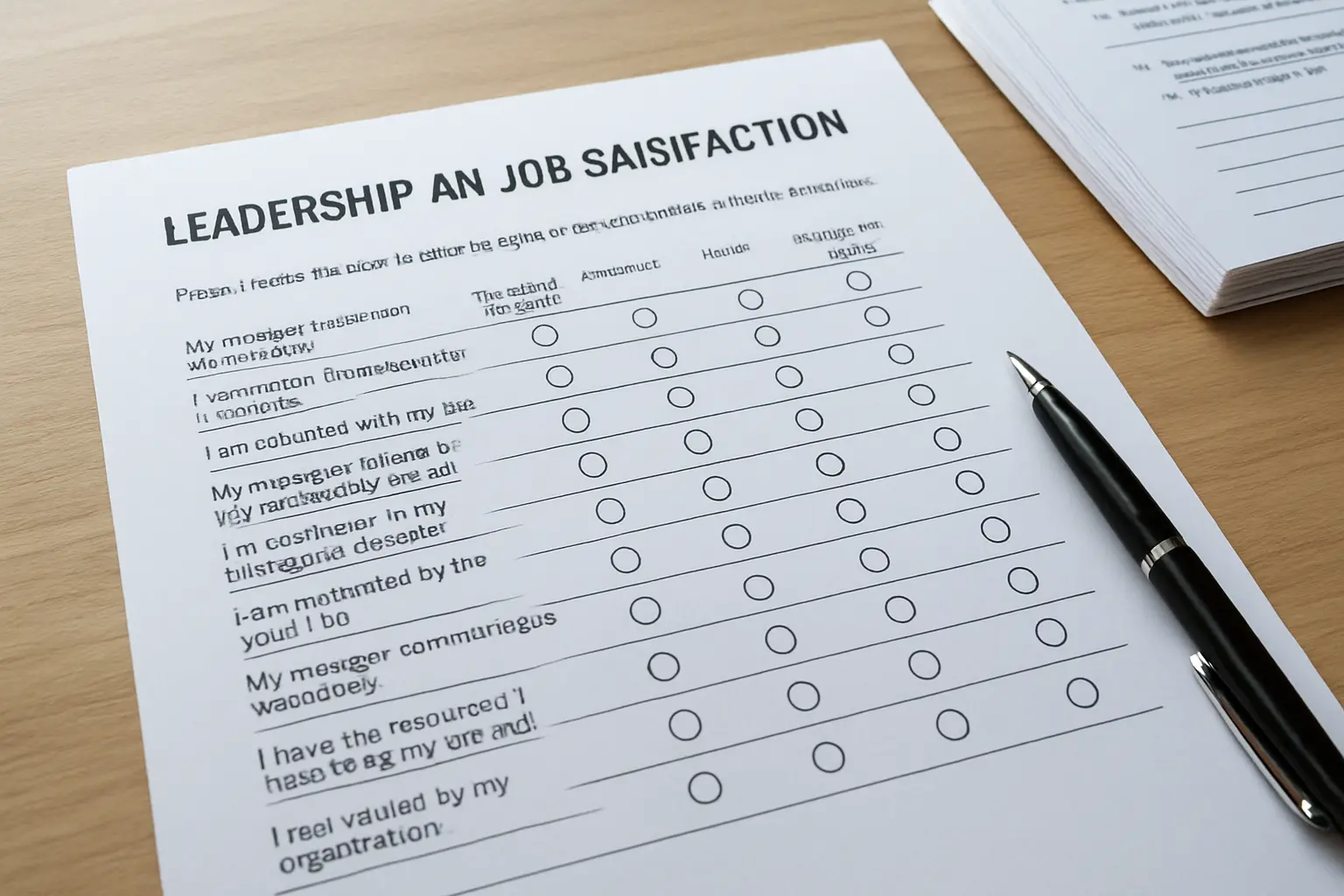
Proposal Chapter One: Introduction, written as it would appear
Background of the study: “Employee job satisfaction has become a central concern for Nigerian deposit money banks, where staff retention is a recurring management challenge. Leadership style is repeatedly cited in the human resource management literature as a determinant of how satisfied employees feel in their roles, yet [state the gap your own literature search actually found — for example, few studies of this relationship among branch-level staff in [City]].”
Statement of the problem: “Despite the volume of leadership research generally, it is not established whether the specific leadership styles practised by branch managers at [Named Bank] in [City] relate to how satisfied their staff report feeling, or which style, if any, predicts higher satisfaction.”
Objectives: (1) To identify the dominant leadership style practised by branch managers at the study bank. (2) To assess the level of job satisfaction reported by branch staff. (3) To examine the relationship between leadership style and job satisfaction. (4) To determine which leadership style dimension most strongly predicts job satisfaction.
Research questions and hypotheses: “What leadership style do branch managers predominantly practise? What is the level of job satisfaction among branch staff? Is there a significant relationship between leadership style and job satisfaction?” Null hypothesis: “There is no significant relationship between leadership style and employee job satisfaction at the study bank.”
Significance: “Findings will assist the bank’s human resource department in leadership development decisions, and add branch-level evidence from [City] to the Nigerian banking-sector literature on this relationship.” Scope: “The study is limited to branch-level staff of [Named Bank] within [City], excluding head-office and regional management staff, and covers the [session] academic session.”
Proposal Chapter Two: Literature review, written as it would appear
A business administration proposal’s Chapter Two states, in the future tense, what the finished chapter will cover — not the full review itself. “Chapter Two will review the conceptual literature on leadership style and job satisfaction, adopt the Full Range Leadership theory (transformational, transactional and laissez-faire styles) as the theoretical framework because it is widely used in banking-sector leadership research and is measured directly by the MLQ, and review empirical studies conducted in Nigerian and West African financial institutions, closing with a summary identifying the gap this study addresses: the branch-level gap stated in Chapter One.” Naming your theory and your empirical anchor points at proposal stage, rather than leaving Chapter Two as “to be completed,” is what convinces a panel the full review is achievable in the time remaining.
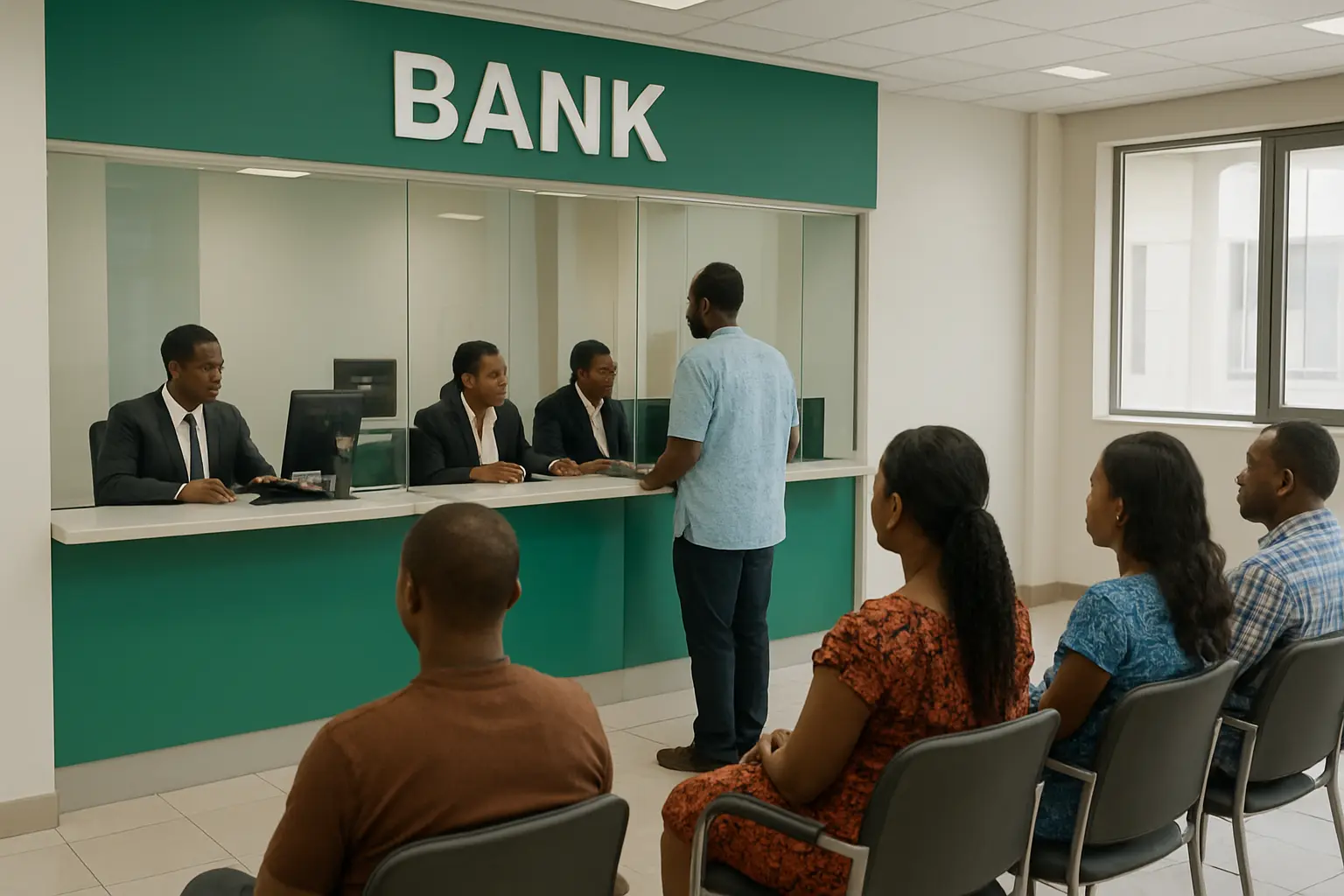
Proposal Chapter Three: Methodology, written as it would appear
“This study will adopt a descriptive correlational survey design. The population will comprise all branch staff of [Named Bank] in [City], estimated at [N] based on the branch’s own staff register. Sample size will be determined using the Taro Yamane formula at a 0.05 margin of error. A stratified random sampling technique will select respondents proportionally across cadres. Data will be collected using a structured questionnaire in three sections: demographics, the Multifactor Leadership Questionnaire (MLQ) short form to measure leadership style, and the Minnesota Satisfaction Questionnaire (MSQ) short form to measure job satisfaction — both established, previously validated instruments, adopted with permission rather than developed from scratch. Content validity will be confirmed by two lecturers in the department, and a pilot test with 10% of the sample size will establish internal consistency via Cronbach’s alpha. Data will be analysed using descriptive statistics for objectives one and two, and Pearson correlation for the hypothesis in objective three, with regression to address objective four.” Every sentence in this chapter is a commitment your supervisor can hold you to — write it as a plan you can actually execute, not an aspiration.
What a business administration proposal needs that a general proposal guide will not tell you
Three things are specific to business administration proposals and worth stating explicitly at defence. First, access before topic: confirm informally with the organisation, or choose a sector-wide survey design instead, before your topic is formally approved — a proposal built around a named organisation that later refuses access is a semester lost, and our guide to getting a company to release case study data covers the request-letter process in full. Second, choose an instrument that already exists for the constructs common in business administration research — leadership, motivation, job satisfaction, organisational commitment — rather than proposing to build one, because a panel is far more comfortable approving a proposal that adopts a validated scale than one built on an instrument that does not exist yet. Third, state the analysis technique in Chapter Three, not “SPSS will be used” — name the actual test (Pearson correlation, regression, ANOVA) each objective needs, which our guide to choosing the right statistical test can help you match to your design before the defence.
How do you choose a defensible business administration topic before you propose it?
The proposal stage is where a weak topic gets caught, not fixed after the fact. Before you write Chapter One in future tense, check that your chosen organisation and variables are actually reachable within one semester — our list of accounting and business administration project topics sorts forty options by exactly this criterion, whether the data is already published, collectable by survey, or dependent on a firm granting access, and a tier-1 or tier-2 topic proposes far more smoothly than a tier-3 one still waiting on a reply. If your department’s convention leans toward objectives and significance written with worked examples rather than the future-tense proposal wording shown here, our guide to written objective, significance and scope examples covers the present-tense version of the same three sections for your eventual Chapter One.
A worked timeline for the proposal’s remaining stages
Most business administration proposal templates expect a short work plan showing when each remaining stage completes. A realistic worked example for a one-semester bank-branch study: Weeks 1 to 2, finalise instrument adaptation and secure written access from the branch; Week 3, ethics or departmental clearance and instrument pilot with 10% of the sample; Weeks 4 to 6, data collection across the sampled branch cadres; Weeks 7 to 8, data entry and analysis in SPSS; Weeks 9 to 10, write Chapters Four and Five; Weeks 11 to 12, supervisor review and corrections before binding. State your own weeks against your own department’s academic calendar rather than copying this range — a timeline that does not account for your specific defence date is the one detail a panel checks against the calendar in the room.
What happens after your proposal is approved?
Approval converts the plan into a licence to collect data — nothing in the proposal’s wording changes retroactively. When you write the finished project, Chapters One to Three shift from future to past or present tense (“this study will adopt” becomes “this study adopted”), and any changes made during data collection — a different sample size than proposed, a revised instrument item — must be documented honestly rather than silently rewritten into the original plan as though nothing changed. Keep your approved proposal as the record of what you committed to; a supervisor comparing the final project against it is a normal part of the defence.
Six mistakes that get a business administration proposal sent back
- Objectives that do not match the hypothesis. If objective three asks about a relationship, the hypothesis must be about that same relationship, worded as a testable null statement.
- A theoretical framework with no stated relevance. Naming a theory is not enough; state in one sentence why its constructs explain your variables.
- An instrument proposed but not named. “A questionnaire will be developed” without naming which validated scale it adapts reads as unplanned.
- A population with no source for the number. State where the population figure comes from — the organisation’s own staff register, not a guess.
- Scope with no stated exclusion. A scope that only says what is included, never what is excluded, leaves the panel unsure what you are actually promising to deliver.
- Significance that lists generic beneficiaries. “This study will benefit students, researchers and the general public” is the sentence every panel has read a hundred times; name the specific department or committee that will actually use the findings.
Frequently asked questions
How long should a business administration research proposal be?
Most Nigerian departments expect 15 to 25 pages covering Chapters One to Three in future tense, though page counts vary by institution — confirm your department’s expectation with your supervisor before finalising length.
Can I change my organisation after the proposal is approved?
Yes, if access genuinely fails, but inform your supervisor immediately and revise the proposal’s population and scope sections to match — do not simply substitute a new organisation into an unrevised document.
Do I need pilot data before my proposal defence?
No. A proposal defence approves the plan before data collection begins; piloting the instrument happens after approval, once you begin Chapter Three’s actual fieldwork.
What is the difference between a proposal and a full research problem statement?
A proposal contains the full statement of the problem as one of its Chapter One sections, but also adds the planned methodology and literature approach — a problem statement alone does not commit you to a design or an instrument.
Should I include a timeline in my proposal?
Most departments expect a work plan or Gantt chart showing when each remaining stage will be completed, particularly for a topic with a fixed access or seasonal constraint — check your department’s proposal template for whether this is a required section.
Can two students in my department propose the same organisation?
Usually yes, provided their research questions and variables differ genuinely — two leadership-and-satisfaction studies at the same bank branch would likely be flagged as duplicative, so confirm with your supervisor that your angle is distinct.
What if my supervisor asks for a different theoretical framework at the proposal defence?
This is a normal outcome of a proposal defence, not a failure — the panel’s role includes catching a framework whose constructs do not actually fit your variables. Revise Chapter Two’s framework section before you proceed to full data collection, and note the change and its reason in your final project’s methodology if your department asks for that record.
Tesify drafts each proposal chapter in the correct future tense and keeps your objectives, hypothesis and methodology aligned with each other automatically, so a panel finds no mismatch between sections.