
A sociology interview or focus group guide for a Nigerian final year project needs four things: questions grouped under your research objectives (not asked in a random order), neutral wording that does not lead the respondent, follow-up probes written in advance, and a pilot round with two or three people before you touch your real sample. A guide without all four is usually the first thing a supervisor sends back.
Why a sociology project cannot reuse a generic questionnaire template
Sociology departments in Nigerian universities examine qualitative work on a different standard from a closed-ended questionnaire. A Likert-scale instrument measures a variable; an interview or focus group guide is built to let a respondent explain a social process in their own words — how a family absorbed a job loss, how a market association resolves a dispute, why a community accepted or resisted a policy. A panel that sees a guide adapted from the site’s own generic questionnaire and interview guide examples without reworking it for a qualitative, process-focused study will usually ask you to redo Chapter Three before data collection is approved. The guide has to be built from your own research objectives outward, not borrowed from a discipline that measures different things — for the fuller methodology chapter this guide sits inside, see how to write Chapter Three of a Nigerian final year project.
How do you turn research objectives into interview questions?
Work objective by objective. For each objective, write one grand-tour opening question that lets the respondent talk broadly, then two to four sociology-scoped probes that narrow toward what your objective actually asks. A worked example, for an objective reading “to examine how internal migration affects the social support systems of migrant traders in Lagos”:
- Grand-tour question: “Can you tell me about how you first settled into this market/community after you arrived?”
- Probe 1: “Who did you rely on in your first few months — family, other traders, a hometown association?”
- Probe 2: “Has that support changed since then? In what way?”
- Probe 3: “Are there situations where you feel you have no one to call on here?”
Notice the probes never name a theory or use academic language — “social capital,” “kinship network,” “social support system” belong in your Chapter Two and your discussion, not in the question you actually ask a trader in the market. A question a respondent has to have a sociology degree to understand is a validity problem, not a sophistication.
What is the difference between an interview guide and a focus group guide?
An individual in-depth interview (IDI) guide is built for one respondent to speak candidly, including on things they might not say in front of others — household finances, conflict with a spouse, an experience of stigma. A focus group discussion (FGD) guide is built for a group of six to ten participants to react to each other, which is useful for observing how a community talks about a shared norm but wrong for anything a respondent would only say privately. Choose IDI when your objective concerns a personal or sensitive experience; choose FGD when your objective concerns a shared community understanding, norm, or practice.
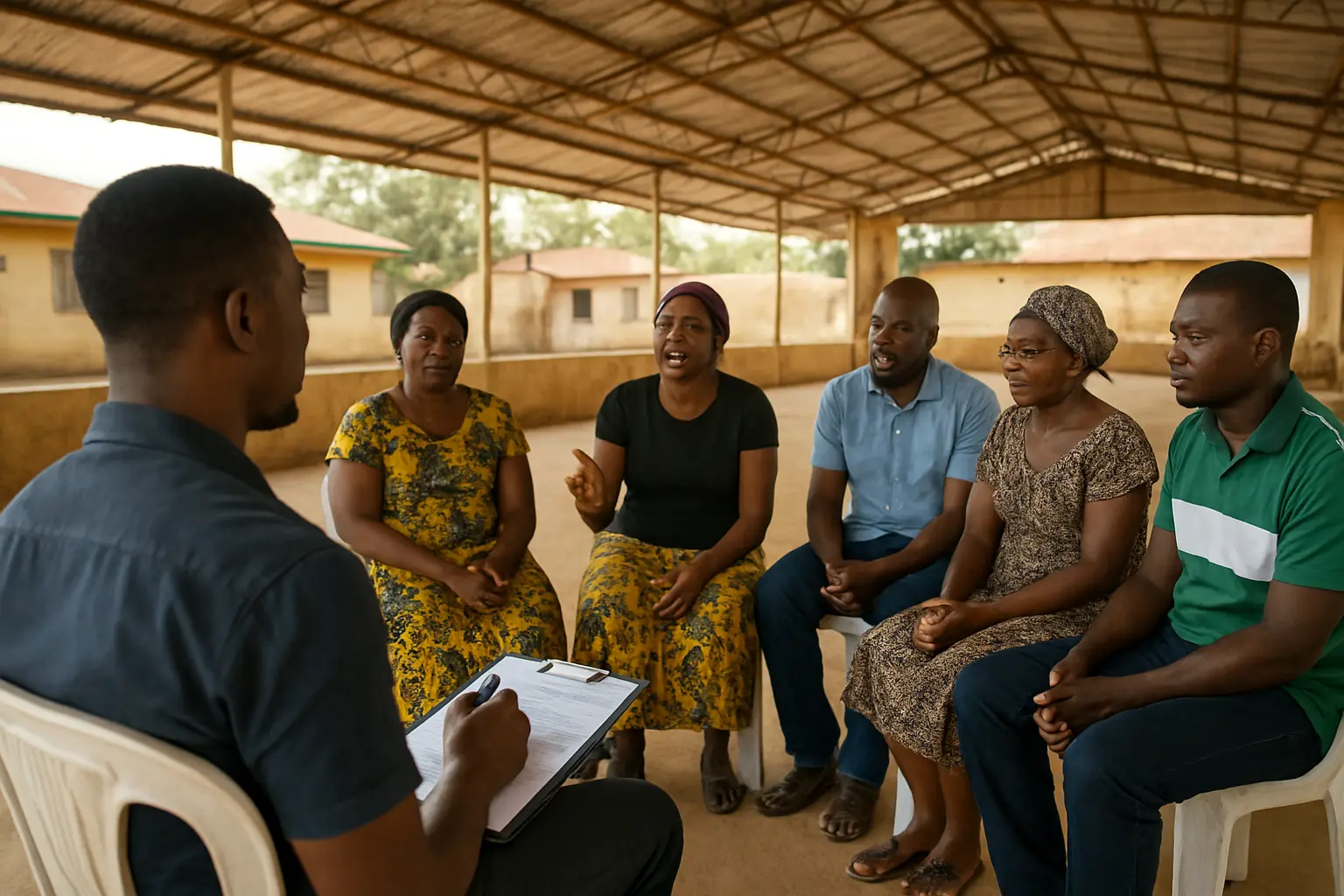
Many Nigerian sociology projects use both — IDIs with key informants (a community leader, a social welfare officer) and FGDs with the wider population, and the education department’s own qualitative guide follows the same split (see the interview and focus group guide for an education project for a side-by-side comparison of how the same instrument-design logic plays out in a different field) — and the guide for each has to be written separately, because a question that works one-to-one (“has this ever put a strain on your marriage?”) is not one you ask in front of six neighbours.
How long should a sociology interview or focus group guide be, and how many people do you actually need?
Plan five to eight core questions with their probes for a 30–45 minute IDI, and six to ten discussion prompts for a 60–90 minute FGD — a guide with twenty questions is not more thorough, it is a sign the researcher has not yet decided what the study is actually about. The companion question — how many respondents is enough for a qualitative study with no Taro Yamane formula to lean on — is answered in full in how many respondents you need for a qualitative final year project; the short version is that most undergraduate sociology projects justify their number by data saturation (the point where new interviews stop producing new themes) rather than a fixed sample-size formula. Departments that examine a qualitative Chapter Three typically expect the guide to be attached as an appendix and referenced by question number in the methodology text, so keep the numbering stable once you start piloting.
What goes into piloting the guide before you use it?
Run the guide with two or three people who resemble your real respondents but are not part of your sample — classmates from the same community, a relative in a similar occupation. Time the session, note where a question was misunderstood or answered in one word, and check whether your probes actually produced the kind of detail your objective needs. Revise the wording, not the objective, and keep a short pilot note (who, when, what changed) — supervisors increasingly ask for this as evidence the instrument was not used untested, and it is a one-paragraph addition to Chapter Three that answers the question before it is asked.
How do you record consent, and what does the Nigeria Data Protection Act 2023 change?
Read the respondent a short consent statement before recording starts — what the study is for, that participation is voluntary, that they can stop at any point, and how their identity will be protected (usually a pseudonym or a participant number, never a real name in your transcripts or your final report). Get spoken or written consent, whichever your ethics process or department requires, and record that consent was given rather than assuming it. The same consent logic applies across disciplines — the nursing department’s guide to ethics approval and consent forms covers the institutional-approval side in more depth, and is worth reading even for a sociology project if your topic touches a health, school, or clinical setting. The Nigeria Data Protection Act 2023 applies to any personal data you collect during fieldwork — audio recordings, names, phone numbers, addresses — which means you need a lawful basis for processing it (consent is the usual one for student research), you should keep raw recordings and transcripts only as long as your project requires, and you should never store identifiable data on a shared or public device. If your topic touches a legally protected category — health status, religion, a minor’s data — check with your department whether it needs to go through your institution’s ethics or research committee before you collect anything.
What theory guides how you analyse the transcripts afterward?
Most Nigerian sociology departments expect thematic analysis for interview and focus group data, most commonly cited to Braun and Clarke’s six-phase approach: familiarising yourself with the data, generating initial codes, searching for themes, reviewing themes, defining and naming themes, and producing the report. Whichever coding software or manual method you use, write your Chapter Three method-of-analysis paragraph around these six phases by name — it is the citation a panel is listening for. For trustworthiness (the qualitative equivalent of validity and reliability), Lincoln and Guba’s four criteria are the standard reference: credibility, transferability, dependability, and confirmability — mention how your study addressed at least two of them (member-checking a summary back to a respondent for credibility, and keeping an audit trail of your coding decisions for dependability, are commonly reported by undergraduate projects).
A worked example: guide for a project on youth unemployment and social identity
For an illustrative objective, “to explore how prolonged unemployment affects the self-perceived social status of graduates,” a short IDI extract might read:
- “Tell me about what a typical week looks like for you right now.” (grand-tour, warms up the respondent)
- “How do you usually answer when someone asks what you do?” (probes self-presentation without naming “identity” or “status”)
- “Has how you see yourself changed since you finished school? In what way?” (direct probe toward the objective)
- “Are there situations — family gatherings, old classmates — where this feels different?” (context-specific probe)
This four-question extract is illustrative, built to show the objective-to-question logic — write your own set from your own objectives rather than adapting it verbatim, since a panel that has seen the same worked example twice will notice.
Common mistakes that get a sociology guide sent back
Three faults come up repeatedly in Nigerian sociology methodology chapters. First, a guide with questions that map to no objective at all — every question should trace back to one of your stated objectives, and if it does not, cut it. Second, leading or double-barrelled questions (“don’t you think unemployment has ruined family life?” asks the respondent to agree and packs two ideas into one question) — rewrite as an open, single-idea question instead. Third, a guide that never changed after piloting, which a careful panel can usually tell from questions that clearly would not work as phrased — for example, jargon a respondent would not use themselves, or a question requiring information the respondent has no way of knowing. Fixing these three before submission is the fastest route to an approved instrument.
Where Tesify fits if you are stuck on the guide itself
Tesify can turn a research objective into a first-draft set of grand-tour questions and probes in the structure above, which you then check against what your own study actually needs and adjust for your specific community or respondent group — the objective-to-question logic still has to be yours, but the blank-page problem of “how do I even phrase this” is the part Tesify removes. Start with Tesify’s free plan to draft your Chapter Three instrument section alongside the guide itself.
Frequently Asked Questions
How many people do you need for a sociology focus group?
Six to ten participants per group is standard, with most Nigerian sociology projects running two to four groups depending on how many distinct respondent categories the study compares (for example, market women versus market men, or younger versus older residents).
Can you use WhatsApp or a phone call to conduct a sociology interview?
Yes, where in-person access is not possible, but say so explicitly in your Chapter Three as a limitation, and be aware that phone interviews usually run shorter and lose non-verbal cues that a face-to-face interview would capture.
Do you need to transcribe every interview word for word?
Yes — a full verbatim transcript, including hesitations and repetitions where they carry meaning, is the standard expectation before thematic coding begins; a summary in your own words is not treated as raw data by most panels.
What is the difference between a structured, semi-structured and unstructured interview guide?
A structured guide asks the same fixed questions in the same order every time; a semi-structured guide (the most common in undergraduate sociology projects) has a fixed core with room to follow up on what the respondent says; an unstructured guide has only broad topics and lets the conversation lead — sociology final year projects almost always use semi-structured guides because they balance comparability across respondents with room to probe.
Should the interview guide be in English or the local language?
Match the respondent’s comfort, not your write-up language — many Nigerian sociology fieldwork interviews are conducted in Yoruba, Igbo, Hausa, Pidgin or another local language and then translated during transcription, which you should state as part of your method, including who did the translation.
How do you handle a respondent who becomes emotional during a sensitive question?
Pause the recording, check whether they want to continue, and have a plan in the guide itself for what you do next — skip to a neutral question, offer to stop the interview, or end the session; state this contingency in your Chapter Three as part of your ethical procedure, not only in the moment.
Do focus group participants need individual consent forms, or is one group form enough?
Each participant should sign or give recorded individual consent, even within a group session — a single group-level form does not document that every individual agreed, which is what your ethics or research committee will usually ask to see.