
Yes — a qualitative education final year project that explores perceptions, experiences or the implementation of a policy needs a written interview or focus group discussion (FGD) guide, built from your research objectives, piloted before use, and submitted alongside your Chapter Three, because a panel expects to see the instrument that actually produced your data, not a description of one.
What is an interview guide, and why does a qualitative education project need one?
An interview guide is a structured list of open-ended questions and probes, organised under your research objectives, that keeps every interview or focus group discussion (FGD) covering the same ground even though the conversation itself is free-flowing. Nigerian faculties of education increasingly accept qualitative and mixed-methods designs — a case study of how teachers experience a new scheme of work, a phenomenological study of pupils’ transition anxiety, an ethnographic account of a school’s inclusion practice — and each of these needs a guide the panel can inspect, not a claim that questions were “asked as they came up.” A guide with no written form is the single fastest way a Chapter Three loses marks in a qualitative education study.
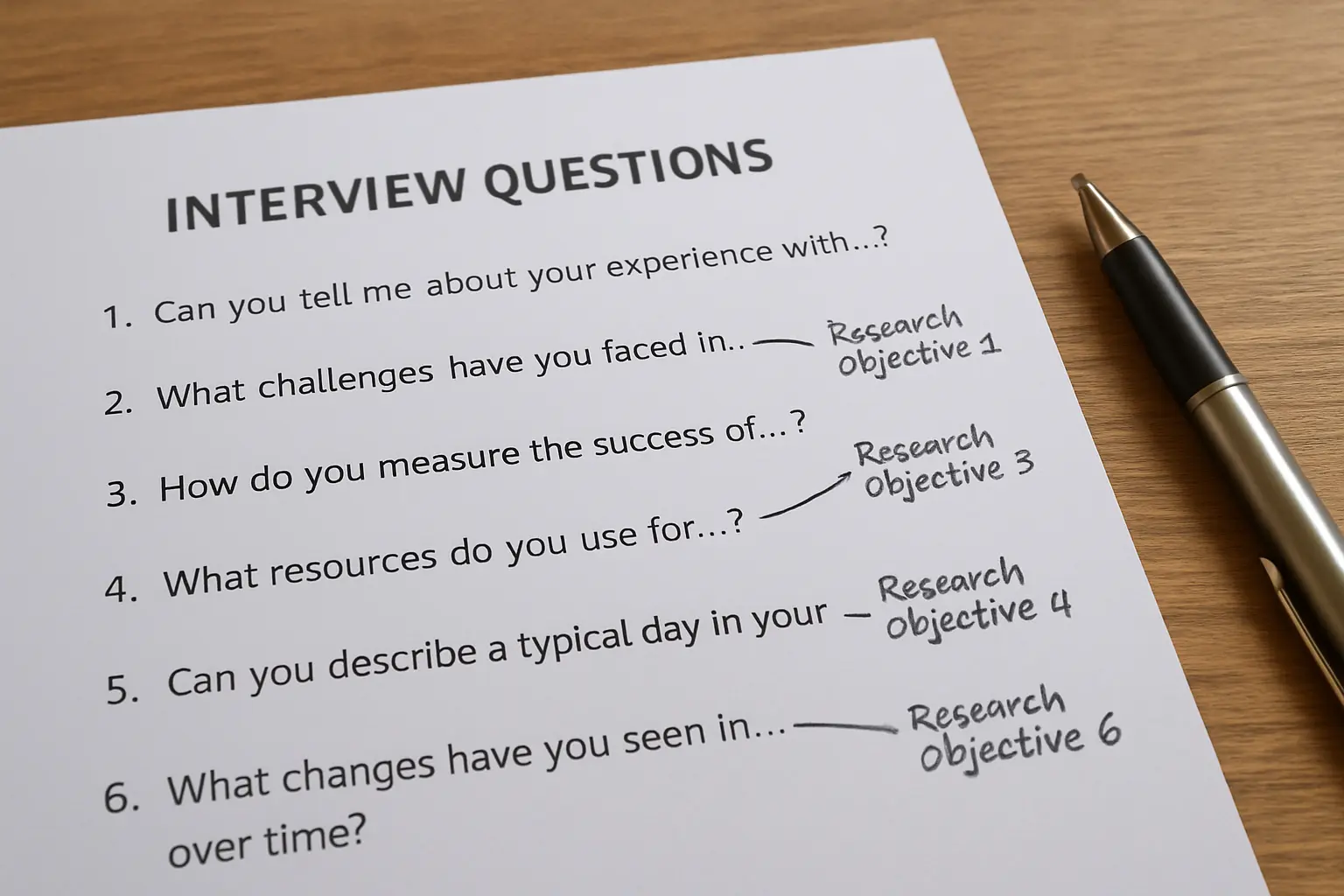
How do you build an interview guide from your research objectives?
Start with your objectives, not your curiosity. Take each research objective from Chapter One and write one core, open-ended question that could plausibly answer it, then two or three follow-up probes under that question that invite the participant to go deeper without leading them toward an answer. A study of how primary school teachers experience NERDC’s revised Basic Education Curriculum might have the objective “to explore teachers’ perceptions of curriculum overload” — the core question becomes “Can you describe how you experience the amount of content you are expected to cover this term?” with probes like “What happens when you fall behind the scheme of work?” and “How do you decide what to skip?” Every question in the final guide should map back to a numbered objective; a panel will ask you to show that mapping, and a table doing exactly that — objective, core question, probes — is worth including as an appendix.
What sections does a complete interview guide contain?
A usable guide has four parts, in this order. First, an opening and rapport section: a short, plain-language reminder of the study’s purpose, confirmation that participation is voluntary, and a warm-up question unrelated to the research topic (“How long have you been teaching at this school?”). Second, the core question set organised by objective, as built above — typically six to ten core questions is enough for a 30–45 minute interview; more than that and interviews run long and participants disengage before the end. Third, a closing section: “Is there anything about this you think I should have asked but didn’t?” is the single most valuable closing question in qualitative interviewing, because it surfaces what your objectives missed. Fourth, an interviewer note space, left blank in the guide itself, for jotting observations immediately after each session while memory is fresh — tone, hesitation, anything that will not survive into the transcript.
How is a focus group discussion (FGD) guide different from a one-on-one interview guide?
An FGD guide covers fewer core questions than an individual interview guide — four to six is typical for a 60–90 minute session — because group interaction takes longer to reach each question and the moderator’s task shifts from probing one person to managing turn-taking among six to ten participants. FGD guides in an education study commonly recruit participants who share a defined characteristic (Junior Secondary 2 pupils in one school, or class teachers from the same local government area), and the guide should include explicit ground rules for the moderator to state at the start: one speaker at a time, no right or wrong answers, and confidentiality of what is shared within the group. Plan for a moderator to run the discussion and a separate note-taker to record non-verbal dynamics and manage the recorder — running both roles alone is the most common reason a Nigerian education FGD produces an unusable transcript.

Do you need to pilot the interview guide before using it?
Yes. Pilot the guide with one or two people who resemble your actual participants but will not be included in your final sample — a teacher from a different school, or a pupil from a different class — and time the session, note any question that produces confusion or a one-word answer, and revise before your real data collection begins. A question that reads clearly on paper often fails the first time it is spoken aloud, and Chapter Three should state plainly that the guide was piloted, with what changed as a result; a single sentence on this point signals to a panel that the instrument was tested, not assumed to work.
What does the transcription and coding step look like after the interviews?
Transcribe every recording in full, word for word, before you start analysing — do not code from memory or from your interview notes alone. Once transcripts are ready, thematic analysis is the method most Nigerian education qualitative projects use, following Braun and Clarke’s six-phase approach: familiarise yourself with the data by reading transcripts through at least once without coding, generate initial codes line by line, search for themes by grouping related codes, review the themes against the full data set, define and name each theme clearly, and produce the write-up with quoted excerpts supporting each theme. Coding can be done manually with coloured highlighters and a codebook in a spreadsheet, or with qualitative analysis software; our comparison of coding and content-analysis tools covers the same software options relevant to an education qualitative study, and our guide to how many respondents a qualitative project needs covers the sample-size question this article does not.
How do you show trustworthiness in a qualitative education chapter?
Panels examining a qualitative education project look for the four criteria that replace validity and reliability in this design: credibility (does the account ring true — member-checking, where you share your interpretation back with a participant, is the strongest evidence), transferability (thick description of the school, participants and context so a reader can judge whether the findings apply elsewhere), dependability (an audit trail showing how you moved from raw transcript to theme), and confirmability (evidence that the themes come from the data, not your assumptions — an excerpt from your codebook, shown as an appendix, does this well). State these four explicitly in Chapter Three rather than assuming a panel will infer them from your write-up.
How does an interview or FGD guide connect to your ethics approval?
Whichever version of the guide you submit for ethics or supervisor approval should be the exact version you use in the field — revising questions afterward without resubmitting the change is a common and avoidable procedural fault. Our guide to ethics approval for a Nigerian final year project, written for nursing but built on the same institutional HREC process most faculties of education also route studies involving minors or staff through, sets out what a complete ethics application needs; consent for interviewing pupils under 18 additionally requires parental or guardian consent alongside the child’s own assent.
How is an interview guide different from a validated instrument or a topic list?
It is easy to confuse three different documents that a Nigerian education project needs at different stages. A topic list helps you choose what to study before you have decided on a design. Once you know your study is quantitative rather than qualitative, our comparison of validated instruments for an education project covers named, already-tested scales such as the TSES and the MSLQ, which a survey design adopts rather than writes from scratch. An interview or FGD guide is neither of these — it is a researcher-written instrument built for one qualitative study, piloted once, and not intended for reuse the way a validated scale is; a panel that expects psychometric validity coefficients on a semi-structured interview guide is applying the wrong standard, and stating that distinction plainly in Chapter Three heads off the confusion before it becomes a question at defence.
What mistakes make a panel reject an interview guide?
Six faults recur across Nigerian education qualitative projects. A guide with leading questions (“Don’t you think the curriculum is overloaded?”) that tells the participant the answer you want rather than asking. A guide with double-barrelled questions asking two things at once (“How do you feel about the curriculum and your school’s resources?”), which produces an answer to only one half. A guide copied wholesale from a different study without adapting it to your own objectives and context. No evidence of piloting anywhere in Chapter Three. Interview or FGD sessions that ran with no separate note-taker, so non-verbal context is lost entirely. And a codebook that appears in Chapter Four with no audit trail showing how a raw transcript line became a named theme — reviewers increasingly ask to see that trail, even at undergraduate level, because it is what separates disciplined coding from a researcher finding whatever they expected to find.
Frequently asked questions
How many questions should an interview guide have?
Six to ten core questions, each with two or three probes, is usually enough for a 30–45 minute one-on-one interview. More than that and sessions run long, participant attention drops, and later answers become shorter and less useful.
Can I change my interview guide partway through data collection?
Minor wording changes to improve clarity are normal and should be noted in your methodology. A substantive change to what you are asking should be treated as a new instrument version, piloted again, and — if your project has ethics approval — resubmitted for that approval before continuing.
Should I show participants the interview guide in advance?
Sharing the topic areas in advance, in your information sheet, is good practice and improves the quality of answers. Sharing every exact question in advance can produce rehearsed rather than genuine responses, so most researchers share the themes, not the full guide.
What is the difference between a semi-structured and an unstructured interview guide?
A semi-structured guide fixes the core questions but allows the order and follow-up probes to vary by conversation — this is what most Nigerian education qualitative projects use. An unstructured guide has only broad topic prompts and no fixed question wording, which needs more interviewing experience to do well and is less common at undergraduate level.
How long should each interview or FGD session last?
A one-on-one interview typically runs 30–45 minutes; a focus group discussion typically runs 60–90 minutes to give every participant a genuine turn. State the actual range your sessions ran in Chapter Three rather than a planned figure.
Do I need to translate my interview guide into a local language?
If your participants are more comfortable in Yoruba, Hausa, Igbo or another language than English, yes — a guide the participant does not fully understand in English will not produce reliable data. State in Chapter Three how the guide was translated and, ideally, back-translated to check the meaning held.
What software can help me code my transcripts?
NVivo and MAXQDA are widely used qualitative analysis packages, though a well-organised spreadsheet with a codebook tab works for an undergraduate-scale study, with cost and learning-curve differences to weigh before you commit to one.
Tesify’s Chapter Three templates keep your interview or FGD guide, your objectives table and your ethics documents consistent with each other, and its editor checks that every question in your guide still traces back to a stated objective before your supervisor does.