
You are in the later years of a computer science degree that suddenly wants two separate documents from you in the same stretch: a SIWES report covering your industrial training placement, and a final year project that is a completely different kind of document with its own five chapters. Confusing the two — or hoping one can substitute for the other — is one of the fastest ways to lose weeks you do not have, and a supervisor or panel will quickly notice a project that reads like a placement report. Here is exactly what changes between them, how the two are assessed by different people, and how to use your placement experience honestly in your final year project without pretending a report is a thesis.
What Is a Computer Science SIWES Report, Exactly?
The Student Industrial Work Experience Scheme (SIWES), managed by the Industrial Training Fund (ITF), places computer science students in a company or IT department for an industrial training placement whose length is set by your programme. Your SIWES report is a structured account of what you actually did during that placement — the technologies you worked with, the tasks assigned to you, the skills you developed — built from your logbook and submitted alongside the SIWES forms your institution’s SIWES unit issues. It is assessed through your institution’s SIWES process against what your logbook and your employer’s supervisor confirm you did, not against a novel piece of research.
What Is a Computer Science Final Year Project, Exactly?
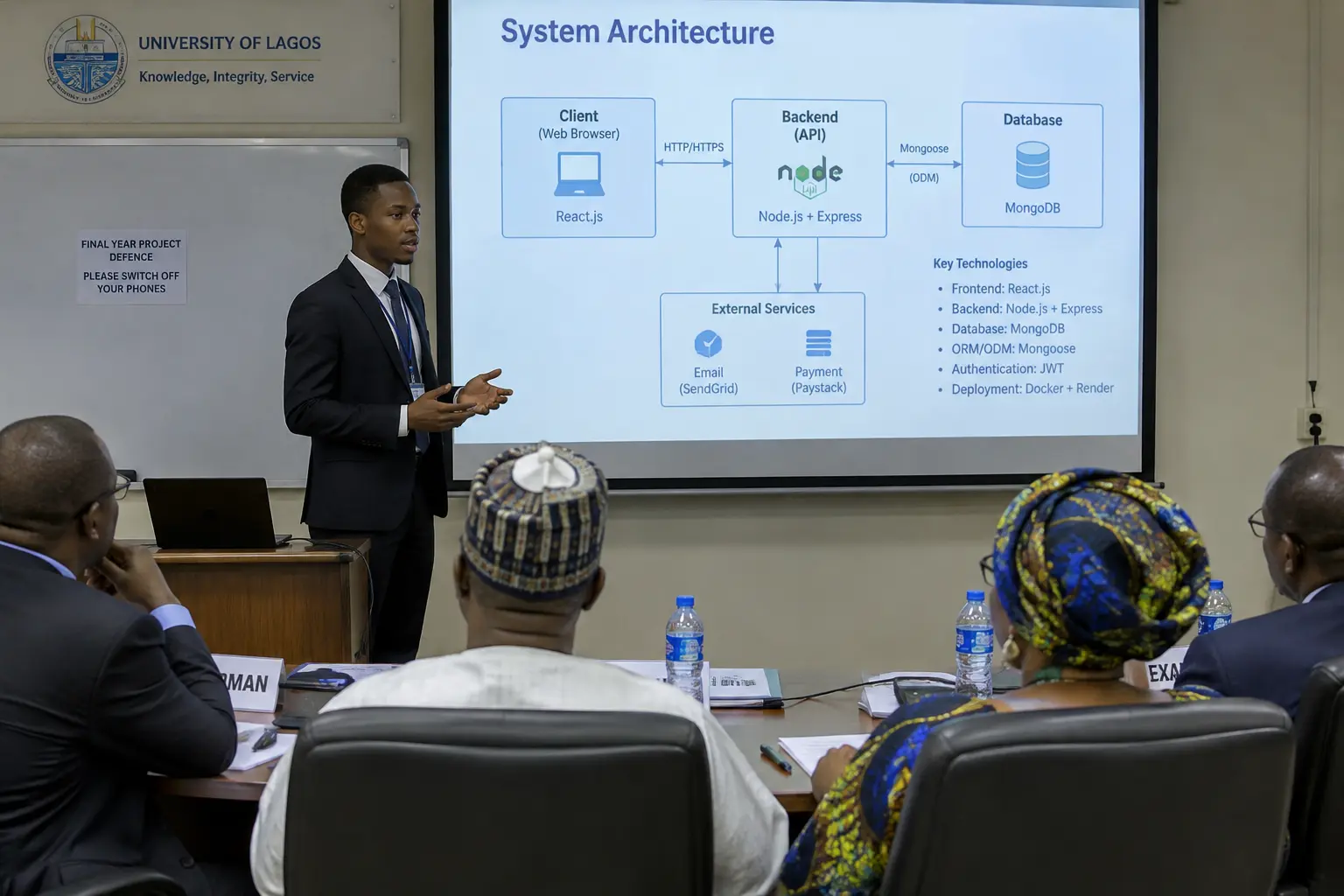
Your final year project is an independent piece of academic work spanning Chapters One to Five: a stated problem and research questions, a literature review situating your work against prior systems or studies, a methodology chapter naming your development approach (Agile, Waterfall, SSADM, or another named methodology), an implementation and testing chapter documenting the system you actually built, and a results/conclusion chapter. It is examined by an academic panel against your stated objectives — not against a supervisor’s confirmation that you showed up and did assigned tasks.
Side by Side: What Actually Changes
| Element | SIWES report | Final year project |
|---|---|---|
| Purpose | Document what you did during a fixed placement | Demonstrate independent research and system-building ability |
| Structure | Logbook-based, following your institution’s SIWES report format | Chapters One to Five (problem, literature, methodology, implementation/results, conclusion) |
| Evaluated by | Your institution’s SIWES coordinator + employer supervisor’s confirmation | An academic panel against your stated objectives |
| Content ownership | Describes work assigned by an employer | A system you designed, built and evaluated yourself, under your supervisor |
| Can one replace the other? | No — they answer different questions for different audiences and cannot substitute for each other | |
Can You Turn Your SIWES Placement Work Into Your Final Year Project Topic?
Sometimes, and this is the one place the two genuinely connect — but only with real reshaping, not a copy-paste. If your placement involved building or contributing meaningfully to a real software system, you can use that domain or problem area as the seed of a final year project topic, provided you do three things your SIWES report never had to do: get explicit permission from the employer to reference or adapt the system’s problem domain (never their proprietary code or data without consent), reframe the work as your own independently scoped project with your own requirements, design decisions and evaluation criteria rather than the employer’s task list, and build the full academic apparatus — literature review, named methodology, testing chapter — that a SIWES report does not require at all.
What you cannot do is submit a lightly edited SIWES report as a final year project, or claim system functionality you did not personally implement. A panel that suspects your “project” is really your placement report with chapter headings pasted on top will ask pointed questions about design decisions your SIWES logbook cannot answer, and being unable to answer them is a worse outcome than starting a fresh, honestly scoped topic.
Steps to Responsibly Reshape Placement Experience Into a Project Topic
- Get written permission from your placement employer to reference the general problem domain, and confirm what specifically you may and may not disclose about their systems or data.
- Narrow to a genuinely researchable problem — not “the system I helped build” but a specific gap or improvement your own version of the system will address, stated as your own research question.
- Design your own version from your own requirements, even if inspired by the placement domain — your implementation, architecture and feature set should be your own decisions, not a reproduction of the employer’s proprietary system.
- Build the academic chapters your SIWES report never needed: a literature review comparing your approach to existing systems, a named development methodology, and a testing/evaluation chapter with your own criteria and results.
Do these four steps in order, not in parallel — trying to write your literature review before you have narrowed your actual research question usually means rewriting it once the topic settles, which costs more time than doing the narrowing first.
A Worked Example: From Placement to Project (Illustrative)
The scenario below is illustrative — built to show the shape of a responsible reshaping, not a template to copy verbatim.
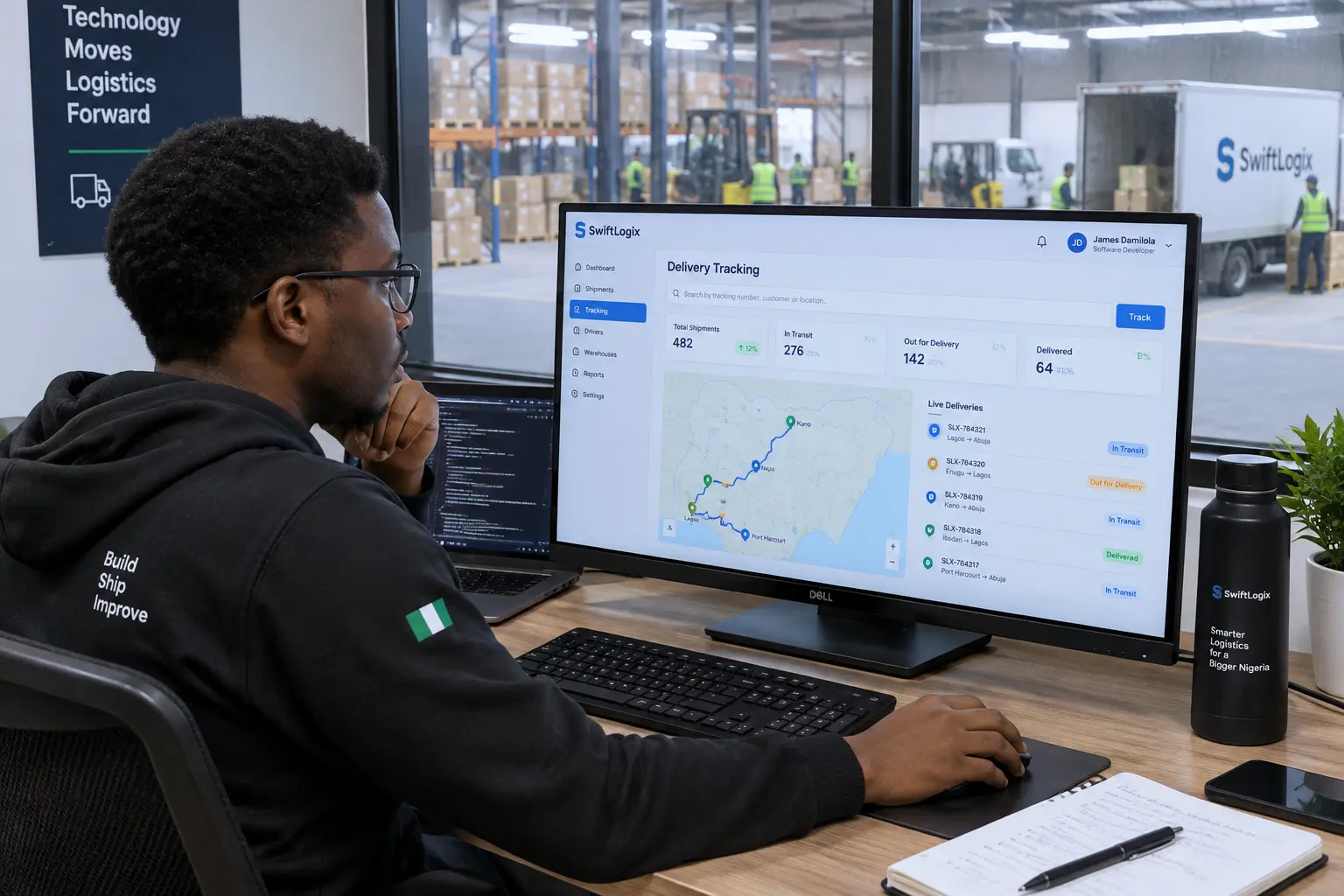
A student placed at a logistics company during SIWES helped maintain an internal delivery-tracking dashboard, mostly fixing bugs and adding minor features assigned by a supervisor — solid SIWES-report material, but not, on its own, a final year project. For their final year project, the same student obtained written permission to reference the general problem domain (delivery tracking for small logistics operators), then designed and built their own independent system from scratch: a different technology stack, their own database schema, their own feature set focused on a gap they identified — real-time delivery-delay prediction, which the employer’s system did not have. Their literature review compared existing delivery-tracking and logistics-prediction systems from published sources; their methodology chapter named an Agile approach with three sprints; their testing chapter reported their own accuracy results for the delay-prediction feature, evaluated against their own test dataset. Nothing from the employer’s actual codebase or proprietary data appears anywhere in the final document — only the general problem domain, referenced with permission, and named generically rather than by the employer’s actual company name unless that company has separately agreed to be identified.
This is the difference in practice: the SIWES placement supplied inspiration and domain familiarity, but every design decision, every line of code, and every result in the final year project is the student’s own, built and evaluated independently of the employer’s system.
What Should Go in Your Final Year Project’s Acknowledgement of Your SIWES Placement?
If your project topic was genuinely inspired by your industrial training, a brief, honest acknowledgement is appropriate and expected — one or two sentences in your introduction or acknowledgements page noting that your interest in the problem area arose from your SIWES placement at a named organisation, without claiming the placement itself as your research contribution. This is different from citing the placement as a data source or methodology reference, which it generally is not, since a placement experience is not a published or citable academic source in the way a journal article or textbook is.
Common Faults When Students Confuse the Two
| Fault | Fix |
|---|---|
| Submitting SIWES logbook content as final year project chapters | Write the required academic apparatus (literature review, methodology, evaluation) from scratch — a logbook is not a Chapter Two |
| Referencing an employer’s proprietary system without permission | Get explicit written permission before naming or describing any employer system in your project |
| Presenting employer-assigned tasks as your own independent design decisions | Be honest about what you built independently versus what you were assigned, and scope your project around your own contribution |
| Skipping the testing/evaluation chapter because “it worked at the placement” | Your final year project needs its own testing evidence for the version you built, not a claim borrowed from placement |
Frequently Asked Questions
Do I submit my SIWES report and final year project to the same person?
Usually not — your SIWES report typically goes to your department’s SIWES coordinator (sometimes alongside the ITF), while your final year project is supervised and examined by your assigned project supervisor and departmental panel.
Can I use the same general topic area for both if my placement and my project interest overlap?
Yes, the underlying domain (e.g. inventory management systems, e-learning platforms) can overlap, but the specific system, requirements and evaluation must be your own independent work for the final year project, built and reasoned through by you.
Is it plagiarism to reference my own SIWES experience in my final year project’s background section?
No — briefly noting that your interest in the topic arose from your industrial training experience is normal and not plagiarism; what would be a problem is reproducing your SIWES report’s descriptive content as if it were original academic analysis.
What if my department requires the SIWES report before I can even register my final year project topic?
Some departments do sequence them this way; if so, treat your SIWES completion as an administrative prerequisite, not as content you can recycle — start your project’s actual research and writing fresh once you are cleared to register a topic.
Does my SIWES supervisor’s evaluation affect my final year project grade?
No — the two are graded separately by different evaluators against different criteria, so a strong SIWES evaluation does not carry over academic credit to your final year project, and a weak one does not penalise it either.
Can Tesify help with both documents?
Tesify is for your final year project chapters, not your SIWES report. More than 9,000 students have used it to write over 15,000 chapters, and every chapter is 100% written by you.
Will my department accept a project that shares a general problem domain with my SIWES placement?
Overlapping domains are usually not a problem, since real-world exposure often does inspire a genuine research interest — what supervisors check for is that the actual system, requirements and evaluation are your own independent work, not a description of someone else’s finished product.
What happens if my SIWES employer refuses permission to reference the problem domain?
Respect that decision and choose a different topic — there is no shortage of final year project domains, and proceeding without permission risks a confidentiality dispute that has nothing to do with your academic work but can still derail your defence.
Whichever stage you are at, the fastest way through a final year project deadline that is colliding with a SIWES submission is to stop trying to make one document do the job of the other. More than 9,000 students have used Tesify to write over 15,000 chapters — chapter by chapter, with their own research decisions front and centre — and every one of those chapters is 100% written by the student. Start your project with Tesify and get your Chapter One moving today, independent of your SIWES timeline.
If your placement was in a different discipline, see how electrical/electronics engineering students turn a SIWES report into a project and how estate management students handle the same transition. Once your topic is scoped, see how to write up a finished software system as a thesis, compare system development methodologies for your Chapter Three, and if you are still at proposal stage, see how to write a computer science project proposal your supervisor will approve.