
Your SIWES placement is finished, your logbook is full of daily entries, and the report is due — but a logbook is not a report, and even a properly written SIWES report is not automatically your final year project. Estate Management students in Nigeria typically complete SIWES at a real-estate or estate-surveying firm, a facility-management company, a property-development company, a government lands or housing agency, or a research institution, and turning that placement into both a compliant SIWES submission and, where your department allows it, a stronger final year project foundation, needs two separate but related documents.
What ITF Form 8 actually requires — get the heading right
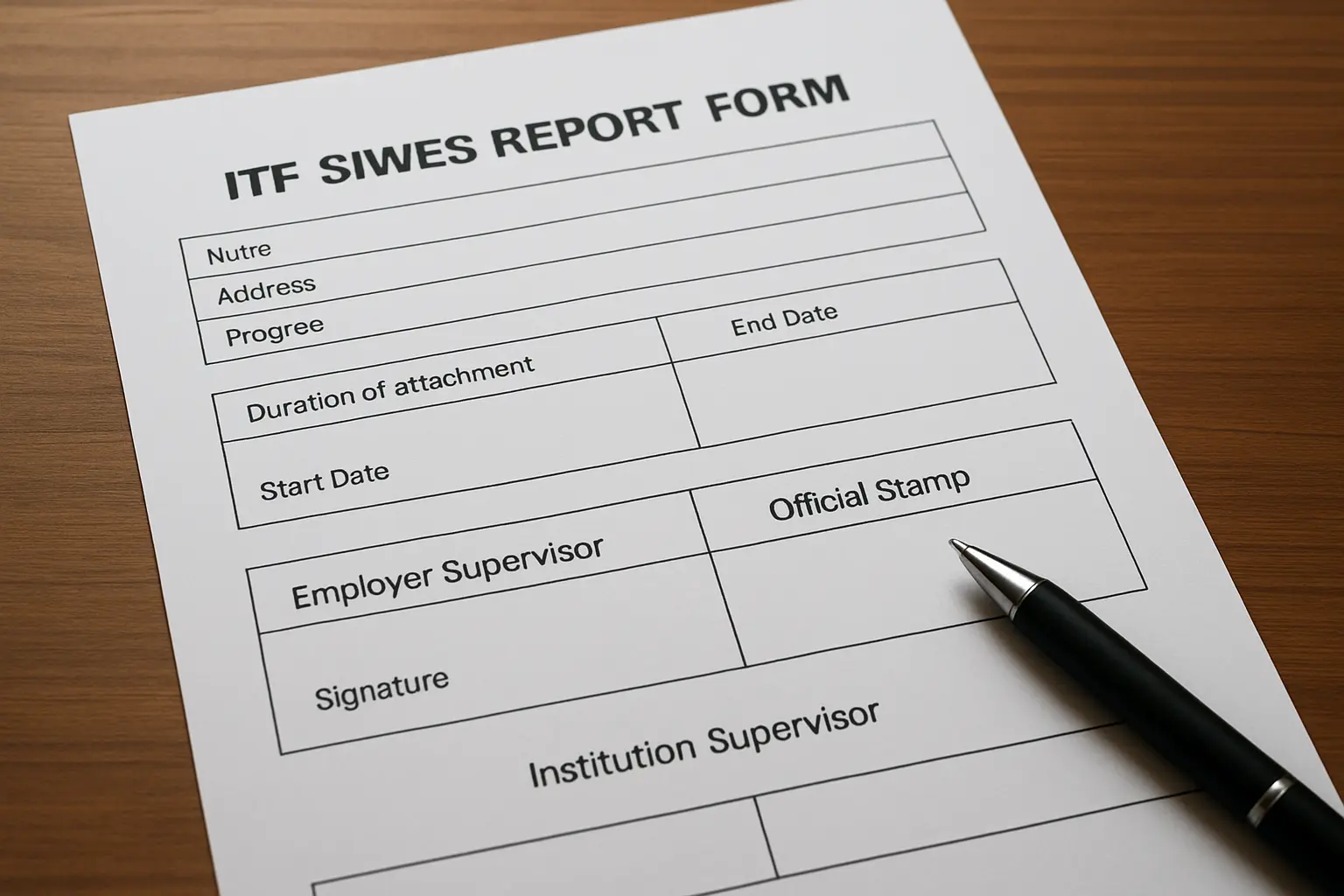
The ITF’s own SIWES report sheet is officially headed the “End of Year Program Report Sheet” (Form 8), not “End of Programme Report Sheet” — a small but real distinction worth getting right if your department checks it against the primary form. It has three parts: Part A is completed by the student, covering your personal and training details and your own account of the placement; Part B is completed by your employer/industry-based supervisor, assessing your performance; Part C is completed by your institution-based supervisor, evaluating your participation. The form carries its own signature and stamp fields for both the employer and institution supervisor sections — leave either blank and the submission is typically returned, so confirm both signatures and stamps are in place well before your submission deadline, not the night before.
What front matter does your written report need?
Beyond Form 8 itself, most Estate Management departments expect the report proper to open with a title page (your name, matriculation number, placement firm, dates, department and institution), a certification or attestation page for your institution-based supervisor, an acknowledgements section, and a table of contents before the report body begins. The site’s guide to project format in Nigeria: title page, certification, dedication and abstract covers the two most commonly referenced published formatting guidelines in detail — the same front-matter conventions largely carry over from a final year project to a SIWES report, so it is worth checking even though that guide was written with the project itself in mind.
From daily logbook entries to a structured report
Your logbook records what you did each day; your report explains what that work meant. For each major task or rotation during your placement — site inspection, property valuation assistance, tenancy documentation, facility maintenance scheduling, whatever your specific placement covered — group related logbook entries into a themed section, then add one paragraph connecting that work to the Estate Management principles or coursework it drew on. A logbook entry reading “accompanied senior surveyor on site inspection” becomes a report paragraph explaining what the inspection assessed, what valuation or condition-survey method was applied, and how that matches or extends what you learned in your valuation or building-technology coursework.
A worked example: turning one week of logbook entries into a report section
Illustrative only — adapt to your own real placement. Suppose your logbook for one week reads: “Monday: accompanied surveyor to inspect a three-bedroom flat for rental valuation. Tuesday: assisted with tenancy agreement drafting. Wednesday: filed comparable-sales data for the valuation. Thursday: attended client meeting on lease renewal terms. Friday: updated the firm’s property listing register.” A report section built from that week might read: “During the second week of placement, I was exposed to the practical rental-valuation process, from initial property inspection through to the comparable-evidence approach used to arrive at an estimated rental value. This built directly on the valuation methods taught in [your valuation course], particularly the use of comparable transactions where an income-based approach was not applicable. I also gained exposure to tenancy documentation and client-facing lease negotiation, which is not covered in as much depth in the classroom setting as it was in this practical context.” Notice the report version names the method, links it to coursework, and reflects on what the practical exposure added — the logbook alone does none of that.

Common Estate Management SIWES placements and what each one gives you to write about
- Estate surveying and valuation firms — property inspection, valuation methodology in practice, client liaison, lease and tenancy documentation.
- Facility management companies — maintenance scheduling, service-charge administration, building-systems oversight, tenant relations.
- Property development companies — site feasibility work, project-monitoring exposure, marketing and sales-support tasks for a development.
- Government lands or housing agencies — land administration processes, title documentation, public housing scheme exposure.
- Research institutions — data collection, literature and market-survey work relevant to a specific Estate Management research theme.
Whichever placement type you had, the report’s strongest sections are the ones that name specific tasks and specific outcomes, not general statements like “I learned a lot about the industry” — a panel or supervisor reading a vague report has nothing concrete to grade.
Can your SIWES report become your final year project?
Some Estate Management departments accept a placement-based case study as a final year project topic — for example, a study of a specific valuation or facility-management process at your placement firm, built on what you observed and documented during SIWES — while others keep the SIWES report and the final year project as entirely separate requirements. Confirm your specific department’s policy before assuming either way; if a placement-based project is allowed, your existing logbook and report become primary source material rather than something you have to reconstruct from memory months later, which is a real head start if your department permits it.
What goes wrong most often
Three faults get an Estate Management SIWES report sent back for revision most often: vague task descriptions with no specific outcome or method named; no explicit connection drawn between what was done at the placement and what was taught in coursework, leaving the report reading like a diary rather than an academic document; and missing or incomplete Form 8 signatures and stamps discovered only at submission, when there is no time left to chase them down. Check all three well before your deadline, not the week of it.
A realistic timeline for the final two weeks before submission
With roughly two weeks left: week one, finish grouping your logbook into themed sections and draft the connecting paragraphs for each; confirm your employer-supervisor’s availability to sign and stamp Part B, and book time with your institution-based supervisor for Part C. Week two, complete Form 8 in full, proofread the entire report against your department’s formatting requirements (cover page, table of contents, pagination), and submit with at least two to three days of buffer before the actual deadline in case a signature or a binding requirement takes longer than expected. Starting Form 8 signature collection in the final 48 hours is the single most common cause of a late or incomplete SIWES submission.
If your defence date and your SIWES deadline are colliding
A SIWES report deadline landing in the same stretch as a final year project defence is a common and genuinely stressful overlap. The site’s guide to starting your final year project this week with a blank Chapter One and an approaching defence date covers the same kind of time-pressure situation from the project side — read it alongside this guide if both deadlines are converging, since the triage logic (what to do first, what can wait) applies across both documents.
How this compares to another discipline’s SIWES report on this site
The same ITF Form 8 structure and the same daily-logbook-to-report logic apply across disciplines — the site’s guide to SIWES report writing for Electrical/Electronics Engineering students covers the identical Form 8 requirements from an engineering placement’s perspective, useful to compare against if your own department’s expectations are unclear and a classmate in a different faculty has already been through the process.
Where Tesify fits
Tesify can turn your grouped logbook themes into structured report prose — the connecting paragraphs between what you did and what it means academically — while the actual placement work, the logbook entries themselves, and your supervisors’ signatures have to be real and yours. If your SIWES experience is also feeding into a final year project topic, Tesify can help draft that Chapter One and literature review too. Start with Tesify’s free plan and turn six months of fieldwork into a report you are not writing alone at the last minute.
Frequently Asked Questions
Is using Tesify to help write a SIWES report considered plagiarism?
No — Tesify helps structure and draft prose around your own real placement experience and logbook entries; the underlying work, tasks and reflections have to be genuinely yours, the same as with any writing assistance tool used honestly.
What if your placement supervisor is slow to sign Form 8?
Follow up in person rather than only by message, and build in at least two weeks of buffer before your submission deadline specifically for signature collection — this is consistently one of the most common last-minute delays students report.
Does a shorter placement (three months instead of six) need a shorter report?
Generally proportional to what you actually experienced rather than a fixed page count — a shorter placement with fewer distinct tasks should not be padded with repetition to hit a page target; depth on what you did genuinely cover matters more than length.
Can you use photos from your placement in the report?
Yes, where your placement firm permits it and no confidential client information is shown — check with your placement supervisor before including any site photos, floor plans, or documents that might be considered the firm’s confidential material.
Is Tesify affordable for a student on a tight budget?
Tesify’s free plan is the starting point specifically for students who need to begin drafting without committing money first — check the current plan details on the platform for what the free tier covers versus a paid upgrade.
What if your placement covered several unrelated task types with no obvious theme?
Group by broad functional area (site work, documentation, client-facing tasks, administrative tasks) rather than forcing an artificial single theme — a report can legitimately have several distinct sections reflecting a placement’s actual variety.
What if you changed placement firms partway through SIWES?
Report on both placements clearly separated by dates and firm names, with a brief note on why the change happened if your department asks for context — do not merge the two experiences into one undifferentiated account.
Does your report need a recommendations section at the end?
Most departments expect a short closing section covering what you would recommend to future SIWES students, and sometimes recommendations to the placement firm itself — keep both specific to your actual experience rather than generic advice.
Should the report be bound, or is a soft copy submission acceptable?
This varies by department and even by year — confirm the current requirement with your SIWES coordinator rather than assuming last year’s format still applies, since binding and submission requirements are among the details departments change most often between sessions.