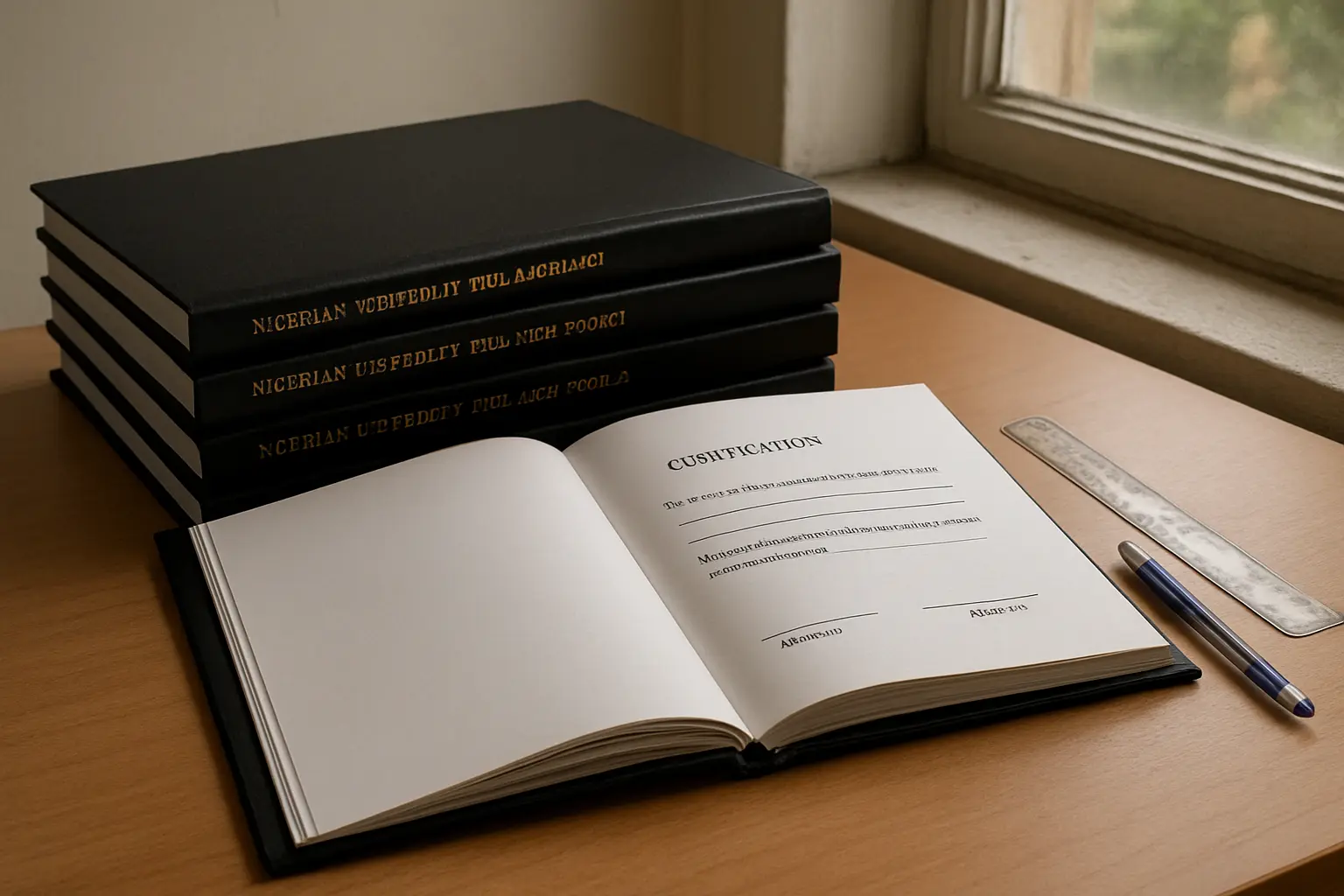
There is no national format for a Nigerian final year project. The format is set by your department, and where a department has no written guide it borrows its university’s postgraduate guidelines. This page reads two of those guidelines in full — Obafemi Awolowo University’s and the University of Ibadan’s — and sets out what they actually specify. They specify a great deal, and on several points they contradict each other.
Our guide to how many chapters a Nigerian project has covers the chapter structure and lists the preliminary pages. This page answers the question that one leaves open: what the measurements, the typeface and the actual wording of each front-matter page are.
The two documents this page is built on
- Obafemi Awolowo University, The Postgraduate College, Guidelines for Writing Theses for Higher Degrees, January 2026. A thirteen-page document published as a PDF on the Postgraduate College site. It carries a title-page specimen as an appendix.
- University of Ibadan, The Postgraduate College, Guidelines for Writing Theses and Dissertations and the University of Ibadan Manual of Style (UIMS), Revised Edition 2023. Its foreword is signed by the Provost, dated May 2023, and it traces the document’s lineage back to a 1981 original.
- Read alongside them: OAU’s Regulations Governing Postgraduate Studies, dated 8th May 2025, whose Part VI is a policy on plagiarism.
State the obvious limitation up front, because it matters. All three are postgraduate documents. Neither university publishes an undergraduate project format guide at these addresses, and an undergraduate final year project is governed by the department, not by the Postgraduate College. What these guidelines give you is not a rule you can cite at your own department — it is a complete picture of what a serious Nigerian format specification contains, so that you know exactly what to ask your department for, and so that you have a defensible default where your department is silent. Get your own guideline in writing first; everything below is a fallback, not an override.
Where the two universities disagree
This is the useful part. If you have been told there is “a standard Nigerian format”, these two documents are the counter-evidence.
| Specification | OAU (January 2026) | University of Ibadan (2023) |
|---|---|---|
| Paper size | A4 | A4, approximately 21.0 cm × 29.7 cm |
| Paper weight | “of good quality” | Not less than 80 grammes |
| Left margin | Not less than 30 mm | 3.7 cm |
| Right margin | 20 mm | 2.5 cm |
| Top and bottom margins | 25 mm each | 2.5 cm, except 5.0 cm above the headings on the first page of each new chapter |
| Typeface and size | Times New Roman 12 | Times New Roman, Point 12 |
| Body line spacing | Double | 1.5 |
| Headings | Chapter heading in UPPER CASE, Times New Roman 14, centred, not underlined | Headings not more than Point 14, capitalised and bold, centred, not underlined |
| Main-body page numbers | Arabic, at the centre top; first page of every chapter not paged | Arabic from (1), at the centre bottom of every page |
| Preliminary page numbers | Roman, centre bottom; title page is page 1 and is not numbered | Roman from (i), centre bottom; “i” does not appear on the title page |
| Student identifier on the title page | Registration Number | Matriculation Number |
| Name order on the title page | FIRST NAME, OTHER NAME and SURNAME, all capitals | Forename–surname order, all letters capitalised |
| Bound copies required | Three | Five |
| Chapter count | Not stated; six required elements listed instead | Not less than five and not more than seven chapters |
| Abstract | Not more than 500 words, four paragraphs | Not more than 500 words, four paragraphs, with three to five keywords |
Read that table once more before you set up your document. Two of Nigeria’s oldest universities disagree on the left margin, on line spacing, and on whether your page number sits at the top or the bottom of the page. Anyone who tells you the Nigerian standard is “2.54 cm all round, Times New Roman 12, double spaced” is describing a convention, not a rule, and neither of these documents fully supports it.

The front matter, in order
OAU lists the preliminary pages explicitly, in capitals, in this order: title page; anti-plagiarism declaration, signed by the candidate; authorisation to copy, signed by the candidate; certification page, signed by supervisor, co-supervisor where applicable, head of department and provost; acknowledgements, maximum two pages; table of contents; list of tables; list of figures and maps; list of plates where applicable; list of cases and statutes, applicable to candidates in faculties such as the Faculty of Law; list of appendices; list of abbreviations; abstract. Then the main body, references or bibliography, appendices, and any published articles arising from the study.
The University of Ibadan’s sequence covers the same ground with two differences worth noting: it opens with a flyleaf reserved for the official signature of the Secretary, Postgraduate College, and it includes a dedication page, which OAU’s list does not name.
The mechanics of assembling front matter in a word processor are the same everywhere, and this walkthrough from a university writing centre covers them clearly. The rules it states are its own institution’s, not Nigeria’s, so take the technique and not the numbers.
The title page, specified
OAU requires the first unnumbered page after the flyleaf to carry: the full title of the thesis; the full name of the author, with first name, other name and surname all in capital letters; the registration number; the author’s qualifications at the time of submission; the degree for which the work is submitted; the department and faculty in which it was written; the Postgraduate College to which it is submitted; and the year of submission. Where the author is an external candidate, the full address of the institution where the work was done goes on the title page and is reproduced in gold on the front cover.
Its appendix sets the sizes: everything on the title page is font size 14, except the registration number and the qualifications, which are font size 12. The submission statement is set in capitals, and reads, in the appendix’s own example, as a single block naming the department, the faculty, the college, the university and the degree.
The University of Ibadan specifies the same elements with three differences: the name is given in forename–surname order rather than surname-first, the identifier is the matriculation number, and the month as well as the year of submission is required. In both cases the title and the author’s name are reproduced in gold lettering on the front cover.
An adaptable title-page block. Replace every bracketed item and set it in the sizes your own department specifies.
[FULL TITLE OF THE PROJECT, ALL CAPITALS]
BY
[FIRST NAME, OTHER NAME, SURNAME — ALL CAPITALS]
[Registration or matriculation number]
[Qualifications held at the time of submission, if any]
A PROJECT SUBMITTED TO THE DEPARTMENT OF [DEPARTMENT], FACULTY OF [FACULTY], [UNIVERSITY], IN PARTIAL FULFILMENT OF THE REQUIREMENTS FOR THE AWARD OF [DEGREE] IN [DISCIPLINE]
[MONTH AND YEAR]
The declaration, specified
OAU prints its anti-plagiarism declaration in full, to be signed by the candidate. Its wording, as published, is this: the candidate, named in capitals with registration number and department, states that they understand the interpretation of plagiarism and are well aware of the University’s policy in that regard; and that the thesis is their own original work, and that other people’s work used, whether from a printed source, the internet or any other source, has been properly acknowledged and referenced in accordance with University policy. A signature and date line follows.
Two things in that wording repay attention. It covers any other source, which on a plain reading includes text produced by a writing tool. And it is a declaration about acknowledgement, not about originality of ideas alone — the obligation is to reference what you used. OAU’s 2025 Regulations reinforce it from the other direction: students must undertake and pass an anti-plagiarism test before commencing study, must adhere to the similarity index determined by the College Board, and must attach the similarity index to thesis drafts before submission for oral examination. Our guide to what similarity percentage Nigerian universities actually accept covers the thresholds.
OAU also requires a separate authorisation to copy, signed by the candidate, with the title and author’s name fully capitalised.
The certification page, specified
OAU publishes the certifying sentence and the signature blocks. The sentence certifies that the research was carried out by the named candidate as part of the requirements for the award of the named degree in the named discipline of the University. Four signature blocks follow, each with a name and date line: Supervisor, Co-Supervisor (where applicable), Head of Department, and Provost, Postgraduate College.
The University of Ibadan’s certification is narrower and more pointed. It is a statement signed by the supervisor or supervisors that the materials recorded in the work resulted from research carried out by the candidate under their direction, and the guideline adds its purpose in one line: a certification indicates that the supervisor admits to the originality of the candidate’s work. That is why the page is not a formality. The signature is a personal attestation, which is also why supervisors read the project before signing it and why the page takes longer to complete than any other.
Undergraduate certification pages typically carry three signatures rather than four — supervisor, head of department and external examiner — but this varies by department and is exactly the kind of detail to confirm in writing before you print. Build the chase into your timeline; our six-week plan to defence puts signature collection where it belongs, which is earlier than you think.
Dedication and acknowledgements, specified
The University of Ibadan defines the dedication in a single sentence: a page showing a statement of dedication to whomever the author prefers. There is no length rule and no required wording. One line is enough, and one line is what most examiners expect.
Acknowledgements are capped at two pages by both guidelines. OAU goes further and suggests the order: supervisor, head of department, academic and non-teaching staff, classmates, family, and it says the section should include anybody who directly contributed to the success of the research. The University of Ibadan says only that it should be concise and not exceed two pages. The two-page cap is a real rule, not advice, and it is one of the easiest corrections for an examiner to demand.
The abstract, specified
Both universities cap the abstract at 500 words and require four paragraphs. OAU sets out what each paragraph does:
- Introduction / Objective. A brief statement of what the work is about, comprising the specific objectives and the overall purpose.
- Methodology. Field work, covering collection of primary and secondary data; laboratory work where applicable; and the methods of data analysis, analytical techniques or statistical techniques where applicable.
- Findings / Results. The specific findings, with a brief discussion of them.
- Conclusion / Implications. The concluding part, which must include the implications of the findings — that is, the contribution to knowledge.
The University of Ibadan adds the keyword rule: a minimum of three and a maximum of five keywords or descriptors that best reflect the content and thrust of the work, and, as far as possible, keywords should not simply repeat words already in the title. OAU adds an administrative requirement students routinely miss: three extra copies of the abstract, beyond those in the bound copies, must be submitted to the Postgraduate College.
Writing the abstract last, in exactly four paragraphs, against a 500-word ceiling, is the single most mechanical task in the whole project, and it is where a well-run Chapter Five pays for itself: paragraphs three and four are a compression of what is already written there.
Quotations, tables and figures
Both guidelines specify quotation handling, and they differ on the trigger. OAU sets the threshold at length in lines: a quotation of less than two lines takes double quotation marks; a longer one, described as a maximum of 40 words, is indented from the left margin, single spaced within the block, and carries no quotation marks. The University of Ibadan indents any quotation longer than four full lines, single spaced, without inverted commas, with a blank line before and after, and confines the indented block within margins of not more than 2 cm left and 2 cm right.
On captions, the University of Ibadan is explicit and the rule is worth memorising because it is the reverse of what students usually do: for tables, the number and title go at the top; for plates and figures, the number and title go below, on the same page. The word Plate, Figure or Table is bold with the first letter capitalised, followed by the number, a full stop, then the caption. References to them in the text are made by number, never by caption. It also rules out one common habit outright: the combined use of footnotes and endnotes in the same work is not acceptable.
Binding
OAU requires three copies, a black cover, and the candidate’s first name, other name and surname in full and in upper case on the cover. The spine carries, from top to bottom, the candidate’s name with initials preceding the surname, the title of the degree, and the year of award. Loose materials must be bound wherever possible, and where that is impossible a scored pocket is provided at the end; cellotape is prohibited “in no circumstance”. The University of Ibadan requires five copies deposited with the Postgraduate College, on paper of not less than 80 grammes, and gold lettering of the title and author’s name on the front cover.
The one email that settles all of this
Send this to your supervisor or examinations officer and get the reply in writing. It is eleven questions and it converts every devolved decision above into a fact you can print against.
- Is there a written departmental project format guide, and may I have the file?
- Left, right, top and bottom margins, in centimetres?
- Typeface and point size for body text, and for chapter headings?
- Line spacing for the body, and for indented quotations?
- Where do page numbers sit on the page, and where does Arabic numbering start?
- Exact order of the preliminary pages, and is a dedication expected?
- How many signatures does the certification page carry, and whose?
- Is a signed anti-plagiarism declaration required, and is there set wording?
- Abstract word limit, number of paragraphs, and are keywords required?
- Referencing style, and which edition?
- How many bound copies, in what cover colour, and by what date?
Question ten matters more than it looks. Neither of these universities simply mandates APA: OAU permits a choice among named styles and requires the latest applicable version, while the University of Ibadan mandates its own Manual of Style. Our guide to what referencing style Nigerian universities actually require sets out both positions.
Formatting is mechanical work that punishes inconsistency and rewards nothing except getting it right. It is also the part of the project most likely to eat your final week. Tesify keeps your chapters, citations and reference list consistent while you write, so the last week is spent on the content and not on the margins — 100% written by you, alongside 9,000+ students and 15,000+ chapters.
Write your project with Tesify
Frequently asked questions
Is there a standard final year project format in Nigeria?
No. The two published university guidelines read for this page disagree on margins, line spacing and page-number position. The format is set by your department, and the National Universities Commission’s Core Curriculum and Minimum Academic Standards govern curriculum content, not document layout.
What margins should I use if my department has not said?
A wider left margin than the others, because the left edge is lost to binding. OAU specifies not less than 30 mm left with 20 mm right and 25 mm top and bottom; the University of Ibadan specifies 3.7 cm left and 2.5 cm elsewhere. Either is defensible as a fallback, but get your own department’s figure in writing before you print.
Single, 1.5 or double spacing?
OAU says double for the body; the University of Ibadan says 1.5. Both say single spacing inside an indented quotation. Since the two disagree, this is a question for your department, not for the internet.
What font should a Nigerian project use?
Both guidelines specify Times New Roman at point 12 for body text, and both cap headings at point 14. This is the one specification on which they agree exactly.
How many signatures does the certification page need?
At OAU’s postgraduate level, four: supervisor, co-supervisor where applicable, head of department, and the Provost of the Postgraduate College. Undergraduate departments commonly use three. Confirm yours, and start collecting them earlier than feels necessary.
How long should the abstract be?
Not more than 500 words in both guidelines, written in four paragraphs: objective, methodology, findings, conclusion and implications. The University of Ibadan additionally requires three to five keywords that do not merely repeat the title.
Where do page numbers go?
This is the sharpest disagreement between the two documents. OAU puts preliminary-page Roman numerals at the centre bottom and main-body Arabic numerals at the centre top, with the first page of each chapter unnumbered. The University of Ibadan puts every page number at the centre bottom. Follow your department.
Does the dedication have a required format?
No. The University of Ibadan defines it as a statement of dedication to whomever the author prefers, with no length or wording rule. One sentence on its own page is standard.
Do these postgraduate guidelines apply to my undergraduate project?
Not as a rule you can cite. They are Postgraduate College documents. Use them as a default where your department is silent, and as a checklist of what to ask for where it is not. Your department’s own guideline overrides everything on this page.
Is the acknowledgements page really limited to two pages?
In both guidelines, yes, and it is stated as a limit rather than a suggestion. OAU also suggests the order: supervisor, head of department, academic and non-teaching staff, classmates, then family.
Do table titles go above or below the table?
Above. The University of Ibadan is explicit: the table number and title go at the top of the table, while plate and figure numbers and titles go below them on the same page. Refer to all of them in the text by number, never by caption.