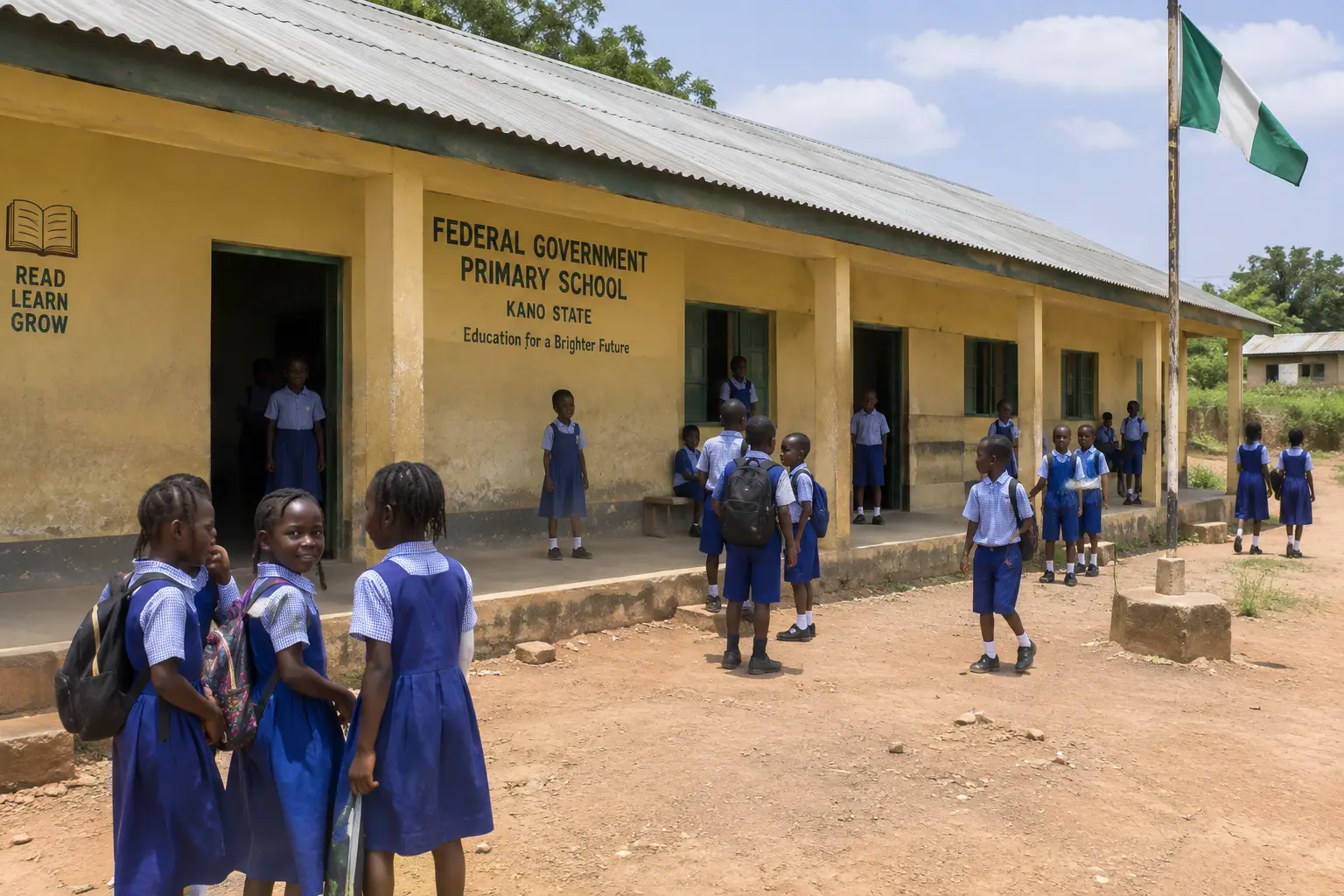
The Universal Basic Education Commission’s own 2022 National Personnel Audit counts 131,377 primary schools nationally, with 31,771,916 pupils and 915,593 teachers — but UBEC’s published figures do not break this down by rural and urban location, which means a final year project on rural primary schools has to build its own bounded population at state or local government level rather than citing a national rural figure that does not exist in UBEC’s own public data.
What UBEC’s National Figures Actually Show
Read directly from the Universal Basic Education Commission’s own site: the 2022 National Personnel Audit (NPA) counted 171,027 UBE schools nationally — 79,775 public and 91,252 private — with total enrolment of 47,010,008 (33,315,654 in public schools, 13,694,354 in private schools) and 1,686,535 teaching staff across all levels. Broken down by level, the audit counted 1,433 Early Childhood Care and Development Education (ECCDE) centres with 7,234,695 children and 354,651 teachers, 131,377 primary schools with 31,771,916 pupils and 915,593 teachers, and 38,217 junior secondary schools with 8,003,397 students and 416,291 teachers. Our guide to where education students find project data covers UBEC alongside WAEC, NECO and NERDC as the wider set of national sources an education project typically draws on.
| Level | Schools | Pupils/students | Teachers |
|---|---|---|---|
| ECCDE | 1,433 | 7,234,695 | 354,651 |
| Primary | 131,377 | 31,771,916 | 915,593 |
| Junior secondary | 38,217 | 8,003,397 | 416,291 |
| All UBE levels | 171,027 | 47,010,008 | 1,686,535 |
Source: Universal Basic Education Commission, 2022 National Personnel Audit, figures as published on the Commission’s own site.
The Honest Limitation: No National Rural-Urban Split
UBEC’s published aggregate figures split schools by public and private ownership, not by rural and urban location. This is a genuine gap worth stating plainly in your Chapter One rather than working around it with an invented estimate: UBEC’s own published data gives no single national figure for “how many rural primary schools exist in Nigeria.” If your project needs a national-level rural school count as background context, either state that the figure is not published at the national level in the source you can access, or narrow your background claim to what UBEC’s own aggregate figures do support (total school, pupil and teacher counts) without implying a rural breakdown that is not there.
Getting a Rural-Specific Figure at State or LGA Level
The route that works is the same one agriculture students use for a farming population: go to the level below the national aggregate, where a rural/urban distinction is more likely to be locally recorded. Your State Universal Basic Education Board (SUBEB) is the state-level equivalent of UBEC and holds school-level data for its state, often including a rural/urban or zone classification the national aggregate does not publish. Your Local Government Education Authority (LGEA) sits one level below SUBEB and typically has the most granular list of schools in a specific LGA, which is usually where the rural/urban distinction is actually meaningful and locally understood, since a school’s rural status is a local, not a national, classification. Request the figure in writing, on letterhead, with a date, the same way agriculture students obtain a farmer population figure from an Agricultural Development Programme zonal office — the appendix that results is what answers a panel’s question about where your population figure came from. Budget more than one visit to get this: a first visit to identify the correct desk officer and a second to collect the actual letter is a normal, not an unusual, timeline for this kind of request.

What Research Problems Work for a Rural Schools Population?
Problems that survive scrutiny are specific and measurable rather than broad claims about “rural education in Nigeria”: teacher availability and retention in rural postings compared with urban postings within the same LGA, infrastructure gaps (classroom-to-pupil ratio, availability of potable water, toilets, electricity) across a defined set of rural schools, pupil enrolment and dropout patterns in a named rural community, access to and uptake of a specific intervention (the Home Grown School Feeding Programme, a named NGO literacy intervention) among rural schools in your study area, and the effect of distance to school on attendance or performance in a rural LGA. Each of these is bounded to a location you can actually visit and a population you can actually define, rather than a claim about rural Nigeria as a whole; our list of education project topics and the permission each one needs covers a wider set of angles sorted by the same access logic.
Choosing Your Design: Case Study, Survey, or Rural-Urban Comparison
A case study of one or a small number of named rural schools works well for an in-depth question about a specific practice, resource or intervention, and is the most achievable design if your access is to a small number of schools you can visit repeatedly. A survey across multiple rural schools in one LGA fits a question about a pattern or association across a defined population — teacher qualification and pupil performance, for example — and needs the SUBEB or LGEA school list described above as its sampling frame. A rural-urban comparative design contrasts a defined set of rural schools against a defined set of urban schools in the same LGA or state on the same measured outcome, which is a stronger design for a claim specifically about a rural-urban gap, but requires access to both groups and a larger overall sample.
A Worked Illustrative Example
The following is a labelled, illustrative example, not a real study. A student studying teacher retention names one LGA, obtains a letter from the LGEA listing 24 public primary schools classified as rural within that LGA, and, since 24 is a small and fully countable population, adopts a census of all 24 schools’ head teachers rather than a sub-sample — each head teacher completes a short structured questionnaire on staff turnover over the past three academic sessions, and the school’s own attendance register supplies pupil enrolment trends over the same period. The research question (“What is the relationship between teacher turnover and pupil enrolment trends in rural primary schools in the named LGA?”) is answerable entirely from the 24-school population the student can actually document, with the LGEA’s letter as the population source in the appendix, rather than from an unverifiable national rural figure.
Access and Consent for a Rural Schools Project
School access in Nigeria runs through the same permission chain regardless of rural or urban location, but the practical steps differ. Written permission from the LGEA or SUBEB is the first gate, followed by the head teacher’s own consent to enter the specific school, and, where your study involves pupils directly (rather than only staff or records), parental or guardian consent is needed since pupils are minors. Rural schools often have a single head teacher who is also the most accessible gatekeeper for the whole permission chain locally, which can make access faster once the LGEA-level permission is secured, though travel time and communication (rural schools are less likely to have a reliable phone or internet contact) should be budgeted into your data-collection timeline realistically. Our guide to ethics approval for an education project covers this permission chain in more detail.
Sampling a Rural School Population
Once you have a bounded list of rural schools from your SUBEB or LGEA source, treat it the same way a finite, known population is treated elsewhere on this site: state the population size and its source and date, and apply a formula such as Taro Yamane if your unit of analysis is individual respondents (teachers, pupils, parents) drawn from across those schools, or, if your unit of analysis is the school itself (you are comparing schools, not individuals within them), state how many schools you are including and why, since a school-level sample of a defined, small population does not always need a sampling formula at all — a census of every rural school in one LGA is often more defensible than a formula-derived sub-sample when the total number of rural schools in your chosen LGA is itself small.
Writing the Population Section Honestly
State your bounded population explicitly — all public primary schools classified as rural by your state’s SUBEB within your chosen LGA, as confirmed in writing by the SUBEB or LGEA office on a stated date, with the exact number of schools — rather than a broad national claim. Where you cite UBEC’s national aggregate figures as background context in Chapter One, cite them exactly as published (schools, pupils, teachers, by level, for the 2022 audit) and do not attach a rural-specific number to them that the source does not itself provide.
Once your population, design and access plan are settled, Tesify keeps your Chapter One background figures, your Chapter Three sampling frame and your consent language consistent across every chapter as your draft grows. Start your education project with Tesify — over 9,000 students and 15,000+ chapters written, 100% written by you.
Frequently asked questions
How many rural primary schools are there in Nigeria?
UBEC’s own published national figures do not break schools down by rural or urban location, so there is no single verified national rural-school count to cite. A state’s SUBEB or a specific LGA’s LGEA is the level at which a rural/urban classification is usually recorded and can be requested for your own bounded study population.
What is the difference between UBEC, SUBEB and LGEA?
UBEC is the federal commission that coordinates and publishes national basic-education data. Each state’s SUBEB is the state-level equivalent, implementing basic education within that state. The LGEA operates at local government level, one step below SUBEB, and typically holds the most granular, school-specific records.
Do I need SUBEB permission, LGEA permission, or both to access a rural school?
Both are usually part of the same permission chain: SUBEB approval is often required first at state level, followed by the LGEA’s own local authorisation, before you approach an individual head teacher. Confirm the exact sequence with your own state’s SUBEB, since the process can vary between states.
Can I compare one rural school to one urban school as a case study?
Yes, as a two-case comparative case study, provided your research question genuinely calls for a comparison rather than treating one location as automatically representative of all rural or all urban schools.
What sample size is normal for a rural schools survey?
It depends entirely on your bounded population’s size. If your unit of analysis is individual teachers or parents across several schools, apply a sample-size formula to that known population; if your unit of analysis is the schools themselves and the total number in your chosen LGA is small, a full census of those schools is often more defensible than a formula-derived sub-sample.
Does UBEC publish school-level enrolment figures I can access directly?
UBEC’s own published site shows national and level-based aggregate figures rather than individual school-level records; for a specific school or LGA’s enrolment figures, the SUBEB or LGEA is the more direct route.
What ethical approval do I need for a study involving primary school pupils?
Written permission from the LGEA or SUBEB, the head teacher’s consent, and parental or guardian consent for any data collected directly from pupils, since they are minors.
Is a rural schools topic harder to get approved than an urban one?
Not inherently, though travel time and communication with rural schools should be budgeted realistically into your data-collection timeline, and a bounded, clearly defined population (one LGA, a named list of schools) is what makes the topic defensible regardless of location.
Can a rural schools project use the Home Grown School Feeding Programme as its focus?
Yes, provided you state the specific programme, the specific LGA and schools you are studying, and the specific outcome you are measuring (attendance, enrolment, nutrition-related indicators) rather than a general claim about the programme’s national effect, which would need a far larger, differently designed study.
Should I cite the 2022 UBEC audit as current, or check for a newer edition first?
State the audit year explicitly, as this article does, rather than presenting the figures as current without a date. If your department expects the most recent available edition, check UBEC’s own site directly before finalising Chapter One, since a newer audit may have been published since this article was written.