
| Use in a law project | Risk level | What you must still do yourself | Disclose it? |
|---|---|---|---|
| Grammar and sentence-level editing | Low | Nothing extra — you wrote the substance | Rarely required, but check your department’s rule |
| Summarising a case or statute you have already read in full | Low–Medium | Verify the summary against the primary source yourself | Usually not, if it is a study aid rather than submitted text |
| Drafting an outline or structure for a chapter | Medium | Write the actual analysis yourself; the outline is scaffolding, not content | Check your department; some ask for a declaration either way |
| Generating case citations or statutory references | High — verified fabrication risk | Verify every citation against NigeriaLII, LawPavilion or the official law report before it enters your project | Yes, if any AI-suggested text or citation appears in your submitted work |
| Writing legal analysis or argument for you to submit as your own | Highest — academic misconduct risk | This is the work your project exists to demonstrate; AI cannot do it for you | Not applicable — submitting work that is not your own is what university plagiarism policies already prohibit |
We could not find a Nigerian university that publishes a formal, written policy specifically governing AI use in a law final year project — but that does not mean anything goes. Two things are already certain: your university’s existing plagiarism and academic misconduct rules apply in full to AI-generated text submitted as your own, and a fabricated case citation in a legal document is a documented, sanctionable failure mode that has already happened in real courtrooms.
This article works through what that means in practice for a Nigerian law final year project specifically — not the generic “can I use AI for my project” question every department answers the same way, but the risks and disclosure questions unique to legal writing, where a fabricated fact costs more than a weak paragraph.
Is there a Nigerian law specifically on AI use in a final year project?
No. A 2026 survey study of undergraduates at the University of Ibadan, published in Frontiers in Education, found that students reported a lack of clear institutional guidelines on acceptable AI tool use, and concluded that Nigerian universities should reconsider their academic integrity frameworks “by creating context-sensitive institutional policies that integrate AI ethics into the curriculum.” That matches what our own search of Nigerian university plagiarism and AI statements turned up: we did not find an institution with a published rule naming AI specifically, which means your existing plagiarism and academic integrity policy — the same one that governs copying from another student’s work — is the rule that actually applies. Read it directly rather than assuming AI sits outside it.
Why is AI-generated case law specifically dangerous for a law project?
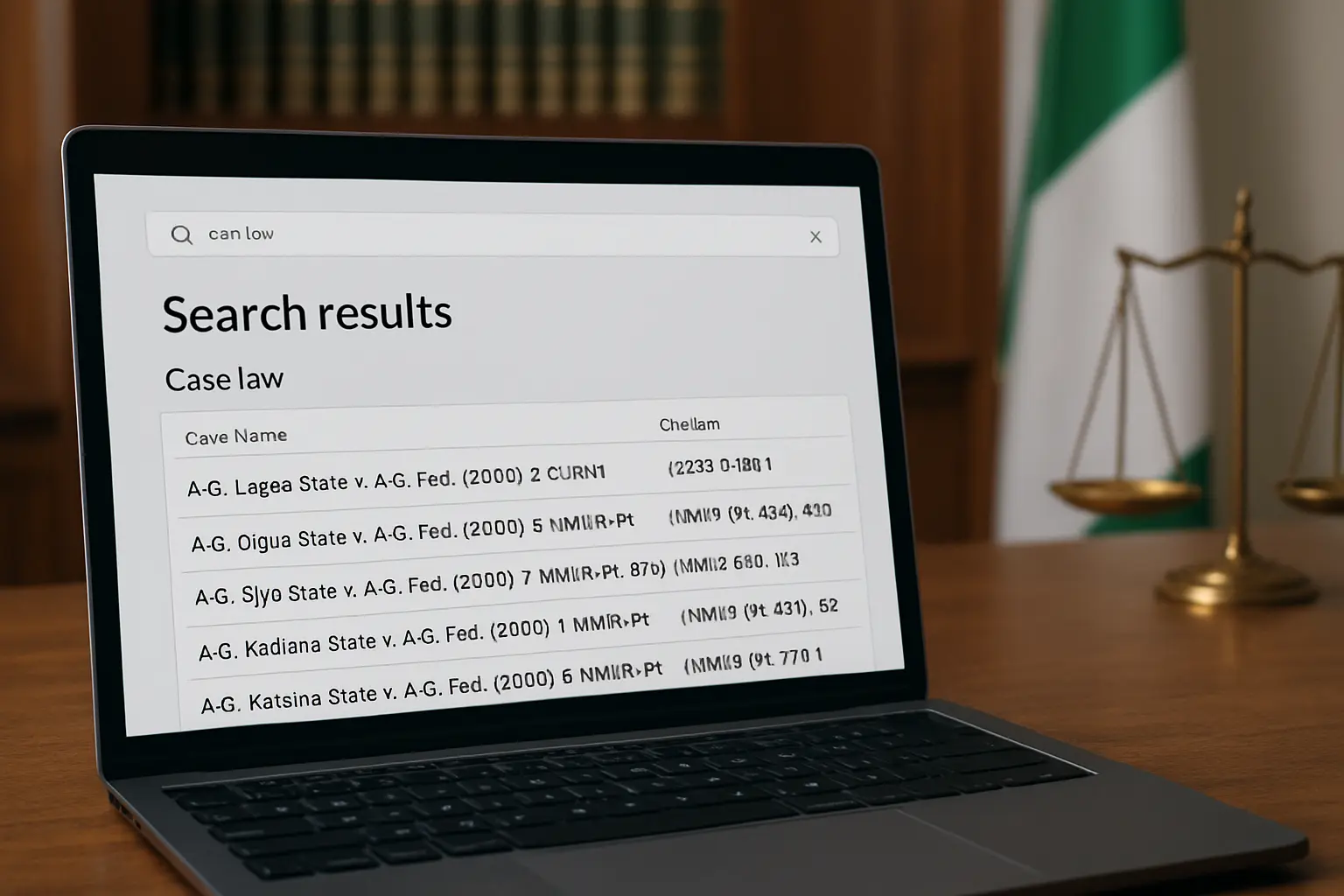
Large language models can generate a citation that reads exactly like a real one — correct court name, plausible year, a case name that sounds right — for a case that does not exist. This is not a hypothetical risk: in Mata v. Avianca, Inc. (U.S. District Court for the Southern District of New York, case 22-cv-1461), lawyers submitted a legal brief containing case citations generated by ChatGPT, several of which turned out to be entirely fabricated. Judge P. Kevin Castel sanctioned the lawyers in a June 2023 decision after the fabrications were discovered. A Nigerian law student citing a Court of Appeal or Supreme Court decision that an AI tool invented faces exactly the same exposure at a lower stake — a panel that spot-checks even one citation and finds it does not exist will not simply mark down that one reference, it will question the reliability of your entire reference list. Verify every AI-suggested case citation against a real legal database — NigeriaLII, LawPavilion or a printed law report — before it appears anywhere in your project.
What counts as “your own work” in a law project that used AI at some stage?
The distinction Nigerian departments actually enforce, even without a named AI policy, is the same one that governs any other unattributed source: did you produce the analysis, or did you submit someone — or something — else’s output as though you had. Using AI to summarise a judgment you have already read, to check your English, or to suggest a structure you then write into yourself falls on the safe side of that line. Asking AI to write your discussion of a case’s ratio decidendi and submitting that discussion unedited does not, and is functionally identical to submitting a classmate’s paragraph. Our guide to whether you can use AI to write your final year project sets out this same line in general terms across all departments; this article applies it specifically to the risks a law project adds.
How do you disclose AI use if your department asks for a declaration?
Where a department’s declaration form or plagiarism statement asks you to state what tools you used, name the tool and describe the use plainly and specifically — “used [tool] to check grammar in Chapters One and Two” reads very differently from a vague “AI-assisted,” and specificity protects you if a question comes up at defence. Our guide to citing ChatGPT and AI in APA 7 covers the exact reference form if you quote or closely paraphrase AI output directly in your text, which a law project should do rarely, if ever, given the citation-fabrication risk above.
Does using AI count as unauthorised practice of law before you are called to the Bar?
This is a different question from academic misconduct, and a narrower one: a final year project is academic work submitted to your department, not legal advice given to a client, so the Legal Practitioners Act’s restrictions on who may practise law do not apply to it in the way they would to advising a member of the public. That said, if your project involves a clinical legal education placement or a law clinic serving real clients, any AI tool use in that client-facing context is a separate, higher-stakes question your clinic supervisor should set the rule on directly — do not extend the academic-project answer in this article to that situation without asking first.
General-purpose AI versus legal research databases: which one verifies itself?
The distinction that matters for a law project is not “AI versus no AI,” it is whether the tool can show you its source. A general-purpose chatbot generates a citation from patterns in its training data with no live link back to a court’s actual judgment — it can sound completely confident while being entirely wrong, because generating plausible-sounding text is what it was built to do, not retrieving verified documents. A legal research database such as NigeriaLII or LawPavilion, by contrast, returns an actual document you can open and read, with a citation that corresponds to a real, retrievable case report — and once you have the real citation in hand, our guide to citing Nigerian laws and cases correctly covers the exact form to reference it in. This is the reason a legal research database ranks ahead of general AI tools for anything citation-bearing — use a general AI tool for structure, phrasing and summarising material you have already verified, and use a legal database for anything that ends up as a citation in your reference list. Treat the two categories as doing different jobs, not as competing options for the same task.
Does the Nigeria Data Protection Act affect AI tool use in a law project?
If your law project analyses real case files, court records naming real litigants, or any personal data you did not source from an already-public judgment, uploading that material into a general-purpose AI tool raises the same Nigeria Data Protection Act 2023 concerns as uploading it to any other third-party service — the Act treats this as processing personal data, and doing so without a proper lawful basis is a compliance question separate from academic integrity. In practice, this means: paraphrase or anonymise case facts before pasting them into an AI tool for summarising, and never upload an entire real, unredacted court file or client-related document to a chatbot as a shortcut. A doctrinal or case-law-based project working entirely from published, already-public judgments does not raise this concern, because the material is public by definition.
What should you actually avoid entirely?
- Never submit an AI-drafted case citation without opening the actual case report and confirming the parties, court, year and holding match what the AI tool produced.
- Never let AI write your legal argument or analysis for a chapter and submit it as your own reasoning — this is the core skill a law project exists to demonstrate.
- Never rely on AI for Nigerian statutory text without checking the actual Act — AI tools trained mostly on non-Nigerian legal material can confidently misstate a Nigerian provision, a section number, or an amendment date.
- Never assume “no published policy” means “no rule applies” — your department’s existing academic integrity policy already covers AI-generated text submitted as your own.
Frequently asked questions
Has any Nigerian university published a specific rule on AI use in law projects?
Not that we could verify. A 2026 survey of University of Ibadan undergraduates found that students reported a lack of clear institutional guidelines on AI tool use — check your own department’s current student handbook directly, since this can change.
Can I use AI to help me find relevant case law?
You can use it to suggest search terms or general areas of law to look into, but treat every case name, citation and holding it produces as unverified until you have opened the actual case in NigeriaLII, LawPavilion, or a printed law report.
What happens if a fabricated citation is found in my project at defence?
Outcomes vary by department, but at minimum expect the panel to question your entire reference list’s reliability, which can affect your grade well beyond the single citation — treat citation verification as non-negotiable, not optional diligence.
Is it different if I use AI only for my introduction and background sections rather than legal analysis?
The risk is lower because these sections involve less claim-specific factual content, but the same submission-as-your-own-work rule still applies, and any citation or statistic AI supplies for your background still needs verification.
Should I ask my supervisor directly about their AI policy?
Yes, and do it early. In the absence of a written departmental policy, your supervisor’s own stated expectation is the rule that will actually govern your project, and getting it in writing over email protects you if the question comes up later.
Will this policy gap close before I graduate?
Possibly, but do not wait for it. The academic literature on Nigerian higher education explicitly recommends universities close this gap, which suggests institutions are aware of the problem, but a recommendation in a published study is not the same as a policy your own faculty has actually adopted — check your current student handbook rather than assuming a future policy applies retroactively to your submission.
Does citing a fabricated case only matter if a judge or examiner actually checks it?
No — the risk exists the moment the fabricated citation enters your written work, whether or not anyone checks it before your defence. A project circulated in your department’s repository afterward, or read by a future student researching the same area, can surface the error long after your defence is over, which is a separate reputational risk from the immediate grading one.
Tesify drafts your own legal analysis with you, chapter by chapter, and is built around you supplying and confirming every case and statute yourself — treat any citation that appears in a draft as unverified until you have opened the source.