
Start with the finding, because it changes what you should do. No Nigerian university document we could read tells you how to cite AI. Not the national regulator, not the two most detailed published postgraduate style guides in the country, not the postgraduate regulations revised in 2025. What does exist is a declaration you sign about acknowledging sources, and it plainly reaches text a machine produced.
This page sets out what the Nigerian documents say, what the APA 7 form actually is where you do need one, why you usually should not use it, and a declaration you can adapt. Whether you may use AI at all — permission, detection and penalties — is covered in our guide to whether you can use AI to write a final year project in Nigeria.
What the Nigerian documents actually say
We checked the regulator and the institutions first, rather than reaching for an international style guide and calling it the Nigerian rule. Here is what that search returned, on 13 September 2026.
- Obafemi Awolowo University, Guidelines for Writing Theses for Higher Degrees, January 2026. A thirteen-page document covering preliminary pages, referencing styles, quotation, tables, margins and binding in detail. It contains no occurrence of “artificial intelligence”, “AI” as a term, “ChatGPT” or “generative”. Revised in January 2026, and silent on the subject.
- OAU, Regulations Governing Postgraduate Studies, 8 May 2025. Its Part VI is a full policy on plagiarism. No AI mention anywhere in the document.
- University of Ibadan Manual of Style, Revised Edition 2023. A complete house referencing style with citation samples down to patents, court cases and social media networks. No AI mention.
- The National Universities Commission. A site search for “artificial intelligence” returns news items about an AI innovation initiative at a university. No directive on AI use in student work appears.
- UNILAG, UNN and OAU site searches for an AI policy return conferences, workshops, summits and awards — institutional activity about AI, not a rule for students citing it.
One result deserves its own paragraph, because it is both real and frustrating. OAU published a news item announcing that it placed first for the Best Institutional AI Policy in Higher Education Award (University Category) at the 2025 AI Awareness Day in Higher Education, at a virtual ceremony on 17 February 2025, with the policy formulated by its Central Office of Research. So an award-winning Nigerian institutional AI policy exists. We could not find the document itself published anywhere a student can read it — the announcement does not link it, and the university’s own thesis-writing guidelines, revised eleven months later, say nothing about AI.
The honest conclusion, then, is not that AI is banned and not that it is permitted. It is that the rule you are governed by is your department’s, and where your department has nothing written, the document that governs you is the declaration you sign.
The declaration you already signed reaches AI
OAU requires an anti-plagiarism declaration among the preliminary pages, signed by the candidate. Its published wording has the student state that they understand the interpretation of plagiarism and are aware of the University’s policy, and that the work is their own original work and that other people’s work used, “either from a printed source, internet, or any other source”, has been properly acknowledged and referenced in accordance with University policy.
Read that middle clause carefully. Any other source is not a decorative phrase. If a passage in your project came from somewhere other than your own head, the declaration you sign commits you to having acknowledged it. That is the operative Nigerian rule on AI text, and it exists whether or not anyone has written the letters A and I into a policy.
OAU’s 2025 Regulations add the enforcement side: students must pass an anti-plagiarism test before commencing study, adhere to the similarity index set by the College Board, and attach the similarity index to thesis drafts before oral examination. Our guide to acceptable plagiarism percentages in Nigerian universities covers the thresholds.
The rule that comes before the reference form
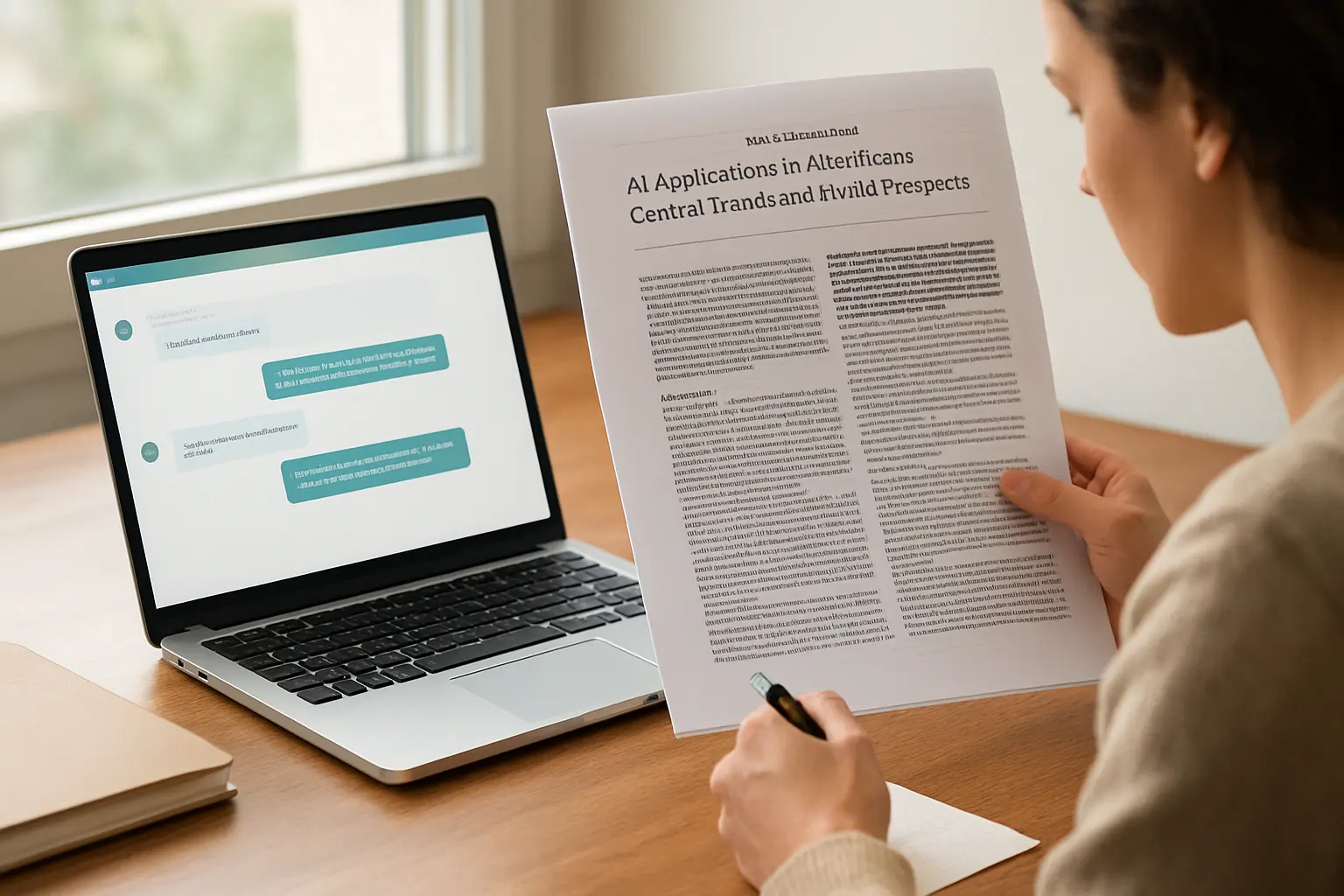
Most students asking how to cite ChatGPT should not be citing ChatGPT at all. The University of Queensland Library’s APA 7th guide, in its guidance on referencing AI use, states it plainly: where the AI output includes sources, it is recommended that you cite those directly rather than citing the output itself.
That is not a technicality. It is the whole logic of a reference list. A reference exists so a reader can go and check the claim. An AI chat is not retrievable by your reader, is not stable, and did not perform the study — so a citation to it points at nothing checkable. If the output told you that something was found, go and find the study that found it, read it, and cite that. If you cannot find the study, you have learned something important: there may not be one.
The same guide gives the fallback for the case where no guideline covers your situation: use the rule for personal communication or correspondence. A personal communication is cited in the text only and does not appear in the reference list, precisely because it is not retrievable.
The APA 7 forms, for when you do need them
You genuinely need a reference to the tool in a small number of cases: when the AI output is itself your object of study, when you reproduce a prompt and its output as data, or when your department has told you to reference it. The University of Queensland Library’s APA 7th guide, whose page was last updated on 11 September 2026 and which is built on the Publication Manual of the American Psychological Association, 7th edition (2019), gives two forms.
An individual AI chat
In text: (Author or company of AI tool, Year) or Author or company of AI tool (Year).
Reference list: Author or company of AI tool. (Year, Month Day). Title of the chat. [Description of the chat type]. AI tool or model. Web address of the chat.
The guide’s worked example uses OpenAI as the author, a dated chat title, the bracketed description “Generative AI chat”, the model name, and a shareable chat link.
A general reference to the tool
In text: (Author or company of AI tool, Year).
Reference list: Author or company of AI tool. (Year). Name of AI tool [Description of AI model used]. Web address of AI tool
Its worked example names the company as author, the tool name in italics, and the bracketed description “Large language model”.
The one thing students get wrong here. The author is the company, not the model. OpenAI is the author; ChatGPT is the title or the tool name. Writing ChatGPT (2026) as an author is the giveaway that the form was guessed rather than looked up.
A limitation worth stating, because it explains why this page quotes a library rather than APA itself. The American Psychological Association’s own style page on citing ChatGPT is not readable by an ordinary fetch: requested on 13 September 2026, apastyle.apa.org/blog/how-to-cite-chatgpt returns HTTP 200 with 212 bytes and zero visible characters — a JavaScript shell with no content. The forms above are therefore quoted through a university library’s APA 7 guide, which is what we could actually read, and we say so rather than implying we read them at APA.
Bear in mind that APA may not be your style at all
If you are at the University of Ibadan, the style is the University of Ibadan Manual of Style, not APA, and it has no AI entry. At OAU, the postgraduate guidelines permit a choice among APA, MLA, Chicago, Vancouver, Harvard, OSCOLA and AMA, “or any other one applicable to specific faculties or disciplines”, and require the latest applicable version. So “cite AI in APA” is the right answer only once you have confirmed that APA is your style. Our guide to what referencing style Nigerian universities actually require covers that first step, and the same reasoning applies to legal sources, where APA also hands the job elsewhere.
A declaration of AI use you can adapt
Where your department requires a declaration, or where nothing is written and you want the question settled in your favour before it is asked, this is the shape. Keep it to one page, place it with the preliminary pages, and have it signed and dated.
DECLARATION ON THE USE OF ARTIFICIAL INTELLIGENCE TOOLS
I, [FIRST NAME, OTHER NAME, SURNAME], [registration or matriculation number], of the Department of [department], [university], declare as follows in respect of this project titled [title].
The research design, the data collection, the analysis, the interpretation and the argument in this work are my own. The following artificial intelligence tools were used, in the ways stated:
- [Tool and model, e.g. a large language model assistant] — used for [e.g. checking grammar and sentence clarity in Chapters One and Two], on [dates or period].
- [Tool] — used for [e.g. formatting reference entries already collected by me], on [dates or period].
No text generated by any of these tools has been submitted as my own writing without being rewritten by me and checked against the sources it refers to. No reference in this work was supplied by an artificial intelligence tool; every source listed was located and read by me. No participant data was entered into any such tool.
Signature: ____________________ Date: ____________
Three sentences in that block do most of the work, and they are worth keeping whatever else you change. The declaration names what the tool did rather than merely that it was used. It states that no reference was machine-supplied, which is the specific failure Nigerian panels test for. And it states that no participant data was uploaded, which is an ethics obligation separate from any AI policy — your respondents gave you their information under conditions, and a public chatbot is not one of them.
The email to send, and why in writing
One message, three questions, and keep the reply:
- Does the department have a written position on the use of AI tools in final year projects? If so, may I have it?
- If a student uses an AI tool for language editing or reference formatting, does the department require that to be declared, and in what form?
- Where the department requires a declaration, is there a template, and where does the page sit among the preliminaries?
Ask before you use anything, not afterwards. The students who get into difficulty are almost never the ones who told their supervisor what they were doing. And a written reply protects you against a change of mind, a change of supervisor, or an examiner with a different view.
What does not need declaring
No reasonable reading of an academic integrity rule requires you to declare a spell-checker, an autocorrect, a search engine, a reference manager doing what reference managers do, or a statistical package computing what you asked it to compute. The line every integrity regime draws is authorship: whether the submitted sentences, and the thinking behind them, are yours. A tool that checks your writing is in a different category from a tool that produces it, and blurring the two in a declaration does you no favours — it makes the genuinely material disclosures harder to see.
Five mistakes
- Citing the model as the author. OpenAI is the author; ChatGPT is the tool. Getting this backwards signals a guessed form.
- Citing the chat instead of the study. If the output names a source, find it, read it, cite it. If you cannot find it, do not cite either.
- Letting a tool generate your references. Fabricated citations are common, plausible and checkable. Our comparison of citation generators for APA style covers what to use instead.
- Assuming APA applies. Confirm your style first. At UI, it is the Manual of Style, which has no AI entry at all.
- Uploading participant data. Transcripts and completed questionnaires carry obligations to the people who gave them. Work from your own drafts and anonymised summaries.
Where this leaves you
You cannot cite your way out of an authorship problem, and in Nigeria you currently cannot cite your way into compliance either, because there is no published national rule to comply with. What you can do is narrow: get your department’s position in writing, cite the underlying sources rather than the output, declare what a tool actually did, and make sure every reference in the project is one you opened. A panel that sees that record has nothing left to probe except your work — which is the position you want to be in at defence.
Tesify is built for exactly that position: it drafts alongside your own thinking, holds your citations against the sentences that use them, and never invents a reference — 100% written by you, alongside 9,000+ students and 15,000+ chapters.
Write your project with Tesify
Frequently asked questions
Is there a Nigerian rule on citing AI in a final year project?
None that we could find published. The National Universities Commission publishes no directive on it, and two of the most detailed Nigerian postgraduate style documents — OAU’s January 2026 thesis guidelines and the University of Ibadan Manual of Style — contain no AI provision at all. Your department’s position governs you.
How do I cite ChatGPT in APA 7?
With the company as author: company name, year, the chat title or tool name, a bracketed description such as Generative AI chat or Large language model, the model, and the web address. But in most cases you should cite the underlying source the output referred to, rather than the chat.
Who is the author of a ChatGPT reference?
OpenAI, the company that makes it. ChatGPT is the tool or the title, not the author. The same pattern applies to any other tool: the company is the author.
Do I have to declare that I used AI?
If your department or supervisor requires it, yes, and get the requirement in writing. Where nothing is written, a short signed declaration stating what each tool actually did is the safer position, and it costs you nothing.
Does an AI chat go in my reference list?
Only where the chat is genuinely your object of study or reproduced as data. Otherwise no. Where no guideline covers your case, the personal communication rule applies, and personal communications are cited in the text only.
Can I let AI generate my references?
Never. Fabricated references are a well-known failure mode, they are plausible enough to survive a quick reading, and they are trivial for an examiner to check. Every source in your project must be one you located and opened.
Is using AI for grammar and editing considered cheating?
Not on any reading we are aware of, provided the sentences and the thinking are yours. The line is authorship, not tool use. Where a declaration is required, say precisely that editing is what the tool did.
Can I put my questionnaire responses into an AI tool for analysis?
Not raw, identifiable participant data. Your respondents gave you their information under specific assurances, and uploading it to a public service breaks them regardless of what any AI policy says. Work with anonymised summaries.
My department has no written AI rule. What governs me?
The university’s academic integrity rules and the declaration you sign. OAU’s published anti-plagiarism declaration covers work used from “a printed source, internet, or any other source”, which on a plain reading includes machine-generated text.
Why does this page quote a university library instead of APA?
Because APA’s own page on the subject serves nothing to an ordinary fetch. Requested on 13 September 2026, it returned 212 bytes with no visible text. The forms here are taken from a university library’s APA 7 guide, which is readable and states its own basis as the 7th edition Publication Manual.
Will an AI detector catch me?
Unreliably, in both directions, and it is the wrong thing to plan around. The reliable test in the Nigerian system is your defence, where a panel asks you to explain and extend work you claim to have written.