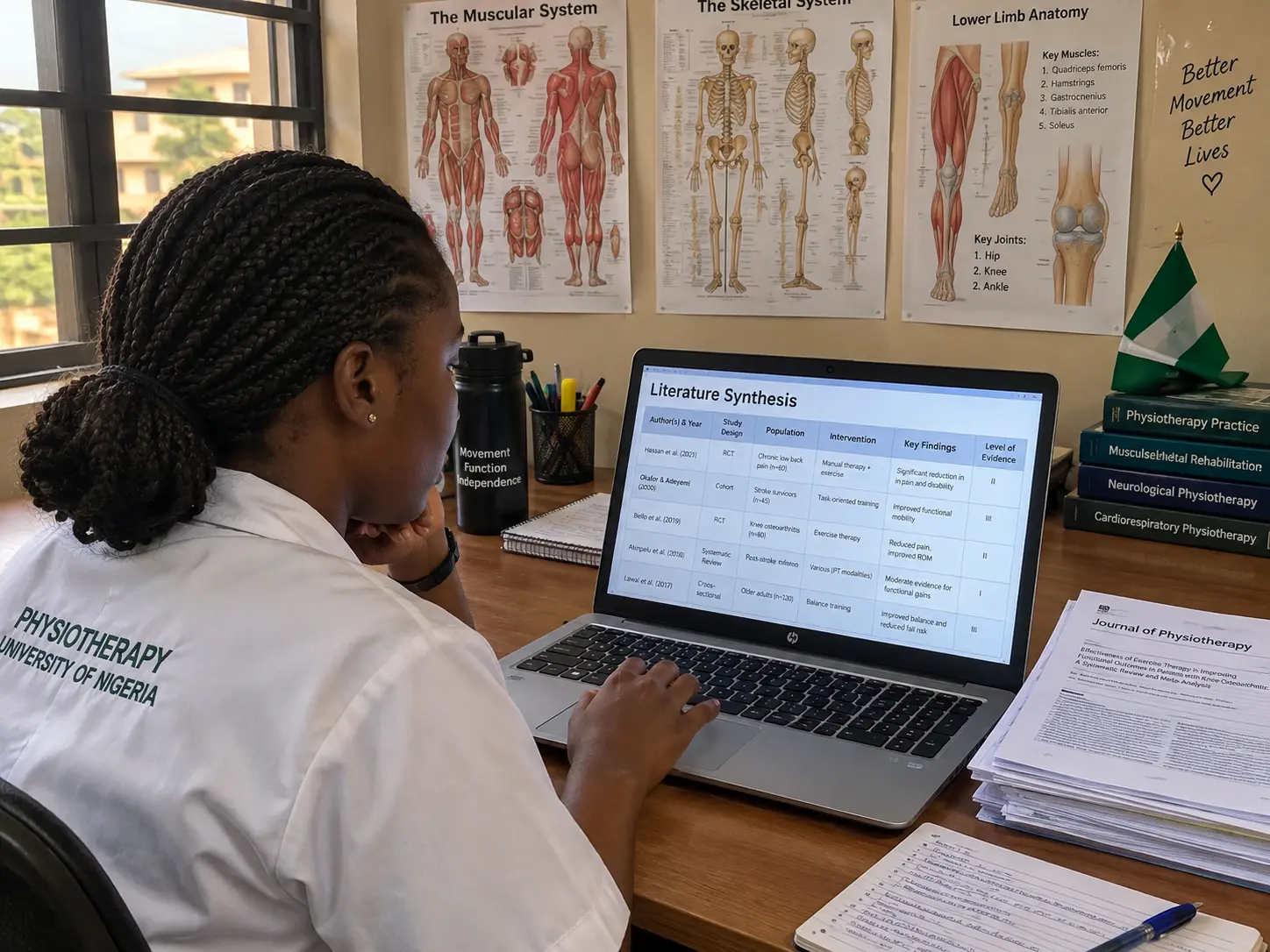
A physiotherapy research gap names the specific patient group, technique, setting or outcome measure that existing studies have not yet examined closely enough in Nigeria — for example, thin local evidence on home-exercise adherence after knee replacement, or the absence of a Nigerian-validated outcome scale for a common condition. This article works through five labelled illustrative gap examples, the four types of gap a Nigerian physiotherapy panel recognises, and the exact process for finding a real one for your own topic.
What Is a Research Gap, and Why Does a Physiotherapy Panel Ask for One?
A research gap is the sentence in your Chapter Two that tells your supervisor exactly what is missing from the literature you have just reviewed — not “not much has been written about this,” but a precise statement of what population, comparison, setting or measurement the existing studies leave unanswered. A Nigerian physiotherapy department expects this because your entire project depends on it: your problem statement restates the gap in plain language, your objectives are built to close it, and your Chapter Five discussion returns to it to say whether you closed it. A vague gap statement (“limited literature exists on this topic in Nigeria”) is the single fastest way to get a topic sent back at proposal stage, because it does not tell the panel what specifically is missing or why it is worth a final year project rather than a wider systematic review.
Physiotherapy education in Nigeria sits under the National Universities Commission’s curriculum for the degree and, once you qualify, under the Medical Rehabilitation Therapists (Registration) Board of Nigeria (MRTB) as the professional regulator — so a genuinely useful gap is one that speaks to a question a working Nigerian physiotherapist, not just an examiner, would want answered.
What Are the Four Types of Research Gap Your Panel Will Recognise?
Most physiotherapy gaps fall into one of four families. Naming which one you are working with, out loud in your literature review, is itself worth marks — it shows the panel you understand the shape of the gap you are closing, not just that one exists.
- Population gap — the intervention or condition has been studied, but not in the specific group your project targets (e.g. studied in adults, not in adolescent athletes; studied in an urban teaching hospital, not in a rural primary health centre).
- Contextual/geographic gap — the evidence exists internationally or in another Nigerian zone, but not for your state, facility type or health system context, where staffing, equipment access and patient follow-up patterns genuinely differ.
- Methodological gap — prior Nigerian studies used a design, instrument or outcome measure with a known limitation (small sample, no control group, a scale never validated locally) that your project can improve on.
- Knowledge/evidence gap — the relationship between two specific variables (an intervention and an outcome, a risk factor and a condition) has not been directly tested at all, even though each has been studied separately.
What Do Worked Research-Gap Examples Look Like Across Physiotherapy Sub-Fields?
The five passages below are illustrative and fictitious — built to show the shape of a defensible gap statement, not to be copied as a real finding. Each follows the same three-move pattern: what is known, what is specifically missing, why that missing piece is worth a final year project.
Musculoskeletal physiotherapy
What is known: Structured home-exercise programmes after total knee replacement are widely reported to improve range of motion and reduce pain in the first twelve weeks. What is missing (illustrative): few of the studies behind this claim measure whether patients in a Nigerian tertiary hospital setting, discharged with a printed exercise sheet and no follow-up call, actually complete the programme at the frequency prescribed. Why it matters: a project measuring self-reported adherence in this specific discharge pathway would tell the department something the international literature does not, because adherence depends heavily on local discharge practice, not just the exercise programme itself.
Neurological/stroke rehabilitation
What is known: Task-specific gait training is an established component of post-stroke rehabilitation protocols. What is missing (illustrative): comparatively little published work describes how caregiver involvement in a Nigerian home setting — where formal outpatient physiotherapy visits are often limited by distance and cost — affects how consistently gait training is actually practised between hospital visits. Why it matters: this reframes the gap from “does task-specific training work” (already answered) to “what makes it work in the setting most Nigerian stroke survivors actually rehabilitate in,” which is a genuinely open, locally specific question.
Sports physiotherapy
What is known: Warm-up protocols that include dynamic stretching and neuromuscular control drills are associated with lower rates of lower-limb injury in organised sport. What is missing (illustrative): most of the supporting evidence comes from professional or well-resourced amateur settings; there is little Nigerian data on whether such a protocol is feasible, or produces the same pattern of injury reduction, in university intramural or state-league football, where pitch conditions, footwear and pre-season preparation time differ. Why it matters: a feasibility-and-outcome project in that specific setting closes a contextual gap the international literature cannot close on its own.
Paediatric physiotherapy
What is known: Early, intensive physiotherapy input improves gross motor outcomes in children with cerebral palsy. What is missing (illustrative): few published Nigerian studies describe how caregiver-delivered home therapy, taught by a physiotherapist during a limited number of clinic visits, compares with clinic-based sessions alone for children whose families cannot attend more than once a month. Why it matters: access to frequent clinic-based therapy is itself unevenly distributed, so this is a gap about delivery model, not about whether physiotherapy helps at all.
Cardiopulmonary physiotherapy
What is known: Structured pulmonary rehabilitation programmes improve exercise tolerance and quality of life in people with chronic respiratory conditions. What is missing (illustrative): there is limited description of how such a programme could be adapted where formal pulmonary rehabilitation units are rare, using simplified equipment and a shorter supervised phase. Why it matters: a project piloting and evaluating an adapted, lower-resource protocol targets a genuine local implementation gap rather than repeating the efficacy question that international trials have already answered.
How Do You Find a Real Research Gap for Your Own Topic?
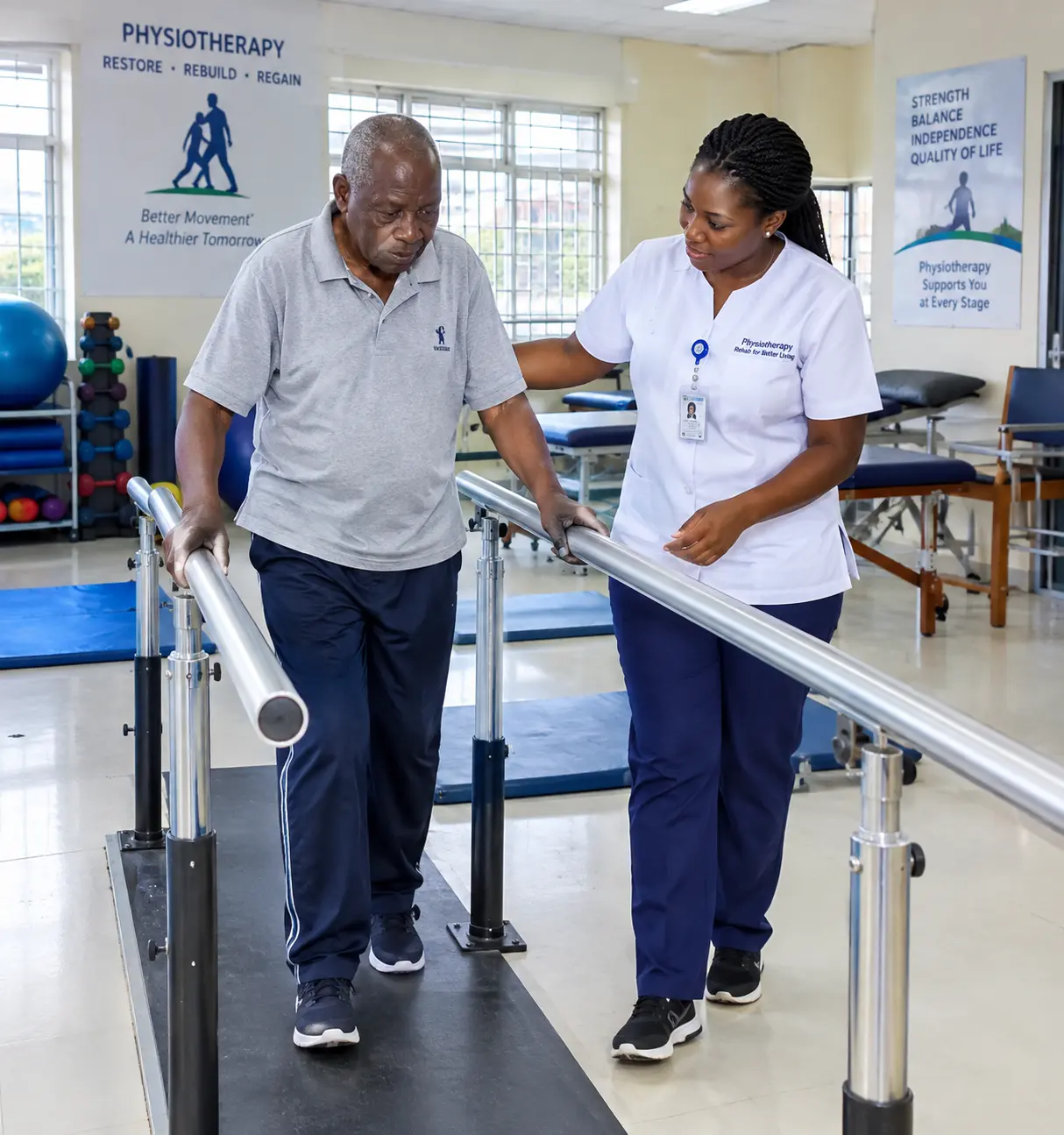
Worked examples show the shape; your own gap has to come from your own reading. Four steps get you there without weeks of aimless searching:
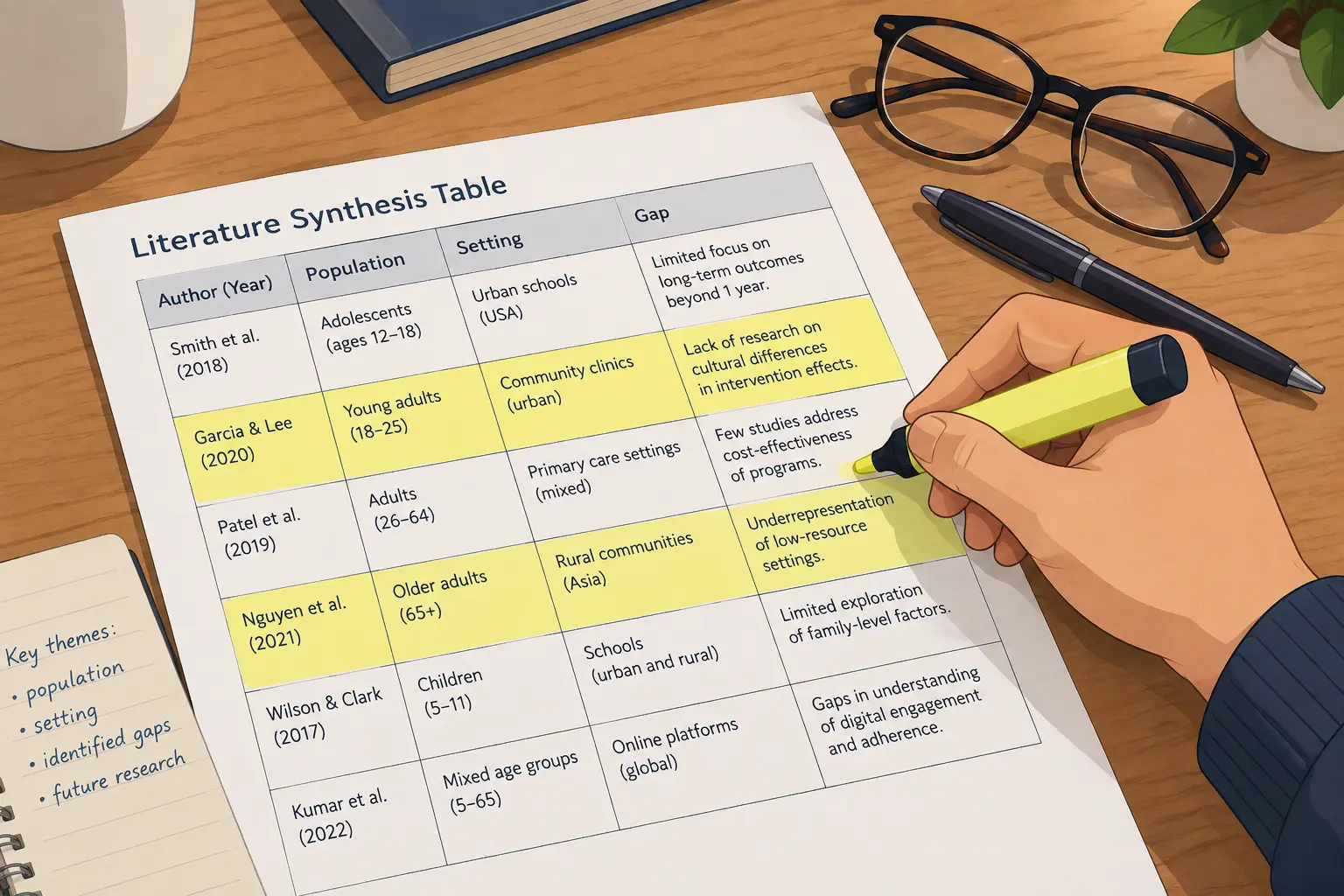
- Build a synthesis table, not a list of summaries. One row per study: author/year, population, setting, design, outcome measured, and — the column that matters — what the study did NOT measure or could not generalise to. Reading down that last column is how a gap becomes visible instead of assumed.
- Sort by the four gap types above. Once your table has ten to fifteen rows, ask which family keeps recurring: are most studies from one population, one setting, one design? That recurring absence is your candidate gap.
- Test it against a “so what” question. A defensible gap answers: if this stays unanswered, what specific clinical or educational decision cannot be made confidently? If you cannot answer that in one sentence, the gap is still too vague to defend.
- Check it has not already been closed. Search the exact population-plus-setting combination you plan to use, not just the broad topic — a gap at the general level often turns out to be already filled once you narrow the search to your specific angle.
What Should You Avoid When Writing a Research Gap Statement?
| Fault | Why it fails | Fix |
|---|---|---|
| “No study has been done on this in Nigeria” | Usually untrue or unverifiable, and does not say what is missing | Name the specific population/setting/measure combination that is missing |
| Restating the topic as the gap | A topic is not automatically a gap; something has to be shown as unanswered | State what the closest existing study measured, then what it left out |
| A gap too broad for one project | “The role of physiotherapy in stroke recovery” cannot be closed by one undergraduate project | Narrow to one variable, one setting, one comparison |
| No link to your objectives | Panels check that every objective traces back to the stated gap | Write objectives that name the exact missing piece as their target |
| Gap copied from another department’s project | A recycled gap statement rarely survives a supervisor’s questions about your own reading | Build your own synthesis table from your own reading list |
How Does the Research Gap Connect to Your Statement of the Problem and Objectives?
The gap, the problem statement and your objectives are three descriptions of the same missing piece, written for three different jobs. The literature-review gap says what the published evidence does not yet show. The statement of the problem restates that same missing piece as a live, felt problem — why it matters to patients, clinicians or the health system now. The objectives then convert it into things you will actually measure or describe. If your gap says “adherence to home exercise after knee replacement is unmeasured in this discharge pathway,” your first objective should read something close to “to assess the level of adherence to prescribed home exercise among post-total-knee-replacement patients discharged from the named study hospital” — not a restatement of the whole topic. Panels read these three sections together and flag any project where the objectives have quietly drifted away from the gap that was supposedly being closed.
Frequently Asked Questions
Is “limited studies exist in Nigeria” an acceptable research gap on its own?
No. It states an absence without saying what specifically is missing, which population or setting is affected, or why it matters. A panel will ask you to name the missing piece precisely before accepting the topic.
Can I use a research gap I found in a review article rather than reading the primary studies myself?
You can start from a review article’s stated limitations, but you should trace at least the key primary studies it cites so you can describe the gap in your own words and confirm it still holds — review articles age, and a gap they named two or three years ago may already have been addressed.
How many studies do I need to read before I can defend a gap statement?
There is no fixed number a Nigerian physiotherapy department publishes, but a synthesis table with fewer than eight to ten relevant studies rarely gives you enough pattern to defend a gap confidently — treat that as a practical floor, not a rule from any regulation.
What is the difference between a population gap and a contextual gap?
A population gap means the same setting has been studied, but not this specific group of patients (children versus adults, for example). A contextual gap means the same population and intervention have been studied, but not in this specific setting, facility type or health system.
Does my research gap need to be something no one anywhere has ever studied?
No — that standard belongs to doctoral work, not an undergraduate physiotherapy project. A gap that has been answered elsewhere but not yet examined in a Nigerian setting, or in your specific facility type, is a legitimate and commonly accepted final year project gap.
Can two students in the same department use gaps from the same broad topic?
Yes, provided each student narrows to a different population, setting, comparison or outcome measure — the specific angle, not the broad topic, is what makes a gap distinct and defensible on its own.
Do I need ethics approval to collect data for a physiotherapy final year project?
Most projects involving patients, caregivers or clinical records need clearance from the relevant institutional health research ethics committee before data collection begins, in the same way nursing and public-health projects do — check with your department early, since this step can take longer than students expect.
Where does the research gap go in my final document — Chapter One or Chapter Two?
The full literature-based gap statement, built from your synthesis table, belongs at the end of Chapter Two as the summary-of-literature-and-gap section. Chapter One’s statement of the problem previews the same gap in plain, problem-focused language before the literature has been reviewed in depth.
Can my supervisor reject a gap even if I found it through a proper literature search?
Yes — a supervisor may judge a genuine gap too narrow to sustain a full project, too broad to finish on time, or not feasible to collect data on given your access and timeline. Bring your synthesis table to the meeting so the conversation is about the evidence, not just the topic.
Turning a synthesis table into a clean, defensible gap statement — and then writing the Chapter Two that supports it — is the kind of structured chapter drafting Tesify is built to support. More than 9,000 students have used Tesify to write over 15,000 chapters, and every sentence is still 100% written by you: the reading, the synthesis table and the gap you defend stay yours. Start your project with Tesify and give your Chapter Two a clear structure from the first draft.
For the sections that come before and after your research gap, see how to build a Chapter Two literature review around it, check whether your topic has already been studied before you commit to a gap, read worked statement of the problem examples that build on a gap the same way, see written objectives, significance and scope examples that trace back to a stated gap, and if your project needs ethics clearance, the process is close to what a nursing final year project’s ethics approval requires.