
A Nigerian law final year project is examined on two things at once: whether the argument is sound, and whether it reads like legal writing rather than a long personal essay. Supervisors correct register faults as often as they correct substance — wrong tense on a settled rule, first-person opinion where a formal claim belongs, a case referred to as “the story” instead of “the instant case.” This guide covers the conventions that make the difference, step by step.
Step 1: Use the Present Tense for Settled Law, the Past Tense for What a Court Did
Legal writing keeps two tenses working side by side, and mixing them up is one of the most common faults in a Nigerian law project’s literature and analysis chapters. A rule that is currently in force is stated in the present tense: “the Companies and Allied Matters Act 2020 provides that…”. A court’s decision is a different matter: “the Supreme Court holds in that case that…” is wrong, because the case was decided in the past, so it becomes “the Supreme Court held in that case that…” But the legal principle the case established, if it remains good law, is stated in the present: “the court held that a company’s separate legal personality survives the death of its sole shareholder.” A rule of law lives in the present tense; a court’s specific act of deciding a specific case lives in the past tense. Keep them separate in the same sentence when you can: “In the case under discussion, the court held [past] that the doctrine of separate legal personality applies [present] even where the company has a single controlling shareholder.” The same logic extends to statutes that have since been repealed or amended: describe what a now-repealed provision provided, in the past tense, and be explicit that it no longer represents current law.
Step 2: Write in a Formal, Impersonal Voice
Legal academic writing avoids the first person almost entirely. Instead of “I think the court was wrong to hold this,” write “it is submitted that the court’s reasoning is open to criticism” or “this position is difficult to reconcile with…” The formal hedge phrases — “it is submitted that,” “it is arguable that,” “this writer contends that” — are not filler; they are how legal writing signals that a claim is the writer’s own argued position rather than settled law. Avoid contractions entirely (“does not,” never “doesn’t”), avoid rhetorical questions in the analysis chapters, and avoid the second person (“you can see that…”) throughout. This formality is not decoration; a panel reads an informal register as a sign the student has not yet absorbed how the profession writes.
Step 3: Refer to Parties and Courts by Their Correct Terms
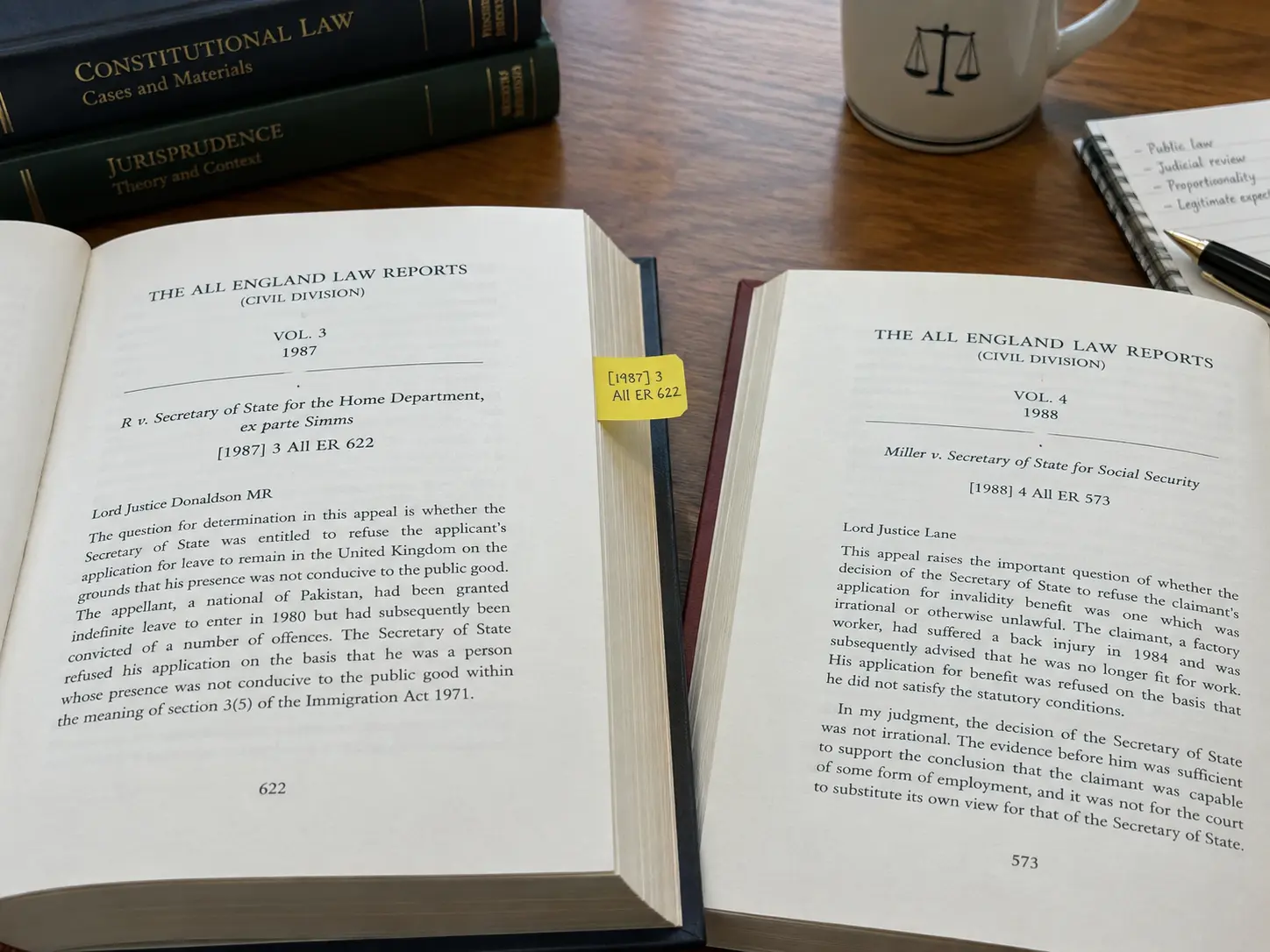
Use the terms a case record actually uses, not a paraphrase. The party who brought the original action is the plaintiff (or claimant, depending on the jurisdiction and court whose report you are following) at first instance, and becomes the appellant or respondent on appeal depending on who is appealing. Refer to a case under current discussion as “the instant case” or “the present case,” not “this case” repeated forty times or “the story.” A court “holds,” “finds,” or “is of the view that” — it does not “say” or “believe.” A statute “provides,” “stipulates,” or “states” — not “says.” These substitutions cost nothing to learn and mark you immediately as someone who has read enough law reports to absorb their vocabulary.
Step 4: Distinguish “Shall,” “May” and “Must” Precisely
Nigerian statutes use modal verbs with specific, technical meaning, and your discussion of them should match that precision. “Shall” in a statute typically signals a mandatory obligation (though courts have sometimes read a particular “shall” as directory rather than mandatory depending on context and consequence — a point worth raising explicitly if your topic turns on it). “May” signals discretion. “Must” is used less often in the statutes themselves but is common in your own analytical prose to state a firm conclusion: “the court must, on this reading, find that…” When you discuss whether a provision is mandatory or discretionary, use the word the statute itself uses and then state your own reading of its legal effect — do not silently substitute “must” for a statute’s “may” and blur the distinction. A worked example: if section 10 of a hypothetical statute states that a registrar “may refuse” an application on named grounds, your analysis should say the refusal power is discretionary, not that the registrar “must refuse” whenever those grounds exist — the two readings lead to very different arguments about a registrar’s decision.
Step 5: Structure Your Analysis Using Issue, Rule, Application, Conclusion
Where your project analyses a legal problem — a hypothetical, a gap in a statute, a conflict between two decided cases — structure each discrete point using the IRAC pattern: state the issue as a precise legal question; state the rule that governs it, drawn from statute or case law; apply the rule to the facts or the problem you are analysing; and state your conclusion. This structure is what makes a legal argument readable to an examiner scanning quickly for the point — a paragraph that opens with three sentences of background before stating the issue reads as unfocused, however sound the underlying analysis is.
Step 6: Use Latin and French Legal Terms Correctly, and Italicise Them
Nigerian legal writing, inherited from English common law practice, retains a working vocabulary of Latin and law-French terms: ratio decidendi (the binding legal principle a case establishes), obiter dictum (a remark made in passing that is not binding), stare decisis (the doctrine of binding precedent), prima facie (on the face of it), mens rea and actus reus (criminal law’s guilty mind and guilty act), locus standi (standing to sue). Italicise these terms consistently throughout your project, use them correctly rather than as decoration (a common fault is writing “the obiter dictum of the case held that…” when the point being cited was in fact the ratio, the binding part, not an aside), and do not overuse them where plain English says the same thing more clearly to a reader outside the profession.
Step 7: Cite Cases and Statutes in the Form Your Faculty Requires, Consistently
Register includes citation form, and a project that cites a case one way in Chapter Two and a different way in Chapter Four reads as carelessly assembled even where every individual citation is technically correct. Decide your citation convention early (OSCOLA, your faculty’s own house style, or the form used in Nigerian law reports such as the NWLR) and hold it throughout — our dedicated guide to citing Nigerian laws and cases covers the exact citation forms for statutes, neutral citations and law reports in detail, so this guide does not repeat that ground; it is the companion piece on getting the surrounding prose right once your citation form is settled. Where you draw a case or statute you are analysing from a database rather than a print report, our guide to legal research databases for a Nigerian law project covers where those sources come from and how current each one is.
Step 8: Avoid the Register Faults That Read as Informal
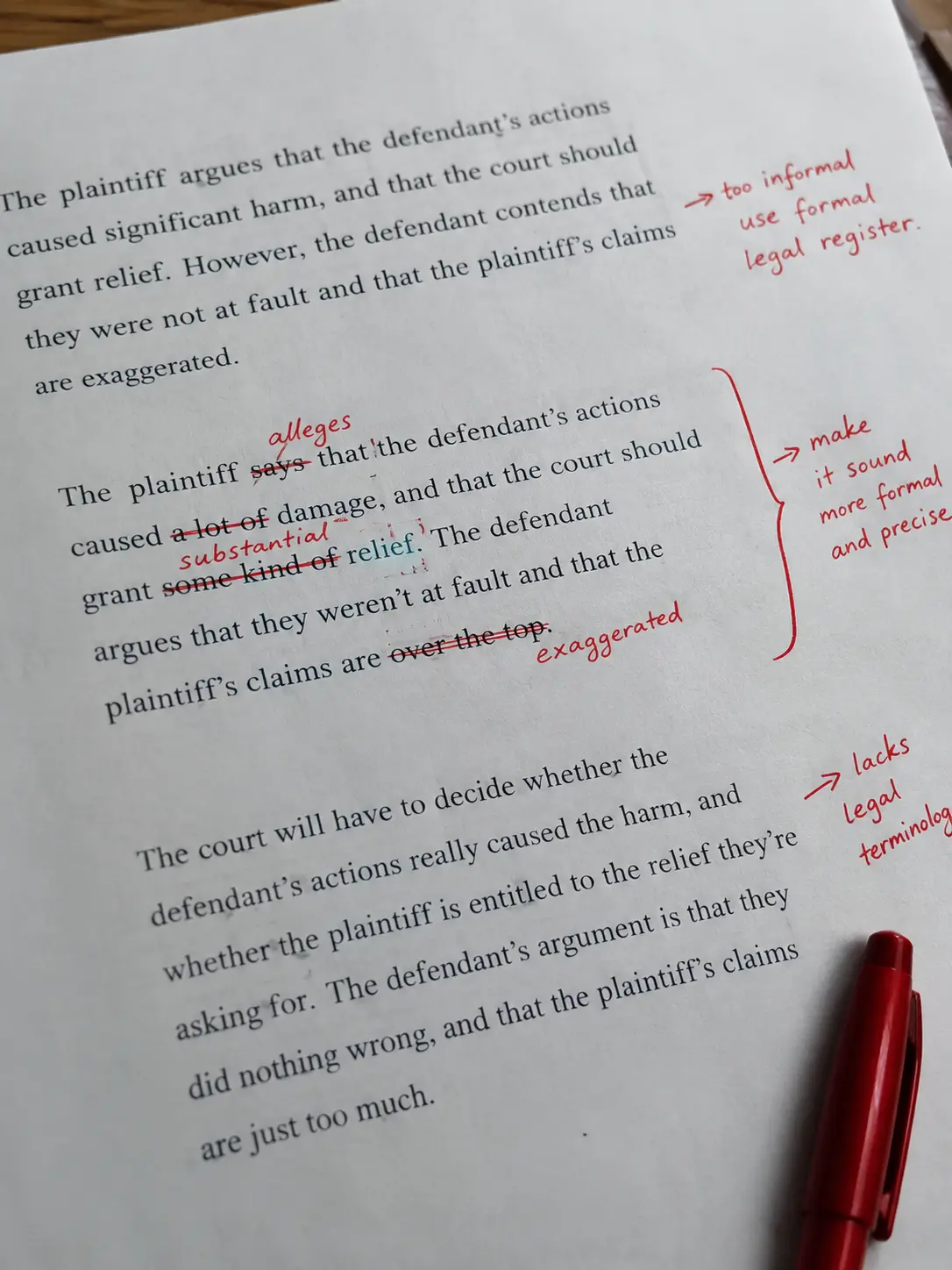
Six habits read as informal regardless of how sound the underlying legal analysis is, and are worth a dedicated proofreading pass before submission: contractions (“isn’t,” “doesn’t”); vague intensifiers (“very,” “really,” “a lot of cases” instead of a precise number or “numerous cases”); first-person opinion stated flatly instead of hedged (“I believe this is wrong” instead of “it is submitted that this reasoning is questionable”); referring to a court by an informal shorthand instead of its full or standard abbreviated name on first use; starting a sentence with “And” or “But” in formal analytical prose; and rhetorical questions used for effect (“But is this really fair?”) rather than posed and then formally answered. A closely related habit worth naming separately is gendered default language — writing “the judge…he” or “the applicant…his” as a default rather than a genuinely gender-neutral construction; many legal-writing style guides now recommend gender-neutral phrasing, and it costs nothing to write “the judge…their” or restructure the sentence to avoid the pronoun altogether.
An Illustrative Before-and-After
Informal, first draft: “I think the court got it wrong in this case because they didn’t really look at the earlier case properly, and it’s not fair to the appellant.” Revised to the expected register: “It is submitted that the court’s reasoning in the instant case is open to criticism, in that it does not adequately engage with the earlier decision of the same court on this point, and arguably produces an outcome inconsistent with the appellant’s legitimate expectation.” The content of the criticism is the same; the register is what changes, and it is the register that a panel reads as evidence of legal training.
Once your citation form and terminology are consistent, Tesify holds that consistency across every chapter as your draft grows — the same tense conventions, the same party terminology, the same citation style from Chapter One through to your conclusion. Draft your law project with Tesify — over 9,000 students and 15,000+ chapters written, 100% written by you.
Frequently asked questions
Can I use “I” anywhere in a Nigerian law final year project?
Most Nigerian law faculties expect the impersonal, hedged voice throughout the analysis and discussion chapters, though some allow limited first-person use in a methodology section describing what the researcher did. Confirm your own faculty’s convention, since it varies.
Should I write “shall” or “will” when discussing what a statute requires?
Quote the statute’s own word exactly when citing it, since that word may carry a specific legal meaning courts have interpreted. In your own analytical sentences describing what the statute requires, plain modern English such as “the Act requires” or “the provision obliges” is clearer than mimicking statutory “shall” in your own prose.
Is it wrong to refer to a court as “they”?
A court is conventionally treated as a singular, impersonal entity in legal writing: “the court held,” not “the court, they held.” Use “it” if a pronoun is needed, and prefer naming the court again over an ambiguous pronoun in a long paragraph discussing more than one court.
How formal does my introduction and background section need to be?
The same formal register applies throughout the project, including Chapter One, though the background section may carry slightly more narrative framing than the tightly structured IRAC analysis of later chapters. Avoid slipping into a conversational tone even there.
Do I italicise every Latin legal term, every time it appears?
Yes, consistently throughout, including on repeated uses — some style guides allow dropping italics after the first use of a very common term such as prima facie, but consistency matters more than which convention you pick, so state and follow one rule throughout.
What is the difference between “ratio decidendi” and “obiter dictum,” and why does the distinction matter for my writing?
The ratio decidendi is the binding legal principle a court’s decision actually rests on; an obiter dictum is a remark made in passing that is not binding, however persuasive. Misattributing a case’s ratio as obiter, or the reverse, is a substantive error that a law panel treats seriously, not just a register slip.
Can I use contractions in direct quotations from a judgment?
Yes. Quote a judgment exactly as written, including any contraction the original judge used; the formal-register rule applies to your own prose, not to material you are quoting verbatim.
Is “the writer” an acceptable substitute for “I” in Nigerian legal academic writing?
It is one accepted convention (“this writer submits that…”) alongside the more common passive-hedge form (“it is submitted that…”). Check which your specific faculty or supervisor prefers, since both are used across different Nigerian law faculties.
How do register and citation style interact at my project defence?
A panel forms an impression of your legal training from your register and citation consistency before it even reaches the substance of your argument, and inconsistent register or citation is a common line of questioning at defence — our guide to what is asked during a project defence covers the wider set of questions a panel typically raises.
Should my literature review chapter use the same formal register as my analysis chapters?
Yes, throughout the whole project, though the balance shifts: a literature review reports what sources say (more description, less argued submission), while an analysis chapter argues your own position (more “it is submitted that” hedging); our guide to writing Chapter Two covers that structural difference in more detail.