
A conceptual framework is a diagram, with a short explanation, that shows the variables in your study and the relationships you expect between them. It is built from the literature and from your own objectives. A theoretical framework, by contrast, presents an existing theory that explains why those relationships should exist. Most Nigerian Chapter Two formats expect both.
What Is a Conceptual Framework in a Final Year Project?
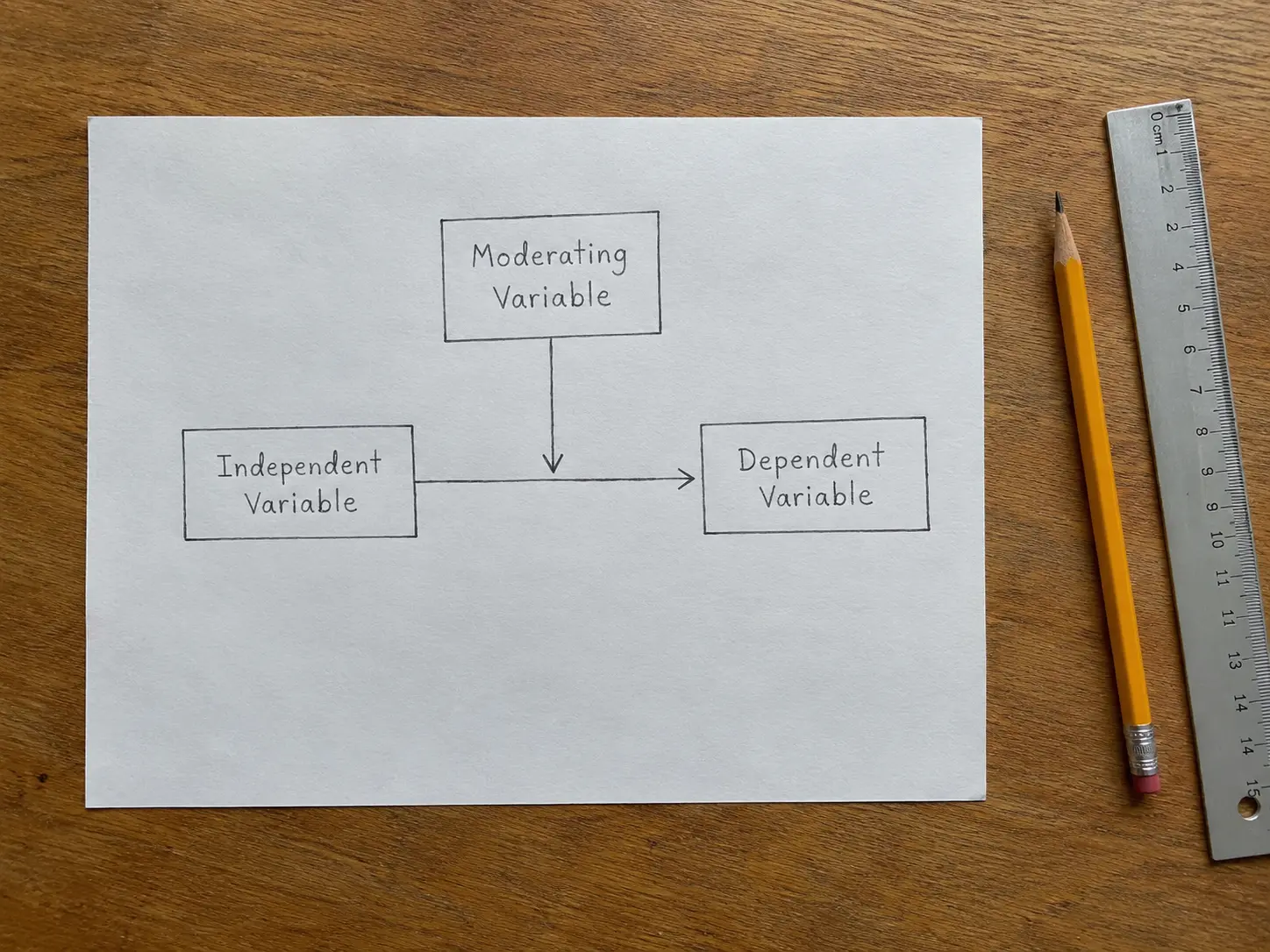
Think of it as the map of your study. Every box is a variable or concept you will measure, every arrow is a relationship you expect or want to test, and the labels tell the reader whether a variable is an independent variable, a dependent variable, a mediator, a moderator or a control. Once the map is drawn, your objectives, research questions, hypotheses and instrument all come from it, so a panel can check at a glance whether the pieces of your project fit together.
A conceptual framework is usually presented as a figure followed by two or three paragraphs. The figure gives the picture. The paragraphs explain each box in one sentence, say which authors or studies support each arrow, and state which arrows your hypotheses will test.
Researchers do not use the terms in exactly the same way, which is why students get confused. A paper in the Journal of Social Sciences by Imenda (2014) is titled “Is there a conceptual difference between theoretical and conceptual frameworks?” and Kivunja (2018), in the International Journal of Higher Education, set out to distinguish between theory, theoretical framework and conceptual framework because, as the author observed from teaching research methods, many students struggle to articulate the differences. A third paper, by Varpio and colleagues in Academic Medicine, makes the same point for health professions research: the words are often used interchangeably. The practical lesson is simple. Read your own department’s guide or a recently approved project from your department and follow how it uses the two words.
How Does a Conceptual Framework Differ From a Theoretical Framework?
| Question | Theoretical framework | Conceptual framework |
|---|---|---|
| What is it built on? | One or more established theories | The variables of your own study, drawn from theory and from previous studies |
| What does it show? | Why the relationship should exist | What the relationship is and which variables are involved |
| Typical form | A written explanation of the theory and its assumptions | A diagram with a short written explanation |
| Who owns it? | The theorist; you apply it | You; it is specific to your study |
| What follows from it? | The reasoning behind your hypotheses | Your hypotheses, variables and instrument sections |
The University of Southern California library’s writing guide defines a theoretical framework as consisting of concepts, with their definitions and reference to relevant scholarly literature, together with the existing assumptions that are being tested, and as the narrative explanation of how the researcher uses the theory and its assumptions to investigate the research problem. That explanation describes the theory side. The conceptual framework is your own picture of how the concepts connect in this particular study. For a full example of the theory side, see our guide to the theoretical framework of an education project, and for one theory built end to end, the article on Social Exchange Theory in a social work project.
Do not confuse this with the conceptual review, the section of Chapter Two where you discuss each concept in turn. The review is prose and covers the literature on each concept. The framework is the picture that comes out of it. Our article on conceptual, theoretical and empirical review examples shows how the review sections read, and the Chapter Two guide shows how all of them fit together.
Where Does the Conceptual Framework Go?
In many Nigerian project formats it sits in Chapter Two, either at the start of the chapter, as a short overview of the study before the literature, or at the end of the conceptual review, as the summary that pulls the concepts together. Some departments put the framework in Chapter One, and some ask for a single combined “theoretical and conceptual framework” section. There is no national rule, so follow your department’s guide or the layout of a recent approved project in your department. What does not change is the order of reasoning: the framework must exist before Chapter Three, because the method chapter depends on it.
How Do You Draw a Conceptual Framework in Six Steps?
- List your variables from the title and objectives. If your title is “staff training and employee productivity in selected banks”, your variables are training and productivity. Every objective should mention at least one of them.
- Assign each a role. Training is the independent variable and productivity the dependent variable. Add a moderator (something that strengthens or weakens the link, such as years of experience), a mediator (something the effect passes through, such as skill level) or a control (something you hold constant, such as bank size) only if the literature gives you a reason and you can measure it.
- Break broad variables into dimensions. If training has two dimensions you plan to measure, such as on-the-job training and classroom training, give each its own box inside the training box.
- Draw one arrow per relationship you will test. Label each arrow H1, H2 and so on. An arrow with no hypothesis is decoration, and a hypothesis with no arrow means the diagram is incomplete.
- Add the support. For every arrow, name at least one source you have actually read that supports the direction of the relationship.
- Write the explanation. One paragraph on the diagram as a whole, then one sentence per box and per arrow, using the same variable names as your objectives and your questionnaire.
Use whatever drawing tool your department accepts, such as shapes in a word processor or a presentation program. Make the figure readable in black and white and give it a number and a caption in the same style as your other figures.
What Do Worked Examples Look Like?
The three examples below are illustrative. The variables are typical for the field, but the sources and measures are yours to supply and verify.
Business administration: training and productivity
| Box | Role | Measured by (illustrative) |
|---|---|---|
| Staff training (on-the-job, classroom) | Independent | Questionnaire items on frequency and type of training |
| Employee productivity | Dependent | Accounts opened per officer per month from branch returns |
| Years of experience | Moderator | Number of years in the bank, from the staff record |
H1: training has a significant effect on productivity. H2: the effect of training on productivity differs by years of experience. The diagram has two arrows, so there are two hypotheses, and the instrument has to capture all three variables.
Nursing: antenatal care uptake
Independent variables might be a woman’s education, distance to the health facility and attitude of health workers; the dependent variable is attendance at antenatal visits. Each independent variable has its own arrow to the dependent variable, and each arrow carries a hypothesis. A control such as parity can be added if the literature supports it and your questionnaire captures it.
Education: teaching method and achievement
The independent variable is the teaching method (two levels, for example activity-based and lecture), the dependent variable is achievement score on a post-test, and a possible moderator is the students’ gender. In an experimental design the framework also shows the pre-test as a control. This pairs naturally with the variables and hypotheses guidance in our article on the variables, hypotheses and operationalisation table, which turns each box into an instrument item.

How Does the Framework Connect to Chapters One, Three and Four?
The framework is the thread that holds the project together. Your objectives in Chapter One name the variables. The framework in Chapter Two connects them. The research design and instrument in Chapter Three measure them, and each hypothesis from an arrow is tested in Chapter Four with a stated test. If a variable appears in the diagram but not in the questionnaire, or in the questionnaire but not in the diagram, the panel will find it. Our guide to the definition of terms shows how to define each box in a way that matches the instrument.
What Mistakes Do Panels Flag?
- Copying a diagram from a past project or a journal article without adapting it to your own variables.
- Arrows without hypotheses, or hypotheses without arrows.
- Too many variables. A final year project rarely needs more than a handful of boxes, because every box must be measured.
- No source behind an arrow. A relationship asserted without literature looks like a guess.
- Calling a theory a conceptual framework and presenting no diagram of your own variables.
- Different names in different places. If the diagram says “productivity” and the questionnaire says “work output”, pick one.
- A figure with no explanation. The diagram needs the paragraphs that interpret it.
A Checklist Before You Show Your Supervisor
- Every variable in the title and objectives appears as a box.
- Each box has a role and a way of being measured.
- Each arrow carries a hypothesis label and a supporting source you have read.
- The figure is numbered, captioned and readable in black and white.
- The explanation uses the same variable names as the instrument.
- The theoretical framework, which explains the why, sits beside it.
Tesify helps you structure and organise your project, and the text is 100% written by you. Start your project with Tesify — 9,000+ students have written 15,000+ chapters with Tesify.
Frequently asked questions
What is a conceptual framework in simple terms?
It is the diagram, with a short explanation, that shows the variables in your study and how you expect them to relate, built from the literature and your objectives.
Is the conceptual framework the same as the theoretical framework?
No. The theoretical framework presents an existing theory and its assumptions. The conceptual framework shows the variables of your own study and the relationships between them. Researchers sometimes use the words loosely, so follow your department’s convention.
Where does the conceptual framework go in a Nigerian project?
Often in Chapter Two, before or after the conceptual review, though some departments place it in Chapter One or combine it with the theoretical framework. Check your department’s guide.
Do I need a diagram?
Most departments expect one, because it lets the panel see the whole study at a glance. Even where it is optional, a diagram usually makes the section easier to defend.
How many variables should the framework contain?
Only as many as you can define, justify from the literature and measure. For a final year project that is usually a small number, and a long diagram is harder to defend than a short one.
Can I copy a conceptual framework from a journal article?
You can adapt one if you cite it and change it to match your own variables and objectives. Copying it unchanged will not fit your instrument, and a panel will ask how each box is measured.
What is the difference between a mediator and a moderator?
A mediator is a variable through which the independent variable has its effect, such as skill level between training and productivity. A moderator is a variable that strengthens or weakens the relationship, such as years of experience.
Does a descriptive study need a conceptual framework?
It still helps. Even without hypotheses, a simple diagram of the concepts you describe and how you group them shows the panel the logic behind your objectives.
How long should the written explanation be?
Short. One paragraph on the diagram as a whole and a sentence or two on each box and arrow is usually enough, with the detail left to the conceptual review.