
AI in education is one of the most talked-about topic areas for Nigerian final year projects right now, and the reason is simple: every education faculty has a live, unresolved question about how AI is actually changing teaching and learning in their own classrooms, and a 2026 project that studies it is more current and more citable than a repeat of an older, already-answered topic.
Why an AI-in-education topic is different from a general education project topics list
Our broader list of forty education project topics covers the full range of approvable education topics by school level and permission requirement. This list narrows to one specific, current lens — artificial intelligence — crossed with education, because AI-in-education topics carry two advantages a general topic does not: the literature is recent enough that you are genuinely contributing to an open question rather than repeating settled ground, and the questions are live ones for schools and teacher-education departments working out how to respond to AI. Read both lists together: the general list for permission and data-access planning, this one for the specific AI angle.

Topics on teacher AI adoption and readiness
- Teachers’ awareness and use of AI tools for lesson planning in [named LGA/school type]. RQ: What proportion of teachers report using AI tools for lesson preparation, and what factors predict adoption versus avoidance?
- Perceived barriers to AI adoption among secondary school teachers. RQ: What barriers (training, device access, policy uncertainty) do teachers report as most limiting their AI use?
- AI literacy training needs among in-service teachers. RQ: What AI-related skills do teachers self-report as lacking, and how does this vary by subject area or years of experience?
- Teacher attitudes toward AI grading and assessment tools. RQ: How do teachers perceive the accuracy and fairness of AI-assisted marking compared to their own judgement?
Topics on student-facing AI use and learning outcomes
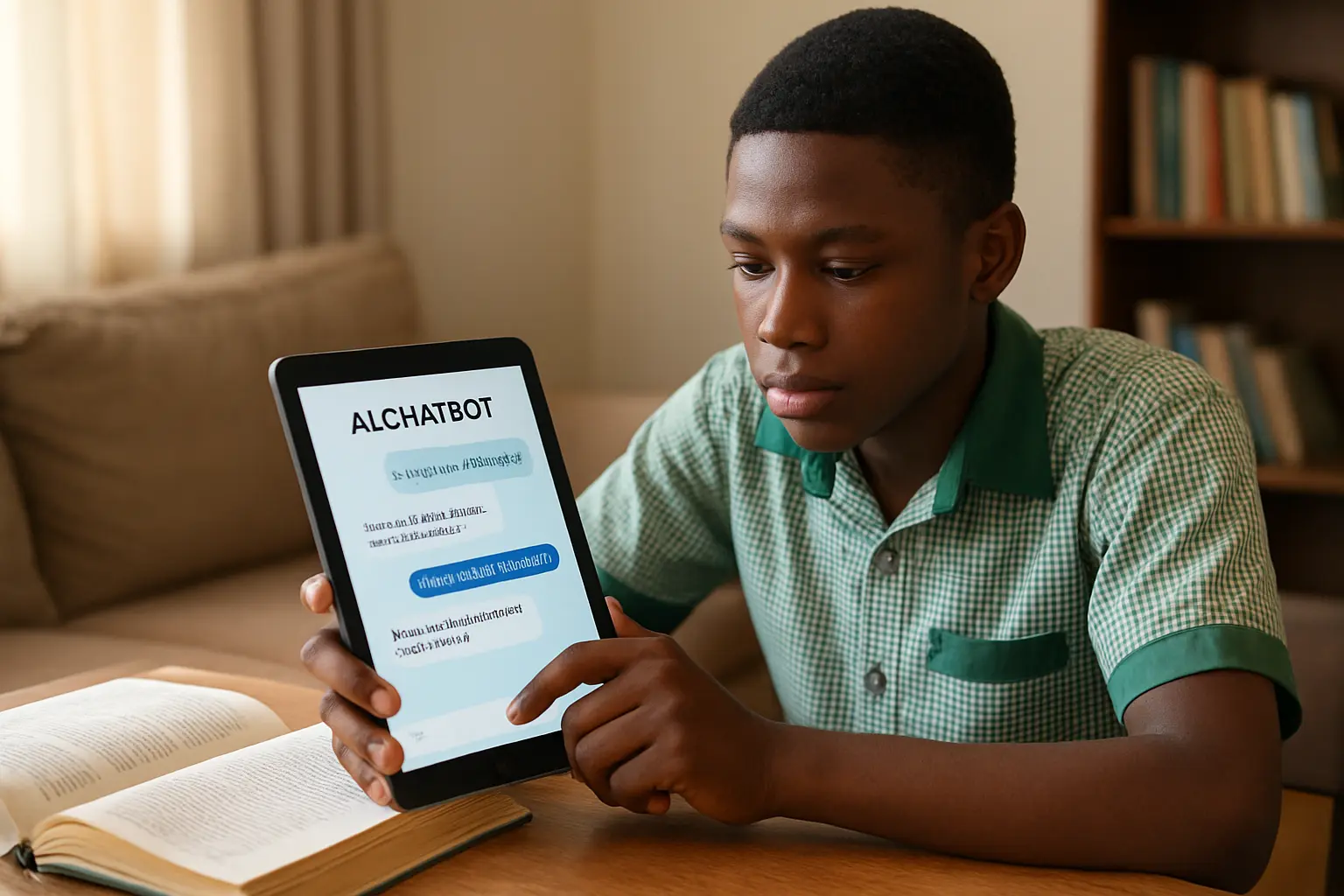
- Use of AI chatbots for homework help among secondary school students. RQ: What proportion of students report using an AI chatbot for schoolwork, and what subjects do they use it for most?
- AI tutoring tools and academic performance in a named subject. RQ: Is there a relationship between reported AI tutoring tool use and performance in [subject] among a defined student group?
- Student perceptions of personalised AI learning platforms. RQ: How do students describe the usefulness of an adaptive learning platform compared to standard classroom instruction?
- Academic integrity concerns around AI use among secondary school students. RQ: What do students report as acceptable versus unacceptable AI use for schoolwork, and how does this align with their school’s actual policy, if one exists?
Topics on curriculum, policy and institutional readiness
- Integration of AI literacy into the basic education curriculum. RQ: To what extent do current scheme-of-work documents at a named school level address AI or digital literacy explicitly?
- School administrators’ readiness to formulate AI-use policy. RQ: What proportion of surveyed schools have any written policy on student or staff AI use, and what do administrators cite as barriers to creating one?
- Comparative study of AI adoption between public and private secondary schools. RQ: Does AI tool access and use differ significantly between public and private school students in a named area, and what explains the gap?
- Parental attitudes toward AI use in their children’s education. RQ: What concerns and expectations do parents report about AI tools in their children’s schooling?
Topics on equity, access and the digital divide
- The urban-rural digital divide in AI-enabled learning access. RQ: What differences exist in device ownership, internet access and reported AI tool use between urban and rural secondary school students in a named state?
- Gender differences in AI tool adoption among students. RQ: Do male and female students report different levels and types of AI tool use for schoolwork, and what factors explain any difference found?
- Cost and access barriers to AI-enabled learning tools among low-income students. RQ: What specific cost or access barriers do students report as limiting their use of AI-enabled study tools?
How to narrow one of these into an approvable, well-scoped topic
Every topic above is a starting point, not a finished title — narrow it the same way any strong Nigerian education topic gets narrowed: name a specific school level, a specific local government area or named schools, and a specific, measurable outcome rather than a broad claim. “AI and education in Nigeria” is unresearchable in one semester; “Teachers’ awareness and use of AI tools for lesson planning among secondary school teachers in [named LGA]” is a topic your department can actually approve, with a countable population (the LGA’s secondary school teachers) and a measurable variable (awareness and reported use, via a structured questionnaire). Once you have narrowed to a specific title, run the same duplication check every student should before submitting three ranked choices: our guide to checking whether your topic has already been studied in your department covers exactly how, and — given how many students are drawn to AI topics right now — this check matters more here than on a less trending topic family.
A fully worked example: from topic to research question set
Take topic 1 from the list above and narrow it fully. Title: “Teachers’ Awareness and Use of AI Tools for Lesson Planning Among Secondary School Teachers in [Named LGA], [State].” Objectives: (1) assess teachers’ level of awareness of AI lesson-planning tools, (2) assess the extent of actual use among aware teachers, (3) identify the factors that predict use versus non-use, (4) determine the specific barriers non-users report. Research questions: “What is the level of awareness of AI lesson-planning tools among secondary school teachers in [LGA]? What proportion of aware teachers report actually using such tools? What factors predict use?” Hypothesis: “There is no significant relationship between years of teaching experience and AI tool adoption among secondary school teachers in [LGA].” This full progression — title, objectives, questions, hypothesis, each one narrower and more specific than the last — is the same shape every topic on this list needs before it becomes a workable Chapter One.
Ethical considerations specific to researching AI use in schools
A study surveying teachers or students about AI use in their own school still needs the standard institutional and, where minors are directly involved, parental consent process any Nigerian education study requires — our guide to ethics approval for a Nigerian final year project, written for a different field but covering the same institutional review logic most Nigerian faculties apply, sets out what a complete application typically needs. One consideration specific to this topic family: framing survey questions neutrally rather than presuming AI use is either universally beneficial or universally risky, since a leading question here (common when researchers hold a strong prior view on AI in education) is one of the more frequent instrument faults a panel catches on this exact topic family. If your study collects any data about specific students’ AI-assisted work or grades, treat that as sensitive academic data under the same Nigeria Data Protection Act 2023 considerations any student-record-based Nigerian study now has to account for.
What theoretical framework fits an AI-in-education topic?
The Technology Acceptance Model (TAM) — perceived usefulness and perceived ease of use predicting adoption intention — fits most AI-adoption topics on this list cleanly, whether the adopter is a teacher or a student. For topics on AI’s effect on learning outcomes specifically, constructivist or self-regulated learning frameworks fit better, since the research question is about learning process rather than tool adoption. Choose the framework whose constructs actually match your named variables, the same rule that applies to any Nigerian final year project’s theoretical framework chapter — our guide to writing the theoretical framework of an education project covers how to build the full write-up around whichever theory fits your specific variables, with a worked example you can adapt.
How many topics from this list can one department accept in a single session?
There is no fixed cap, but supervisors increasingly flag near-identical AI-adoption topics submitted by multiple students in the same session, precisely because this topic family has become so popular so quickly. Differentiate genuinely — a different school level, a different subject area, a different local government, or a different specific AI tool category (tutoring chatbots versus adaptive learning platforms versus AI grading tools are three distinct mechanisms, not interchangeable labels for “AI”) — rather than submitting a title that swaps one word from a classmate’s already-approved topic.
Frequently asked questions
Is an AI-in-education topic harder to research than a traditional education topic?
Not necessarily — most of these topics use the same survey-based design and validated-instrument logic as any other education project. What differs is the literature review, which draws on more recent sources since the field is moving quickly, so budget extra time for literature currency rather than assuming an older textbook covers it.
Do I need special permission to study AI use in a school?
The same permission process applies as any school-based education project — head teacher or school authority approval, and parental consent if minors are directly surveyed. Our general topics list covers the permission layer these topics also need.
Can I combine an AI topic with a specific subject, like mathematics or English?
Yes, and this often produces a stronger, more specific topic — “AI tutoring tool use and performance in mathematics among JSS3 students” is more approvable and more measurable than a subject-agnostic version of the same question.
Is this topic list only for education students, or can other departments use it?
These specific topics are scoped to education faculties, but the AI-adoption research pattern (awareness, use, barriers, outcomes) applies to any department studying AI adoption in its own professional context — adapt the population and setting to your own field.
How current does my literature review need to be for an AI-in-education topic?
Given how quickly AI tools and adoption patterns change, prioritise sources from the last two to three years wherever possible, and state explicitly in your review if a foundational theory or older study is included for its theoretical rather than current-data value.
Should I name specific AI tools (like a particular chatbot) in my title and questionnaire?
Naming a category (AI chatbots, adaptive learning platforms) rather than one specific branded product usually ages better across your writing timeline, since tool popularity shifts quickly — but if your research question genuinely concerns one specific, widely adopted tool in your context, name it and note in your limitations that findings may not generalise to other tools in the same category.
Is a mixed-methods design common for these topics?
Yes — a quantitative survey on adoption levels paired with a small number of qualitative interviews exploring why teachers or students adopted or avoided AI tools is a common, well-regarded design for this topic family, since the “why” behind an adoption pattern often needs more than a Likert scale can capture.
Tesify helps you narrow an AI-in-education topic into an approvable research question, build your literature review from current sources, and keep your objectives, hypothesis and instrument consistent across chapters — all from the free plan, no card required.