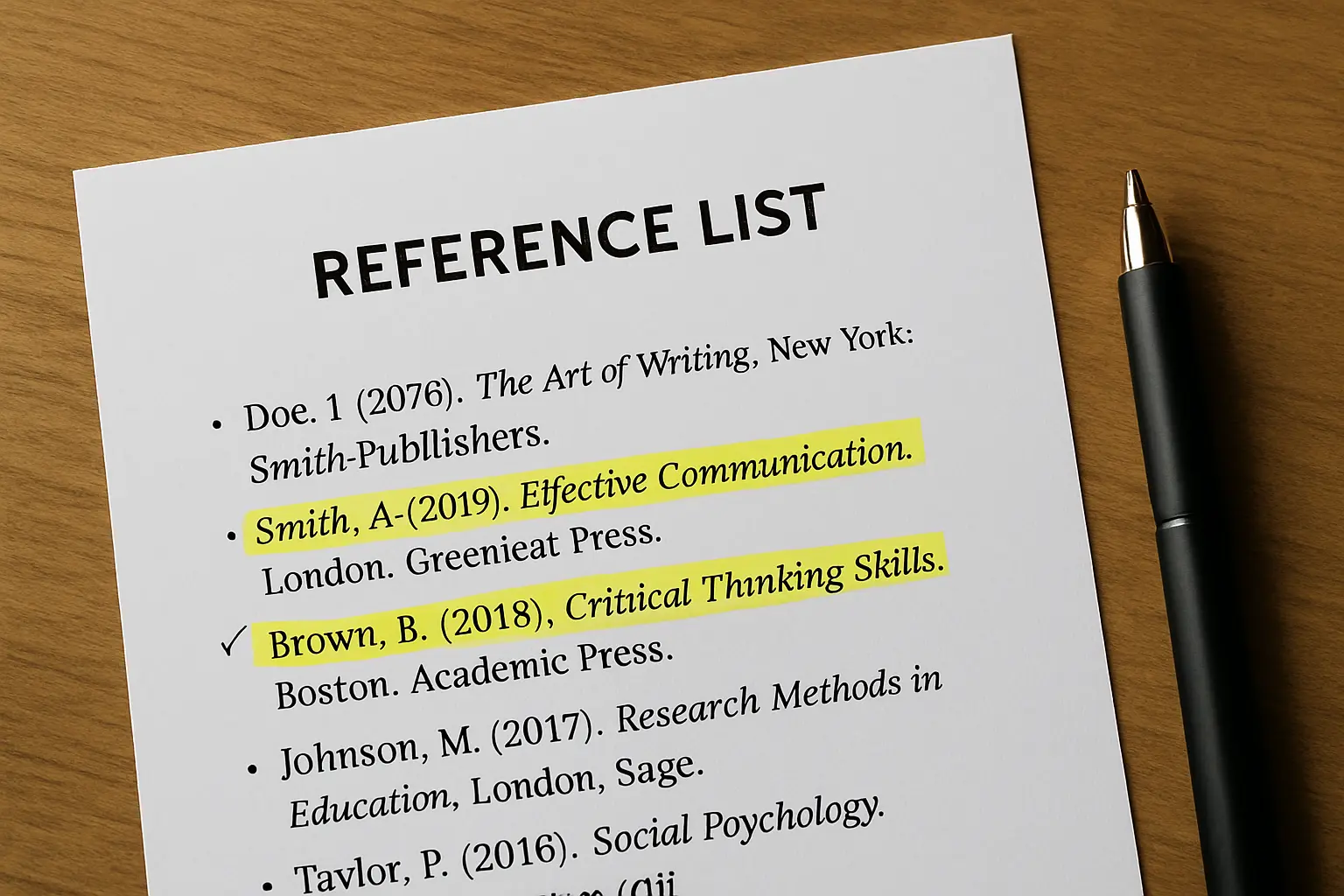
Your Chapter Two came back again. Not for grammar, not for referencing — the corrections sit on the citations themselves, and you have started searching for something that will just write the review for you. Before you do that, read ten of your own sentences. The fault is almost always one word in each, and it is the verb.
Start free in Tesify and keep every source attached to the claim it supports
A generated literature review will not fix this. It produces the same fault at higher speed, because the fault is a judgement about how strongly each study proved its point, and that judgement can only be made by somebody who has opened the study. What follows is the actual skill, in the form your supervisor is marking.
What it costs you to leave this alone
Two things, and the second is the expensive one.
Supervision cycles. A chapter returned for citation problems is a chapter returned, and in a Nigerian department a cycle is rarely less than a fortnight. Two of those is a month you did not have.
The first question at your defence. A panel that reads Okonkwo (2021) proved that training increases productivity will open by asking what Okonkwo actually did. If the answer is a questionnaire administered to eighty staff of one bank, the word proved has just cost you the opening exchange, and it will not be the last question about it. That verb is a claim you made, not one Okonkwo made.
The three bands, which is the whole idea
Every verb you use to introduce a source sits in one of three bands. Your supervisor and your panel react to the band, never to the individual word.
- Neutral — you are reporting what a study did, taking no position on whether it was right: stated, reported, described, examined, investigated, surveyed, measured, observed, noted.
- Tentative — the study points somewhere without settling it: suggested, indicated, implied, proposed, posited, argued, maintained, contended.
- Strong — you are endorsing the finding as established: demonstrated, established, confirmed, proved, revealed, showed.
Most Nigerian projects use one band for everything, and it is usually the strong one. That is what produces a chapter in which forty studies all appear to have settled their questions permanently, which is exactly the impression a panel will test.
There is a fourth band worth knowing: claimed, alleged, purported distance you from a source. They are legitimate, but only if the next sentence says why — a small sample, an unvalidated instrument, a conclusion the data does not carry. Used alone they read as an insult you did not justify.

Take the band from the study’s design, not from its abstract
This is the mechanical part, and it removes most of the red ink on its own.
| What the study you are citing actually did | Band it licenses | Verbs that fit | Verb that overreaches |
|---|---|---|---|
| Descriptive survey | Neutral | reported, described, found a level of | proved, demonstrated |
| Correlational | Neutral to tentative | reported an association, found a relationship | showed that X causes Y |
| Causal-comparative | Neutral to tentative | found a difference, reported higher scores among | established the effect of |
| Quasi-experimental | Strong is available | demonstrated, showed an effect of | proved |
| Case study of one organisation | Neutral to tentative | described, identified, explored | found that Nigerian firms |
| Systematic review | Strong is available | synthesised, concluded across studies | discovered |
| Conceptual or theoretical paper | Tentative | argued, proposed, contended, theorised | found, showed |
Notice that no single undergraduate survey reaches the strong band, however large the sample. If you cannot tell which design a source used, that is not a verb problem — you have not read its methodology, and that is a much larger correction than the one you were trying to make.
Note also that this table is about other people’s studies. The parallel question of how strongly you may state your own results is a separate decision, set out in the guide to how strongly you can state your findings in Chapter Five.
Do not inherit the author’s overclaim
Authors overstate their own work constantly. A paper reporting a weak correlation of r = .21 will often conclude in its own abstract that the variable significantly influences the outcome. Copy that verb and you have adopted their overclaim as yours, and your panel will question you about it rather than them.
Read the results table, not the abstract. Then write:
Adeyemi (2022) reported a weak positive relationship between training frequency and employee productivity (r = .21, p = .03) among 180 staff of three commercial banks in Enugu.
rather than:
Adeyemi (2022) demonstrated that training significantly influences employee productivity.
The second sentence is not a shorter version of the first. It has promoted an association into an influence and a weak effect into a demonstration, and both promotions happened inside the verb.
The double frame, which is the most common single error
This one comes from speech rather than carelessness, and almost every Nigerian Chapter Two contains it:
✗ According to Okafor (2021), he stated that training improves productivity.
✗ In the study of Okafor (2021), it was found by him that…
✓ Okafor (2021) reported that training was associated with higher productivity.
✓ Training was associated with higher productivity (Okafor, 2021).
According to X is already a reporting frame. Adding he stated that reports the same thing twice and leaves the sentence with no clear subject. Choose one. The second correct form is worth using deliberately, because it puts the finding in the subject position and the citation out of the way.
The related habit: the study of Okafor (2021) and in the study carried out by Okafor (2021) are both longer ways of writing Okafor (2021). Across a forty-page review that is several hundred words a panel reads as padding.
Rotate inside the band, never across it
Repeating stated twenty times is a real fault. The usual cure makes it worse: the writer opens a thesaurus and drifts between bands without noticing. Noted, observed and reported are interchangeable. Revealed and established are not interchangeable with them, because they change your position.
- Neutral rotation: reported → noted → described → examined → observed.
- Tentative rotation: suggested → indicated → proposed → implied.
- Strong rotation: demonstrated → established → confirmed.
A word on opined, which appears in a great many Nigerian projects. It is understood, but it is journalese and rare in current academic English, and it tells the reader nothing about how strongly the source established anything. It belongs with the other register habits collected in the comparison of which writing checkers actually catch Nigerian academic English — where you will also find the reason no grammar checker will ever flag it for you.
The twenty-minute audit, tonight
- Open Chapter Two. Use Find on each of these one at a time: proved, demonstrated, showed, revealed, established, confirmed.
- For every hit, open the source and read its methodology. Survey or correlational? Downgrade the verb.
- Find According to. Delete any second reporting verb in the same sentence.
- Find the study of and carried out by. Cut both wherever the author’s name alone will serve.
- Find opined. Replace each with a verb chosen from the band the study licenses.
- Read one section aloud. If the same verb appears three times in a paragraph, rotate inside the band.
Steps 1 and 2 are the ones that change your mark. The rest is tidying. None of this requires you to read anything new — every source is one you have already cited.
Where Tesify fits, and where it does not
It will not make this judgement for you, and you should be suspicious of anything that says it will. What it removes is the reason the judgement is so expensive to make.
- Start on the free plan. That is enough to bring your existing chapters into one connected project and see the whole review at once.
- Every citation stays attached to the source it came from. When you need to check whether demonstrated is defensible, the methodology is one click away instead of an evening of hunting through a downloads folder.
- The chapters stay connected. The verb you used about Adeyemi in Chapter Two and the comparison you draw to Adeyemi in Chapter Four are visible together, which is where inconsistencies actually surface.
- The reference list is built from what you cited. The reconciliation pass stops being a separate job.
Over 9,000 students have written more than 15,000 chapters with it, and every word is still written by you. For the architecture of the chapter itself — conceptual review, theoretical framework, empirical review and the gap — the sections and their order are set out in the guide to writing Chapter Two section by section, and the sentences that join it to the chapters either side are in the guide to writing the sentences that join your chapters together.
Stop hunting for the methodology every time you check a verb
Bring your chapters and your sources into one project, run the six-step audit above, and hand your supervisor a Chapter Two whose corrections are about substance.
Frequently asked questions
Can an AI write my literature review for me?
It must not. Submitting review text you did not write is misconduct in every Nigerian university, and chatbots also fabricate references, which is caught at defence. Where AI legitimately helps is structure, feedback on your own drafts and keeping citations attached to sources — the boundary is drawn in the guide to whether you can use AI to write your final year project in Nigeria.
What is a reporting verb?
The verb that introduces what a source did or said — reported, suggested, demonstrated, argued. It carries your position on how strongly that source established its finding, which is why two verbs can cite the same paper and commit you to different claims.
Why does my supervisor keep querying my citations?
Usually because the verbs are stronger than the studies behind them. A descriptive survey that is said to have proved something is the most common instance, and it is a judgement error rather than a language error.
Can I write that a study proved something?
Almost never in an undergraduate reference list. Proof belongs to replicated experimental evidence. A descriptive survey reports levels and a correlational study reports relationships; neither proves anything.
Is opined acceptable in a Nigerian project?
It is understood but it reads as journalese, it is rare in current academic English, and it says nothing about how strongly the source established its point. Replace it with a verb from the band the study licenses.
What is wrong with According to Okafor (2021), he stated that?
It reports the same thing twice. According to X is already a reporting frame, so adding he stated that leaves the sentence without a clear subject. Use one frame or the other.
How do I avoid repeating the same verb?
Rotate within the band you already chose rather than opening a thesaurus. Reported, noted, described and observed are interchangeable; revealed and established are not, because they change your stance.
Does this apply to Chapter Four as well?
Yes, and it matters more there, because you are reporting your own study. Keep your verbs no stronger than your own statistics and hedge the comparison between your result and the literature.
How much does Tesify cost in naira?
There is a free plan, which is the right place to start. Current plans and naira pricing are published on the Tesify site rather than quoted here, so you are reading today’s figure rather than one written months ago.
Will my department treat using Tesify as cheating?
Tesify is built for honest writing: the research, the sources and the argument stay yours, and every word is still written by you. Your department’s academic integrity policy governs it, and a growing number of Nigerian departments now ask for a declaration of AI assistance.
Will fixing my verbs reduce my similarity score?
Not directly, and treat any tool promising that as a risk rather than a solution. Similarity is about matched text, not verb choice. What verb work does is remove the corrections your supervisor is writing and the questions your panel would otherwise open with.
How long does the audit take?
About twenty minutes for a full Chapter Two, because every source in it is one you have already cited. The two steps that change your mark are searching for the strong verbs and checking each one against the study’s methodology.