
A digital marketing project’s research questions and hypotheses use variables specific to online channels — engagement rate, click-through rate, influencer credibility, social media brand awareness — not the generic price-promotion-place-product variables a traditional marketing project uses, because digital marketing’s actual mechanism runs through platform-specific metrics a 4Ps framework was never built to capture.
How is a digital marketing project different from a general marketing project?
General marketing projects, the kind our existing guide to research questions and hypotheses for a marketing project covers, typically test consumer outcomes against the traditional marketing mix — price sensitivity, promotional spend, distribution channel, product attributes. A digital marketing project instead tests consumer response to a specific online channel’s mechanics: does a brand’s Instagram posting frequency relate to engagement, does an influencer’s perceived credibility relate to purchase intention, does email open rate predict conversion. The variables live inside platform analytics and online consumer behaviour theory, not the classic marketing-mix literature — which means your theoretical framework, your instrument, and your data source are all different from a general marketing project even when the underlying research design (a survey, a correlational study) looks similar on paper.
What are the most common digital marketing variables Nigerian departments accept?
Six variables recur across approved Nigerian digital marketing projects. Social media marketing intensity — frequency and reach of a brand’s posting activity. Engagement rate — likes, comments, shares and saves relative to reach or follower count. Influencer credibility — the perceived trustworthiness, expertise and attractiveness of an influencer endorsing a product, usually drawn from source credibility theory. Brand awareness — recall and recognition of a brand through digital touchpoints specifically, distinct from offline brand awareness. Purchase intention — the dependent variable most digital marketing studies converge on, the stated likelihood a consumer will buy after digital exposure. Electronic word-of-mouth (eWOM) — the volume and valence of online reviews and recommendations, and its relationship to consumer trust and buying decisions.
What does a worked digital marketing hypothesis look like?
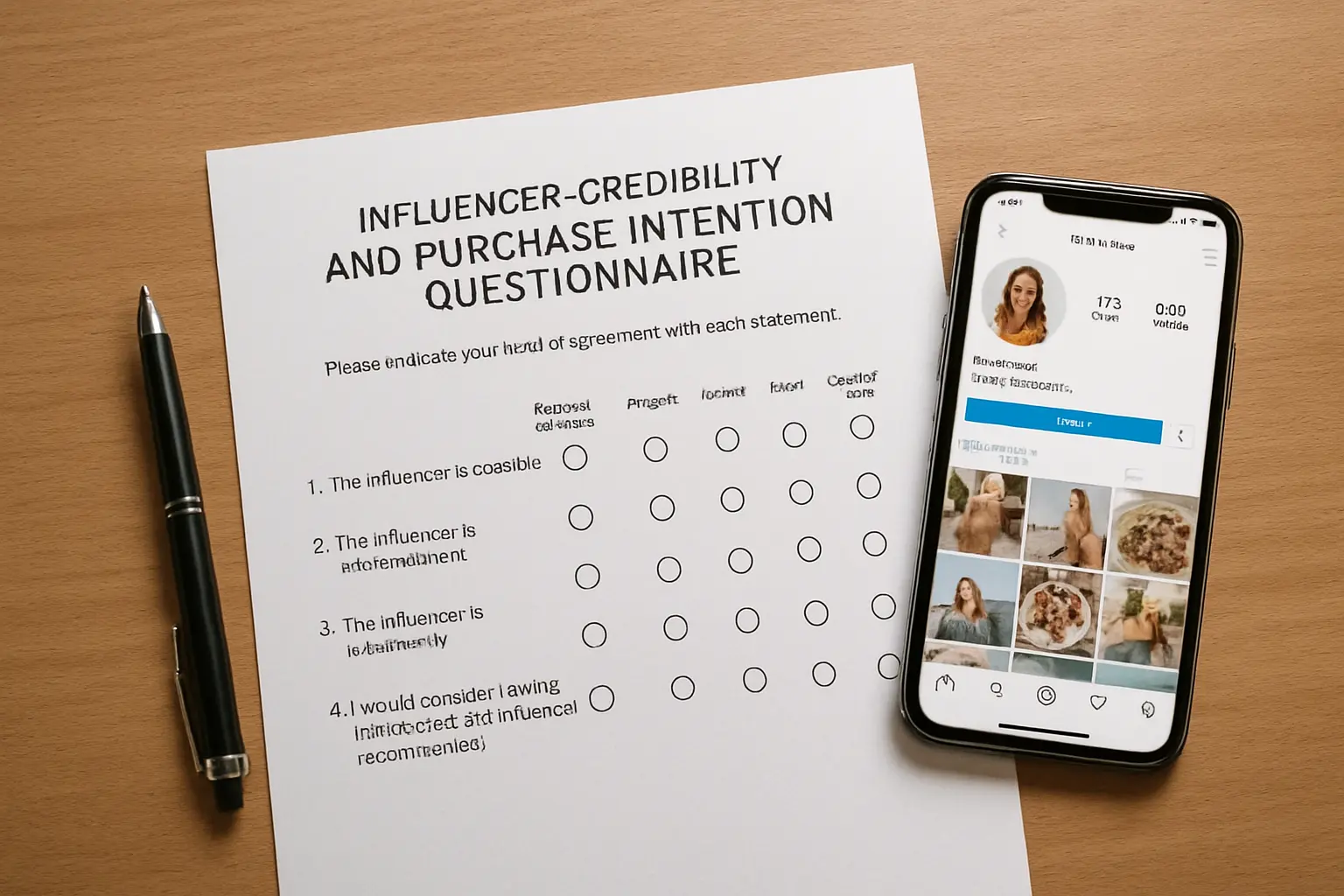
Take one fully worked example: “Influencer Marketing Credibility and Purchase Intention Among Nigerian Social Media Users.” Objective: to examine the relationship between perceived influencer credibility and purchase intention among Nigerian Instagram users aged 18–35. Research question: “Is there a significant relationship between perceived influencer credibility and purchase intention?” Null hypothesis: “There is no significant relationship between perceived influencer credibility and purchase intention among Nigerian social media users.” The independent variable, influencer credibility, is typically operationalised using an adapted source credibility scale (trustworthiness, expertise, attractiveness sub-dimensions); the dependent variable, purchase intention, using a short, validated purchase-intention scale. This pairing determines the statistical test: two continuous scale scores call for a Pearson correlation, or a regression if you are also testing which credibility dimension predicts intention most strongly.
How do you write the objectives for a digital marketing project?
Objectives should name the specific platform and the specific mechanism, not “social media” in general. “To examine the effect of social media marketing on consumer behaviour” is too broad to design an instrument against — which platform, which behaviour, which mechanism. “To determine the relationship between Instagram influencer credibility and purchase intention among Nigerian university students” is specific enough that your Chapter Three instrument writes itself from the objective. Four objectives is a common, manageable count at undergraduate level: (1) assess the level of the independent variable among your sample, (2) assess the level of the dependent variable, (3) examine the relationship between them, (4) determine which sub-dimension or demographic factor moderates that relationship.

What theoretical frameworks fit a digital marketing project?
Three theories recur across Nigerian digital marketing research and map cleanly onto the variables above. Source Credibility Theory (Hovland and colleagues) fits any study involving influencer or endorser effects, explaining why a message’s perceived source shapes its persuasive power. The Technology Acceptance Model (TAM) fits studies of consumer adoption of a digital channel or platform itself — perceived usefulness and perceived ease of use predicting adoption intention. Elaboration Likelihood Model (ELM) fits studies distinguishing how consumers process an ad or influencer message centrally (evaluating actual argument quality) versus peripherally (reacting to surface cues like follower count or production quality). Choose the one whose constructs genuinely map onto your named variables, not the one most commonly cited in your department’s other projects.
What instrument measures digital marketing variables?
Most digital marketing variables are measured with adapted Likert-scale items drawn from established marketing and consumer-behaviour literature, rather than platform-native analytics data, because most undergraduate projects survey consumer perception rather than pull actual platform API data. A source-credibility scale adapted from Ohanian’s classic instrument, a purchase-intention scale adapted from established consumer-behaviour research, and a brand-awareness scale are the most commonly reused instruments — state the adaptation and original source explicitly in Chapter Three, and pilot-test with 10% of your sample before full data collection, the same as any other instrument-based project.
How do you choose your sample for a digital marketing project?
Sample choice follows directly from your named platform and mechanism, not a generic “Nigerian consumers” population. A study of Instagram influencer credibility should sample actual Instagram users who follow at least one influencer in the relevant product category, not a general student population that may or may not use the platform — a filter question early in your questionnaire (“Do you follow any influencers on Instagram?”) screens out respondents who cannot meaningfully answer your later items. Sample size follows the same Taro Yamane or Krejcie-and-Morgan logic as any other survey-based Nigerian final year project once you have a defensible population figure; the harder part for a digital marketing study is usually defining that population precisely enough to justify a number, since “everyone on Instagram” is not a countable population the way a named organisation’s staff register is. Where the population cannot be precisely counted, state that explicitly and use a purposive or convenience sampling justification rather than presenting an invented population figure as though it were exact.
How does reliability and validity work for an adapted digital marketing scale?
An adapted scale — a source-credibility instrument built for celebrity endorsement research, repurposed for social media influencers, for example — still needs its own reliability check in your specific sample, because reliability is a property of how a scale performs with your respondents, not a fixed property of the scale itself. Pilot the adapted instrument with 10% of your intended sample and report the Cronbach’s alpha you actually obtained for each sub-dimension separately (trustworthiness, expertise, attractiveness), not a single combined figure that can mask one weak sub-dimension. Our guide to what counts as a good Cronbach’s alpha covers the bands and what to do if your pilot figure for one sub-dimension comes back below the usual 0.70 threshold — often a reverse-scored item that was not correctly recoded.
Which statistical test fits a digital marketing hypothesis?
Once your variables are operationalised as scale scores, the test follows the same logic as any other quantitative Nigerian project: two continuous variables call for a Pearson correlation to test a stated relationship, and a simple or multiple regression to test which of several predictors (credibility sub-dimensions, engagement metrics) most strongly predicts your dependent variable. A comparison across categories — purchase intention differing by platform, or by whether a respondent follows influencers or not — calls for a t-test or ANOVA instead. Our general guide to choosing the right statistical test for a Nigerian final year project covers the full decision logic; a digital marketing project’s variables are almost always continuous scale scores, which narrows the choice to correlation, regression, or a mean-comparison test depending on exactly what your research question asks.
Common mistakes in a Nigerian digital marketing project’s variables
- Naming “social media” as the independent variable without a specific platform. Instagram, TikTok and X have different mechanics; a variable defined at the “social media” level cannot be operationalised precisely.
- Confusing reach, impressions and engagement. These are three distinct metrics; using them interchangeably in your objectives produces an instrument that cannot cleanly measure any one of them.
- Borrowing a theoretical framework whose constructs do not match the variables. The Technology Acceptance Model explains platform adoption, not influencer persuasion — check that your chosen theory’s actual constructs map onto your named variables before committing to it.
- An unfiltered sample that cannot answer platform-specific questions. Surveying respondents who do not use the platform you are studying produces unusable or guessed responses to your core items.
- A purchase-intention item with no time frame. “Would you buy this product” is vaguer than “How likely are you to purchase this product within the next month” — specificity here improves both your instrument’s validity and its face credibility to a panel.
Frequently asked questions
Can I use actual platform analytics data instead of a survey?
Some digital marketing projects do pull real engagement metrics from a brand’s public social media account rather than surveying consumers, but this shifts your design toward content or trend analysis rather than a consumer-perception survey, and needs a different methodology chapter — confirm with your supervisor which design your department expects before choosing.
What is the difference between engagement rate and reach?
Reach counts how many unique accounts saw a post; engagement rate measures the proportion of that audience who actually interacted with it (liked, commented, shared). A post can have high reach and low engagement, or the reverse — state which one your study actually measures, since they answer different research questions.
Is influencer marketing the same as celebrity endorsement research?
They share theoretical roots in source credibility research, but influencer marketing specifically concerns social media personalities with a built, often niche, follower relationship, distinct from traditional celebrity endorsement literature built around mass-media advertising — cite the more recent influencer-specific literature rather than only older celebrity-endorsement studies.
Can I study a specific Nigerian brand’s digital marketing campaign?
Yes, and this is a common, well-received design — a case study of one brand’s specific campaign, analysing its content strategy and measured or surveyed consumer response, gives you concrete, citable material rather than an abstract hypothetical scenario.
How many social media platforms should my study cover?
One platform, studied properly, usually produces a stronger project than three platforms studied superficially — your instrument, theoretical framework and findings should all be scoped to the one platform you name in your title and objectives.
Do I need a specific age range for my sample?
Most Nigerian digital marketing studies scope to 18–35 or a university-student population, both because this age group is the heaviest social media user base and because it is the population students can actually reach for data collection — state your chosen range and justify it briefly rather than leaving it unstated.
Can I study a small or medium enterprise’s digital marketing rather than a large brand?
Yes, and this is often more accessible for a case-study-style project — many Nigerian SMEs run active social media accounts and their owners may be reachable for a supplementary interview alongside your consumer survey, which a large multinational brand’s marketing team rarely is.
Tesify builds your digital marketing objectives, hypotheses and instrument in a way that stays consistent with each other across chapters, and points you to the right theoretical framework for the specific platform and mechanism your project actually studies.