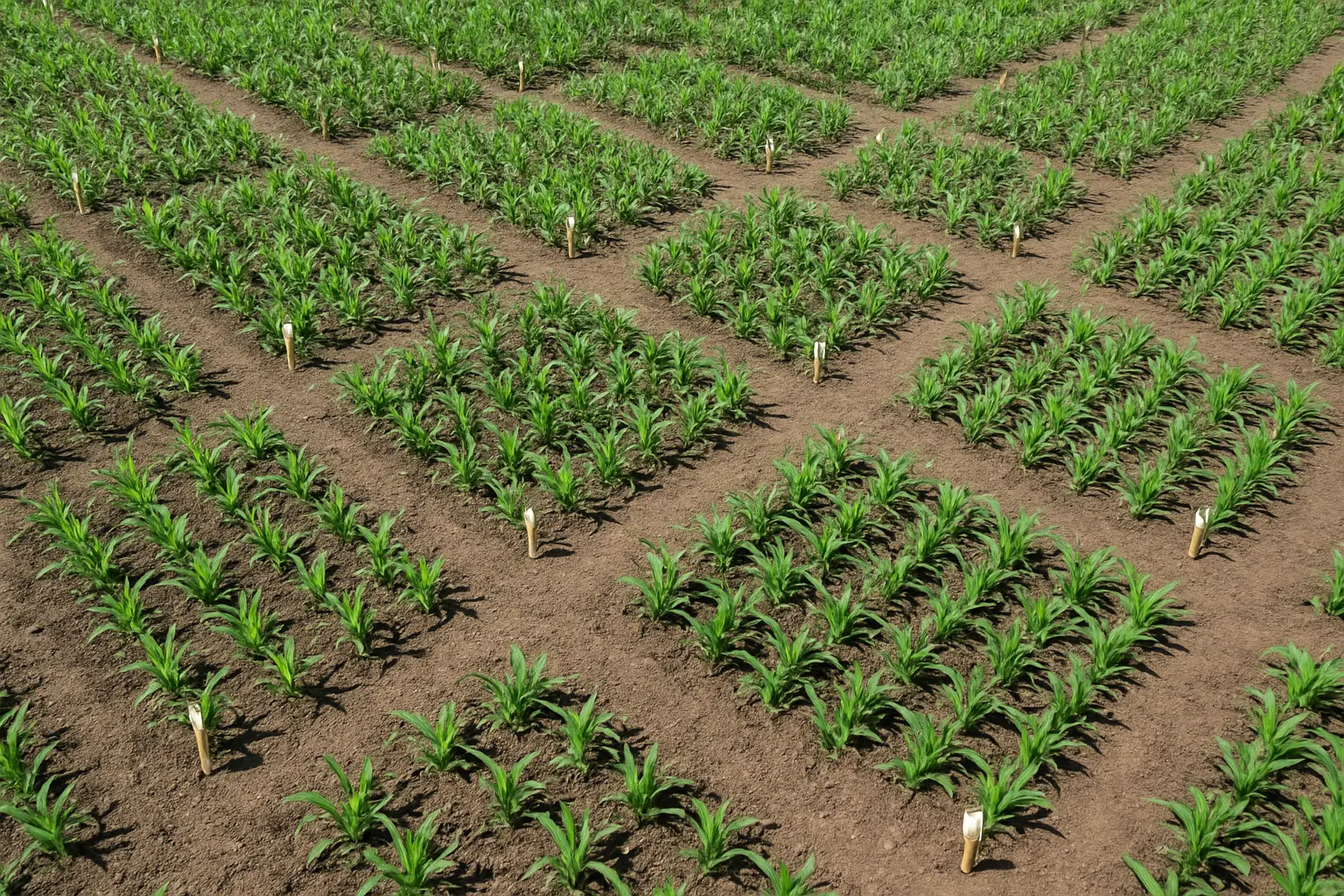
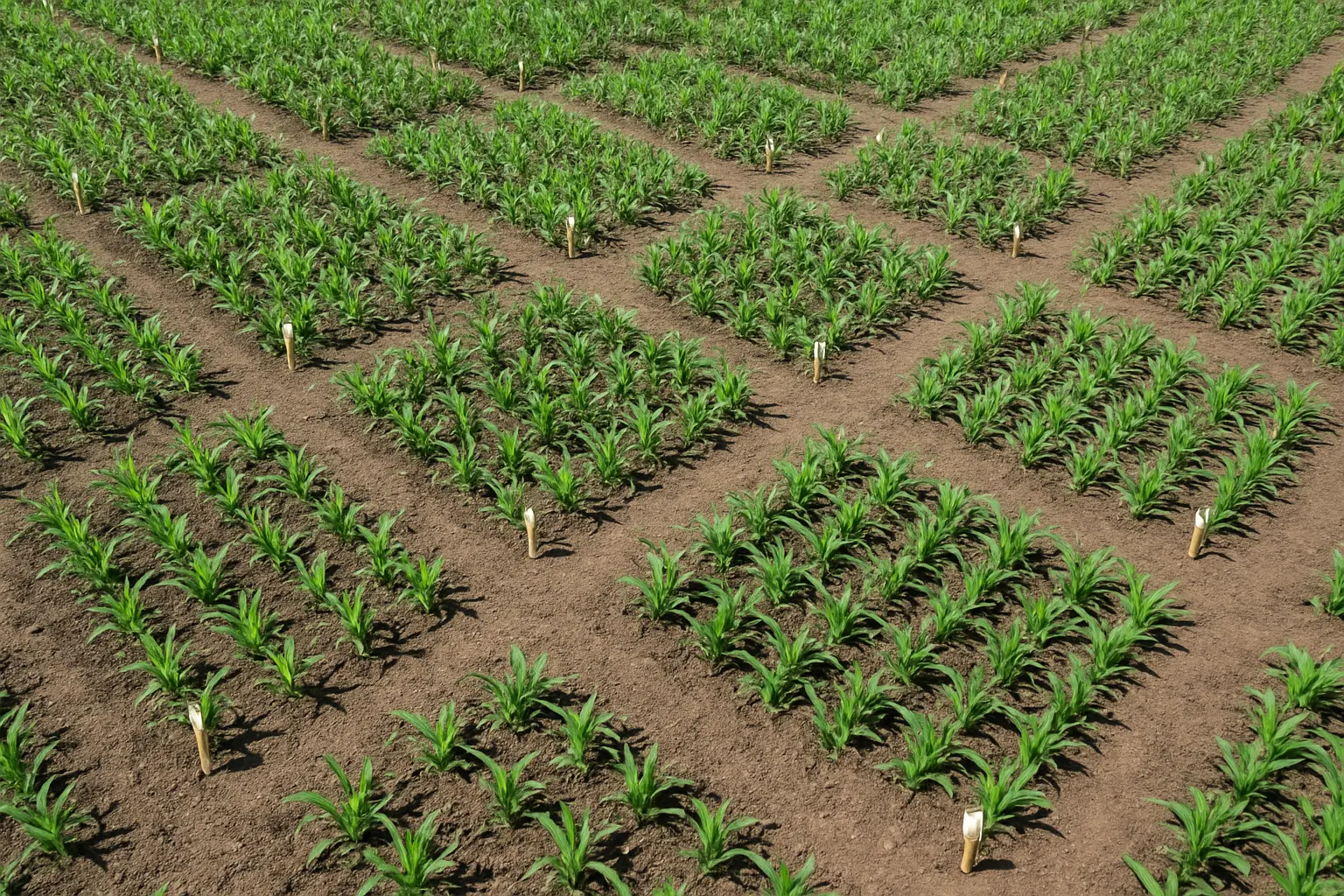
An experimental agriculture final year project in Nigeria is built around a field or screenhouse trial with named treatments, replications, and a formal experimental design — usually a Completely Randomised Design (CRD), Randomised Complete Block Design (RCBD), or split-plot design — analysed with analysis of variance (ANOVA), not a questionnaire and a Likert scale. Here is how to choose your design and structure the trial, step by step.
What makes an agriculture project “experimental” rather than survey-based?
A survey-based agriculture project asks farmers or extension workers about practices, constraints, or adoption through a questionnaire, and its Chapter Three looks like any other social-science methodology chapter — closer to the population-and-sample-size work a farmer survey needs. An experimental agriculture project instead manipulates a variable directly — applying different fertiliser rates, planting densities, or crop varieties to physical plots — and measures the outcome (yield, plant height, disease incidence) under controlled conditions. If your topic involves the words “effect of,” “response of,” or “performance of” a crop under different treatments, you are almost certainly running an experimental design, and Chapter Three needs to name that design explicitly rather than describing a population and sample size the way a survey project would.
Step 1: Choose your experimental design
Three designs cover most Nigerian undergraduate agriculture projects:
- Completely Randomised Design (CRD). Treatments are assigned to experimental units entirely at random, with no blocking. CRD is the simplest design and is appropriate when your growing environment is genuinely uniform — a screenhouse trial with controlled lighting and irrigation is the classic case in a Nigerian department’s facilities.
- Randomised Complete Block Design (RCBD). The field is divided into blocks that group together plots sharing a source of variation (a soil-fertility gradient, a slope, or shade from a nearby structure), and every treatment appears once in every block. RCBD is the default choice for most open-field trials in Nigeria, because few university teaching or research farms have a genuinely uniform field, and blocking removes that variation from your error term rather than letting it inflate it.
- Split-plot design. Used when you are testing two factors where one is harder to randomise at a fine scale than the other — for example, irrigation method (main plot, applied to a large area) crossed with fertiliser rate (subplot, applied within each irrigation plot). Split-plot designs are more advanced and are more common in postgraduate than undergraduate Nigerian agriculture projects, but they appear in final year projects testing two treatment factors together.
State your chosen design explicitly in Chapter Three’s opening sentence — “This study adopted a Randomised Complete Block Design with three replications” — rather than describing the layout first and leaving the reader to infer the design’s name.
Step 2: Define your treatments and replications
List your treatments as a numbered or lettered set before you describe the layout: for a fertiliser trial, this might be T0 (control, no fertiliser), T1 (organic manure at a stated rate), T2 (NPK at a stated rate), and T3 (a combined organic-inorganic rate) — four treatments is a common, manageable number for an undergraduate trial. Replicate each treatment at least three times; three replications is the practical minimum most Nigerian departments accept for a valid ANOVA, since fewer replications leave too few degrees of freedom for the error term to detect a real treatment difference. State your replication count and justify it in one sentence: “Three replications were used, giving 12 experimental units in total, consistent with the minimum replication recommended for field trials of this scale.”
Step 3: Lay out your field or screenhouse trial
Draw your field layout as a labelled diagram before you plant — block number down one axis, treatment plots across, with a buffer row or path between plots to prevent fertiliser or pest treatments bleeding across plot boundaries. Randomise treatment positions within each block using a random number table or a simple draw, not by placing treatments in the same order in every block, which reintroduces the systematic bias blocking is meant to remove. Record your plot size, spacing, and planting date precisely — these numbers belong in Chapter Three and are the first thing an examiner checks when judging whether your yield figures are comparable across treatments, in much the same way a non-questionnaire Chapter Four in another discipline lives or dies on precisely recorded physical measurements rather than survey responses.
Step 4: Collect your data on a fixed schedule
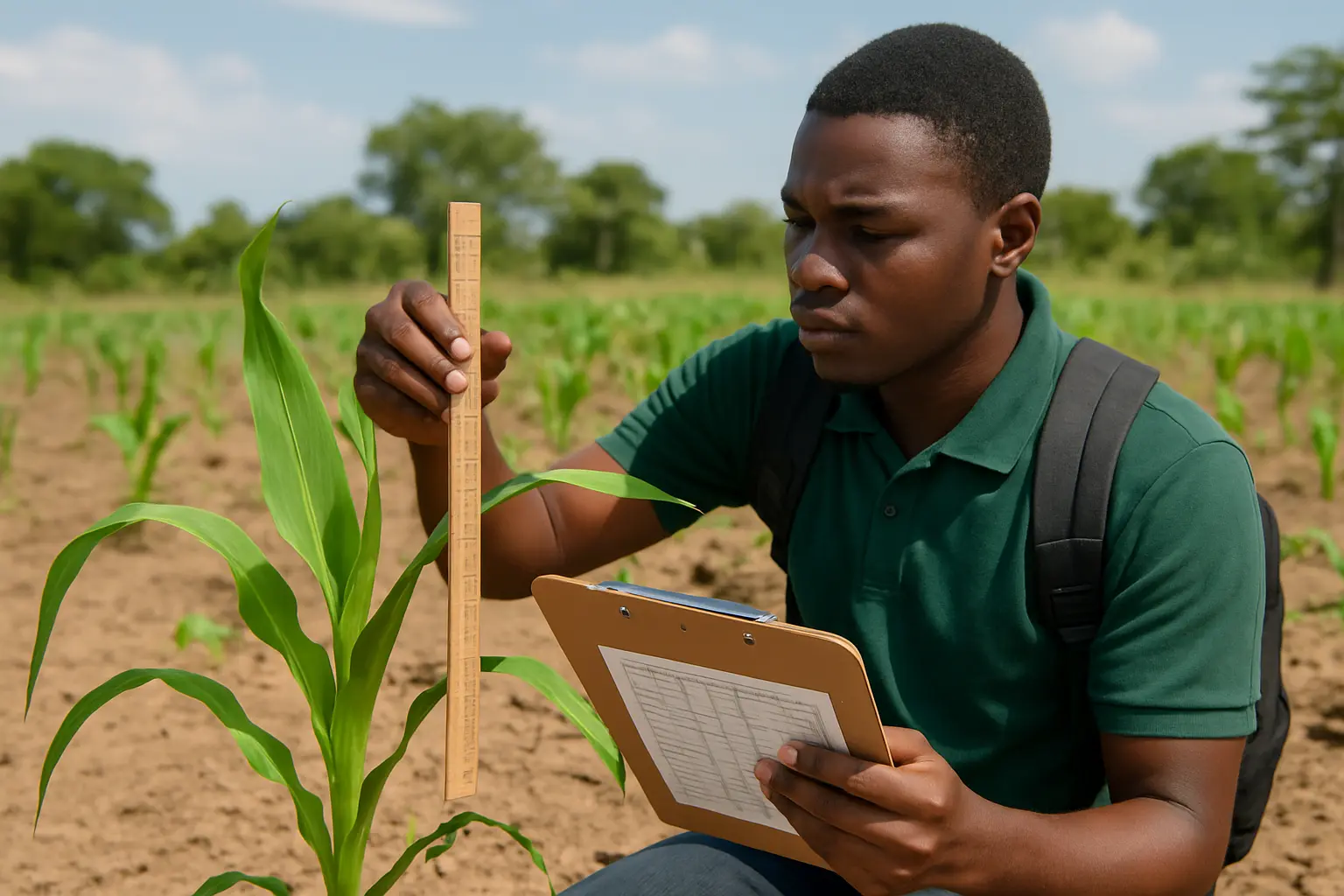
Decide your data-collection schedule before planting, not as the trial progresses: growth parameters (plant height, number of leaves, stem girth) are typically recorded at fixed intervals — say, every two weeks from two weeks after planting — while yield and yield components are recorded once, at harvest. Tag a fixed number of sample plants per plot (commonly five, excluding border plants) rather than measuring every plant, and use the same tagged plants for every measurement round so your growth data forms a genuine repeated-measures record rather than a new random sample each time.
Step 5: Analyse with ANOVA and a mean-separation test
Once your data is collected, analysis of variance is the standard test for a CRD or RCBD trial — it tests whether treatment means differ by more than chance, using the design’s own error term (block effects are removed from the error term in RCBD, which is why RCBD is more powerful than CRD when real field variation exists). If ANOVA shows a significant treatment effect, follow it with a mean-separation test — Duncan’s Multiple Range Test (DMRT) or Least Significant Difference (LSD) are both standard in Nigerian agriculture departments — to identify which specific treatment means differ from which others; ANOVA alone tells you that a difference exists, not where it is. SPSS, JASP, or a dedicated agricultural statistics package such as GenStat (where your department has a licence) will run both the ANOVA and the mean-separation test from the same dataset, and the resulting table is exactly the format your Chapter Four should present it in.
Worked example: an RCBD fertiliser-trial write-up
“This study adopted a Randomised Complete Block Design with three replications to evaluate the effect of four fertiliser treatments (T0: control, T1: 200 kg/ha NPK 15:15:15, T2: 10 t/ha poultry manure, T3: 100 kg/ha NPK combined with 5 t/ha poultry manure) on the growth and yield of maize. The experimental field was divided into three blocks to account for an observed slope-related fertility gradient, giving twelve plots of 3 m × 3 m each, separated by a 1 m path. Treatments were randomly assigned to plots within each block using a table of random numbers. Plant height and number of leaves were recorded on five tagged plants per plot at two, four, and six weeks after planting, and grain yield was recorded at harvest and converted to kg/ha. Data were subjected to analysis of variance, and treatment means were separated using Duncan’s Multiple Range Test at the 5 per cent probability level.”
Common mistakes with agriculture experimental designs
Three mistakes recur in Nigerian undergraduate agriculture projects. First, naming a design in Chapter Three that the field layout does not actually follow — claiming RCBD while planting treatments in the same fixed order in every block, which is not randomisation. Second, using too few replications (one or two) and then running ANOVA anyway; a mean-separation test on a design with insufficient replication is statistically unreliable even if the software produces an output. Third, mixing up which factor is the “main plot” and which is the “subplot” in a split-plot write-up — get this reversed and your degrees of freedom and error terms in the ANOVA table will be wrong, which an examiner familiar with the design will catch immediately. Confirm your design and layout with your supervisor before planting, not after data collection, since an error caught at that stage usually cannot be fixed without repeating the trial.
Frequently asked questions
Do I need to know the statistical theory behind ANOVA to use it correctly?
You need to understand what your design’s error term represents and why blocking (or not blocking) changes it, but you do not need to derive the ANOVA formulas by hand — statistical software computes them. Being able to explain the logic in the defence, not the arithmetic, is what a panel actually checks.
How many treatments should an undergraduate agriculture trial have?
Four to six treatments including a control is typical and manageable within a single growing season and a department’s available land or screenhouse space. More treatments increase the workload for data collection without necessarily strengthening the project.
Can I combine an experimental trial with a farmer questionnaire in the same project?
Yes — some Nigerian agriculture projects run a field trial and a smaller supporting survey of farmer perceptions of the practice being tested, but treat them as two clearly separated methodology sections in Chapter Three, each with its own design description, rather than blending the two into one paragraph.
What is the minimum number of replications an examiner will accept?
Three is the practical minimum most Nigerian departments accept for a valid RCBD or CRD analysis. Fewer replications are sometimes tolerated for resource-constrained trials but should be justified explicitly and flagged as a limitation.
Is a split-plot design too advanced for an undergraduate project?
Not inherently, but it is more demanding to lay out, manage, and analyse correctly than CRD or RCBD, and mistakes in the main-plot/subplot distinction are common. Discuss with your supervisor whether your resources and timeline support it before committing.
How is a screenhouse trial different from a field trial in terms of design choice?
A screenhouse’s more uniform, controlled environment often justifies CRD, since the field-variation problem RCBD’s blocking solves is less pronounced indoors. An open field almost always benefits from RCBD unless the plot is demonstrably uniform.
What goes in Chapter Four if my project is a field trial rather than a survey?
Chapter Four presents your ANOVA tables (one per parameter measured), the mean-separation results with superscript letters showing which means differ significantly, and a discussion interpreting the treatment differences against the mechanism you expect — for example, why a combined organic-inorganic treatment outperformed either alone.
Does a field trial need ethics approval the way a human-participant survey does?
No formal human-subjects ethics review is usually required for a plant trial itself, but if the same project includes a farmer questionnaire component, that component follows the same informed-consent expectations as any Nigerian project collecting data from people.
Tesify’s Chapter Three templates for experimental designs keep your stated design, your randomisation, and your ANOVA structure consistent, and flag a mismatch — such as a claimed RCBD with an undescribed blocking factor — before your supervisor does. Start on the free plan to draft your experimental design section.