
You are two months from submission, Chapter Two is a folder of PDFs you have not read, and the search you typed was “write my final year project with AI”. Nobody types that phrase out of laziness. They type it because the gap between what they know and what is on the page has become genuinely frightening.
Here is the honest version of what AI can and cannot do for that gap, chapter by chapter, and the workflow that leaves you with a project you can stand behind when a panel starts asking questions.
The one rule that decides everything
AI can move your material onto the page. It cannot supply the material.
Every failure mode in AI-assisted project writing comes from crossing that line. A tool asked to explain your findings in academic prose is doing legitimate work. A tool asked to invent findings is generating something you will be asked to defend and cannot. A tool asked to structure your literature review around the sources you read is helping. A tool asked to produce a literature review from a title is producing citations that may not exist.
Where departmental policy sits on all this is a separate question, and it is not answered nationally. The National Universities Commission lays down minimum academic standards and accredits programmes; it does not publish a rule that governs AI use in every Nigerian university. That leaves the decision with departments, which is why the article on whether you can use AI on a Nigerian final year project is worth reading before you start — ask your supervisor, and take the answer as binding.
Before you open any tool: the four things only you can produce
- An approved topic. Not a topic you like — one your supervisor has signed off. Everything downstream depends on it.
- Your population and your access. Who you can actually reach, and how many of them exist. A faculty examinations officer settles this in one visit.
- Your data. Questionnaires returned, records obtained, interviews recorded. This is the part with no shortcut.
- Your department’s format. The handbook, or a past project from the departmental library. Formats differ by institution and no tool knows yours.
If any of these four is missing, no writing tool helps, because there is nothing to write about yet. Get them first. It usually takes a week.
Chapter One: outline first, prose second
Chapter One is the easiest chapter to draft with assistance and the easiest to draft badly, because its sections are formulaic enough that a tool will happily produce a generic version that says nothing about your study.
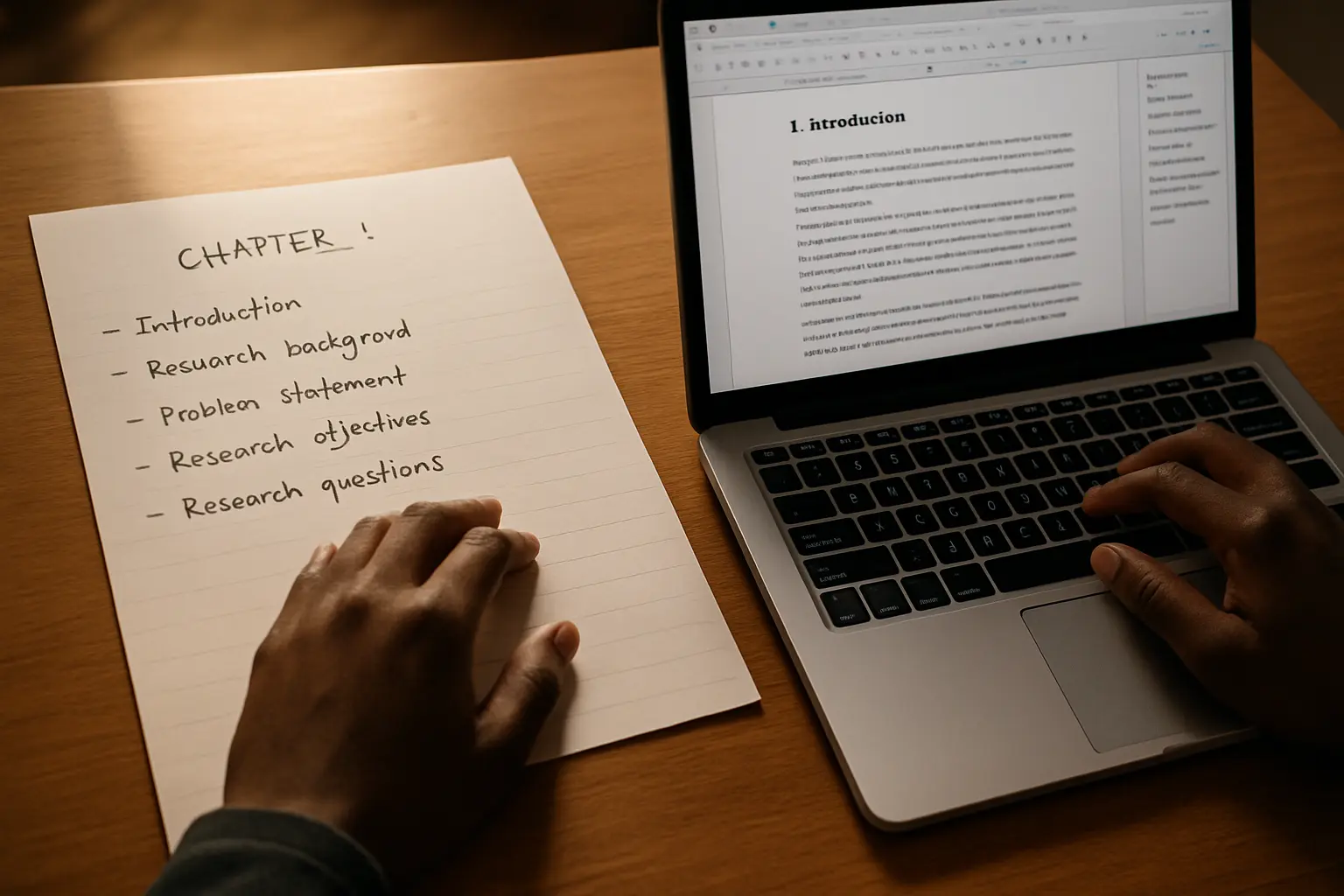
The workflow that works: write the skeleton yourself in note form — one line for the problem, one line per objective, one line per research question, one line on scope — then use the tool to expand each line into prose and to check that your research questions actually correspond to your objectives one for one. That correspondence is what a panel tests, and it is a structural check a tool does well.
What to refuse: any background section full of confident statistics you did not source. If a draft hands you a figure, either find it at its primary source and cite it properly or delete the sentence. The section-by-section anatomy of what belongs here is in the guide to writing Chapter One.
Chapter Two: the citation trap, and how to avoid it entirely
This is where AI-assisted projects most often go wrong, and the failure is specific: fabricated references. A general-purpose chatbot asked for a literature review will produce fluent paragraphs attached to author-year citations that look completely normal and sometimes do not exist. Nigerian supervisors have become very good at spotting this, and the check is trivial — they search for the paper.
The safe workflow inverts the order. Collect your sources first, read them, then draft around them. Concretely:
- Assemble ten to twenty real papers on your topic and put them in a reference manager. Which manager matters less than that you use one — the trade-offs are set out in the comparison of Mendeley and Zotero for Nigerian students.
- Read each one and write two sentences yourself: what it did, and what it did not do.
- Group those notes by theme, not by author. Themes are what a review is organised around.
- Only then draft, working strictly from your own notes, and never accept a citation you cannot open.
Verify every single reference before submission. If you cannot find the paper, the paper does not go in. The theoretical framework section needs the same discipline: you must be able to name who propounded your theory and in what year, because you will be asked. The full method is in the guide to Chapter Two.
Chapter Three: the chapter AI should barely touch
Methodology is a record of decisions you made. A tool can format it, tighten the prose and check your tense is consistent past tense. It must not choose your design, invent your sample size or describe a validation procedure you did not run.
Use assistance for exactly three things here: turning your notes into the conventional section order, checking that your population is larger than your sample and that your returned figure is smaller than your distributed figure, and confirming every research question has an analytical tool attached. Everything else is yours. The nine sections and the arithmetic panels check are in the Chapter Three guide.
Chapter Four: interpretation, not generation
You bring the tables. You have run the analysis, or your supervisor has helped you run it, and you have real numbers.
What assistance is genuinely good at: turning “mean 3.42, criterion 2.50, hypothesis accepted” into the three-part interpretive sentence a panel wants — what the finding says, whether it supports the hypothesis, and whether it agrees with the studies in Chapter Two. Students who can compute a mean often cannot write that sentence, and it is a writing problem, not a statistics problem.
What it must never do: produce a number. If a draft contains a figure that is not in your output, delete it. A fabricated result is the one error that ends a project rather than delaying it.
Chapter Five: the easiest win of the whole project
Summary, conclusion and recommendations follow mechanically from the four chapters before them — which is why so many students, exhausted by then, write them badly. Every summary point should trace to a finding, every conclusion to an objective, and every recommendation to a specific finding and a named actor.
This is a strong use of assistance, because it is a consistency task. Have the tool check objective by objective that each one has a corresponding finding, conclusion and recommendation, and flag any that does not. That gap is one of the four things panels most reliably fail students for.
The similarity question, answered properly
Students ask whether AI-drafted text will be flagged as plagiarism. The honest answer has two halves.
Similarity and AI detection are different measurements. A similarity report compares your text against a corpus — Turnitin describes its own as “an unparalleled repository of student papers, current and archived web pages, and premium subscription articles from top publishers across 170 languages”. Text drafted from your own notes about your own data has nothing to match against, so it typically scores low on similarity for the same reason any original writing does.
AI detection is a separate product feature and a separate judgement, and departments differ in whether they use it and what they do with the result. There is no national threshold to hide behind either way: the published postgraduate guidelines at Obafemi Awolowo University and the University of Ibadan set no numeric plagiarism ceiling at all, while Covenant University’s centre handbook sets 20 per cent — so the governing rule is your department’s, as detailed in the article on acceptable plagiarism percentages.
What actually protects you is not a score. It is being able to account for every paragraph, every citation and every number. That is a property of how you worked, not of which tool you used.
What this workflow is not
It is not a way to submit a project you did not write. A purchased or generated document that arrives complete leaves you with the same problem in the defence room — decisions you cannot explain, numbers you cannot reconcile, and paragraphs you cannot account for. That failure mode, and the resale market behind it, is covered in the article on what project topics and materials sites are actually selling.
The difference is not subtle. In this workflow every decision, every source and every number is yours. The tool changes how long it takes to get them onto the page, and nothing else.
Draft your own project, chapter by chapter
Tesify is built for exactly this workflow. You bring your topic, your sources and your data; it structures the chapter, keeps your citations attached to the sources you actually opened, and helps you turn notes into academic prose you can defend. Over 9,000 students have used it to write more than 15,000 chapters, and 100 per cent of the work is still written by you. Current pricing, including what you can do before paying anything, is listed on the Tesify site.
Frequently asked questions
Can AI write my entire final year project for me?
It can produce text that looks like a project, but it cannot produce your data, your population or your decisions, and those are what a panel examines. A complete generated document leaves you undefendable at exactly the moment it matters.
Is using AI on a final year project cheating in Nigeria?
There is no national rule. Departments decide, and they differ, so ask your supervisor directly and follow their answer. Using a tool to draft your own material is a very different act from submitting generated findings, and most policies turn on that distinction.
Will my supervisor know I used AI?
Supervisors most often notice through content, not style: citations that do not resolve, a methodology you cannot explain, or a register that does not match your earlier submissions. Working from your own sources and notes removes all three tells because the work genuinely is yours.
What about fabricated references?
This is the biggest practical risk with general-purpose chatbots. Never accept a citation you have not opened. Collect real sources first, read them, then draft, and verify the entire reference list before submission.
Can AI analyse my data?
It can help you decide which test suits your data type and hypothesis, and help you write up a result. Run the analysis in a statistics package and keep the output, because a panel may ask to see it.
How long does drafting a chapter this way actually take?
With sources collected and read, a Chapter Two draft is a matter of days rather than weeks. The reading and the data collection are still the slow parts, and no tool changes that.
What if my supervisor forbids AI entirely?
Then do not use it. A supervisor’s instruction governs, and the cost of ignoring it is far greater than the time it saves. Ask instead whether tools like grammar checking and reference managers are acceptable, since many supervisors distinguish between them.
Does a reference manager count as AI?
No. Reference managers store and format citations you have collected yourself, and they are standard practice everywhere. Nobody objects to them, and using one will save you more time before your defence than almost anything else.
I have three weeks left. Is it too late?
Not necessarily, if your data exists. If it does not, collecting it is the first task and everything else waits. If you have data but no chapters, the week-one recovery plan sets out the order to work in.
What should I be able to do before I walk into the defence?
Explain every paragraph, reproduce your sample size calculation, state your response rate, interpret any table on request, and name the source of every figure. If you can do those five things, how you drafted is not the issue. The full question inventory is in the guide to project defence questions.