Tag: supervisor

  • Your Supervisor Has Rejected Your Project Topic Twice. Here Is How to Get One Approved This Week

    Your Supervisor Has Rejected Your Project Topic Twice. Here Is How to Get One Approved This Week

    Two topics submitted, two rejections, no explanation longer than a sentence, and the department’s approval deadline is this week. Meanwhile your coursemates already have supervisors assigned and have started Chapter One, and every week you lose here is a week gone from the far end of the project — the analysis and the corrections, where time actually runs out.

    Here is the thing nobody tells you: topics are almost never rejected for being uninteresting. They are rejected for a small number of structural faults, and each one has a specific fix. Once you can name which fault yours has, the third submission is usually the last.

    Turn an approved topic straight into Chapter One with Tesify

    The five faults, and what each one sounds like

    Supervisors are busy and their feedback is compressed. A one-line comment usually maps to one of these.

    What they said The actual fault The fix
    “Too broad.” / “Narrow it down.” No bounded population or location Add a specific population, a named institution or organisation, and a period
    “Not feasible.” / “How will you get the data?” Respondents you cannot actually reach in one session Switch to a population you have access to, and say how
    “This has been done.” / “Check the department.” An existing project in the same department Change the population, the variable or the context — not the wording
    “What are you measuring?” Variables that cannot be operationalised Name the variables and how each will be measured
    “This is not in our area.” Outside the department’s scope or the supervisor’s field Re-anchor it in a departmental subject area, or accept a different supervisor

    Notice what is not on this list: originality in the grand sense. An undergraduate project does not have to be novel to the world. It has to be bounded, feasible and not already sitting in your department’s project archive.

    Fault 1: too broad — the fix is three specifics

    “Impact of social media on students” is not a topic; it is a subject area. It has no population you can sample, no location you can reach and no period.

    Add three things and it becomes researchable:

    • Who — “300-level Mass Communication students”
    • Where — a named faculty, institution or organisation
    • When — the academic session

    “Influence of social media use on the academic performance of 300-level Mass Communication students in [named institution], 2026/2027 session” is the same idea, and it is approvable. It also hands you your Chapter One scope section for free, as set out in the guide to writing Chapter One.

    Fault 2: not feasible — the access question decides everything

    This is the rejection that most often comes disguised as something else, and it is the one that would have hurt you most if it had been approved.

    Before you submit any topic, answer one question honestly: can you personally reach these respondents, this session, without a gatekeeper who may say no?

    Topics that fail this test look ambitious and are traps: bank staff across several branches, civil servants in a ministry, hospital patients, secondary school pupils in a state, respondents in another city. Each one needs written permission from an organisation that has no obligation to reply quickly.

    Topics that pass it are the ones you can actually finish: students in your own faculty, traders in a market you can visit, staff of a single organisation where you have a contact, or a documentary study using published records.

    Choosing an accessible population is not lowering your ambition. It is the difference between finishing and not.
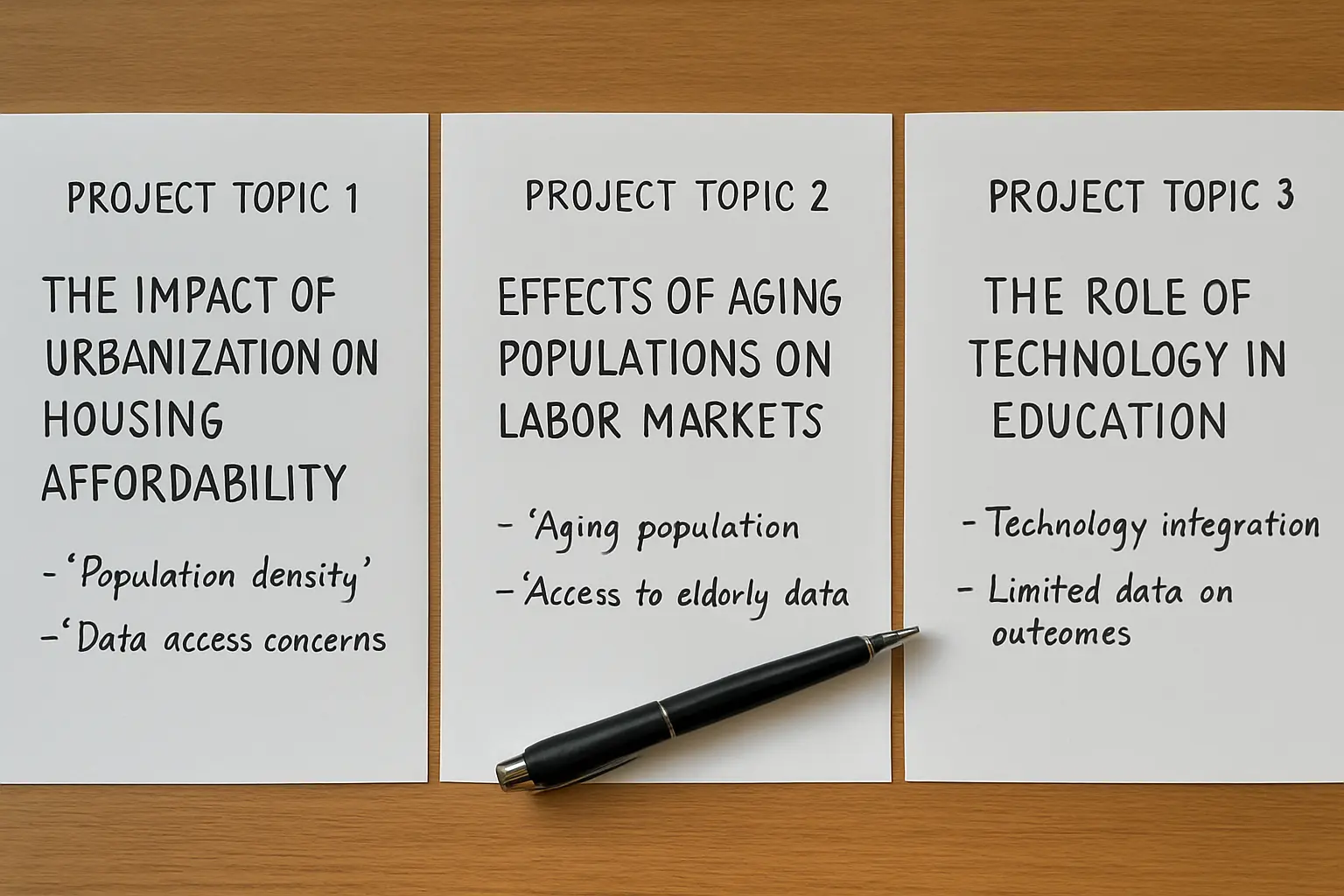
    Three candidate project topics written on separate sheets and annotated with notes on population and data access
    Never submit one topic. Submit three, each annotated with who the respondents are and how you will reach them.

    Fault 3: already done — change the substance, not the wording

    Departments keep project archives, and a supervisor who has read a hundred projects recognises one immediately.

    Rewording does not help and it is transparent. What works is changing one of three things:

    1. The population. The same question asked of a different group is a different study.
    2. A variable. Add a moderating or mediating factor the earlier project did not consider.
    3. The context or period. A study conducted before a major policy or technology change is genuinely a different setting.

    Before you resubmit, go to the department’s project archive and look. Ten minutes there prevents the third rejection, and it also gives you your first citations. If your topic is one where you want to know how much has actually been published, the counting method is in the article on whether your project topic has already been studied in Nigeria.

    Fault 4: unmeasurable variables

    “What are you measuring?” means your topic names concepts that cannot be turned into questionnaire items or observations.

    The test: for each variable in your title, can you say in one sentence how it will be measured? “Academic performance” measured as CGPA is fine. “Effectiveness” with no stated measure is not. “Awareness” measured as a score on a set of items is fine; “awareness” on its own is not.

    Write the measurement beside each variable before you submit. This is also the exact question a panel asks at the proposal seminar, which is covered in the guide to writing a research proposal for a Nigerian final year project.

    Fault 5: outside the department’s area

    Sometimes the topic is fine and simply belongs to another department. A supervisor who says “this is not our area” is telling you they cannot examine it, not that it is a bad idea.

    Two moves. Re-anchor the same interest inside your discipline — a technology question becomes a management question if the variables are adoption and productivity rather than architecture. Or ask the coordinator whether a supervisor in the relevant subject area is available. Neither takes long, and both are better than a fourth submission of the same thing.

    The one-page brief that gets approvals

    Stop submitting titles. Submit a page. Supervisors reject titles because a title gives them nothing to approve, and approving it blind is a risk they carry for a whole session.

    Bring three candidate topics, each on the same one-page format:

    1. Working title — with population, location and period in it.
    2. The problem, in two sentences. What is wrong, and for whom.
    3. Objectives — three or four, each starting with a verb.
    4. Population and access — who they are, roughly how many, and how you will reach them. Name the contact or the route.
    5. Variables and measurement — one line each.
    6. Method — design, instrument, and roughly how the data will be analysed.
    7. Three sources — real ones you have opened, showing the area is researched.

    Three of those pages is about twenty minutes of a supervisor’s time and it changes the conversation completely. Instead of “is this a good topic?” — a question they answer defensively — you are asking “which of these three should I do?”, which is a question they can answer in five minutes and which makes them a collaborator in the choice.

    It also means a rejection of one candidate does not cost you a week. You still have two live.

    A Nigerian student handing a single-page topic brief to a supervisor reading it in a university office
    A title asks your supervisor to take a risk. A one-page brief asks them to make a choice.

    Do not buy a topic to end this faster

    At exactly this point, a vendor selling ready-made project topics and materials starts to look like the sensible option. It is the most expensive shortcut available at this stage, and the reasons are set out in full in the article on what you are actually buying from project topics and materials sites.

    The short version, specific to the topic stage: a bought topic comes with a population you have not verified you can reach, variables you did not choose, and often a study your department has already seen. You will still fail faults 2 and 3 — just later, and after paying.

    What to do in the next 48 hours

    1. Read your rejection again and map it to a fault above. If the comment was too short to map, ask one specific question — “was it the scope or the access?” — rather than a general “why?”.
    2. Go to the department’s project archive and list what has been done in your area in the last three sessions.
    3. Write three one-page briefs, each with a population you can genuinely reach.
    4. Book the consultation and take all three.
    5. The moment one is approved, start Chapter One that day. Approval is not a milestone to celebrate for a week; it is the starting gun.

    That last point matters more than any of the others. The weeks lost to topic rejection come out of the analysis stage, not the writing stage, and the analysis stage is where projects actually run out of time.

    How Tesify shortens the part that comes next

    Once a topic is approved, the constraint changes from decision-making to volume: Chapter One’s sections, a literature review from sources you can actually cite, and a methodology that matches what you promised in the brief.

    Tesify takes your approved topic, your population and your sources, and builds the chapters in the structure your department expects — holding the section order, keeping every citation attached to a source you actually opened, and turning your notes into academic prose. The decisions stay with you, which is exactly why the work survives a defence.

    Three things it removes from the week after approval:

    • Structure. The chapter shape is there before you write a sentence, so you are filling a form rather than inventing one.
    • The reference trail. Citations stay attached to their sources instead of being reconstructed at 2 a.m. before submission.
    • Restarting. The blank page after each supervisor comment is where most of the lost time actually goes — the same loop described in the article on breaking the Chapter Two correction cycle.

    If you have not even reached the topic stage cleanly and are starting from nothing, the week-one system is in the guide to starting your final year project this week.

    Get the approval, then move the same day

    Tesify structures your project chapter by chapter around your own approved topic, your own respondents and your own sources, and keeps every citation attached to a source you actually opened. Over 9,000 students have used it to write more than 15,000 chapters, and 100 per cent of the work is still written by you. Current pricing, including what you can do before paying anything, is listed on the Tesify site.

    Start Chapter One in Tesify

    Frequently asked questions

    Why does my supervisor keep rejecting my project topic?

    Almost always for one of five structural reasons: it is too broad, the respondents are not reachable in one session, the study already exists in the department, the variables cannot be measured, or it falls outside the department’s area. Ask which one applies rather than resubmitting a reworded version of the same topic.

    How much does Tesify cost in naira?

    Payment methods and pricing change, so the reliable source is the Tesify site itself rather than a figure quoted in an article. What you can do before paying anything is listed there too. Nothing about the topic-approval process above requires you to pay for anything.

    Is using a tool like this considered cheating?

    That depends on your department’s policy, which you should confirm with your supervisor rather than assume. The distinction that matters is authorship: the topic, the population, the design and the interpretation are yours, and a tool that structures and drafts around your decisions is different from one that supplies a study. The full treatment is in the article on whether you can use AI to write your final year project.

    Will this raise my similarity score?

    Text you write about your own respondents and your own data has nothing to match against and behaves like any other original writing. What raises a score is uncited paraphrase of other people’s work, and what your department’s threshold actually is differs by institution — set out in the article on acceptable plagiarism percentages in Nigerian universities.

    How many topics should I submit at once?

    Three, each on a one-page brief. One topic asks your supervisor to take a risk; three ask them to make a choice, which is a much easier thing to do quickly. It also means one rejection does not cost you another week.

    Can I use a topic from a project topics website?

    You can look at one for ideas, but do not submit it as yours. It will usually fail on access or on already having been done in your department, and you will discover that after paying. The risks are covered in the article on project topics and materials in Nigeria.

    What if my supervisor gives no reason at all?

    Ask one closed question rather than an open one. “Was the problem the scope or the access to respondents?” gets an answer in a corridor; “why was it rejected?” often does not get answered at all.

    Should the topic be quantitative or qualitative?

    Whichever answers your question, but be aware that the sample-size justification differs sharply and that many Nigerian departments expect a formula. If you are considering a qualitative design, read how to defend the sample first, in the article on how many respondents a qualitative project needs.

    How specific should the title be?

    Specific enough that a reader knows the variables, the population, the location and the period without asking. If any of those four is missing, expect “narrow it down”.

    Does the topic have to be original?

    Not original to the world. It has to be bounded, feasible and not a repeat of an existing project in your own department. Changing the population, adding a variable or shifting the context is enough to make an existing question a new study.

    What if I lose weeks to this and fall behind?

    Compress the stage after approval rather than the analysis stage. Draft Chapter One and the proposal immediately, since both come straight out of the brief you already wrote, and protect the weeks you will need for data collection and analysis. Losing time at the front is recoverable; losing it at the back is not.


  • Your Supervisor Has Not Replied in Three Weeks and the Deadline Is Not Moving

    Your Supervisor Has Not Replied in Three Weeks and the Deadline Is Not Moving

    Three weeks, four unanswered messages, one visit to an office that was locked — and a submission date that has not moved a single day. Every week you spend waiting is a week subtracted from your own work, and nobody in the department will credit you for it later.

    The cost is not abstract. Students lose a whole semester this way and it never appears in the record as “my supervisor was unavailable”; it appears as a project submitted late or a chapter that never got written. Meanwhile the classmate whose supervisor is equally busy is on Chapter Four, because they worked out early which parts genuinely need a signature and which do not.

    Keep your chapters moving with Tesify — start free

    A student waiting outside a locked lecturer's office holding a printed chapter and a phone showing an unanswered call
    A locked door is information. It tells you to change the channel, not to come back tomorrow and wait again.

    First, understand why the silence is happening

    Almost none of it is about you. A Nigerian lecturer supervising final year students is usually carrying a full teaching load, postgraduate supervision, departmental committee work and often a second campus. Twenty to thirty supervisees is common. A message asking “sir, have you looked at my chapter?” is the twenty-fifth identical message that week and it carries no information the supervisor can act on in under a minute.

    That reframing is useful because it tells you what to change. You are not competing for goodwill; you are competing for the two spare minutes in which a decision is cheap to make. Make your request fit in two minutes and the reply rate changes.

    Write the one email that gets answered

    Long attachments with no question attached are the messages that sit unopened. Replace them with this shape and send it on a Monday morning:

    1. Subject line with your name, your topic in five words, and what you need. “Adeyemi — SME financing project — 3 questions, need reply by Friday.”
    2. One line of context. “Chapter Three is drafted and attached; I am ready to start data collection.”
    3. Exactly three numbered questions, each answerable yes or no or with one word. Not “please review my methodology”. Instead: “1. Is a sample of 300 by Taro Yamane acceptable for a population of 1,200? 2. Should I use a four-point or five-point scale? 3. May I begin distribution next week?”
    4. A stated deadline and a stated default. “If I do not hear by Friday I will proceed with the four-point scale and adjust if you advise otherwise.” This is the single highest-value sentence in the email, because it converts silence into a decision instead of a blockage.
    5. The attachment last, named properly: Surname_ChapterThree_v2_18Aug2026.docx.

    Send the same email through a second channel — WhatsApp with a one-line “sir, I have sent an email with three short questions” — and then stop. Do not send a fifth follow-up; send this email once and move to escalation on schedule.

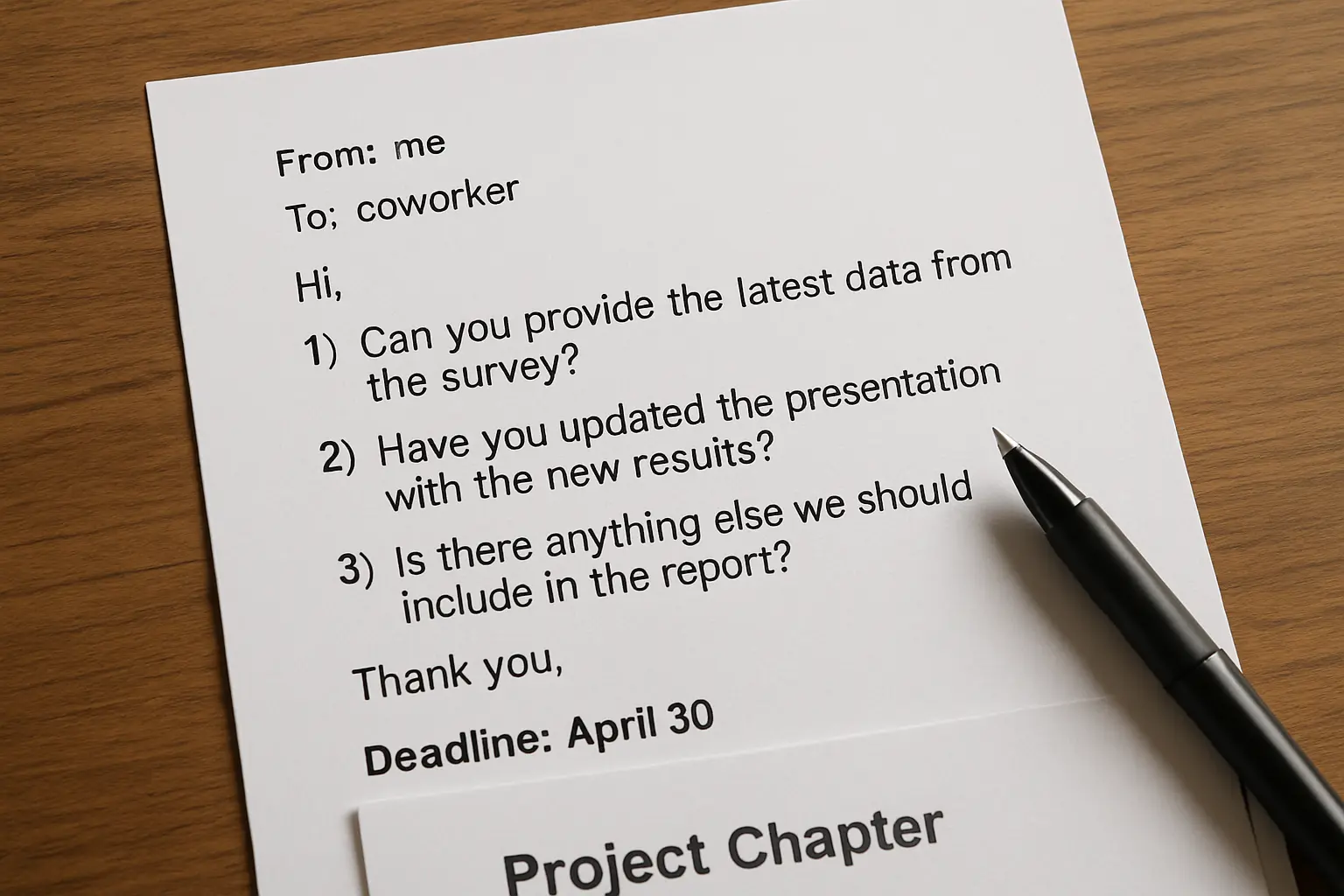
    A printed email containing three numbered questions and a stated deadline, resting on a project chapter
    Three closed questions and a stated default. This is answerable in the two minutes a supervisor actually has.

    Know what you may progress without sign-off

    This is where most of the lost time is recovered. A great deal of a final year project does not require anyone’s approval to advance, and doing it now means that when the reply arrives you spend the meeting on the decisions only a supervisor can make.

    Progress freely:

    • Chapter Two. Reading, synthesising and drafting the literature review never needed permission, and the section-by-section method is in the guide to writing Chapter Two.
    • The mechanics of Chapter One — background, statement of the problem, objectives, research questions — following the Chapter One guide.
    • Your reference list and your referencing style, which is a departmental fact you can confirm from the handbook rather than from your supervisor — see how to reference the way your university requires.
    • Drafting the instrument, even if you cannot distribute it yet.
    • Building your Chapter Three skeleton from the methodology guide, leaving only the decisions you flagged in your three questions.

    Do not progress without approval:

    • A change of topic or a change of research questions. That approval is the one thing that cannot be reconstructed later, and the document that carries it is your proposal — see how to write a research proposal.
    • Distributing questionnaires to respondents. A sample collected against an instrument your supervisor later rejects is weeks you cannot get back.
    • Anything requiring an introduction letter from the department.

    Escalate on a schedule, not on a feeling

    Escalation is normal departmental process, not an accusation, and doing it calmly and on a timetable protects the relationship. Set the dates in advance so you are not deciding while frustrated.

    1. Day 0. Send the three-question email with a stated default. Copy yourself.
    2. Day 7. Resend the identical email with one line on top: “Following up on the questions below, sir.” Same thread, no new attachment.
    3. Day 14. Go in person during a posted consultation hour, with the chapter printed and the three questions on the front page. A printed page in someone’s hand is answered far more often than an attachment.
    4. Day 21. Contact the project coordinator or level adviser. Keep it factual and short: the dates you wrote, the questions asked, the work completed, and the deadline you are working towards. Ask for guidance on how to proceed, not for a new supervisor.
    5. Any point. If you learn your supervisor is on sabbatical, on leave or has travelled, go to the coordinator immediately. That is an administrative reallocation, not a complaint.

    Keep a one-page log of every contact attempt with dates. If the deadline slips through nobody’s fault, that log is the difference between an explanation and an excuse.

    Two students reviewing each other's printed project chapters in a campus study room
    A classmate cannot approve your methodology, but they can find the four things your supervisor would have flagged first.

    Get feedback from somewhere while you wait

    You do not need your supervisor to tell you that a paragraph has no citation, that your objectives and research questions do not match in number, or that Chapter Two summarises twenty studies without naming a gap. Those are the corrections that come back most often, and they are all findable without them.

    Swap chapters with a classmate under a different supervisor and mark each other against the specific things Nigerian supervisors return work for — the pattern is set out in the guide to breaking the Chapter Two correction loop. Then read your own draft against the questions a panel will ask, which are largely predictable and listed in what panels ask at a project defence.

    Where Tesify fits in this specific gap

    The problem in a silent-supervisor stretch is not motivation; it is having nobody to tell you whether the chapter you just wrote holds together. Tesify keeps your objectives, research questions, method and results in one connected document, so the misalignments a supervisor would have caught are visible to you first.

    1. Start on the free plan — no payment needed to draft and check your first chapter, which is the point of it as an entry step.
    2. Draft Chapter Two with citations attached to claims, so the reference list is finished when the chapter is.
    3. Run the alignment check yourself: research questions, objectives, hypotheses and — once you have data — tables, all in the same numbering.
    4. Arrive at the meeting with three decisions to make, not a chapter to be read. A supervisor with two minutes can give you three answers; they cannot read forty pages.
    5. Keep the version history, so “I sent this on 4 August” is a fact rather than a memory.

    It is 100% written by you, alongside 9,000+ students and 15,000+ chapters. It does not replace your supervisor’s approval and it cannot sign anything — the same honest workflow described in the AI workflow guide.

    Stop losing weeks to an inbox

    Tesify keeps your whole project as one connected document so you can keep writing while you wait, and walk into the next meeting with three questions instead of forty pages. Start on the free plan, alongside 9,000+ students and 15,000+ chapters — every word still written by you.

    Start your project in Tesify

    Frequently asked questions

    How much does Tesify cost in naira?

    Current plans and naira pricing are on the Tesify site itself, and we do not quote a figure here that could be out of date by the time you read it. There is a free entry plan to start with; check the pricing page for what the paid tiers include before you commit.

    Is it rude to escalate to the project coordinator?

    No, provided it is factual and on a schedule. Coordinators exist partly to handle supervision that has stalled. Bring dates, the questions you asked and the work you completed — not a complaint about a person.

    How long should I wait before following up?

    Seven days for a first follow-up, fourteen for an in-person visit during a posted consultation hour, twenty-one before contacting the coordinator. Set those dates when you send the first message.

    Can I change supervisors?

    Sometimes, and it is a departmental decision rather than yours. Reallocation is routine when a supervisor is on leave or sabbatical and rare otherwise. Ask the coordinator what is possible; do not approach another lecturer directly first.

    Should I start collecting data without approval?

    No. An instrument your supervisor later rejects means the data collected with it is unusable, which costs far more than the wait. Draft the instrument, prepare your distribution plan, and hold.

    Will using an AI writing tool be held against me?

    Every Nigerian university punishes submitting writing that is not yours, and several departments now require you to declare assistance. No national rule bans the tools themselves — where the line sits is set out in the guide to whether you can use AI on a final year project. Read your own department’s rule and follow it.

    Will a tool-written chapter raise my similarity score?

    Text you did not write yourself is the risk, whatever produced it. Write your own sentences, cite as you go, and check before submission — what a pre-check can and cannot see is explained in the plagiarism checker comparison, and the target figure in what percentage is acceptable.

    What if my supervisor answers only on WhatsApp?

    Use it, then send yourself an email summarising what was agreed and the date. A verbal or chat approval that nobody recorded is the one that gets remembered differently later.

    My supervisor keeps saying “come back next week”. What then?

    Convert the meeting into a decision request. Hand over one printed page with three closed questions and ask for answers on it. “Come back next week” is usually a reflex triggered by an open-ended request.

    Does an unresponsive supervisor excuse a late submission?

    Rarely, and only if you documented it. Your contact log is what turns it from an excuse into an explanation the coordinator can act on.

    What if I am already behind and the defence is close?

    Then the order you work in matters more than the supervisor. Start from a blank chapter and a fixed date with the plan in how to start your project this week.

  • Your Supervisor Returned Chapter Two Again: How to Break the Correction Loop

    Your Supervisor Returned Chapter Two Again: How to Break the Correction Loop

    Your Supervisor Returned Chapter Two Again: How to Break the Correction Loop

    Fourth submission. Same chapter. More red ink than last time, and some of it contradicts what you were told in round two. You are now genuinely unsure whether you are getting closer or further away, and the defence date has not moved.

    Rebuild your chapter with Tesify

    Flat vector illustration of a chapter returned repeatedly covered in supervisor corrections

    Why the loop keeps going

    Because you are fixing the comments. That sounds like exactly the right thing to do, and it is the reason the chapter keeps coming back.

    When you address forty comments one at a time, you produce a document that has answered forty small objections and still has the same underlying problem it had in round one. The supervisor reads it, sees the same structural fault, and writes forty new comments — often on different sentences, because the old ones are gone. From your side it looks like the goalposts moved. From theirs, the chapter still does not work.

    The loop breaks when you stop treating the comments as a task list and start treating them as symptoms.

    The three kinds of correction

    Before you change a single line, read every comment and sort it into one of three buckets. Do this on paper or in a separate document, not in the chapter itself.

    1. Structural corrections — the ones that matter

    “This is a summary, not a review.” “Where is the gap?” “You have not connected this to your objectives.” “This is descriptive.” These are not comments about paragraphs. They are one comment about the whole chapter, written in four places.

    Response: restructure, do not edit. If your literature review is organised author by author — Author A said this, Author B said that — no amount of sentence-level fixing will satisfy a supervisor who wants it organised by theme with a gap emerging at the end. Rewriting the chapter around themes is faster than three more rounds of patching.

    2. Evidential corrections

    “Source?” “Too old.” “Says who?” “This is not what that study found.” These are about the relationship between your claims and your sources.

    Response: go back to the sources, and be honest about the ones you have not actually read. A citation you inherited from another project’s reference list is the most common origin of “this is not what that study found”, and it is the correction most damaging to your credibility with a supervisor.

    3. Presentational corrections

    Formatting, referencing style, spelling, table numbering, heading levels. Real, but trivial.

    Response: fix them all in one pass at the end, mechanically. Never let these consume the attention that the structural bucket needs — and note that presentational corrections repeating across rounds often mean you are formatting to the wrong referencing style entirely, which is worth confirming rather than re-fixing.

    Flat vector illustration of scattered corrections being sorted into categories before rewriting

    Why sorting works when fixing does not

    The sort is not an organisational nicety. It changes what you are looking at.

    Forty scattered comments feel like forty problems, which is overwhelming and gives you no way to decide what to do first. The same forty comments sorted into buckets usually turn out to be three structural problems, eight evidential ones and twenty-nine presentational ones. That is a completely different and far more tractable situation, and you can see immediately that the twenty-nine are not why the chapter keeps coming back.

    It also tells you whether you are actually making progress. If round three had five structural comments and round four has one, the chapter is converging even though the total count barely moved. If round four still has five, nothing you did addressed the real fault, and doing more of it will not help. That is a diagnosis you cannot get from a raw comment count, and it is the difference between a student who feels the loop is endless and one who can see it closing.

    What a supervisor is actually checking in Chapter Two

    Published university guidelines are clearer about this than most departmental briefings are. Obafemi Awolowo University’s postgraduate guidelines specify that the main body of a thesis must contain an introduction, a literature review, methodology, results or findings, a conclusion, and a contribution to knowledge.

    Notice that the literature review sits between the problem you stated and the method you chose. That is its job. It is not a display of how much you read. It exists to show that the gap named in Chapter One is real, and to justify the method you are about to use in Chapter Three.

    Judge your own chapter against that test before resubmitting. If a reader finishes it without being convinced the gap exists, the chapter has not done its work regardless of how many sources it contains — and that is what “this is descriptive” means.

    How to make the next submission the last one

    1. Sort every outstanding comment into the three buckets before changing anything.
    2. Count the structural bucket. If it has more than two entries, plan a rewrite rather than an edit.
    3. Ask one clarifying question, in writing, before you start. Not “any thoughts?” but “Should the review be organised by theme or by variable?” A specific question is answerable in one line; a vague one gets no reply.
    4. Rewrite the structure first, with the argument running from broad field to your specific gap, and every theme ending in what remains unknown.
    5. Then fix the evidential bucket, opening each source you cite. Remove anything you cannot verify rather than defending it.
    6. Then do one presentational pass, all of it at once.
    7. Send it with a short covering note listing what you changed structurally. A supervisor who can see you understood the main point reads the chapter differently.
    8. Do not stop working while you wait. Draft Chapter Three. Feedback on Two is not a prerequisite for starting Three; it is a prerequisite for finalising Two.

    When the corrections contradict each other

    This happens, and it is not always a mistake on your supervisor’s part. Round two asked for more detail because the section was thin; round four asks for less because the added detail buried the argument. Both comments were right about the draft in front of them.

    Say so plainly and without accusation: “In the earlier draft you asked me to expand the theoretical section; in this one it reads as too long. Should I keep the expanded version and cut the descriptive parts, or return to the shorter version?” You will get a decision, and you will have it in writing.

    Where two supervisors genuinely disagree, do not adjudicate between them and do not quietly follow one. Put the conflict to both in the same message and ask them to settle it. Choosing a side privately is how a student ends up defending a chapter that one of their own examiners rejected.

    Where Tesify helps

    Restructuring is the correct response to a structural correction and also the most daunting, because it means dismantling something you have already rewritten three times.

    • Rebuild the chapter around a thematic outline rather than reordering paragraphs by hand, so the argument, not the paragraph order, drives the structure.
    • Keep every source attached to the claim it supports as you rewrite, which is what stops the evidential bucket refilling in the next round.
    • Hold the whole five-chapter shape in one place, so a change in Chapter Two does not silently break its link to the objectives you set in Chapter One.
    • Keep referencing consistent across rewrites, which is where mixed formatting usually creeps in — and where a similarity report later picks up passages that lost their citation during restructuring.

    The analysis and the argument stay yours: 100% written by you, alongside 9,000+ students and 15,000+ chapters. What changes is that a rewrite stops being a week of dread.

    Frequently asked questions

    How many rounds of corrections is normal?

    There is no standard figure. What matters is whether the comments are getting smaller. Structural comments in round four mean the chapter has not yet been restructured.

    My supervisor’s comments are just “expand this”. What do I do?

    Ask a specific question in writing — which section, and in what direction. Guessing produces another round.

    Is it rude to ask my supervisor to clarify?

    No. A precise question takes them ten seconds and saves you a fortnight. Vague resubmissions cost them far more time than questions do.

    Should I rewrite the whole chapter or edit it?

    Count the structural corrections. More than two, rewrite. Editing around a structural fault is what keeps the loop running.

    Can I skip to Chapter Three while waiting?

    Yes, and you should. Waiting turns a supervisor’s slow fortnight into your lost month.

    What if I disagree with a correction?

    Say so once, briefly, with a reason — and then follow the instruction if it stands. Your supervisor knows the examiners.

    My two supervisors contradict each other. What now?

    Put the conflict to both in the same message and ask them to resolve it. Do not choose privately.

    How do I know when Chapter Two is finished?

    When a reader who has not seen your topic before finishes it convinced the gap is real and that your method follows from it.

    Should I start over from a downloaded project?

    No. Beyond the integrity risk, it imports someone else’s structure into a chapter your supervisor is judging against your own Chapter One.

    The chapter is closer than it feels

    A chapter returned four times feels like failure and is usually the opposite — it means a supervisor is still engaging with it. Sort the comments, fix the structure once, and the loop closes. Most students are one honest rewrite away from approval, spending it instead on a fifth round of patching.

    If you are also still trying to get a first chapter written at all, start there and come back to this.

    Restructure your chapter with Tesify