Tag: project defence

  • Six Weeks to Defence: The Week-by-Week Endgame Plan (2026)

    Six Weeks to Defence: The Week-by-Week Endgame Plan (2026)

    Six weeks is enough. Projects that come apart in the last six weeks almost never come apart on the research — they come apart on sequencing, because the student spent week five polishing Chapter Two and discovered in week six that the binder needs three days and the supervisor travelled.

    Here is the order that works, and the reason it is in this order.

    First, the two deadlines that are not yours

    Before you plan anything, find out two things, today, by asking rather than assuming.

    When does your supervisor need the final draft? Not when the defence is — when they need it in hand to sign off. That is usually one to two weeks before submission, and it is the real deadline your writing is working towards.

    How long does binding take, and how many copies does the department want? Hardbinding is not instant, the number of copies varies by department, and every final year student in your faculty will be at the same binder in the same week. This is the single most commonly underestimated item in the whole calendar.

    Write both dates down and count backwards from them. Everything below assumes you have.

    Week 6: finish the analysis

    Encode, screen, run every test, produce every table. No prose this week.

    If your data is collected but Chapter Four is still blank, that specific paralysis and the four-evening route out of it are covered in what to do when your data is collected and Chapter Four is blank. If your analysis is done, use this week to rebuild any table you are unsure about, because everything downstream depends on the numbers being final.

    End of week test: every research question and every hypothesis has exactly one output block, and you have deleted the exploratory runs.

    Week 5: write Chapter Four

    One table, one paragraph, in the order of your research questions, then the hypothesis sub-sections. The structure and the worked Nigerian tables are in the guide to writing Chapter Four.

    Send it to your supervisor at the end of this week even if it is imperfect. A supervisor reading Chapter Four in week five can still shape it; one receiving it in week two cannot.

    Week 4: Chapter Five, abstract, and the front matter nobody plans for

    Chapter Five is written entirely from Chapter Four and introduces nothing new. Summary of findings, conclusion, recommendations — each recommendation traceable to a specific finding.

    Then the parts students forget exist until the week they are due: title page, certification page, dedication, acknowledgements, table of contents, list of tables, list of figures, abstract, references, appendices. The appendices need your questionnaire, and often your output.

    The abstract is written last, after Chapter Five, because it summarises the whole document. Write it in one sitting and keep it to the word limit your department states.
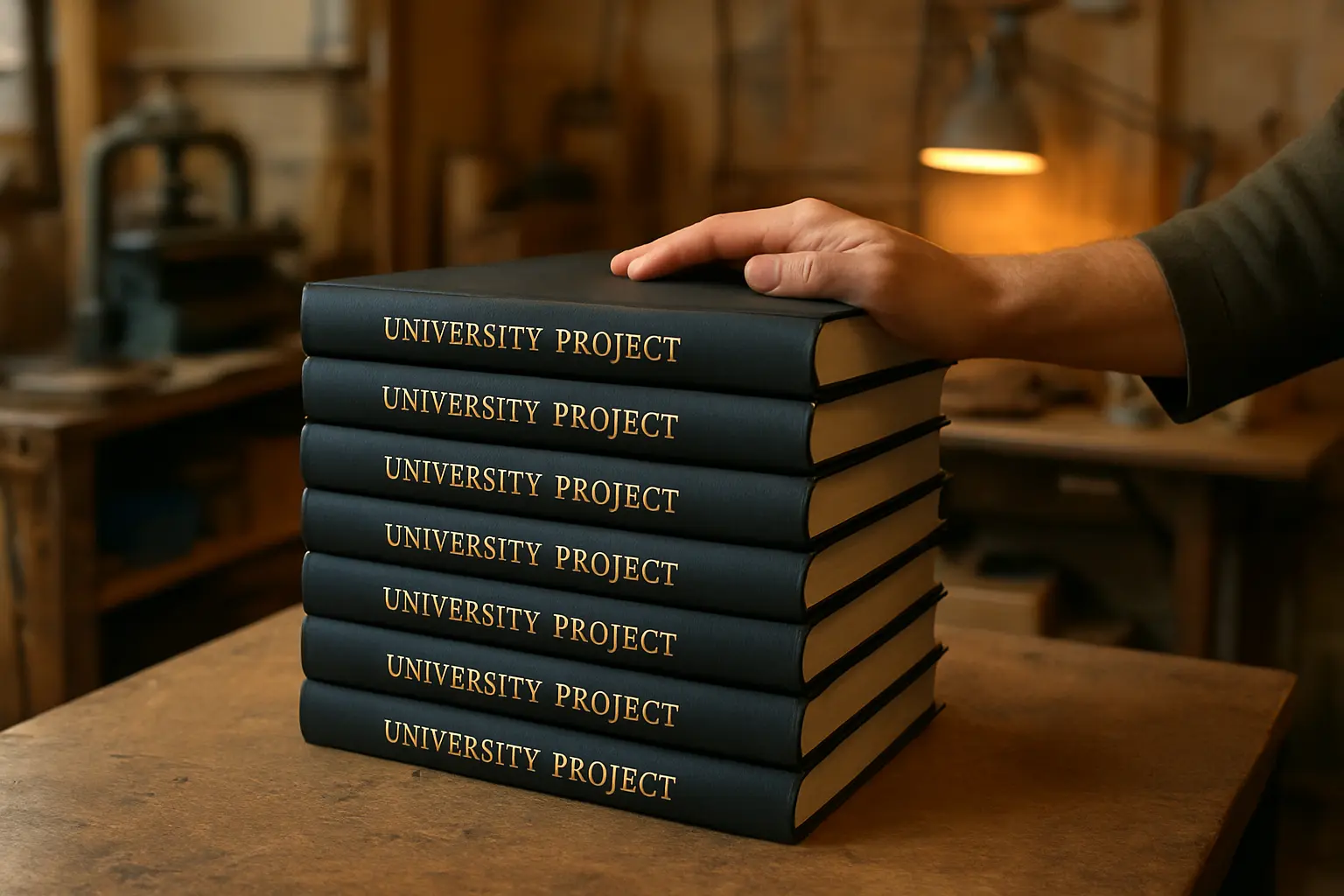
    Several hardbound final year project copies stacked after binding
    Book the binder in week three, not week one of the last fortnight. Every final year student in your faculty has the same idea in the same week.

    Week 3: corrections, the similarity check, and booking the binder

    Your supervisor’s comments come back this week. Triage them before editing: presentation fixes are minutes each, interpretation gaps are about an hour each, and anything sending you back to the data file goes first because everything downstream depends on it.

    Run your department’s similarity check now rather than after binding. If your institution has a stated acceptable percentage, you need the report in hand while there is still time to fix what it finds — and the fixes are rewriting and citing, not paraphrase tricks.

    Book the binder this week. Ask what file format they want, how many days they need, and what the cover text must say.

    Week 2: reconcile, then freeze the document

    This is a checking week, not a writing week. Five checks, in order:

    1. One respondent count in Chapter Three, every Chapter Four table note, and the abstract.
    2. Research questions match sub-sections — same number, same order, same wording as Chapter One.
    3. Every table and figure numbered and referred to by number in the text.
    4. Every in-text citation appears in the reference list, and every reference list entry appears in the text.
    5. Page numbers, margins and line spacing match your department’s format sheet exactly.

    Then freeze it. Send to the binder. A document you keep improving is a document that never gets bound, and a late binding is a missed defence.

    Week 1: rehearse

    Build the slides — usually ten to fifteen: title, background and problem, objectives and research questions, method, findings table by table, conclusion, recommendations. One idea per slide, no paragraphs.

    Then rehearse out loud, standing, with a coursemate playing a hostile panel member. The first time you say an answer aloud should not be in the room. Work through the standard question bank in what questions are asked during a project defence and make sure you can answer every one about your study.

    Four things to know cold, without looking: your respondent count, your reliability coefficient, why you chose each statistical tool, and what your lowest-scoring item means. Those four cover most of what a panel actually asks.

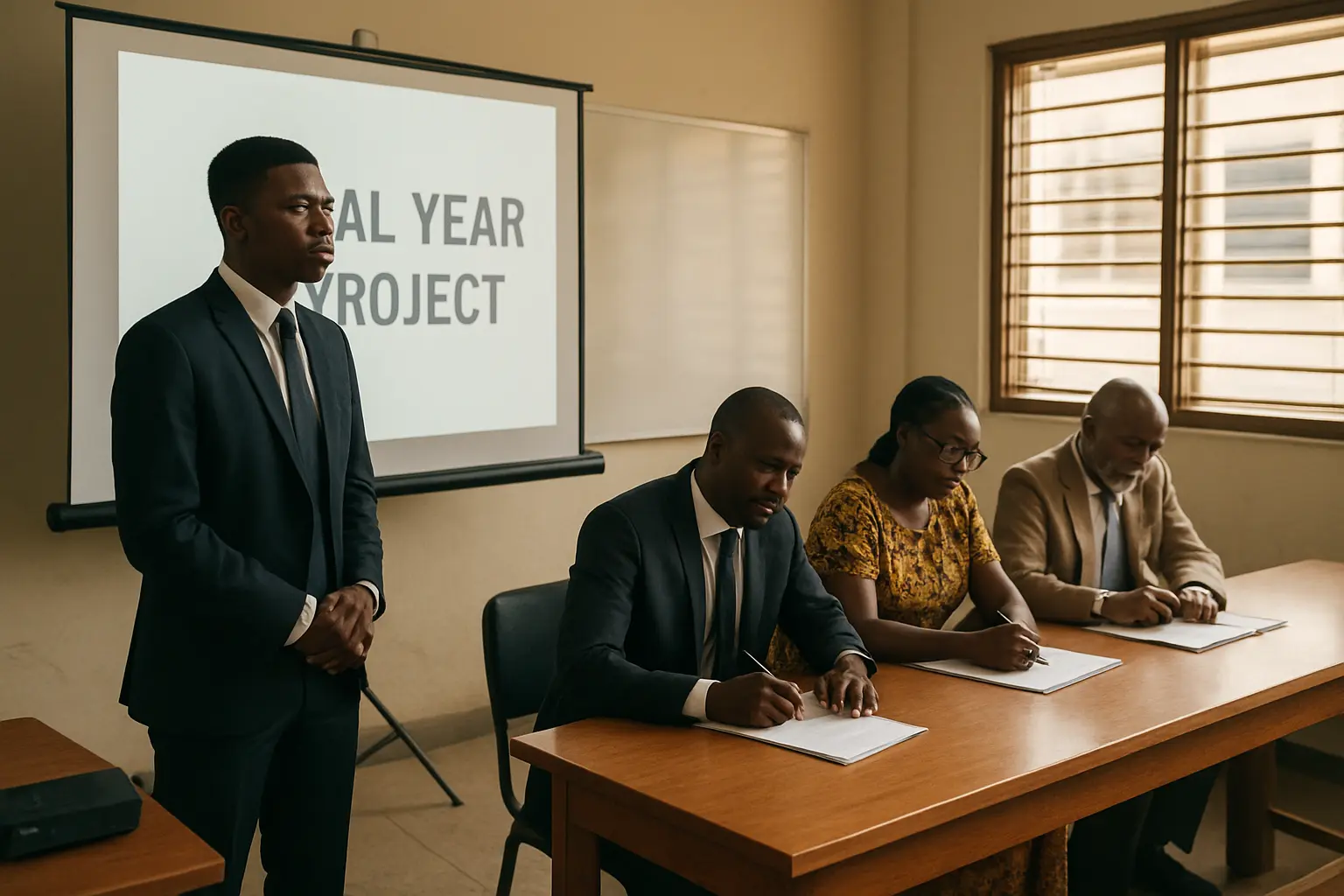
    A Nigerian student rehearsing a project defence presentation in front of a coursemate
    One coursemate, one afternoon, asking the hardest questions they can. It is the cheapest preparation available and almost nobody does it.

    What to carry on the day

    • Your bound copies, plus one working copy you are willing to write in.
    • Your data file and your output, on a laptop and on a flash drive. “Let us see your output” is a reasonable request and an unanswerable one if the file is at home.
    • Your questionnaire, including the validated copy and the reliability figures for each section.
    • Pen and paper, with one group member assigned to write down every correction verbatim and the name of the panel member who asked for it.

    That last item matters more than it sounds. Panel members contradict one another, and the written record is what lets your supervisor arbitrate afterwards. The list you walk out of the room with is the deadline you are actually working to next, and reconstructing it from memory three days later never goes well.

    The three failures this plan is designed to prevent

    Polishing instead of finishing. Rewriting Chapter Two in week two feels productive and is not. Chapters One to Three are approved. Leave them.

    Discovering a logistical requirement late. Binding time, copy counts, a certification page that needs two signatures from people who are not both on campus. All of it is knowable in week six by asking.

    Waiting for a groupmate. Do the work that cannot wait, keep a written record of who did what, and tell your supervisor the truth if asked. A deadline does not pause for a group chat.

    If you are reading this and have not started at all rather than being six weeks out, the earlier problem — a blank document and no system — is the one addressed in final year project writing help.

    Six weeks is enough if the structure holds

    Tesify keeps your chapters in the structure your department expects and every citation attached to a source you actually opened, so the last six weeks go into finishing rather than reformatting and re-checking. Over 9,000 students have used it to write more than 15,000 chapters, and every word is still written by you.

    Finish your project in Tesify

    Frequently asked questions

    How do I prepare for a project defence in Nigeria?

    Finish the analysis first, write Chapter Four, then Chapter Five and the front matter, act on your supervisor’s corrections, run the similarity check, bind on time, and spend the final week rehearsing aloud against a question bank.

    Is six weeks enough to finish a final year project?

    Yes, if your data is already collected and Chapters One to Three are approved. It is not enough if you still have to collect data, because respondents and scheduling cannot be compressed.

    When should I book the binder?

    About three weeks before the deadline, and ask then how many days they need and how many copies your department requires. Binding is the most commonly underestimated item in the whole timeline.

    What should I do first if my defence is very close?

    Ask your supervisor when they need the final draft and ask your department how many bound copies are required. Both deadlines belong to other people, and everything else is planned backwards from them.

    How many slides should my defence presentation have?

    Usually ten to fifteen: title, background and problem, objectives, method, findings, conclusion and recommendations. One idea per slide, and never paragraphs of text you will read aloud.

    What do I need to know without looking it up?

    Your respondent count, your reliability coefficient, why you chose each statistical tool, and what your lowest-scoring item means. Those four cover the majority of what panels ask.

    What should I take into the defence room?

    Your bound copies plus a working copy, your data file and output on both a laptop and a flash drive, your questionnaire with its reliability figures, and paper for recording corrections as they are spoken.

    Should I keep editing after sending the file to the binder?

    No. Freeze the document when it goes for binding. A project you keep improving is a project that misses its binding slot, and a late bound copy can cost you the defence date.

    What if my supervisor returns corrections very late?

    Act on them in order of cost — anything requiring re-analysis first, then interpretation, then formatting. Keep the correction list and tick items off, and send a short note with the resubmission saying what changed.

    Do I run the plagiarism check before or after binding?

    Before, always. A similarity report that arrives after binding is a report you cannot act on, and the fixes it calls for are rewriting and proper citation rather than quick paraphrasing.

    Can I still pass if my findings are not significant?

    Yes. You are assessed on whether the research was properly conducted and honestly reported, not on whether the results were interesting. A well-defended non-significant finding is entirely acceptable.

  • Your Civil Engineering Project Has No Questionnaire. So What Goes in Chapter Four? (2026)

    Your Civil Engineering Project Has No Questionnaire. So What Goes in Chapter Four? (2026)

    You have spent six weeks in the materials laboratory. There are cube crushing results at 7, 14, 21 and 28 days sitting in a notebook, a sieve analysis you ran three times, and a slump reading for every mix. Now you open Chapter Four to start writing, search for guidance, and every template you find opens with a bio-data table of respondents, a four-point Likert scale and a 2.50 decision criterion.

    None of it applies to you. You did not administer a single questionnaire and you are not going to.

    This is one of the loneliest points in a Nigerian engineering project, and it is entirely solvable. Chapter Four does the same job in every discipline — it presents what you found and interprets it — but in civil engineering the data are measurements, the comparison is against a standard rather than a mean criterion, and the tables look completely different.

    What Chapter Four is actually for

    Strip away the survey conventions and Chapter Four answers three questions in order:

    1. What did the tests produce? — presentation
    2. What do those numbers mean against a reference? — analysis
    3. Why did they come out that way? — interpretation

    Your chapter follows your objectives from Chapter One, in the same order, exactly as a survey-based project does. If objective one was to determine the physical properties of the material and objective two was to determine the compressive strength at varying replacement levels, then section 4.1 presents the physical properties and section 4.2 presents the strength results. That sequencing rule is the one thing engineering projects share with the standard structure described in the pillar on data presentation, analysis and interpretation — read it for the interpretation style, and ignore its Likert tables.

    The four table types that carry an engineering Chapter Four

    1. The material characterisation table

    This comes first, before any performance result, because it establishes that your inputs were what you claimed. For a concrete study it holds specific gravity, bulk density, moisture content, fineness modulus and the aggregate grading. For a soil study it holds natural moisture content, specific gravity, Atterberg limits — liquid limit, plastic limit, plasticity index — and the grading from the sieve analysis, followed by the AASHTO or USCS classification that those values produce.

    Each row should carry three columns: the property, your measured value, and the standard requirement or typical range. That third column is what turns a data dump into analysis, and students consistently leave it out.

    2. The results-by-variable table

    This is the heart of the chapter. Rows are your treatment levels — replacement percentages, curing ages, mix ratios, compaction efforts — and columns are the measured outputs.

    For a partial replacement study, a table of average compressive strength in N/mm² with replacement level down the side and curing age across the top presents the entire experiment on a single page. Report the mean of your three cubes per age per mix, and state in the table caption that each value is the average of three specimens. Panels ask whether you tested one cube or three, and a caption answers it before the question arrives.

    3. The comparison-against-standard table

    Every measured value in a civil engineering project means something only relative to a specification. Your comparison column names the reference explicitly — the relevant British Standard for the test method, the Nigerian Industrial Standard for the material, or the Federal Ministry of Works General Specification for Roads and Bridges for pavement layer requirements.

    So a CBR value of 12 per cent is not a finding on its own. “A soaked CBR of 12 per cent, which falls below the minimum specified for subbase material in the Nigerian General Specification, indicating that the soil requires stabilisation before use in that layer” is a finding, because it carries a decision.

    4. The trend chart

    One chart per relationship, no more. Strength against curing age with a line for each replacement level. Dry density against moisture content for a compaction curve, with the maximum dry density and optimum moisture content marked. Load against deflection for a structural test.

    Axes labelled with units, a caption below in your department’s figure-numbering format, and referenced in the text as “Figure 4.3 shows…” before it appears. Charts that are never mentioned in the prose read as decoration.

    Do you need statistics at all?

    Often less than you fear, and occasionally more.

    If your project measured properties without comparing treatments — characterising a soil, testing sandcrete blocks from three markets — descriptive presentation against standards is sufficient. Means and, ideally, standard deviations across your replicates are all a panel expects.

    If your project varied a treatment across levels, an analysis of variance strengthens the chapter considerably. Testing five replacement percentages at 28 days, ANOVA tells you whether the differences between mixes are statistically significant rather than experimental scatter, and a post-hoc test tells you which specific pairs differ. Regression is appropriate where you are modelling one continuous variable against another, such as strength against curing age.

    None of this requires expensive software. The tools that handle ANOVA and regression on a project-sized dataset are compared in the piece on SPSS, Excel, JASP and jamovi for a final year project, and two of the four are free.

    The interpretation paragraph, in three moves

    Presenting a table is not analysis. After every table, write a paragraph that makes three moves:

    Move one — state what the table shows, in numbers. “Table 4.2 shows that compressive strength at 28 days decreased from 24.6 N/mm² at 0 per cent replacement to 18.3 N/mm² at 20 per cent replacement.”

    Move two — compare it to the reference or the trend. “The 10 per cent replacement mix attained 22.1 N/mm², which exceeds the 20 N/mm² target strength for the design grade, while replacement levels above 15 per cent fell below it.”

    Move three — explain why, with a citation. “The reduction at higher replacement levels is attributable to the lower calcium content of the pozzolanic material and its slower rate of strength development, consistent with the findings of [author] ([year]), who reported a similar decline beyond 15 per cent replacement.”

    Three moves, three or four sentences, after every single table. Do that consistently and Chapter Four writes itself at roughly a page per table.

    What belongs in Chapter Five instead

    Recommendations do not go in Chapter Four. “Ten per cent replacement is recommended for non-structural applications” is a Chapter Five sentence. Chapter Four reports that the 10 per cent mix met the target strength; Chapter Five decides what should be done about it, alongside the summary, conclusion and contribution to knowledge set out in the guide to writing Chapter Five of a Nigerian final year project.

    Keeping that boundary clean is one of the easiest marks in an engineering project, and mixing the two is one of the most common corrections.

    The questions the panel will ask about your results

    Four, reliably:

    • “How many specimens per data point?” Three is the expectation for cube tests. If you tested one, say so and record it as a limitation rather than letting the panel discover it.
    • “Which standard did you test to?” Name the test standard, not just the test. “Compressive strength was determined in accordance with BS 1881” is the answer.
    • “Why did the strength drop at that level?” A mechanism, not a restatement. Chemistry, particle packing, water demand — something physical.
    • “What would you have done differently?” Have one honest answer ready: more curing ages, a wider replacement range, duplicate soaked CBR samples.

    The wider inventory of what Nigerian panels ask, across all six areas they probe, is in the guide to project defence questions in Nigeria. Computer science students face the same structural problem with a build project instead of a laboratory one, and the parallel is worth reading in the comparison of system development methodologies for a computer science project.

    You have the results. The writing is the bottleneck.

    This is the part nobody warns engineering students about. The laboratory work is finished, the numbers are correct, you know exactly what they mean — and there are still forty pages of formal departmental prose standing between you and submission, with a defence date that is not moving.

    Writing up is not the same skill as running a CBR test, and it should not be what costs you a class of degree.

    Tesify drafts your chapters from your own topic, objectives and results. It writes around the tables you already produced, keeps your terminology and reference list consistent across every chapter, and lets you rework a section after your supervisor’s corrections without rebuilding the chapter from the beginning. Your data stay yours, your findings stay yours, and the interpretation stays yours — what disappears is the blank page.

    The free plan is the place to start. You can draft a chapter, see whether the output sounds like your department’s house style, and decide from there without paying anything.

    Start your project on Tesify for free and get Chapter Four written around your test results this week.

    Frequently asked questions

    What goes in Chapter Four of a civil engineering project?

    Presentation of laboratory or field results, analysis of those results against the relevant standards, and interpretation of why the values came out as they did. It is organised in the order of your objectives, and it typically contains material characterisation tables, results tables by treatment level, comparison against specification, and trend charts — with an interpretation paragraph after each one.

    Does an engineering project need hypotheses and statistical tests?

    Not always. Characterisation studies present descriptive results against standards. Studies comparing treatment levels benefit from analysis of variance to show whether differences are significant, and regression where you are modelling one continuous variable against another. Check your department’s guidelines, since some require formal hypotheses even for laboratory work.

    How many cubes should I crush per test age?

    Three specimens per mix per curing age is the standard expectation, with the reported strength being their average. State in the table caption that each value is a mean of three specimens. If constraints forced you to fewer, report the actual number and record it as a limitation in Chapter Five rather than leaving the panel to find it.

    Is using an AI writing tool for my project cheating?

    It depends entirely on what you use it for. Using a tool to draft and structure prose around results you generated yourself is writing assistance, in the same family as a reference manager or a grammar checker. Submitting work whose findings, data or analysis you did not produce is academic dishonesty. Your own institution’s policy governs, so read it, and disclose your use of AI tools if your department requires disclosure.

    Will using Tesify raise my similarity score?

    Drafts are generated for your specific topic, objectives and results rather than assembled from existing project documents, and the citations are attributed. The reliable practice regardless of tool is to run a similarity check yourself before submission, review anything flagged, and quote or paraphrase properly with attribution. No tool should ever be presented as a way to defeat a university’s plagiarism check.

    How much does Tesify cost, and is there a free option?

    There is a free plan, and it is the sensible way to start — draft a chapter, judge the output against your department’s house style, and only then decide whether a paid plan is worth it to you. Current plan details and naira pricing are shown when you create a project.

    Can it write my chapter if my data are tables of test results rather than survey responses?

    Yes. You supply the results and the standards you are comparing against, and the draft is built around them — presentation, comparison and interpretation in the sequence your objectives set. Laboratory and design-based projects are exactly the case where a generic survey template fails and drafting against your own material matters most.

    What if my supervisor sends the chapter back with corrections?

    That is expected, and it is the case the tool is built for. You revise the specific section against the comment rather than rewriting the chapter, and the surrounding text, terminology and references stay consistent. Most of the time lost in a Nigerian project goes to correction cycles, not to first drafts.

  • What Questions Are Asked During a Project Defence in Nigeria? (2026)

    What Questions Are Asked During a Project Defence in Nigeria? (2026)

    Project defence panels in Nigeria ask about the same six things every time: why you chose the topic, what your objectives were, what other researchers found, how you collected your data, what your results actually say, and what your work contributes. There is no national question bank. Your department sets the format, and the panel reads your own chapters back to you.

    Is there an official list of project defence questions in Nigeria?

    No. The National Universities Commission lays down minimum academic standards and accredits programmes through the Core Curriculum and Minimum Academic Standards framework across sixteen disciplines. It does not publish a defence question bank, a defence duration, or a panel composition rule that applies to every Nigerian university. The panel in front of you is constituted by your department, and it works to your department’s or postgraduate college’s own guidelines.

    This is the same pattern that governs almost everything about a Nigerian final year project. As with the acceptable plagiarism percentage and the number of chapters you are expected to write, the confident national rule circulating on project sites does not exist. What exists is a set of institutional documents that disagree with each other in the detail and agree almost perfectly on the substance.

    The substance is what you can prepare for. Obafemi Awolowo University’s Postgraduate College guidelines, revised in January 2026, prescribe that the main body of a thesis must contain an introduction, a literature review, a methodology, results and findings, a conclusion, and a statement of the contribution to knowledge. Those are six required elements, not six chapters, and they are almost word for word the six things a panel interrogates. If you can defend each element on its own, you have covered the defence.

    What is the very first question a panel asks?

    Almost always a variant of “tell us about your work” or “why this topic?” It sounds like small talk. It is not. It is the panel establishing, in your first ninety seconds, whether you understand your own project or whether you are reciting something.

    Prepare a spoken answer of roughly sixty to ninety seconds that names the problem, the gap, the objective, the method and the headline finding, in that order. Do not open with a definition of your key term. Do not open with the history of the field. Panels have sat through hundreds of these, and an opening that starts at the beginning of the world signals that you are stalling.

    The follow-up is nearly guaranteed: “why does this matter?” or “who benefits from this study?” That is your significance of the study section being read back to you. Every clause you wrote in Chapter One is a promise you are now being asked to keep, so re-read it the night before rather than trusting your memory of what you wrote eight months ago.

    What questions are asked about Chapter One?

    Chapter One questions test whether your project has a defensible boundary. The recurring ones are:

    • “What exactly is the problem you set out to solve?” Answer in one sentence, in the present tense, about the world and not about the literature.
    • “What are your research objectives, and did you achieve all of them?” Count them out loud. If you wrote four objectives and only three are evidenced in Chapter Four, say so before the panel finds it.
    • “Why is your scope limited to this location, population or period?” The honest answer, which is access, time and cost, is acceptable if it is stated as a deliberate delimitation rather than discovered as an accident.
    • “What is the difference between your limitations and your delimitations?” Delimitations are boundaries you chose. Limitations are constraints imposed on you. Students mix these two up more often than any other pair of terms in a Nigerian defence.
    • “Define your key operational terms.” Panels ask this to check that your definitions match how you actually measured things in Chapter Three.
    A bound final year project open on a desk with handwritten panel corrections in the margin
    Corrections are the normal outcome of a Nigerian project defence, not a punishment.

    What questions are asked about the literature review?

    The single most common Chapter Two question in a Nigerian defence is “what is the gap in the literature, and who says so?” A panel is not asking you to prove that nobody in the world has written on your topic. It is asking you to name two or three specific studies and state precisely what each one did not do that you did.

    Expect these as well:

    • “What theoretical framework did you adopt, and why that one rather than the alternatives?” You must be able to name at least one theory you rejected and give a reason.
    • “Who propounded that theory, and in what year?” This is a memory check and it is asked constantly. Learn the originator and date of every named theory in your framework.
    • “Is this the most recent work on the subject?” A literature review dominated by pre-2015 sources invites this question. Have two or three recent studies ready to name.
    • “Whose work is this paragraph?” A panellist pointing at an uncited passage is the worst moment of any defence. If you built your chapter properly, every claim traces to a source, which is the method set out in the section-by-section guide to Chapter Two.

    What questions are asked about methodology?

    Methodology questions are where undefended projects fall apart, because a panel can test your answers against arithmetic you cannot revise on the spot.

    • “What is your research design and why is it appropriate?” Name the design, then justify it against the objective, not against convenience.
    • “What is your population, and how did you arrive at your sample size?” If you used a formula, be ready to name it and reproduce it. Panels do check the arithmetic.
    • “What sampling technique did you use?” If you handed questionnaires to whoever was available, that is convenience sampling. Call it what it is; do not label it random.
    • “How did you test the validity and reliability of your instrument?” Face validity through your supervisor is a real answer. A reliability coefficient with no test behind it is not.
    • “Why did you use that statistical tool?” Match the tool to the data type and the hypothesis, and be able to say what the tool would have shown had the result gone the other way.
    • “Did you obtain permission or ethical clearance?” Increasingly asked in health, nursing and education departments.

    What questions are asked about results and findings?

    Chapter Four questions are the most dangerous because students memorise their tables without ever articulating what the tables mean.

    The panel will pick a single table and ask “interpret this for us.” Do not read the numbers aloud. State what the number tells you about your research question, then state whether it supports or contradicts your hypothesis, then state whether it agrees with the studies you reviewed in Chapter Two. That three-part move of finding, hypothesis and literature is what separates a pass from a rewrite.

    Other reliable Chapter Four questions: “how many questionnaires did you distribute and how many came back?” so know your response rate as a percentage; “why is this figure so high or so low?”; and the one students dread, “your finding contradicts the literature, explain.” A contradicted hypothesis is not a failed project. Saying “I don’t know why” is a failed answer, while “the difference is plausibly explained by X, and testing that would require Y” is a good one.

    What questions are asked about the contribution to knowledge?

    The Obafemi Awolowo University guidelines make the contribution to knowledge a required element of the main body, and panels treat it as such. Expect “what is new here?” and “what should someone do with this finding?”

    Undergraduate panels are realistic about scale. Nobody expects a final year project to overturn a field. A defensible contribution can be a local one: this variable had not previously been measured in this population, or this instrument had not been applied in this Nigerian context. State it in one sentence and do not inflate it, because an overclaimed contribution invites the panel to dismantle it.

    What questions are asked about your references and originality?

    Two of these come up constantly. The first is “which referencing style is this, and did you apply it consistently?” Nigerian universities do not agree on a single style. The University of Ibadan’s Postgraduate College mandates its own house style, while Obafemi Awolowo University permits seven named styles by discipline and requires that the latest applicable version be used. Confirm your department’s requirement rather than assuming APA, because the differences are set out in the guide to Nigerian referencing requirements.

    The second is originality. Departments that run a similarity check will have your report in front of them, and a panellist may ask you to account for a matched passage. Turnitin states plainly on its own product page that its Similarity report compares work against “an unparalleled repository of student papers, current and archived web pages, and premium subscription articles from top publishers across 170 languages”, and that its Flags Panel highlights “potentially manipulated text such as replaced or hidden characters”. The practical consequence for a defence is simple: a matched passage you can explain as a properly cited quotation is survivable, and a matched passage you cannot account for is not.

    A Nigerian student rehearsing answers to defence questions with a laptop and printed chapters in a campus library
    Six index cards, one claim and one piece of evidence each, is the whole defence.

    How should you prepare in the final week?

    Work backwards from the six elements rather than from your chapter numbers. For each of the six, write a single index card carrying one sentence of claim and one sentence of evidence. Six cards is the whole defence.

    Then do three things. Read your own abstract aloud until you can say it without the page, because the abstract is the compressed version of every answer you will give. Reconcile your numbers across chapters, because the sample size in Chapter Three, the number of returned instruments in Chapter Four and the figure in your abstract must be the same number, and a mismatch found by the panel costs you more than a weak finding. Finally, prepare the correction posture: panels expect you to write, not to argue. Take every correction down verbatim, and if you do not understand one, ask for the specific page.

    If you are still finishing chapters rather than rehearsing them, the constraint is drafting speed, not knowledge. That is the situation the week-one recovery plan is built for, and the guide to breaking the supervisor correction loop covers the version of this problem where the chapters exist but keep coming back in red ink.

    What do panels actually fail students for?

    Rarely for a weak finding. Overwhelmingly for one of four things: numbers that do not reconcile between chapters, a methodology the student cannot justify, passages the student cannot account for, and objectives that were never evidenced in the results. Every one of those is a writing and record-keeping problem rather than an intelligence problem, which is why the defence is so much more preparable than students assume.

    Walk into your defence with chapters you can actually defend

    Tesify helps you draft, structure and reference your project chapter by chapter with the citation trail intact, so when a panellist points at a paragraph and asks whose work it is, you have an answer. Over 9,000 students have used it to move from a blank page to a defensible draft, and every word is still written by you.

    Start your project chapter in Tesify

    Frequently asked questions

    How long does a project defence last in Nigeria?

    There is no national rule. In practice most undergraduate defences run between fifteen and forty-five minutes including questions, and departments running many students in one day keep them at the shorter end. Ask your departmental secretary for your schedule rather than assuming.

    How many people sit on a defence panel?

    It varies by institution and level. Undergraduate panels are typically constituted from departmental staff with your supervisor present. At postgraduate level the certification requirements are heavier, and the Obafemi Awolowo University Postgraduate College requires the certification page of a thesis to be signed by the supervisor, a co-supervisor, the head of department and the provost.

    Can my supervisor defend my project for me?

    No. Your supervisor may clarify a procedural point, but the panel is assessing you. Supervisors who intervene too readily usually stop when a panellist redirects the question, so do not plan around being rescued.

    What should I wear to a project defence?

    Formal or smart corporate dress is the expectation across Nigerian universities. Some departments issue an explicit dress code with the defence timetable. Nobody has ever lost marks for being too smartly dressed.

    Should I prepare slides?

    Only if your department asks for them. Where slides are used, keep them to a handful covering problem, objectives, method, results and contribution, and never read them aloud. Where they are not used, bring a bound copy and your correction notebook.

    What happens if I cannot answer a question?

    Say so briefly and offer what you do know. “I did not test that, but the design would require X” is a respectable answer. Inventing a figure is not, and panels catch invented figures immediately because they do not reconcile with your tables.

    Do I fail if the panel gives corrections?

    No. Corrections are the normal outcome of a Nigerian project defence, not a punishment. The pass condition is that you make them and resubmit within the deadline your department sets.

    Will the panel ask about my plagiarism score?

    They may, in departments that run a check. Institutions differ sharply here: the Covenant University centre handbook sets a twenty per cent ceiling, while the published postgraduate guidelines at Obafemi Awolowo University and the University of Ibadan set no numeric threshold at all. Ask your department what it uses before you assume any number applies to you.

    Can I be asked about a chapter my supervisor approved?

    Yes. Supervisor approval is not panel approval, and panellists frequently question sections the supervisor passed. Prepare all six elements regardless of which ones your supervisor spent time on.

    What is the single most common defence question?

    “Why did you choose this topic?” It opens most Nigerian defences, and it is the one students most often answer badly by explaining how they chose it rather than why it was worth choosing.