Tag: OpenAlex

  • Has Your Project Topic Already Been Studied in Nigeria? How to Count It (2026)

    Has Your Project Topic Already Been Studied in Nigeria? How to Count It (2026)

    On four common Nigerian project topics, studies from Nigerian institutions account for between 0.6 and 7.4 per cent of the world’s literature. That ratio is the most useful number a Chapter Two can carry, because it converts the vaguest sentence in Nigerian project writing — “few studies have been carried out in the Nigerian context” — into a claim with evidence behind it.

    The four worked counts

    Each row below is a single query against the OpenAlex index, run on 17 August 2026, restricted to works published from 2016 onward whose title or abstract matches the phrase. The Nigerian column additionally restricts to works with at least one Nigerian institutional affiliation.

    Topic phrase Nigerian-affiliated works Works worldwide Nigerian share Source and date
    youth unemployment 921 12,493 7.4% OpenAlex, 17 Aug 2026
    entrepreneurship education 1,229 43,556 2.8% OpenAlex, 17 Aug 2026
    financial inclusion 1,648 63,653 2.6% OpenAlex, 17 Aug 2026
    e-learning 1,263 215,782 0.6% OpenAlex, 17 Aug 2026

    Two of those rows deserve a pause.

    Youth unemployment is the outlier at 7.4 per cent, nearly three times the share of the next topic. That is what you would expect of a subject the country has an unusual amount of direct experience with, and it means a student choosing this topic is entering a genuinely crowded local field rather than an empty one.

    E-learning is the lowest at 0.6 per cent, and its world total is misleading. 215,782 global hits reflects a term used across every discipline and every country, much of it in senses that have nothing to do with your study. A low share against an enormous and loosely defined world total is weaker evidence than a low share against a tight one. That is a caution about the method, not a finding about the topic.

    Why counting beats asserting

    Every Nigerian project template asks Chapter Two to end on a gap. Most undergraduate manuscripts discharge that requirement with a sentence like “however, limited studies have been carried out in Nigeria”, and every panel member has read that sentence several hundred times.

    The question that follows is always the same: how do you know? Without a count, the honest answer is that you searched for a while and did not find much, which is indistinguishable from not having searched properly. With a count, you can say that 921 of 12,493 indexed studies on the topic since 2016 carry a Nigerian affiliation, name the index and the date, and move on.

    The procedure, in five steps

    1. Reduce your topic to one or two phrases. Not the whole title. “Financial inclusion”, not “The effect of financial inclusion on the growth of small and medium scale enterprises in Auchi metropolis”.
    2. Count the world. Search the phrase in title and abstract, restricted to a sensible period — the last ten years is defensible in most fields.
    3. Count Nigeria. Add the country filter for author institutions. This filters on where the researchers are, not on whether the paper mentions Nigeria, which is exactly what a plain keyword search cannot do.
    4. Divide. The share is more meaningful than either raw number, because it controls for how large the field is.
    5. Record the query, the date and both counts in your search log, then repeat for any second phrase your topic needs.

    Do this at topic-selection stage, not in the week you write Chapter Two. A count of four on your exact topic tells you something urgent about scope while there is still time to act on it, and a count in the thousands tells you to narrow before your supervisor does it for you.

    A notebook page narrowing a broad project topic through three progressively specific lines
    Count at each level of narrowing. The level where the number drops sharply is usually where your contribution sits.

    The instrument caveat, and it is a large one

    The counts above use a title and abstract match. A general relevance search over the full record returns very different numbers for the same phrase: on financial inclusion, the loose search returned 18,560 Nigerian works where the title-and-abstract match returned 1,648 — a factor of eleven.

    Neither number is wrong; they answer different questions. The loose search finds anything the index considers relevant, including papers that merely cite financial-inclusion research in passing. The tight search finds papers that are actually about it. For a gap statement you want the tight one, and you must say which you used.

    Three further limits to state plainly if you report a count in your manuscript.

    • Indexing is incomplete. Work published in Nigerian journals that are not indexed in the source you queried will not appear, and that is a real volume of research. A count is a floor, not a census.
    • Unpublished projects are invisible. Approved undergraduate and master’s projects sitting in departmental libraries are in no bibliographic index at all. For the purpose of not duplicating work, those are the ones most likely to be identical to your plan, because they came from a department like yours.
    • Phrasing decides the answer. “Youth unemployment”, “graduate unemployment” and “joblessness among young people” describe overlapping things and return different counts. Run each and report all of them rather than picking the smallest.

    Because of the second limit in particular, a count supplements searching your own departmental library and Nigerian journals rather than replacing either. Whichever sources you use, name them and the period covered — and keep the references themselves organised as you go, which is what a reference manager is for, as compared in the guide to Mendeley and Zotero for Nigerian students.

    What the number does not license you to say

    A low count is not a finding, and it is not automatically a justification. Three claims to avoid.

    “No studies exist.” Almost never true, and one query by a panel member can disprove it. Say “few indexed studies”, give the number, and name the index.

    “This is the first study of its kind.” The strongest form of overreach available to an undergraduate, and it is unnecessary. A project can be worth doing without being unprecedented.

    “The topic is under-researched, therefore my study is important.” Scarcity alone is not importance; some topics are little studied because they matter little. The gap statement has to say why the missing work is worth doing, not merely that it is missing.
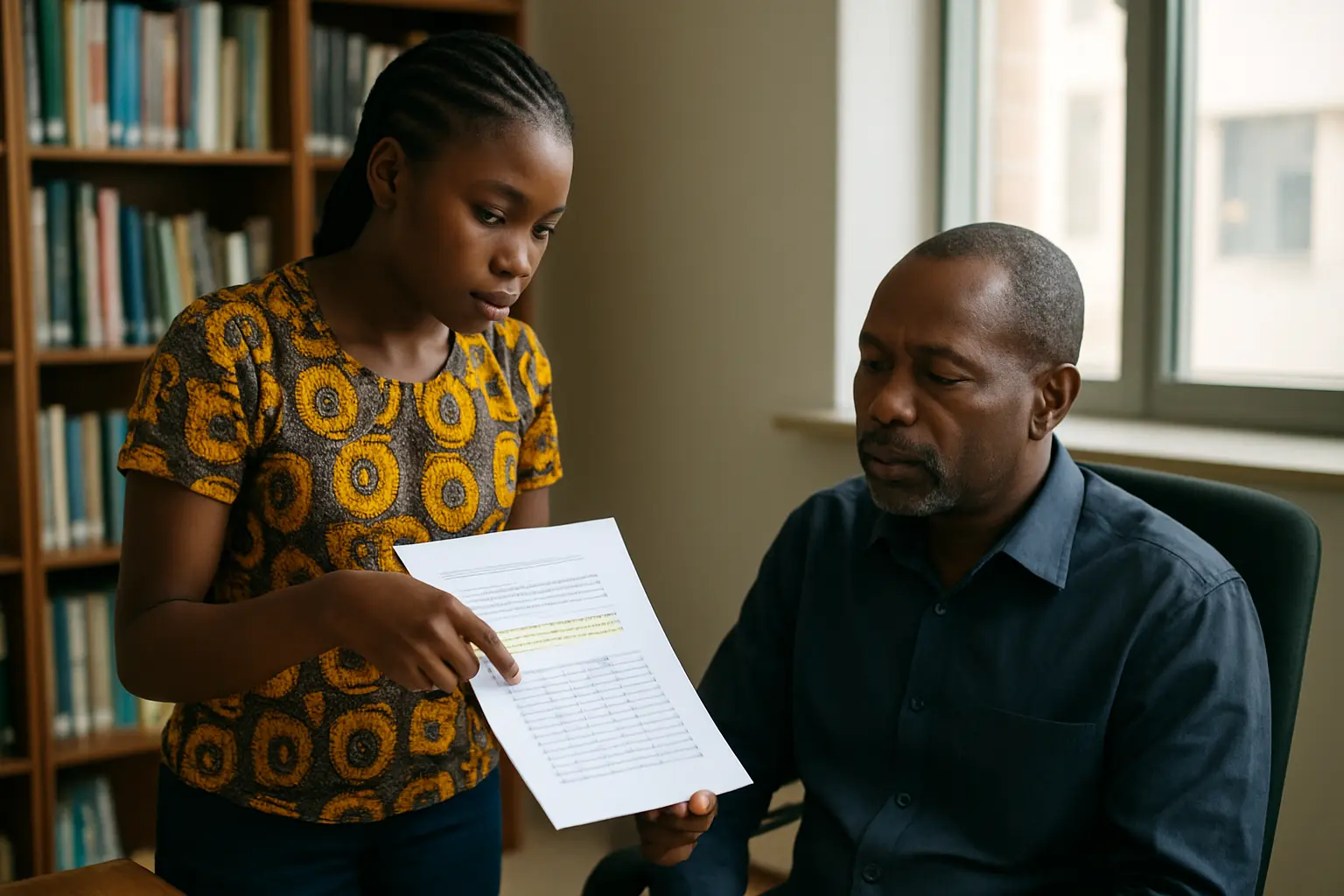
    A Nigerian student showing a supervisor a printed gap statement backed by a search log
    A gap statement with a count behind it survives the follow-up question. One without a count invites it.

    Turning the count into the sentence Chapter Two needs

    The gap statement is the last paragraph of your review, and with a count in hand it writes itself.

    Template: “A search of the OpenAlex index conducted on [date] returned [world count] works published since [year] whose title or abstract concerned [topic], of which [Nigerian count] carried a Nigerian institutional affiliation. Of those, the reviewed studies examined [what has been done], predominantly among [what population, in what setting]. None examined [your variable combination] among [your population] in [your locale], which is the gap the present study addresses.”

    Three things that template does. It names the instrument and the date, so the claim is checkable. It distinguishes what exists from what is missing, rather than implying nothing exists. And it lands on your own population and locale, which is where almost every legitimate undergraduate contribution actually lives — you are rarely the first person to study the variable, and you are frequently the first to study it in your local government area.

    How that paragraph fits into the rest of the chapter, and how to synthesise the studies you did find rather than stacking summaries, is set out in the guide to writing Chapter Two section by section. Every source you name in it has to appear correctly in your reference list, following the conventions in referencing a Nigerian university project in APA. And for the wider context of how much Nigerian research exists in total, see how much research Nigerian universities publish.

    Write the gap once, and keep it attached to the search that proves it

    Tesify holds your chapters in the structure your department expects and keeps each citation tied to the source you actually opened, so the gap statement in Chapter Two and the sources behind it never drift apart. Over 9,000 students have used it to write more than 15,000 chapters, and every word is still written by you.

    Build your literature review in Tesify

    Frequently asked questions

    How do I know if my project topic has already been studied?

    Count it. Search your topic phrase in title and abstract across a bibliographic index, once worldwide and once filtered to Nigerian institutions, over a fixed period, and record both numbers with the date. Then search your own departmental library separately for projects the index does not cover.

    How many Nigerian studies exist on a typical project topic?

    On the four topics counted here, Nigerian-affiliated work made up between 0.6 and 7.4 per cent of the world total since 2016 — 921 works on youth unemployment against 12,493 worldwide, and 1,648 on financial inclusion against 63,653.

    Is it a problem if many studies already exist?

    No. A well-studied variable gives you a validated instrument, a settled framework and findings to compare against. What you need is a population, setting or variable combination that has not been examined, not an untouched subject.

    Can I say no studies exist on my topic?

    Avoid it. Say few indexed studies exist, give the count, name the index and the date. Absolute claims are disproved by one query and they cost you credibility on everything else in the chapter.

    Does a low count mean my topic is good?

    Not by itself. Some topics are little studied because they are hard to research or of limited consequence. Your justification has to explain why the missing work matters, not just that it is missing.

    Do unpublished projects count as existing studies?

    For the purpose of not duplicating work, absolutely — and they are the most likely to match your plan, because they came from a department like yours. They are invisible to bibliographic indexes, so search your departmental library separately.

    What period should I count over?

    The last ten years is defensible in most fields and matches the recency most Nigerian templates expect in the empirical review. State the period alongside the count; a number without a date range means nothing.

    Why did I get two very different counts for the same phrase?

    Because a general relevance search and a title-and-abstract match are different queries. The loose search returned 18,560 Nigerian works on financial inclusion where the tight one returned 1,648. Use the tight one for a gap claim and say so.

    Should the count go in Chapter One or Chapter Two?

    Chapter Two, in the summary of literature or gap section. A brief version can support the background in Chapter One, but the counted evidence belongs with the review it summarises.

    Do I have to cite the database itself?

    Yes, if you report a count from it. Name the index, the query, the filters and the date of access, exactly as you would for any other data source, so the number can be reproduced.

    My topic returns thousands of Nigerian studies. What now?

    Narrow it and count again. Add the population, the sector or the locale and re-run the query. The level of narrowing at which the number drops sharply is usually where your contribution sits.

  • How Much Research Do Nigerian Universities Publish? (2026)

    How Much Research Do Nigerian Universities Publish? (2026)

    Nigerian research output has nearly tripled in a decade: 16,560 works with a Nigerian institutional affiliation were indexed for 2015, against 46,381 for 2024 — a 2.8-fold rise. Every figure below was queried directly from the OpenAlex API on 17 August 2026, and the institutional leaderboard comes with a verified defect that means you cannot cite it as printed.

    The national figures, year by year

    Publication year Works with a Nigerian institutional affiliation Source and date read
    2015 16,560 OpenAlex API, 17 Aug 2026
    2016 18,064 OpenAlex API, 17 Aug 2026
    2017 21,150 OpenAlex API, 17 Aug 2026
    2018 25,271 OpenAlex API, 17 Aug 2026
    2019 30,955 OpenAlex API, 17 Aug 2026
    2020 39,984 OpenAlex API, 17 Aug 2026
    2021 42,779 OpenAlex API, 17 Aug 2026
    2022 42,400 OpenAlex API, 17 Aug 2026
    2023 45,115 OpenAlex API, 17 Aug 2026
    2024 46,381 OpenAlex API, 17 Aug 2026

    Three features of that series are worth stating carefully before anyone quotes it.

    The growth is real and large. 2024 is 2.8 times the 2015 figure, and the steepest single jump is 2019 to 2020, where output rose by roughly nine thousand works in one year.

    It is not monotonic. 2022 came in at 42,400 against 42,779 for 2021 — a small decline. If you present this series as uninterrupted growth, a careful reader will find the one year that is not.

    The most recent years are not comparable. The same query returned 58,829 works for 2025 and 55,537 for 2026 — a year that was seven and a half months old when the query ran. A 2026 count already approaching the 2025 total in August is telling you about how records enter the index, not about Nigerian productivity. Use 2024 as your most recent settled year, and say why.

    Open access: four fifths of it

    Of the 46,381 works indexed for 2024, 37,165 are flagged open access — 80.1 per cent.

    That figure has a direct practical consequence for a final year student whose university library subscription is thin: roughly four in five recent Nigerian-affiliated papers should be readable without paying for them. It does not mean one search box will surface them all, which is why the databases you search and the way you record those searches matter — a point covered in the guide to writing Chapter Two.

    A notebook page recording a statistic alongside its source name and the date it was read
    Write every figure down with its source and the date you read it. These are live indexes, and a number without a date stops being checkable.

    The institutional table, and why it carries a warning

    OpenAlex lists 269 Nigerian institutions of type “education”. Ranked by the works count recorded on each institution’s own record:

    Institution Works count Citations Citations per work
    University of Ibadan 52,306 1,472,499 28.2
    University of Nigeria 38,144 756,538 19.8
    Edo State University Uzairue 31,682 28,873 0.9
    University of Lagos 28,403 513,424 18.1
    Obafemi Awolowo University 28,017 599,259 21.4
    Ahmadu Bello University 25,037 527,031 21.1

    Read from the OpenAlex institutions endpoint on 17 August 2026. Citations per work computed from the two preceding columns.

    Read down the last column. Five of the six sit between 18 and 28 citations per work, which is a normal range for a large Nigerian university. One sits at 0.9 — roughly twenty times below its neighbours. That is not a finding about research quality. It is a signal that the row is wrong.

    The defect, and how to check it yourself in two minutes

    Every institution record carries a headline works count. You can also ask the works endpoint how many works it holds for that same institution. The two should broadly agree. Re-deriving each figure that way, on the same day, gives this:

    Institution Institution record says Works endpoint returns Difference
    University of Ibadan 52,306 46,723 −11%
    University of Nigeria 38,144 33,393 −12%
    University of Lagos 28,403 25,531 −10%
    Edo State University Uzairue 31,682 2,199 −93%

    Three of the four cluster between −10 and −12 per cent, which is consistent with ordinary indexing lag and is nothing to worry about. The fourth is a 14.4-fold discrepancy.

    To be clear about what this is not: the institution is real. The ROR registry, the authoritative register of research organisation identifiers, confirms that ror.org/049ajby27 is Edo State University Uzairue — also known as Edo University Iyamho — established in 2016, located in Auchi, Nigeria, with active status. A young university founded in 2016 has not published 31,682 works. This is a counting artefact in the index, not a fake record and not a claim about the institution.

    The rule that follows: an institutional works count is a starting point, never a citable figure. If your Chapter One needs to say how much a named Nigerian university publishes, re-derive the number from the works endpoint, and state the date you did it.

    The first page of a printed journal article with the author affiliation line underlined
    The two-minute check: open a few of the works credited to an institution and read the affiliation line on each.

    How to cite these figures without overstating them

    1. Name the source and the date you read it. These are live indexes, not annual publications. “OpenAlex, queried 17 August 2026” is the honest form.
    2. Stop at 2024. Say explicitly that later years are incomplete, and if you show a partial figure, label it.
    3. Prefer national counts to institutional ones. The country filter behaved consistently in every check above. The institution records did not.
    4. Do not turn a count into a quality claim. Volume says nothing about whether research is good, and it is heavily driven by institution size and discipline mix. A panel will make that point if you do not.
    5. Never mix vintages. A 2024 count from one source beside a 2019 count from another does not belong in one sentence without both dates attached — the same discipline that applies to the enrolment figures in how many university students there are in Nigeria.

    What this is actually useful for in your project

    Two things, and neither is padding your background with a big number.

    A rationale. If Nigerian output nearly tripled in a decade while the literature on your specific topic stayed thin, that contrast is a real justification for your study and it is far stronger than an unsupported assertion that “few studies have been conducted”. Where that argument belongs is set out in the guide to writing Chapter One.

    A measure that is not the one everybody else uses. Output is the third distinct measure of the Nigerian university system, alongside the institution count covered in how many NUC-accredited universities there are and the enrolment figures. Counting institutions, counting students and counting publications answer three different questions, and a background section that conflates them is a background section a panel will unpick.

    What none of it replaces is reading the papers. A count tells you how much exists; only reading tells you what it found — and that distinction is exactly what a panel is testing when it asks what a source you cited actually concluded.

    Keep every figure attached to the source you read it from

    Tesify holds your chapters in the structure your department expects and keeps each citation tied to the source you actually opened, so a figure in Chapter One can still be traced at the defence. Over 9,000 students have used it to write more than 15,000 chapters, and every word is still written by you.

    Draft your background section in Tesify

    Frequently asked questions

    How many research papers do Nigerian institutions publish each year?

    46,381 works with a Nigerian institutional affiliation were indexed for 2024, according to an OpenAlex query run on 17 August 2026. The 2015 figure was 16,560, so output rose 2.8-fold across the decade.

    Which Nigerian university publishes the most research?

    University of Ibadan leads, with 52,306 works on its OpenAlex record and 46,723 returned by the works endpoint. Treat the rest of the leaderboard carefully — at least one high-ranked row is inflated roughly fourteenfold.

    Why does Edo State University Uzairue rank so high?

    Because of a counting artefact. Its institution record shows 31,682 works while the works endpoint returns 2,199, a 14.4-fold gap, and its citations-per-work ratio of 0.9 is about twenty times below comparable universities. ROR confirms it is a real university established in 2016 in Auchi, so the institution is genuine and the number is not.

    What proportion of Nigerian research is open access?

    80.1 per cent of the 46,381 works indexed for 2024 are flagged open access — 37,165 of them. That is the practical reason a student with a thin library subscription can still build a current literature review.

    Can I cite OpenAlex in my project?

    Yes, as a database, naming it and the date you queried it. What you should not do is cite an institutional works count you have not re-derived from the works endpoint.

    Why is the 2026 figure almost as high as 2025?

    Because indexing is not synchronised with the calendar and recent years keep changing. A partial-year count approaching a full previous year is an artefact of how records enter the index, so use 2024 as your most recent settled figure.

    Did Nigerian research output ever fall?

    Once in the decade shown: 2022 returned 42,400 works against 42,779 for 2021. It is a small dip, but present it accurately rather than describing the series as uninterrupted growth.

    Does a high publication count mean a university is better?

    No. Count measures volume, not quality, and it is strongly influenced by institution size and discipline mix. Sliding from one to the other is the first thing a panel will pick up.

    How do I check an institutional figure myself?

    Query the works endpoint for that institution and compare the total against the number on the institution record. If they disagree by much more than about ten per cent, use the works-endpoint figure and say so.

    How many universities does OpenAlex list for Nigeria?

    269 Nigerian institutions of type “education” as at 17 August 2026. That is an index count and is not the same thing as the number of NUC-accredited universities, which is counted on a different basis.

    Where do these numbers belong in my project?

    In Chapter One, as background establishing why the study matters, or in Chapter Two as context for the state of the literature. They are not findings, so they do not belong in Chapter Four.