Tag: literature review

  • Before You Let an AI Write Your Literature Review, Look at Your Verbs (2026)

    Before You Let an AI Write Your Literature Review, Look at Your Verbs (2026)

    Your Chapter Two came back again. Not for grammar, not for referencing — the corrections sit on the citations themselves, and you have started searching for something that will just write the review for you. Before you do that, read ten of your own sentences. The fault is almost always one word in each, and it is the verb.

    Start free in Tesify and keep every source attached to the claim it supports

    A generated literature review will not fix this. It produces the same fault at higher speed, because the fault is a judgement about how strongly each study proved its point, and that judgement can only be made by somebody who has opened the study. What follows is the actual skill, in the form your supervisor is marking.

    What it costs you to leave this alone

    Two things, and the second is the expensive one.

    Supervision cycles. A chapter returned for citation problems is a chapter returned, and in a Nigerian department a cycle is rarely less than a fortnight. Two of those is a month you did not have.

    The first question at your defence. A panel that reads Okonkwo (2021) proved that training increases productivity will open by asking what Okonkwo actually did. If the answer is a questionnaire administered to eighty staff of one bank, the word proved has just cost you the opening exchange, and it will not be the last question about it. That verb is a claim you made, not one Okonkwo made.

    The three bands, which is the whole idea

    Every verb you use to introduce a source sits in one of three bands. Your supervisor and your panel react to the band, never to the individual word.

    • Neutral — you are reporting what a study did, taking no position on whether it was right: stated, reported, described, examined, investigated, surveyed, measured, observed, noted.
    • Tentative — the study points somewhere without settling it: suggested, indicated, implied, proposed, posited, argued, maintained, contended.
    • Strong — you are endorsing the finding as established: demonstrated, established, confirmed, proved, revealed, showed.

    Most Nigerian projects use one band for everything, and it is usually the strong one. That is what produces a chapter in which forty studies all appear to have settled their questions permanently, which is exactly the impression a panel will test.

    There is a fourth band worth knowing: claimed, alleged, purported distance you from a source. They are legitimate, but only if the next sentence says why — a small sample, an unvalidated instrument, a conclusion the data does not carry. Used alone they read as an insult you did not justify.
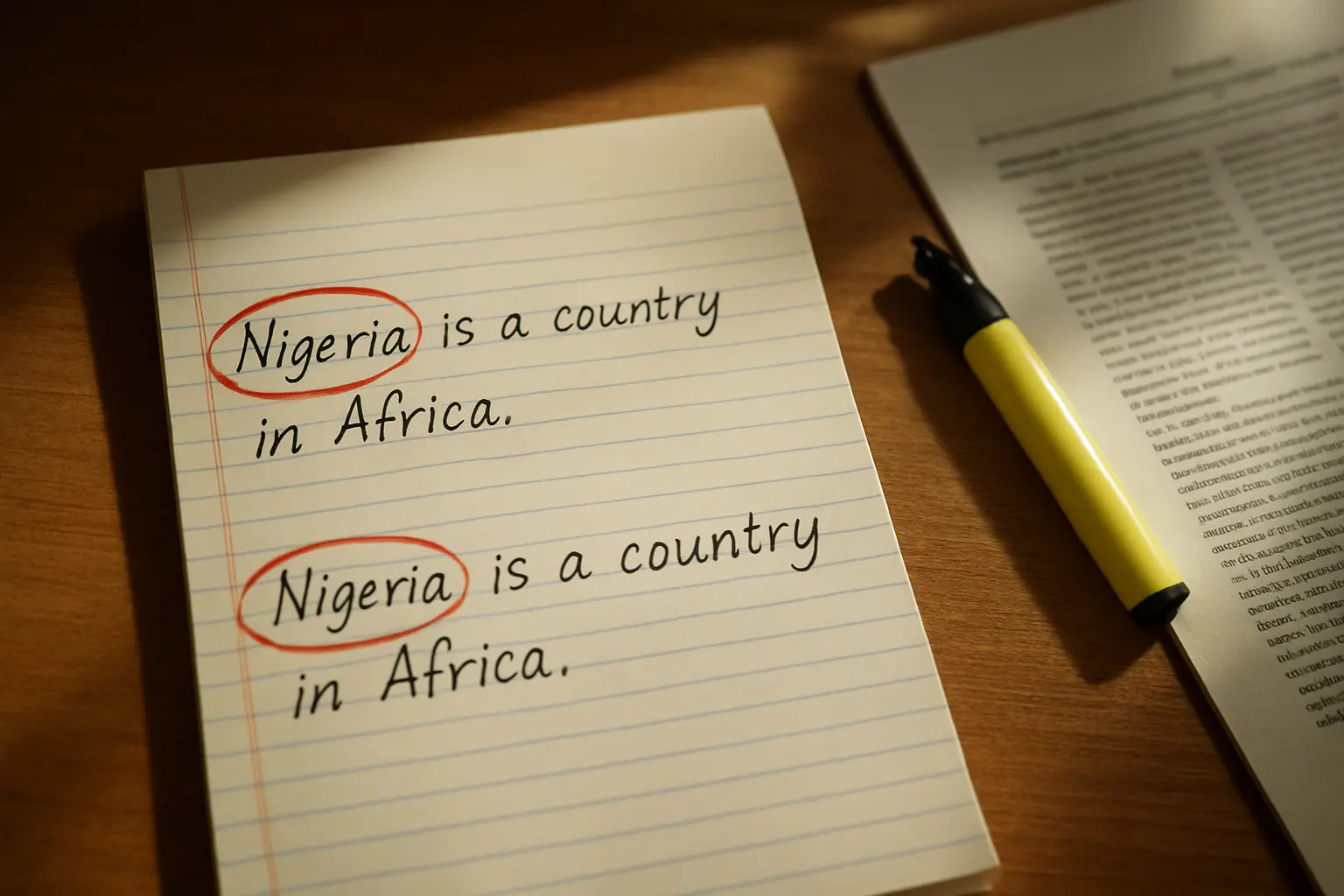
    A Nigerian student comparing two versions of the same sentence in a project chapter, one word circled in each
    Two sentences citing the same study, committing you to two different positions. The difference is one word.

    Take the band from the study’s design, not from its abstract

    This is the mechanical part, and it removes most of the red ink on its own.

    What the study you are citing actually did Band it licenses Verbs that fit Verb that overreaches
    Descriptive survey Neutral reported, described, found a level of proved, demonstrated
    Correlational Neutral to tentative reported an association, found a relationship showed that X causes Y
    Causal-comparative Neutral to tentative found a difference, reported higher scores among established the effect of
    Quasi-experimental Strong is available demonstrated, showed an effect of proved
    Case study of one organisation Neutral to tentative described, identified, explored found that Nigerian firms
    Systematic review Strong is available synthesised, concluded across studies discovered
    Conceptual or theoretical paper Tentative argued, proposed, contended, theorised found, showed

    Notice that no single undergraduate survey reaches the strong band, however large the sample. If you cannot tell which design a source used, that is not a verb problem — you have not read its methodology, and that is a much larger correction than the one you were trying to make.

    Note also that this table is about other people’s studies. The parallel question of how strongly you may state your own results is a separate decision, set out in the guide to how strongly you can state your findings in Chapter Five.

    Do not inherit the author’s overclaim

    Authors overstate their own work constantly. A paper reporting a weak correlation of r = .21 will often conclude in its own abstract that the variable significantly influences the outcome. Copy that verb and you have adopted their overclaim as yours, and your panel will question you about it rather than them.

    Read the results table, not the abstract. Then write:

    Adeyemi (2022) reported a weak positive relationship between training frequency and employee productivity (r = .21, p = .03) among 180 staff of three commercial banks in Enugu.

    rather than:

    Adeyemi (2022) demonstrated that training significantly influences employee productivity.

    The second sentence is not a shorter version of the first. It has promoted an association into an influence and a weak effect into a demonstration, and both promotions happened inside the verb.

    The double frame, which is the most common single error

    This one comes from speech rather than carelessness, and almost every Nigerian Chapter Two contains it:

    ✗ According to Okafor (2021), he stated that training improves productivity.
    ✗ In the study of Okafor (2021), it was found by him that…
    ✓ Okafor (2021) reported that training was associated with higher productivity.
    ✓ Training was associated with higher productivity (Okafor, 2021).

    According to X is already a reporting frame. Adding he stated that reports the same thing twice and leaves the sentence with no clear subject. Choose one. The second correct form is worth using deliberately, because it puts the finding in the subject position and the citation out of the way.

    The related habit: the study of Okafor (2021) and in the study carried out by Okafor (2021) are both longer ways of writing Okafor (2021). Across a forty-page review that is several hundred words a panel reads as padding.

    Rotate inside the band, never across it

    Repeating stated twenty times is a real fault. The usual cure makes it worse: the writer opens a thesaurus and drifts between bands without noticing. Noted, observed and reported are interchangeable. Revealed and established are not interchangeable with them, because they change your position.

    • Neutral rotation: reported → noted → described → examined → observed.
    • Tentative rotation: suggested → indicated → proposed → implied.
    • Strong rotation: demonstrated → established → confirmed.

    A word on opined, which appears in a great many Nigerian projects. It is understood, but it is journalese and rare in current academic English, and it tells the reader nothing about how strongly the source established anything. It belongs with the other register habits collected in the comparison of which writing checkers actually catch Nigerian academic English — where you will also find the reason no grammar checker will ever flag it for you.
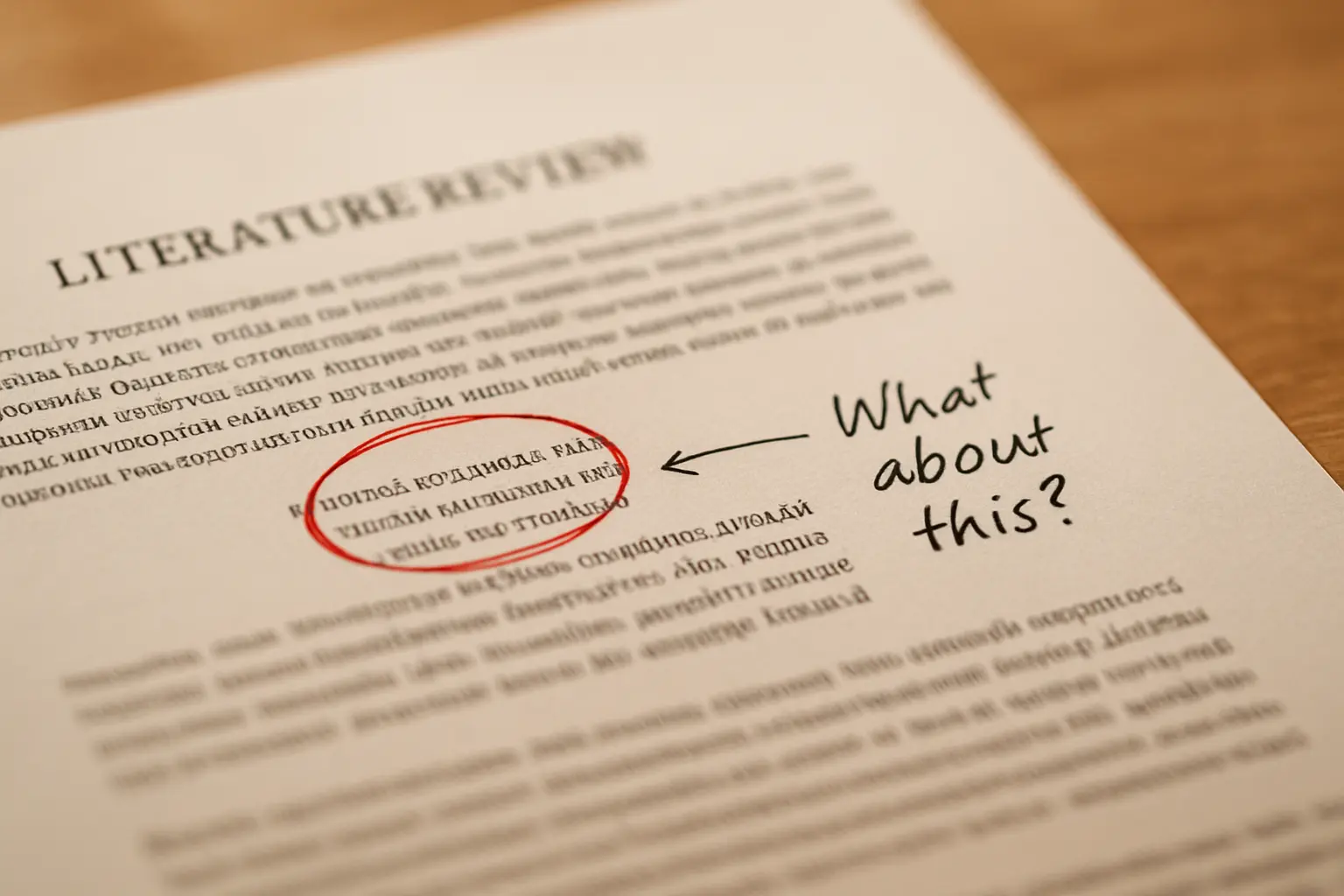
    A supervisor's margin note beside a circled verb in a printed literature review
    The correction arrives as a circled word and a question. It is almost never asking for a synonym.

    The twenty-minute audit, tonight

    1. Open Chapter Two. Use Find on each of these one at a time: proved, demonstrated, showed, revealed, established, confirmed.
    2. For every hit, open the source and read its methodology. Survey or correlational? Downgrade the verb.
    3. Find According to. Delete any second reporting verb in the same sentence.
    4. Find the study of and carried out by. Cut both wherever the author’s name alone will serve.
    5. Find opined. Replace each with a verb chosen from the band the study licenses.
    6. Read one section aloud. If the same verb appears three times in a paragraph, rotate inside the band.

    Steps 1 and 2 are the ones that change your mark. The rest is tidying. None of this requires you to read anything new — every source is one you have already cited.

    Where Tesify fits, and where it does not

    It will not make this judgement for you, and you should be suspicious of anything that says it will. What it removes is the reason the judgement is so expensive to make.

    1. Start on the free plan. That is enough to bring your existing chapters into one connected project and see the whole review at once.
    2. Every citation stays attached to the source it came from. When you need to check whether demonstrated is defensible, the methodology is one click away instead of an evening of hunting through a downloads folder.
    3. The chapters stay connected. The verb you used about Adeyemi in Chapter Two and the comparison you draw to Adeyemi in Chapter Four are visible together, which is where inconsistencies actually surface.
    4. The reference list is built from what you cited. The reconciliation pass stops being a separate job.

    Over 9,000 students have written more than 15,000 chapters with it, and every word is still written by you. For the architecture of the chapter itself — conceptual review, theoretical framework, empirical review and the gap — the sections and their order are set out in the guide to writing Chapter Two section by section, and the sentences that join it to the chapters either side are in the guide to writing the sentences that join your chapters together.

    Stop hunting for the methodology every time you check a verb

    Bring your chapters and your sources into one project, run the six-step audit above, and hand your supervisor a Chapter Two whose corrections are about substance.

    Start free in Tesify

    Frequently asked questions

    Can an AI write my literature review for me?

    It must not. Submitting review text you did not write is misconduct in every Nigerian university, and chatbots also fabricate references, which is caught at defence. Where AI legitimately helps is structure, feedback on your own drafts and keeping citations attached to sources — the boundary is drawn in the guide to whether you can use AI to write your final year project in Nigeria.

    What is a reporting verb?

    The verb that introduces what a source did or said — reported, suggested, demonstrated, argued. It carries your position on how strongly that source established its finding, which is why two verbs can cite the same paper and commit you to different claims.

    Why does my supervisor keep querying my citations?

    Usually because the verbs are stronger than the studies behind them. A descriptive survey that is said to have proved something is the most common instance, and it is a judgement error rather than a language error.

    Can I write that a study proved something?

    Almost never in an undergraduate reference list. Proof belongs to replicated experimental evidence. A descriptive survey reports levels and a correlational study reports relationships; neither proves anything.

    Is opined acceptable in a Nigerian project?

    It is understood but it reads as journalese, it is rare in current academic English, and it says nothing about how strongly the source established its point. Replace it with a verb from the band the study licenses.

    What is wrong with According to Okafor (2021), he stated that?

    It reports the same thing twice. According to X is already a reporting frame, so adding he stated that leaves the sentence without a clear subject. Use one frame or the other.

    How do I avoid repeating the same verb?

    Rotate within the band you already chose rather than opening a thesaurus. Reported, noted, described and observed are interchangeable; revealed and established are not, because they change your stance.

    Does this apply to Chapter Four as well?

    Yes, and it matters more there, because you are reporting your own study. Keep your verbs no stronger than your own statistics and hedge the comparison between your result and the literature.

    How much does Tesify cost in naira?

    There is a free plan, which is the right place to start. Current plans and naira pricing are published on the Tesify site rather than quoted here, so you are reading today’s figure rather than one written months ago.

    Will my department treat using Tesify as cheating?

    Tesify is built for honest writing: the research, the sources and the argument stay yours, and every word is still written by you. Your department’s academic integrity policy governs it, and a growing number of Nigerian departments now ask for a declaration of AI assistance.

    Will fixing my verbs reduce my similarity score?

    Not directly, and treat any tool promising that as a risk rather than a solution. Similarity is about matched text, not verb choice. What verb work does is remove the corrections your supervisor is writing and the questions your panel would otherwise open with.

    How long does the audit take?

    About twenty minutes for a full Chapter Two, because every source in it is one you have already cited. The two steps that change your mark are searching for the strong verbs and checking each one against the study’s methodology.


  • Retracted Research Papers with Nigerian Authors: What the Data Says About Your Reference List (2026)

    Retracted Research Papers with Nigerian Authors: What the Data Says About Your Reference List (2026)

    The Retraction Watch database records 239 retracted or corrected papers with a Nigerian author affiliation. Half of those notices were issued in the last twenty months. Two-thirds of the withdrawn papers were published between 2019 and 2023 — which is exactly the recency window your literature review is told to prefer. The median gap between publication and retraction is 1.8 years, so a 2023 paper you are about to cite is sitting inside the riskiest band.

    Every figure below was computed directly from the full Retraction Watch dataset, downloaded from Crossref Labs on 19 August 2026. The method, including one trap that would have silently cut a third off the count, is set out at the end so you can repeat it.

    The headline numbers

    Measure Value
    Records with a Nigerian affiliation 239
    Of which formal retractions 234
    Corrections, expressions of concern, reinstatements 5
    Sole-Nigerian author teams 68
    International co-authorships 171
    Nigeria’s world rank by retraction count 37th of 184 countries
    Records carrying a usable DOI 236 of 239

    Computed from the Retraction Watch database (71,871 rows), Crossref Labs, read 19 August 2026.

    For scale, the top of that global table is China with 37,874 records, the United States with 7,428 and India with 6,340. Nigeria’s 239 is a small number in absolute terms and it should not be reported as a national scandal. What makes it worth a Chapter One or Chapter Two is not its size but its shape.

    A Nigerian student checking a journal article against a retraction record on a laptop
    The check takes about thirty seconds per source and it is the only one that cannot be done after submission.

    The shape: this is a very recent phenomenon

    Retraction notices involving Nigerian-affiliated authors, by the year the notice was issued:

    Year of notice Records
    2020 10
    2021 9
    2022 7
    2023 15
    2024 24
    2025 97
    2026 (to 19 August, partial) 23

    Half of every Nigerian-affiliated retraction ever recorded was issued in 2025 or 2026. The 2025 figure alone is four times the 2024 figure and larger than the whole of 2020–2024 combined.

    Two honest readings of that, and you should give both if you cite it. It may reflect more Nigerian papers being withdrawn. It also reflects publishers running large retrospective integrity sweeps across their back catalogues in this period, which lifts every country’s count at once. A rise in retractions is partly a measure of how hard anyone is looking, and a background section that presents it purely as a decline in standards is making a claim the data does not support.

    The part that actually affects your reference list

    Now look at when the retracted papers were published, rather than when they were withdrawn:

    Publication year of the withdrawn paper Records
    2018 8
    2019 18
    2020 21
    2021 27
    2022 34
    2023 57
    2024 25

    157 of the 239 — 66 per cent — were published between 2019 and 2023.

    That matters because of advice you have already been given. Literature review guidance in Nigerian departments routinely tells students to prefer sources from roughly the last five to ten years, and that is sound advice for currency. But the recency band and the retraction band are the same band. Following the recency rule without checking retraction status points you directly at the highest-risk cohort.

    The timing figures make the same point from the other side. Across all 239 records, both dates are present, and the median time from publication to retraction is 1.8 years while the mean is 2.2 years; 73 per cent were withdrawn within three years of publication. A paper published in 2023 or 2024 that looks fine today has not yet passed through the window in which most retractions happen.

    How to check a paper in thirty seconds

    Because 236 of the 239 records carry a usable DOI, the check is almost always available. Three routes, in the order worth trying.

    1. Read the title on the publisher’s page. Retracted articles are usually renamed. Both sample records we opened had titles beginning “RETRACTED ARTICLE:” and “RETRACTED:”. This catches most cases and costs nothing — but only if you open the actual article page rather than citing from a search result snippet or a PDF someone shared.
    2. Query Crossref with the DOI. Put https://api.crossref.org/works/ followed by the DOI into your browser address bar. Search the page for updated-by. If the paper has been withdrawn there will be an entry with "type": "retraction" and the date. We verified this on two of the Nigerian records: one returned a retraction dated 12 August 2025, the other a retraction dated 15 August 2023. It is free, needs no account, and works on a phone.
    3. Search PubPeer for the title or DOI. It hosts post-publication comments and often flags concerns well before a formal notice appears.

    A note on the Retraction Watch database’s own web search at retractiondatabase.org: it is the canonical public interface, but our automated request looped on a cookie redirect, so it needs an ordinary browser session rather than a script. If it does not load first time, use the Crossref route above.

    Do this for the sources your argument actually rests on — the studies you cite for a figure, a definition or a finding you build on — rather than for all sixty entries in your reference list. Ten minutes across your ten load-bearing sources is the right budget.

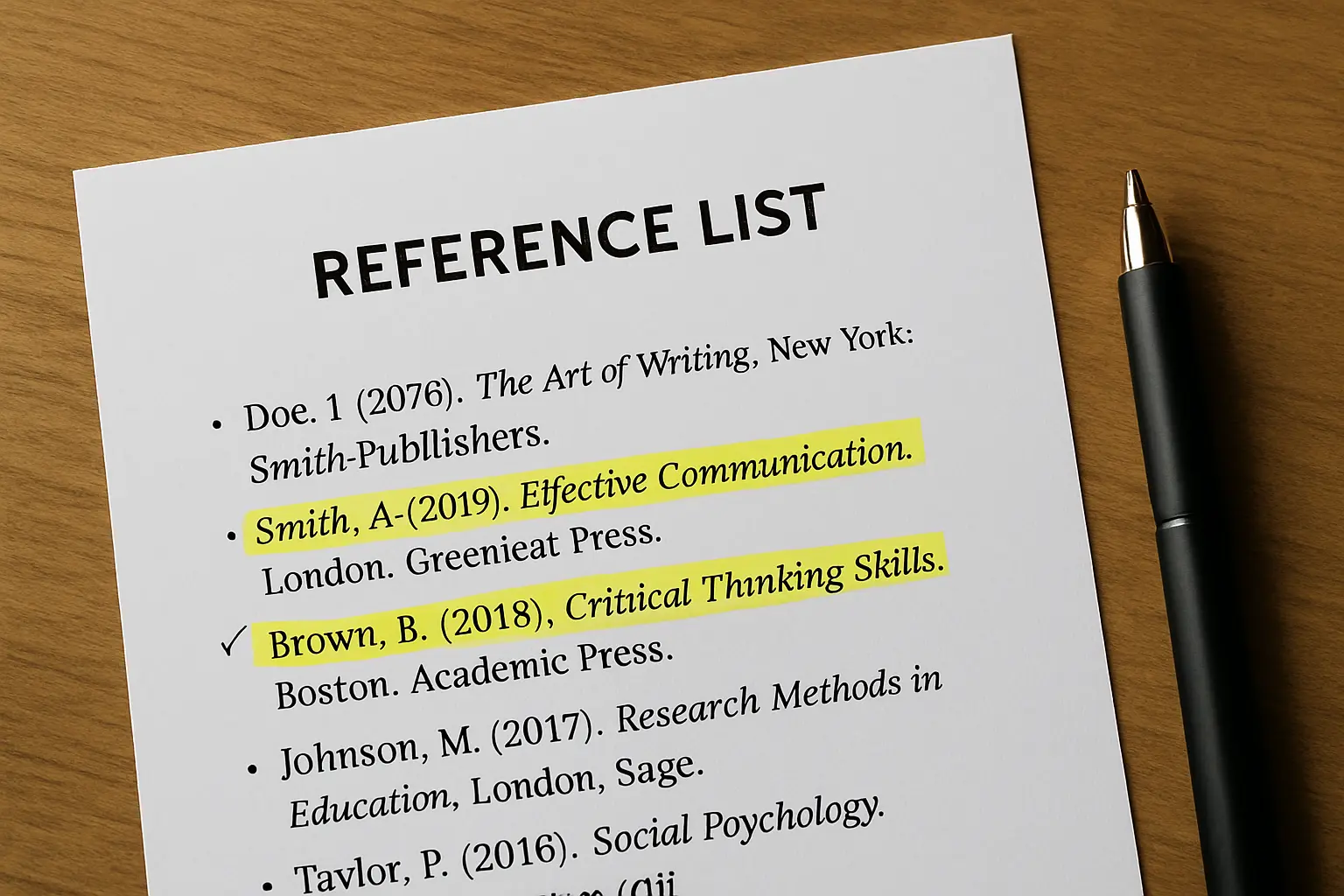
    A printed reference list with two entries marked for a retraction check
    Check the sources your argument leans on, not every entry. Ten load-bearing citations is the realistic target.

    Why the papers were withdrawn

    Each record can carry several reasons, so these overlap. The most frequent across the 239:

    Reason Records
    Investigation by journal or publisher 122
    Unreliable results or conclusions 119
    Duplication of or in an image 59
    Euphemisms for duplication 55
    Objections by the authors themselves 50
    Concerns about referencing or attribution 47
    Concerns about the underlying data 37
    Plagiarism of or in the article 23
    Concerns about peer review 22

    Two things are worth noticing. Plagiarism is not the main driver. It appears in 23 records, against 119 for unreliable results and 59 for image duplication. The dominant failure is not copied text but findings that did not hold up — which is a different problem from the one Nigerian integrity policy is mostly built around, as the guide to acceptable plagiarism percentages in Nigerian universities describes. A similarity checker would not have caught most of these.

    And 50 records list objections by the authors, meaning researchers themselves initiated or supported the withdrawal. Retraction is not always a verdict against someone; sometimes it is the correction mechanism working.

    Where the retractions sit, by field

    The subject tags cluster heavily in the physical and life sciences: materials science 55, biochemistry 41, nanotechnology 35, chemistry 26, environmental sciences 24, chemical engineering 21. By journal, Heliyon accounts for 31 records; by publisher, Springer Nature 40, Elsevier 34 with a further 31 under Cell Press, Taylor and Francis 19, Wiley 17.

    If your project sits in education, management, sociology or the other fields most Nigerian undergraduate projects occupy, your topic area is barely represented here. That is a genuine reason to worry less — and also a reason not to write “Nigerian research has an integrity crisis” in your Chapter One, because the data behind that sentence is concentrated in a handful of laboratory disciplines.

    One table you will not find above is a ranking of Nigerian universities by retraction count. We could have produced one, and it would have been wrong. The affiliation field in this dataset is unnormalised free text captured at department level — the same university appears under many different strings, one research group accounts for 28 records on its own, and there is no consistent institution identifier. Counting those strings would manufacture a league table out of a formatting artefact. It is the sort of number that spreads quickly and cannot be defended, so we have not published it.

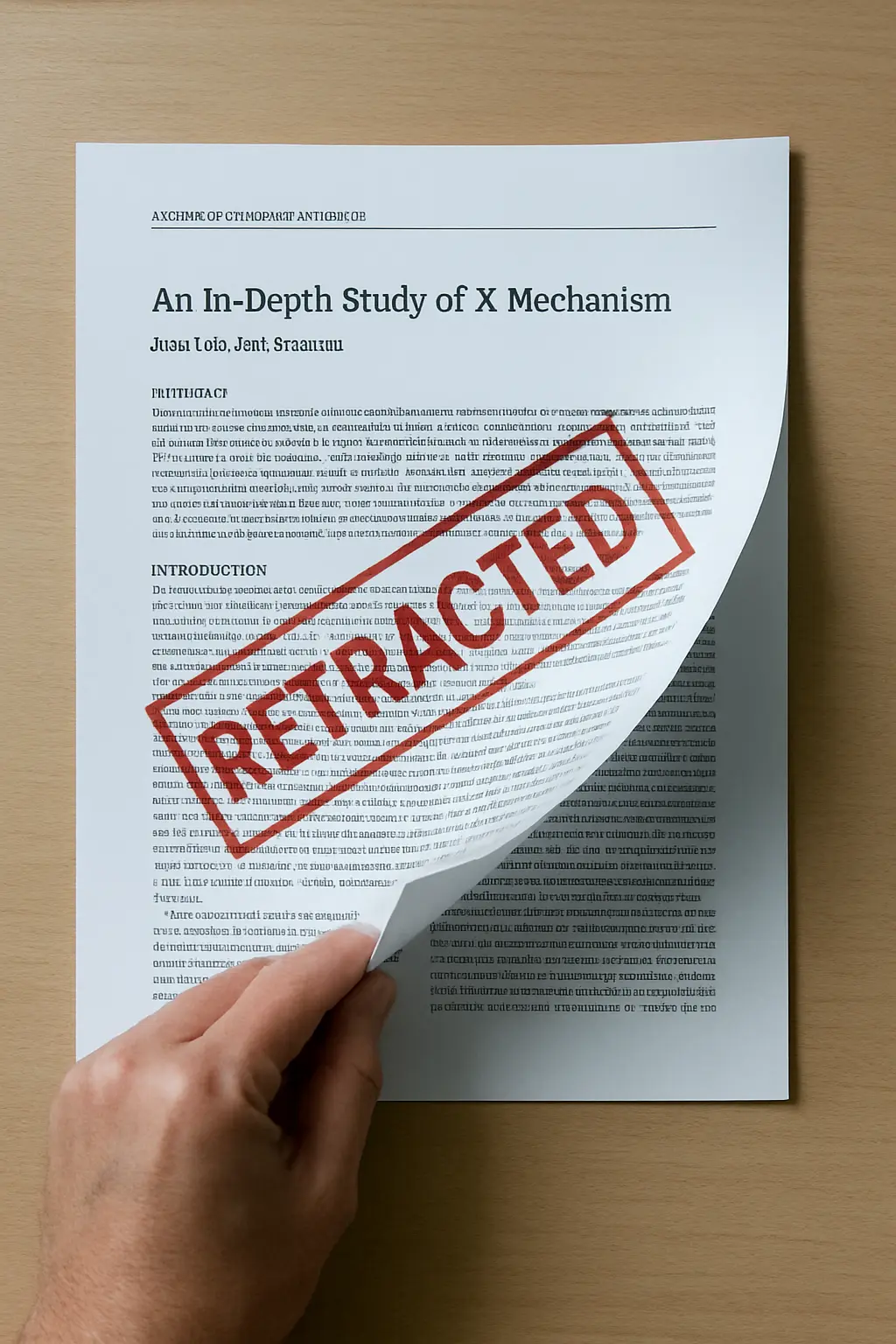
    The first page of a printed journal article bearing a withdrawal notice across it
    A withdrawn paper does not disappear. It stays downloadable, stays cited, and keeps its original DOI.

    How to use this in your project, without overclaiming

    1. As a methods safeguard, not a headline. The strongest use is a sentence in your methodology saying you verified the retraction status of your key sources. That is a real quality claim and almost no undergraduate project makes it.
    2. Give the notice year and the publication year separately. They tell different stories and conflating them is the commonest error with this dataset.
    3. Attribute and date it. “Retraction Watch database, via Crossref Labs, retrieved 19 August 2026.” These files are updated continuously, so an undated figure stops being checkable — the same discipline the enrolment figures need in how many university students there are in Nigeria.
    4. Do not convert 239 into a rate. Dividing it by an output figure from a different source, with a different coverage rule and a different date, produces a ratio that looks precise and means very little.
    5. Never cite a retracted paper as though it stands. If a withdrawn study is genuinely relevant to your argument, you may still discuss it — but say plainly that it was retracted, in what year, and why, and do not rely on its findings. A panel that recognises the paper will ask, and the question list in what is asked during a project defence already covers whether you actually read your sources.

    The habit that prevents all of this is upstream: record each source properly when you first find it, with its DOI, so that checking it later is a lookup rather than an archaeology exercise. That is what a reference manager is for, as set out in the Mendeley versus Zotero comparison, and the DOI is also the field most citation generators will fill the rest of the entry from. Building that reference list is the core work of Chapter Two, and a fabricated or withdrawn source there is the defect that most reliably survives to the defence — which is also why an AI-invented citation is so dangerous, a point covered in whether you can use AI on a final year project.

    The method, and the trap that quietly shrinks the answer

    The full Retraction Watch database is published openly by Crossref Labs as a single CSV. Anyone can download it and count.

    Check the row count before you compute anything. An earlier attempt at this download returned HTTP 200 and a perfectly well-formed CSV — that was silently truncated to 20,368 rows. It parsed without a single error and would have produced a Nigeria figure of 153 rather than 239 — a third of the record set missing, with nothing in the file to say so. A complete file at the time of writing is 65,950,236 bytes and 71,871 rows. We re-downloaded on 19 August 2026 and confirmed both figures before recomputing every number on this page.

    The general rule is worth more than this dataset: a successful HTTP status is not evidence that you received the whole file. Any time you compute a statistic from a bulk download, verify the row count or byte size against what the publisher says it should be. A number derived from a truncated file is wrong in a way that no amount of careful arithmetic afterwards will reveal.

    Keep every source attached to the record you checked

    Tesify holds your chapters in the structure your department expects and keeps each citation tied to the source you actually opened, so a reference you verified in August can still be traced at your defence in November. Start on the free plan, alongside 9,000+ students and 15,000+ chapters, with every word still written by you.

    Build your reference list in Tesify

    Frequently asked questions

    How many Nigerian research papers have been retracted?

    239 records carrying a Nigerian author affiliation appear in the Retraction Watch database as at 19 August 2026, of which 234 are formal retractions. That places Nigeria 37th of the 184 countries represented.

    How do I check whether a paper has been retracted?

    Open the publisher’s page and look for “RETRACTED” in the title, then paste the DOI after https://api.crossref.org/works/ in your browser and search for updated-by with type retraction. PubPeer is a useful third check for concerns raised before a formal notice.

    What happens if I cite a retracted paper in my project?

    It undermines whatever argument rested on it, and a panel member who knows the paper will raise it. If the study is still relevant you may discuss it, but state that it was retracted and why, and do not treat its findings as standing evidence.

    Are recent papers safer to cite?

    Not from this point of view. Two-thirds of the withdrawn Nigerian-affiliated papers were published between 2019 and 2023, and the median gap between publication and retraction is 1.8 years. Recent papers are more current but have had less time to be checked.

    Why did Nigerian retractions jump in 2025?

    97 notices were issued in 2025 against 24 in 2024. Part of that is more withdrawals; part is publishers running large retrospective integrity sweeps, which raises every country’s count at once. Present both explanations rather than only the first.

    Is plagiarism the main reason papers get retracted?

    No. Plagiarism appears in 23 of the 239 records, while unreliable results or conclusions appear in 119 and image duplication in 59. A similarity checker would not have detected most of these.

    Which Nigerian universities have the most retractions?

    We deliberately do not publish that table. The affiliation field is unnormalised free text recorded at department level, so the same university appears under many strings and one research group accounts for 28 records alone. Any ranking built from it would be an artefact of formatting rather than a finding.

    Does a retraction mean the authors committed fraud?

    Not necessarily. 50 of the 239 records list objections by the authors themselves, and honest error, image mix-ups and publisher-side peer review failures all lead to retraction. It is a correction mechanism as well as a sanction.

    Can I use this data in my Chapter One?

    Yes, as background, provided you name the source and the date you retrieved it and keep the notice year separate from the publication year. It is context rather than a finding, so it does not belong in your results chapter.

    Where do I get the dataset myself?

    Crossref Labs publishes the full Retraction Watch database as an open CSV. Download it, confirm the row count matches the published size before computing anything, and filter the country column.

    My field is education, not chemistry. Does this apply to me?

    Less so. The retractions cluster in materials science, biochemistry, nanotechnology and chemistry, and the social sciences are barely represented. Check your load-bearing sources anyway, but do not import a laboratory-science problem into a social-science background section.

    Should I mention the retraction check in my methodology?

    Yes, in one sentence, if you did it. Saying that the retraction status of key sources was verified and giving the date is a genuine quality claim that costs you a line and distinguishes your chapter from almost every other one on the pile.

  • Your Supervisor Returned Chapter Two Again: How to Break the Correction Loop

    Your Supervisor Returned Chapter Two Again: How to Break the Correction Loop

    Your Supervisor Returned Chapter Two Again: How to Break the Correction Loop

    Fourth submission. Same chapter. More red ink than last time, and some of it contradicts what you were told in round two. You are now genuinely unsure whether you are getting closer or further away, and the defence date has not moved.

    Rebuild your chapter with Tesify

    Flat vector illustration of a chapter returned repeatedly covered in supervisor corrections

    Why the loop keeps going

    Because you are fixing the comments. That sounds like exactly the right thing to do, and it is the reason the chapter keeps coming back.

    When you address forty comments one at a time, you produce a document that has answered forty small objections and still has the same underlying problem it had in round one. The supervisor reads it, sees the same structural fault, and writes forty new comments — often on different sentences, because the old ones are gone. From your side it looks like the goalposts moved. From theirs, the chapter still does not work.

    The loop breaks when you stop treating the comments as a task list and start treating them as symptoms.

    The three kinds of correction

    Before you change a single line, read every comment and sort it into one of three buckets. Do this on paper or in a separate document, not in the chapter itself.

    1. Structural corrections — the ones that matter

    “This is a summary, not a review.” “Where is the gap?” “You have not connected this to your objectives.” “This is descriptive.” These are not comments about paragraphs. They are one comment about the whole chapter, written in four places.

    Response: restructure, do not edit. If your literature review is organised author by author — Author A said this, Author B said that — no amount of sentence-level fixing will satisfy a supervisor who wants it organised by theme with a gap emerging at the end. Rewriting the chapter around themes is faster than three more rounds of patching.

    2. Evidential corrections

    “Source?” “Too old.” “Says who?” “This is not what that study found.” These are about the relationship between your claims and your sources.

    Response: go back to the sources, and be honest about the ones you have not actually read. A citation you inherited from another project’s reference list is the most common origin of “this is not what that study found”, and it is the correction most damaging to your credibility with a supervisor.

    3. Presentational corrections

    Formatting, referencing style, spelling, table numbering, heading levels. Real, but trivial.

    Response: fix them all in one pass at the end, mechanically. Never let these consume the attention that the structural bucket needs — and note that presentational corrections repeating across rounds often mean you are formatting to the wrong referencing style entirely, which is worth confirming rather than re-fixing.

    Flat vector illustration of scattered corrections being sorted into categories before rewriting

    Why sorting works when fixing does not

    The sort is not an organisational nicety. It changes what you are looking at.

    Forty scattered comments feel like forty problems, which is overwhelming and gives you no way to decide what to do first. The same forty comments sorted into buckets usually turn out to be three structural problems, eight evidential ones and twenty-nine presentational ones. That is a completely different and far more tractable situation, and you can see immediately that the twenty-nine are not why the chapter keeps coming back.

    It also tells you whether you are actually making progress. If round three had five structural comments and round four has one, the chapter is converging even though the total count barely moved. If round four still has five, nothing you did addressed the real fault, and doing more of it will not help. That is a diagnosis you cannot get from a raw comment count, and it is the difference between a student who feels the loop is endless and one who can see it closing.

    What a supervisor is actually checking in Chapter Two

    Published university guidelines are clearer about this than most departmental briefings are. Obafemi Awolowo University’s postgraduate guidelines specify that the main body of a thesis must contain an introduction, a literature review, methodology, results or findings, a conclusion, and a contribution to knowledge.

    Notice that the literature review sits between the problem you stated and the method you chose. That is its job. It is not a display of how much you read. It exists to show that the gap named in Chapter One is real, and to justify the method you are about to use in Chapter Three.

    Judge your own chapter against that test before resubmitting. If a reader finishes it without being convinced the gap exists, the chapter has not done its work regardless of how many sources it contains — and that is what “this is descriptive” means.

    How to make the next submission the last one

    1. Sort every outstanding comment into the three buckets before changing anything.
    2. Count the structural bucket. If it has more than two entries, plan a rewrite rather than an edit.
    3. Ask one clarifying question, in writing, before you start. Not “any thoughts?” but “Should the review be organised by theme or by variable?” A specific question is answerable in one line; a vague one gets no reply.
    4. Rewrite the structure first, with the argument running from broad field to your specific gap, and every theme ending in what remains unknown.
    5. Then fix the evidential bucket, opening each source you cite. Remove anything you cannot verify rather than defending it.
    6. Then do one presentational pass, all of it at once.
    7. Send it with a short covering note listing what you changed structurally. A supervisor who can see you understood the main point reads the chapter differently.
    8. Do not stop working while you wait. Draft Chapter Three. Feedback on Two is not a prerequisite for starting Three; it is a prerequisite for finalising Two.

    When the corrections contradict each other

    This happens, and it is not always a mistake on your supervisor’s part. Round two asked for more detail because the section was thin; round four asks for less because the added detail buried the argument. Both comments were right about the draft in front of them.

    Say so plainly and without accusation: “In the earlier draft you asked me to expand the theoretical section; in this one it reads as too long. Should I keep the expanded version and cut the descriptive parts, or return to the shorter version?” You will get a decision, and you will have it in writing.

    Where two supervisors genuinely disagree, do not adjudicate between them and do not quietly follow one. Put the conflict to both in the same message and ask them to settle it. Choosing a side privately is how a student ends up defending a chapter that one of their own examiners rejected.

    Where Tesify helps

    Restructuring is the correct response to a structural correction and also the most daunting, because it means dismantling something you have already rewritten three times.

    • Rebuild the chapter around a thematic outline rather than reordering paragraphs by hand, so the argument, not the paragraph order, drives the structure.
    • Keep every source attached to the claim it supports as you rewrite, which is what stops the evidential bucket refilling in the next round.
    • Hold the whole five-chapter shape in one place, so a change in Chapter Two does not silently break its link to the objectives you set in Chapter One.
    • Keep referencing consistent across rewrites, which is where mixed formatting usually creeps in — and where a similarity report later picks up passages that lost their citation during restructuring.

    The analysis and the argument stay yours: 100% written by you, alongside 9,000+ students and 15,000+ chapters. What changes is that a rewrite stops being a week of dread.

    Frequently asked questions

    How many rounds of corrections is normal?

    There is no standard figure. What matters is whether the comments are getting smaller. Structural comments in round four mean the chapter has not yet been restructured.

    My supervisor’s comments are just “expand this”. What do I do?

    Ask a specific question in writing — which section, and in what direction. Guessing produces another round.

    Is it rude to ask my supervisor to clarify?

    No. A precise question takes them ten seconds and saves you a fortnight. Vague resubmissions cost them far more time than questions do.

    Should I rewrite the whole chapter or edit it?

    Count the structural corrections. More than two, rewrite. Editing around a structural fault is what keeps the loop running.

    Can I skip to Chapter Three while waiting?

    Yes, and you should. Waiting turns a supervisor’s slow fortnight into your lost month.

    What if I disagree with a correction?

    Say so once, briefly, with a reason — and then follow the instruction if it stands. Your supervisor knows the examiners.

    My two supervisors contradict each other. What now?

    Put the conflict to both in the same message and ask them to resolve it. Do not choose privately.

    How do I know when Chapter Two is finished?

    When a reader who has not seen your topic before finishes it convinced the gap is real and that your method follows from it.

    Should I start over from a downloaded project?

    No. Beyond the integrity risk, it imports someone else’s structure into a chapter your supervisor is judging against your own Chapter One.

    The chapter is closer than it feels

    A chapter returned four times feels like failure and is usually the opposite — it means a supervisor is still engaging with it. Sort the comments, fix the structure once, and the loop closes. Most students are one honest rewrite away from approval, spending it instead on a fifth round of patching.

    If you are also still trying to get a first chapter written at all, start there and come back to this.

    Restructure your chapter with Tesify