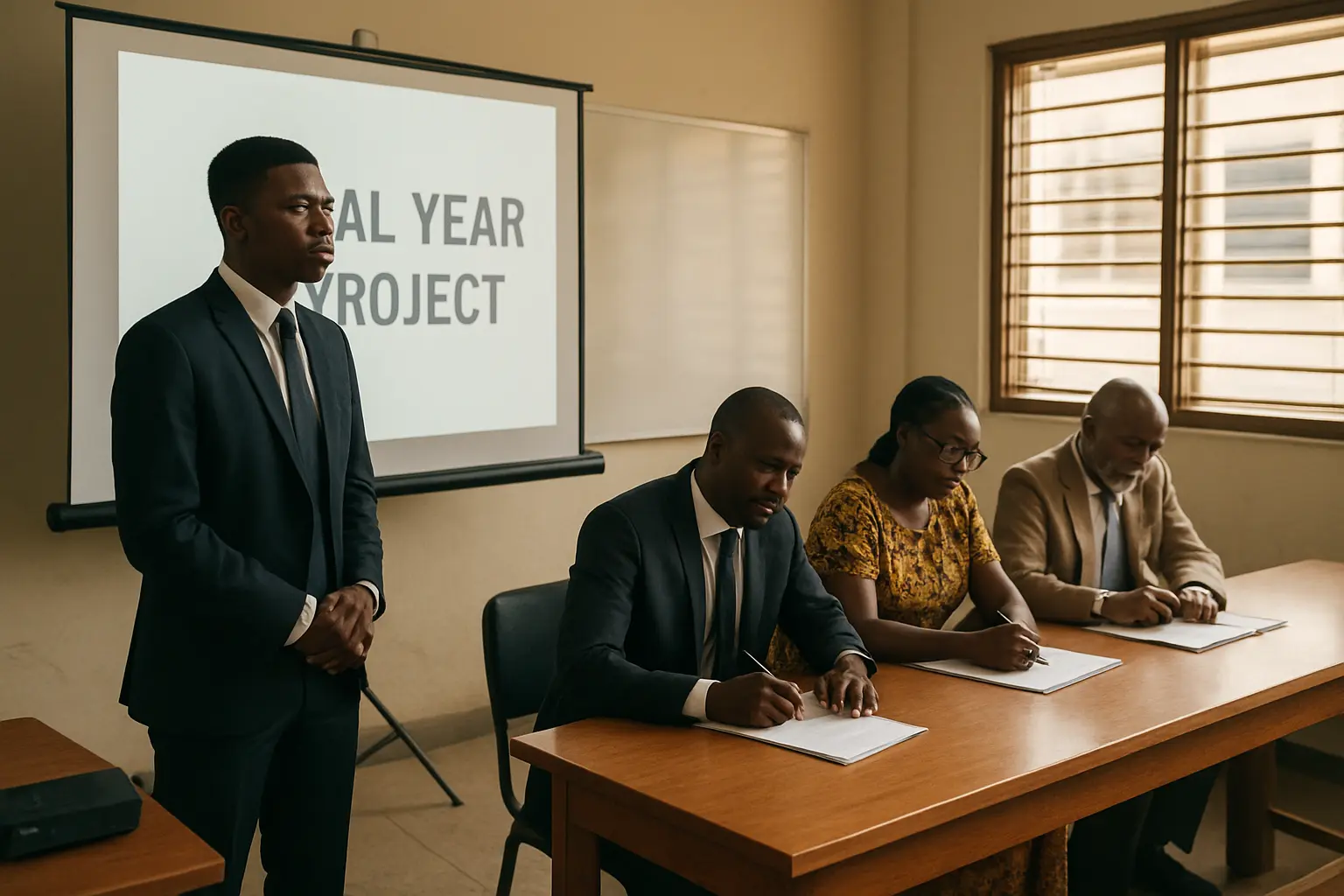
Project defence panels in Nigeria ask about the same six things every time: why you chose the topic, what your objectives were, what other researchers found, how you collected your data, what your results actually say, and what your work contributes. There is no national question bank. Your department sets the format, and the panel reads your own chapters back to you.
Is there an official list of project defence questions in Nigeria?
No. The National Universities Commission lays down minimum academic standards and accredits programmes through the Core Curriculum and Minimum Academic Standards framework across sixteen disciplines. It does not publish a defence question bank, a defence duration, or a panel composition rule that applies to every Nigerian university. The panel in front of you is constituted by your department, and it works to your department’s or postgraduate college’s own guidelines.
This is the same pattern that governs almost everything about a Nigerian final year project. As with the acceptable plagiarism percentage and the number of chapters you are expected to write, the confident national rule circulating on project sites does not exist. What exists is a set of institutional documents that disagree with each other in the detail and agree almost perfectly on the substance.
The substance is what you can prepare for. Obafemi Awolowo University’s Postgraduate College guidelines, revised in January 2026, prescribe that the main body of a thesis must contain an introduction, a literature review, a methodology, results and findings, a conclusion, and a statement of the contribution to knowledge. Those are six required elements, not six chapters, and they are almost word for word the six things a panel interrogates. If you can defend each element on its own, you have covered the defence.
What is the very first question a panel asks?
Almost always a variant of “tell us about your work” or “why this topic?” It sounds like small talk. It is not. It is the panel establishing, in your first ninety seconds, whether you understand your own project or whether you are reciting something.
Prepare a spoken answer of roughly sixty to ninety seconds that names the problem, the gap, the objective, the method and the headline finding, in that order. Do not open with a definition of your key term. Do not open with the history of the field. Panels have sat through hundreds of these, and an opening that starts at the beginning of the world signals that you are stalling.
The follow-up is nearly guaranteed: “why does this matter?” or “who benefits from this study?” That is your significance of the study section being read back to you. Every clause you wrote in Chapter One is a promise you are now being asked to keep, so re-read it the night before rather than trusting your memory of what you wrote eight months ago.
What questions are asked about Chapter One?
Chapter One questions test whether your project has a defensible boundary. The recurring ones are:
- “What exactly is the problem you set out to solve?” Answer in one sentence, in the present tense, about the world and not about the literature.
- “What are your research objectives, and did you achieve all of them?” Count them out loud. If you wrote four objectives and only three are evidenced in Chapter Four, say so before the panel finds it.
- “Why is your scope limited to this location, population or period?” The honest answer, which is access, time and cost, is acceptable if it is stated as a deliberate delimitation rather than discovered as an accident.
- “What is the difference between your limitations and your delimitations?” Delimitations are boundaries you chose. Limitations are constraints imposed on you. Students mix these two up more often than any other pair of terms in a Nigerian defence.
- “Define your key operational terms.” Panels ask this to check that your definitions match how you actually measured things in Chapter Three.
What questions are asked about the literature review?
The single most common Chapter Two question in a Nigerian defence is “what is the gap in the literature, and who says so?” A panel is not asking you to prove that nobody in the world has written on your topic. It is asking you to name two or three specific studies and state precisely what each one did not do that you did.
Expect these as well:
- “What theoretical framework did you adopt, and why that one rather than the alternatives?” You must be able to name at least one theory you rejected and give a reason.
- “Who propounded that theory, and in what year?” This is a memory check and it is asked constantly. Learn the originator and date of every named theory in your framework.
- “Is this the most recent work on the subject?” A literature review dominated by pre-2015 sources invites this question. Have two or three recent studies ready to name.
- “Whose work is this paragraph?” A panellist pointing at an uncited passage is the worst moment of any defence. If you built your chapter properly, every claim traces to a source, which is the method set out in the section-by-section guide to Chapter Two.
What questions are asked about methodology?
Methodology questions are where undefended projects fall apart, because a panel can test your answers against arithmetic you cannot revise on the spot.
- “What is your research design and why is it appropriate?” Name the design, then justify it against the objective, not against convenience.
- “What is your population, and how did you arrive at your sample size?” If you used a formula, be ready to name it and reproduce it. Panels do check the arithmetic.
- “What sampling technique did you use?” If you handed questionnaires to whoever was available, that is convenience sampling. Call it what it is; do not label it random.
- “How did you test the validity and reliability of your instrument?” Face validity through your supervisor is a real answer. A reliability coefficient with no test behind it is not.
- “Why did you use that statistical tool?” Match the tool to the data type and the hypothesis, and be able to say what the tool would have shown had the result gone the other way.
- “Did you obtain permission or ethical clearance?” Increasingly asked in health, nursing and education departments.
What questions are asked about results and findings?
Chapter Four questions are the most dangerous because students memorise their tables without ever articulating what the tables mean.
The panel will pick a single table and ask “interpret this for us.” Do not read the numbers aloud. State what the number tells you about your research question, then state whether it supports or contradicts your hypothesis, then state whether it agrees with the studies you reviewed in Chapter Two. That three-part move of finding, hypothesis and literature is what separates a pass from a rewrite.
Other reliable Chapter Four questions: “how many questionnaires did you distribute and how many came back?” so know your response rate as a percentage; “why is this figure so high or so low?”; and the one students dread, “your finding contradicts the literature, explain.” A contradicted hypothesis is not a failed project. Saying “I don’t know why” is a failed answer, while “the difference is plausibly explained by X, and testing that would require Y” is a good one.
What questions are asked about the contribution to knowledge?
The Obafemi Awolowo University guidelines make the contribution to knowledge a required element of the main body, and panels treat it as such. Expect “what is new here?” and “what should someone do with this finding?”
Undergraduate panels are realistic about scale. Nobody expects a final year project to overturn a field. A defensible contribution can be a local one: this variable had not previously been measured in this population, or this instrument had not been applied in this Nigerian context. State it in one sentence and do not inflate it, because an overclaimed contribution invites the panel to dismantle it.
What questions are asked about your references and originality?
Two of these come up constantly. The first is “which referencing style is this, and did you apply it consistently?” Nigerian universities do not agree on a single style. The University of Ibadan’s Postgraduate College mandates its own house style, while Obafemi Awolowo University permits seven named styles by discipline and requires that the latest applicable version be used. Confirm your department’s requirement rather than assuming APA, because the differences are set out in the guide to Nigerian referencing requirements.
The second is originality. Departments that run a similarity check will have your report in front of them, and a panellist may ask you to account for a matched passage. Turnitin states plainly on its own product page that its Similarity report compares work against “an unparalleled repository of student papers, current and archived web pages, and premium subscription articles from top publishers across 170 languages”, and that its Flags Panel highlights “potentially manipulated text such as replaced or hidden characters”. The practical consequence for a defence is simple: a matched passage you can explain as a properly cited quotation is survivable, and a matched passage you cannot account for is not.
How should you prepare in the final week?
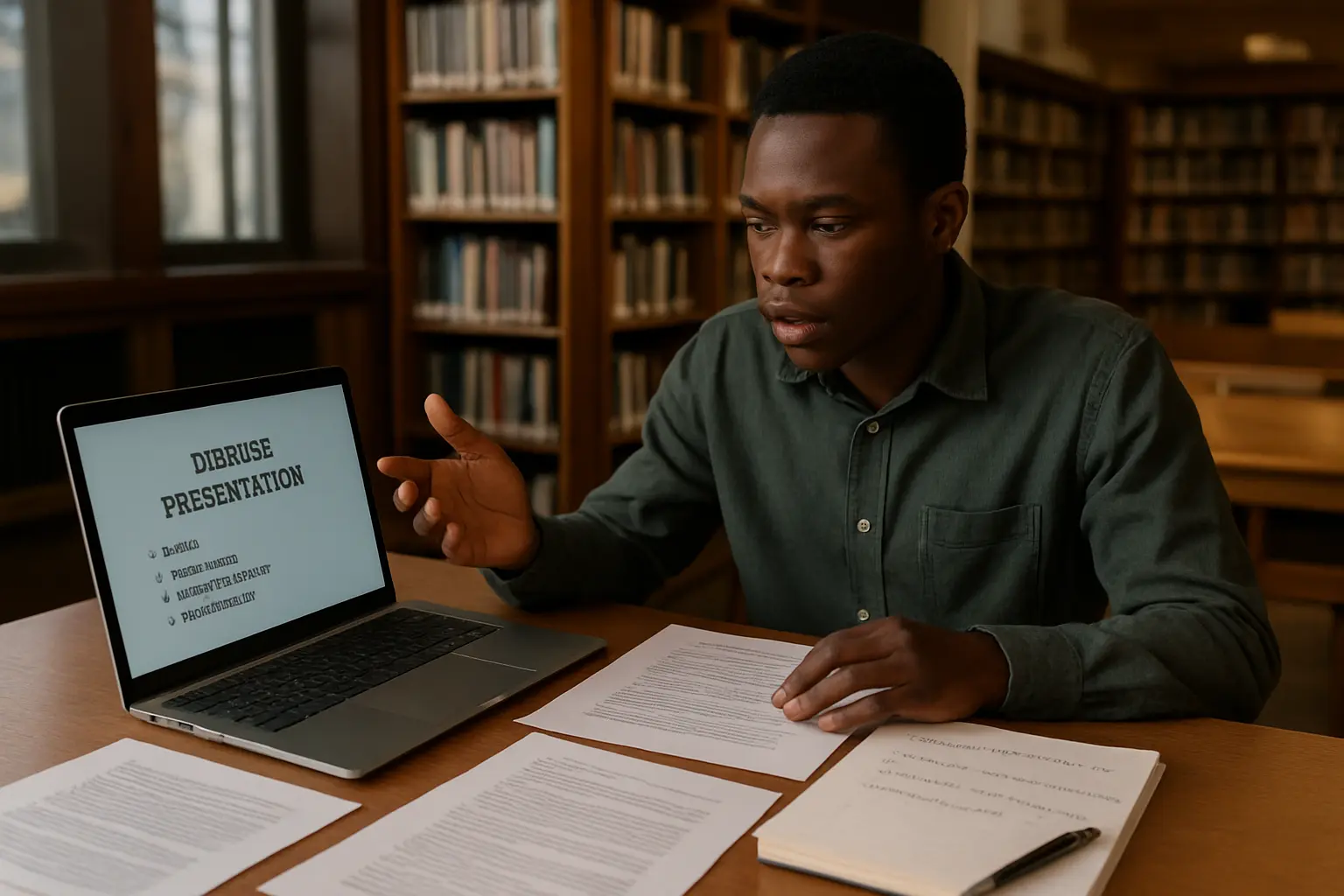
Work backwards from the six elements rather than from your chapter numbers. For each of the six, write a single index card carrying one sentence of claim and one sentence of evidence. Six cards is the whole defence.
Then do three things. Read your own abstract aloud until you can say it without the page, because the abstract is the compressed version of every answer you will give. Reconcile your numbers across chapters, because the sample size in Chapter Three, the number of returned instruments in Chapter Four and the figure in your abstract must be the same number, and a mismatch found by the panel costs you more than a weak finding. Finally, prepare the correction posture: panels expect you to write, not to argue. Take every correction down verbatim, and if you do not understand one, ask for the specific page.
If you are still finishing chapters rather than rehearsing them, the constraint is drafting speed, not knowledge. That is the situation the week-one recovery plan is built for, and the guide to breaking the supervisor correction loop covers the version of this problem where the chapters exist but keep coming back in red ink.
What do panels actually fail students for?
Rarely for a weak finding. Overwhelmingly for one of four things: numbers that do not reconcile between chapters, a methodology the student cannot justify, passages the student cannot account for, and objectives that were never evidenced in the results. Every one of those is a writing and record-keeping problem rather than an intelligence problem, which is why the defence is so much more preparable than students assume.
Walk into your defence with chapters you can actually defend
Tesify helps you draft, structure and reference your project chapter by chapter with the citation trail intact, so when a panellist points at a paragraph and asks whose work it is, you have an answer. Over 9,000 students have used it to move from a blank page to a defensible draft, and every word is still written by you.
Frequently asked questions
How long does a project defence last in Nigeria?
There is no national rule. In practice most undergraduate defences run between fifteen and forty-five minutes including questions, and departments running many students in one day keep them at the shorter end. Ask your departmental secretary for your schedule rather than assuming.
How many people sit on a defence panel?
It varies by institution and level. Undergraduate panels are typically constituted from departmental staff with your supervisor present. At postgraduate level the certification requirements are heavier, and the Obafemi Awolowo University Postgraduate College requires the certification page of a thesis to be signed by the supervisor, a co-supervisor, the head of department and the provost.
Can my supervisor defend my project for me?
No. Your supervisor may clarify a procedural point, but the panel is assessing you. Supervisors who intervene too readily usually stop when a panellist redirects the question, so do not plan around being rescued.
What should I wear to a project defence?
Formal or smart corporate dress is the expectation across Nigerian universities. Some departments issue an explicit dress code with the defence timetable. Nobody has ever lost marks for being too smartly dressed.
Should I prepare slides?
Only if your department asks for them. Where slides are used, keep them to a handful covering problem, objectives, method, results and contribution, and never read them aloud. Where they are not used, bring a bound copy and your correction notebook.
What happens if I cannot answer a question?
Say so briefly and offer what you do know. “I did not test that, but the design would require X” is a respectable answer. Inventing a figure is not, and panels catch invented figures immediately because they do not reconcile with your tables.
Do I fail if the panel gives corrections?
No. Corrections are the normal outcome of a Nigerian project defence, not a punishment. The pass condition is that you make them and resubmit within the deadline your department sets.
Will the panel ask about my plagiarism score?
They may, in departments that run a check. Institutions differ sharply here: the Covenant University centre handbook sets a twenty per cent ceiling, while the published postgraduate guidelines at Obafemi Awolowo University and the University of Ibadan set no numeric threshold at all. Ask your department what it uses before you assume any number applies to you.
Can I be asked about a chapter my supervisor approved?
Yes. Supervisor approval is not panel approval, and panellists frequently question sections the supervisor passed. Prepare all six elements regardless of which ones your supervisor spent time on.
What is the single most common defence question?
“Why did you choose this topic?” It opens most Nigerian defences, and it is the one students most often answer badly by explaining how they chose it rather than why it was worth choosing.