Tag: deadline

  • Your Supervisor Has Not Replied in Three Weeks and the Deadline Is Not Moving

    Your Supervisor Has Not Replied in Three Weeks and the Deadline Is Not Moving

    Three weeks, four unanswered messages, one visit to an office that was locked — and a submission date that has not moved a single day. Every week you spend waiting is a week subtracted from your own work, and nobody in the department will credit you for it later.

    The cost is not abstract. Students lose a whole semester this way and it never appears in the record as “my supervisor was unavailable”; it appears as a project submitted late or a chapter that never got written. Meanwhile the classmate whose supervisor is equally busy is on Chapter Four, because they worked out early which parts genuinely need a signature and which do not.

    Keep your chapters moving with Tesify — start free

    A student waiting outside a locked lecturer's office holding a printed chapter and a phone showing an unanswered call
    A locked door is information. It tells you to change the channel, not to come back tomorrow and wait again.

    First, understand why the silence is happening

    Almost none of it is about you. A Nigerian lecturer supervising final year students is usually carrying a full teaching load, postgraduate supervision, departmental committee work and often a second campus. Twenty to thirty supervisees is common. A message asking “sir, have you looked at my chapter?” is the twenty-fifth identical message that week and it carries no information the supervisor can act on in under a minute.

    That reframing is useful because it tells you what to change. You are not competing for goodwill; you are competing for the two spare minutes in which a decision is cheap to make. Make your request fit in two minutes and the reply rate changes.

    Write the one email that gets answered

    Long attachments with no question attached are the messages that sit unopened. Replace them with this shape and send it on a Monday morning:

    1. Subject line with your name, your topic in five words, and what you need. “Adeyemi — SME financing project — 3 questions, need reply by Friday.”
    2. One line of context. “Chapter Three is drafted and attached; I am ready to start data collection.”
    3. Exactly three numbered questions, each answerable yes or no or with one word. Not “please review my methodology”. Instead: “1. Is a sample of 300 by Taro Yamane acceptable for a population of 1,200? 2. Should I use a four-point or five-point scale? 3. May I begin distribution next week?”
    4. A stated deadline and a stated default. “If I do not hear by Friday I will proceed with the four-point scale and adjust if you advise otherwise.” This is the single highest-value sentence in the email, because it converts silence into a decision instead of a blockage.
    5. The attachment last, named properly: Surname_ChapterThree_v2_18Aug2026.docx.

    Send the same email through a second channel — WhatsApp with a one-line “sir, I have sent an email with three short questions” — and then stop. Do not send a fifth follow-up; send this email once and move to escalation on schedule.
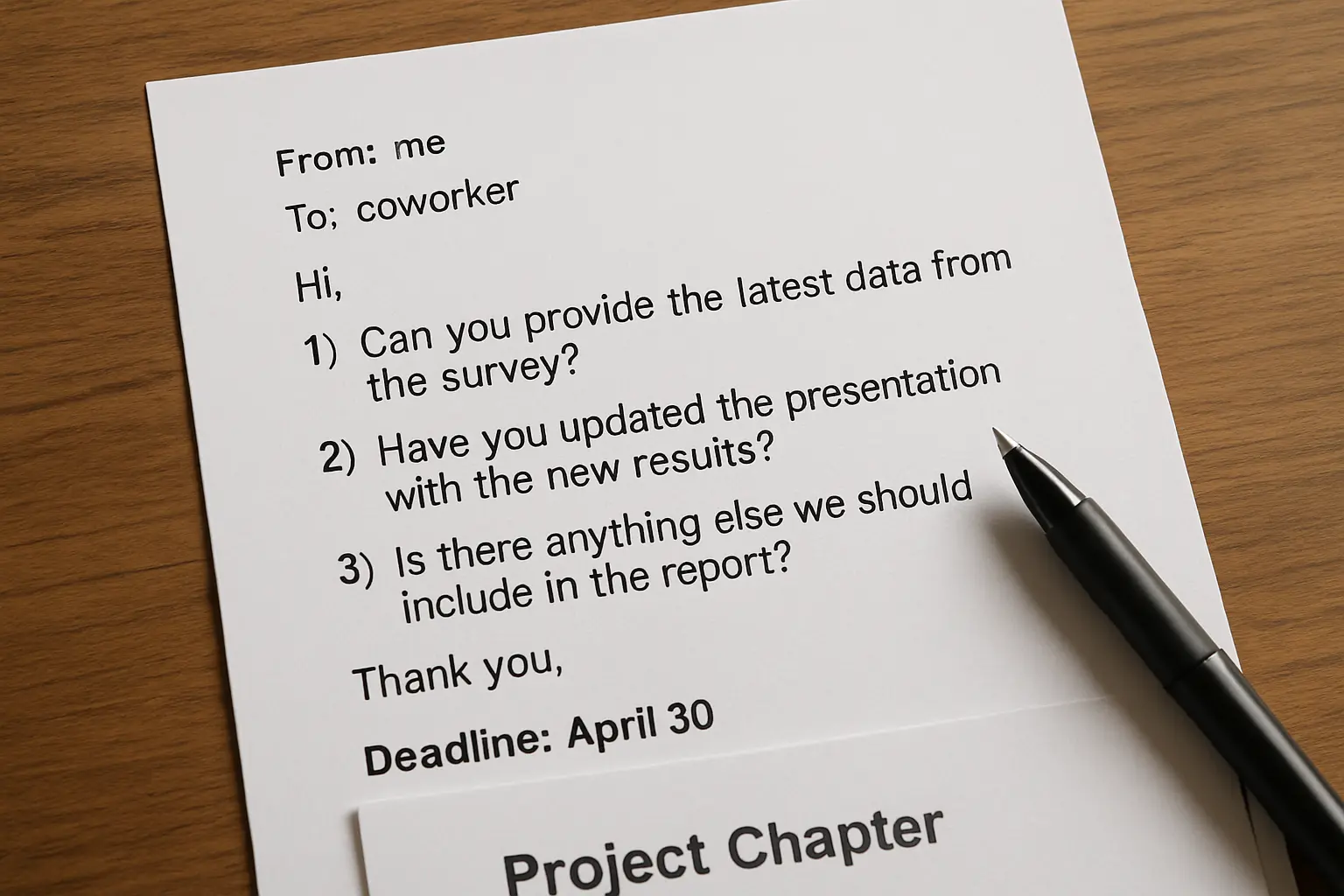
    A printed email containing three numbered questions and a stated deadline, resting on a project chapter
    Three closed questions and a stated default. This is answerable in the two minutes a supervisor actually has.

    Know what you may progress without sign-off

    This is where most of the lost time is recovered. A great deal of a final year project does not require anyone’s approval to advance, and doing it now means that when the reply arrives you spend the meeting on the decisions only a supervisor can make.

    Progress freely:

    • Chapter Two. Reading, synthesising and drafting the literature review never needed permission, and the section-by-section method is in the guide to writing Chapter Two.
    • The mechanics of Chapter One — background, statement of the problem, objectives, research questions — following the Chapter One guide.
    • Your reference list and your referencing style, which is a departmental fact you can confirm from the handbook rather than from your supervisor — see how to reference the way your university requires.
    • Drafting the instrument, even if you cannot distribute it yet.
    • Building your Chapter Three skeleton from the methodology guide, leaving only the decisions you flagged in your three questions.

    Do not progress without approval:

    • A change of topic or a change of research questions. That approval is the one thing that cannot be reconstructed later, and the document that carries it is your proposal — see how to write a research proposal.
    • Distributing questionnaires to respondents. A sample collected against an instrument your supervisor later rejects is weeks you cannot get back.
    • Anything requiring an introduction letter from the department.

    Escalate on a schedule, not on a feeling

    Escalation is normal departmental process, not an accusation, and doing it calmly and on a timetable protects the relationship. Set the dates in advance so you are not deciding while frustrated.

    1. Day 0. Send the three-question email with a stated default. Copy yourself.
    2. Day 7. Resend the identical email with one line on top: “Following up on the questions below, sir.” Same thread, no new attachment.
    3. Day 14. Go in person during a posted consultation hour, with the chapter printed and the three questions on the front page. A printed page in someone’s hand is answered far more often than an attachment.
    4. Day 21. Contact the project coordinator or level adviser. Keep it factual and short: the dates you wrote, the questions asked, the work completed, and the deadline you are working towards. Ask for guidance on how to proceed, not for a new supervisor.
    5. Any point. If you learn your supervisor is on sabbatical, on leave or has travelled, go to the coordinator immediately. That is an administrative reallocation, not a complaint.

    Keep a one-page log of every contact attempt with dates. If the deadline slips through nobody’s fault, that log is the difference between an explanation and an excuse.

    Two students reviewing each other's printed project chapters in a campus study room
    A classmate cannot approve your methodology, but they can find the four things your supervisor would have flagged first.

    Get feedback from somewhere while you wait

    You do not need your supervisor to tell you that a paragraph has no citation, that your objectives and research questions do not match in number, or that Chapter Two summarises twenty studies without naming a gap. Those are the corrections that come back most often, and they are all findable without them.

    Swap chapters with a classmate under a different supervisor and mark each other against the specific things Nigerian supervisors return work for — the pattern is set out in the guide to breaking the Chapter Two correction loop. Then read your own draft against the questions a panel will ask, which are largely predictable and listed in what panels ask at a project defence.

    Where Tesify fits in this specific gap

    The problem in a silent-supervisor stretch is not motivation; it is having nobody to tell you whether the chapter you just wrote holds together. Tesify keeps your objectives, research questions, method and results in one connected document, so the misalignments a supervisor would have caught are visible to you first.

    1. Start on the free plan — no payment needed to draft and check your first chapter, which is the point of it as an entry step.
    2. Draft Chapter Two with citations attached to claims, so the reference list is finished when the chapter is.
    3. Run the alignment check yourself: research questions, objectives, hypotheses and — once you have data — tables, all in the same numbering.
    4. Arrive at the meeting with three decisions to make, not a chapter to be read. A supervisor with two minutes can give you three answers; they cannot read forty pages.
    5. Keep the version history, so “I sent this on 4 August” is a fact rather than a memory.

    It is 100% written by you, alongside 9,000+ students and 15,000+ chapters. It does not replace your supervisor’s approval and it cannot sign anything — the same honest workflow described in the AI workflow guide.

    Stop losing weeks to an inbox

    Tesify keeps your whole project as one connected document so you can keep writing while you wait, and walk into the next meeting with three questions instead of forty pages. Start on the free plan, alongside 9,000+ students and 15,000+ chapters — every word still written by you.

    Start your project in Tesify

    Frequently asked questions

    How much does Tesify cost in naira?

    Current plans and naira pricing are on the Tesify site itself, and we do not quote a figure here that could be out of date by the time you read it. There is a free entry plan to start with; check the pricing page for what the paid tiers include before you commit.

    Is it rude to escalate to the project coordinator?

    No, provided it is factual and on a schedule. Coordinators exist partly to handle supervision that has stalled. Bring dates, the questions you asked and the work you completed — not a complaint about a person.

    How long should I wait before following up?

    Seven days for a first follow-up, fourteen for an in-person visit during a posted consultation hour, twenty-one before contacting the coordinator. Set those dates when you send the first message.

    Can I change supervisors?

    Sometimes, and it is a departmental decision rather than yours. Reallocation is routine when a supervisor is on leave or sabbatical and rare otherwise. Ask the coordinator what is possible; do not approach another lecturer directly first.

    Should I start collecting data without approval?

    No. An instrument your supervisor later rejects means the data collected with it is unusable, which costs far more than the wait. Draft the instrument, prepare your distribution plan, and hold.

    Will using an AI writing tool be held against me?

    Every Nigerian university punishes submitting writing that is not yours, and several departments now require you to declare assistance. No national rule bans the tools themselves — where the line sits is set out in the guide to whether you can use AI on a final year project. Read your own department’s rule and follow it.

    Will a tool-written chapter raise my similarity score?

    Text you did not write yourself is the risk, whatever produced it. Write your own sentences, cite as you go, and check before submission — what a pre-check can and cannot see is explained in the plagiarism checker comparison, and the target figure in what percentage is acceptable.

    What if my supervisor answers only on WhatsApp?

    Use it, then send yourself an email summarising what was agreed and the date. A verbal or chat approval that nobody recorded is the one that gets remembered differently later.

    My supervisor keeps saying “come back next week”. What then?

    Convert the meeting into a decision request. Hand over one printed page with three closed questions and ask for answers on it. “Come back next week” is usually a reflex triggered by an open-ended request.

    Does an unresponsive supervisor excuse a late submission?

    Rarely, and only if you documented it. Your contact log is what turns it from an excuse into an explanation the coordinator can act on.

    What if I am already behind and the defence is close?

    Then the order you work in matters more than the supervisor. Start from a blank chapter and a fixed date with the plan in how to start your project this week.
  • Blank Chapter One, Defence Date Approaching: How to Start Your Final Year Project This Week

    Blank Chapter One, Defence Date Approaching: How to Start Your Final Year Project This Week

    Blank Chapter One, Defence Date Approaching: How to Start Your Final Year Project This Week

    Your topic was approved weeks ago. The document is still open on your laptop with a title and nothing under it. Every time you sit down you read the title, feel the size of the thing, and close it again. Meanwhile the defence date moves closer and the guilt makes opening the file harder than the writing ever was.

    Start your Chapter One with Tesify

    Flat vector illustration of a student facing a blank first chapter as a defence date approaches

    The problem is not that you cannot write

    You have written essays, tests and seminar papers for four years. What has changed is not the writing. It is that for the first time nobody has told you what the first sentence is supposed to do.

    An essay question defines its own shape. A project does not. You have been handed a topic, a supervisor and a deadline, and the structure is assumed to be obvious — five chapters, “everybody knows”. So you sit down to write “Chapter One” as a single undifferentiated object, which is an impossible task, and conclude that you are the problem.

    You are not. The task was never “write Chapter One”. It is a sequence of eight or nine short, defined sections, and each one is small.

    The first move: stop writing and lay out the sections

    Before you produce a single sentence of prose, put the headings in the document. Background to the study. Statement of the problem. Objectives. Research questions. Hypotheses, if your study needs them. Significance. Scope and delimitation. Limitations. Definition of terms.

    That takes four minutes and changes the task completely. You are no longer facing a blank page. You are facing nine small boxes, and you can fill any of them in any order. Most students discover they can write the significance section immediately, because they know why their topic matters — and once anything is written, the document stops being blank and the resistance drops.

    Then write the statement of the problem, because it is the section that decides whether your supervisor approves the chapter, and everything else in the project points back at it. Our section-by-section guide to Chapter One shows the sentences each section needs.

    Why the blank page wins so often

    It is worth understanding the mechanism, because knowing it makes it much easier to beat.

    Starting is expensive and finishing is cheap. When you open a document containing nothing, your mind has to hold the entire project at once — topic, argument, structure, standard, deadline — before it can produce a single word. That is genuinely hard, and it is hard in a way that has nothing to do with how well you write. When you open a document containing a heading called “Definition of terms” with two entries already under it, you only have to hold the next entry. The cost collapses.

    This is why “I will start when I have read more” never works. More reading does not reduce the cost of starting; it raises it, because now there is more to hold. The only thing that reduces it is putting something imperfect on the page and letting the document carry the structure instead of your memory.

    What a realistic week looks like

    This assumes an approved topic and no data collected yet.

    1. Day 1. Lay out the headings. Write the significance section and the definition of terms. Both are short and neither requires deep reading. End the day with something written.
    2. Day 2. Draft the statement of the problem badly on purpose. A rough complete version is workable; a perfect half-version is not.
    3. Day 3. Read enough to support the background. Cite as you go — never leave a claim uncited “for later”.
    4. Day 4. Write the background from those sources, moving from the general field to your specific angle.
    5. Day 5. Write objectives and research questions together, in matching order and number, and add hypotheses only if you will actually test them.
    6. Day 6. Write scope, delimitation and limitations. Read the whole chapter once and check it narrows throughout.
    7. Day 7. Send it to your supervisor. Do not polish it for another week first.

    That is a chapter in seven ordinary days, without heroics, and none of those days requires more than a couple of focused hours.

    Flat vector illustration of a blank page turning into a structured outline of sections

    What waiting actually costs

    It is worth being specific, because the cost stays invisible until it lands all at once.

    Your supervisor’s time is not on demand. A chapter sent in week two gets comments and a second draft. The same chapter sent in week ten gets whatever attention is left in a period when every other final year student is submitting too.

    Signatures take longer than writing. Published guidelines can require a certification page signed by the supervisor, a co-supervisor where applicable, the head of department and the provost. That is four people’s availability, and it is not something you can compress by working harder the night before.

    Rushed work is where integrity problems begin. Nearly every genuine case starts as a passage pasted in a panic with the citation left for later. The policies that govern this vary by institution — one Nigerian university publishes a 20% maximum and states that plagiarism discovered after a degree is awarded attracts immediate withdrawal of the degree. Time pressure is the single biggest driver of that risk.

    A repeated year is the real price. Not finishing does not cost you a chapter. It costs another session.

    Where Tesify fits

    Tesify exists for the exact moment described at the top of this page: you have the topic, you have the time blocked out, and you cannot start.

    • It gives you the structure as a working document. The five-chapter shape with the sections already laid out, so every session opens onto a defined box rather than a blank page. This removes the single largest source of stalling.
    • It drafts section by section, with you. You bring the topic, the argument and the sources; the tool removes the cold-start cost of turning an empty section into a first paragraph you can then fix.
    • It keeps citations attached as you write, which removes the end-of-project scramble to reconstruct where a claim came from — the scramble that produces uncited passages.
    • It keeps your reference list in one consistent style, which matters more than students expect given that Nigerian institutions do not share a single required referencing style.

    The work stays yours. It is 100% written by you, and 9,000+ students and 15,000+ chapters have gone through the same process. What the tool removes is overhead, not authorship — and overhead is precisely what a student with a deadline cannot afford to spend attention on.

    Frequently asked questions

    What does Tesify cost?

    Pricing is published on the Tesify site and changes, so check it there rather than trusting a figure quoted in an article. You can open the editor and see how the workflow fits your project before deciding anything.

    Is using an AI writing tool cheating?

    That depends on your institution’s rules, which are the only ones that bind you, and many Nigerian institutions have been revising them. Tesify is built around work that remains written by you — the boundary that matters is whether the argument, the analysis and the words are yours, and whether you disclose tool use where your department requires it. Read your own department’s policy and follow it.

    Will it raise my similarity score?

    Similarity comes from matching text, most often uncited quotation and reused material. Drafting your own argument with citations attached as you write is what keeps that number honest. Note also that Turnitin itself states its similarity score does not determine whether plagiarism has occurred — a human makes that judgment.

    Do I still need to do my own research?

    Yes. No tool collects your data, chooses your design or decides what your findings mean. Those are the things you are examined on.

    My supervisor has not approved my topic yet. Should I start?

    You can draft the background reading, but do not write the statement of the problem until the topic is settled, because that section defines everything downstream.

    How long does a final year project take?

    There is no national figure and any specific number you see quoted is somebody’s estimate. Plan by sections completed rather than by weeks elapsed.

    Can I write it all in the final month?

    Some students do and it shows. The bigger risk is procedural: signatures, corrections and departmental checks all take time you cannot compress.

    What if my English is not strong?

    Write the argument first in whatever words come, then improve the expression. Weak structure fails a project; imperfect phrasing rarely does.

    Should I buy a completed project instead?

    No. Beyond the integrity consequences, downloaded and purchased material is the most heavily indexed text in existence and among the easiest to match — and you will still have to defend it in front of a panel that asks how you chose your sample.

    I have lost weeks already. Is it too late?

    Almost certainly not, but the answer depends on your submission date rather than on how bad you feel. Work out how many weeks remain, tell your supervisor honestly where you are, and start the first section today rather than building a recovery plan you will not follow.

    The next hour decides this

    You are not going to find a week with fewer demands in it. The project gets written in ordinary hours by tired people, and the only thing standing between you and a first chapter is a document with nine headings in it instead of one.

    Put the headings in. Write the easiest section. Then keep going.

    Open Tesify and start Chapter One