
Two topics submitted, two rejections, no explanation longer than a sentence, and the department’s approval deadline is this week. Meanwhile your coursemates already have supervisors assigned and have started Chapter One, and every week you lose here is a week gone from the far end of the project — the analysis and the corrections, where time actually runs out.
Here is the thing nobody tells you: topics are almost never rejected for being uninteresting. They are rejected for a small number of structural faults, and each one has a specific fix. Once you can name which fault yours has, the third submission is usually the last.
Turn an approved topic straight into Chapter One with Tesify
The five faults, and what each one sounds like
Supervisors are busy and their feedback is compressed. A one-line comment usually maps to one of these.
| What they said | The actual fault | The fix |
|---|---|---|
| “Too broad.” / “Narrow it down.” | No bounded population or location | Add a specific population, a named institution or organisation, and a period |
| “Not feasible.” / “How will you get the data?” | Respondents you cannot actually reach in one session | Switch to a population you have access to, and say how |
| “This has been done.” / “Check the department.” | An existing project in the same department | Change the population, the variable or the context — not the wording |
| “What are you measuring?” | Variables that cannot be operationalised | Name the variables and how each will be measured |
| “This is not in our area.” | Outside the department’s scope or the supervisor’s field | Re-anchor it in a departmental subject area, or accept a different supervisor |
Notice what is not on this list: originality in the grand sense. An undergraduate project does not have to be novel to the world. It has to be bounded, feasible and not already sitting in your department’s project archive.
Fault 1: too broad — the fix is three specifics
“Impact of social media on students” is not a topic; it is a subject area. It has no population you can sample, no location you can reach and no period.
Add three things and it becomes researchable:
- Who — “300-level Mass Communication students”
- Where — a named faculty, institution or organisation
- When — the academic session
“Influence of social media use on the academic performance of 300-level Mass Communication students in [named institution], 2026/2027 session” is the same idea, and it is approvable. It also hands you your Chapter One scope section for free, as set out in the guide to writing Chapter One.
Fault 2: not feasible — the access question decides everything
This is the rejection that most often comes disguised as something else, and it is the one that would have hurt you most if it had been approved.
Before you submit any topic, answer one question honestly: can you personally reach these respondents, this session, without a gatekeeper who may say no?
Topics that fail this test look ambitious and are traps: bank staff across several branches, civil servants in a ministry, hospital patients, secondary school pupils in a state, respondents in another city. Each one needs written permission from an organisation that has no obligation to reply quickly.
Topics that pass it are the ones you can actually finish: students in your own faculty, traders in a market you can visit, staff of a single organisation where you have a contact, or a documentary study using published records.
Choosing an accessible population is not lowering your ambition. It is the difference between finishing and not.
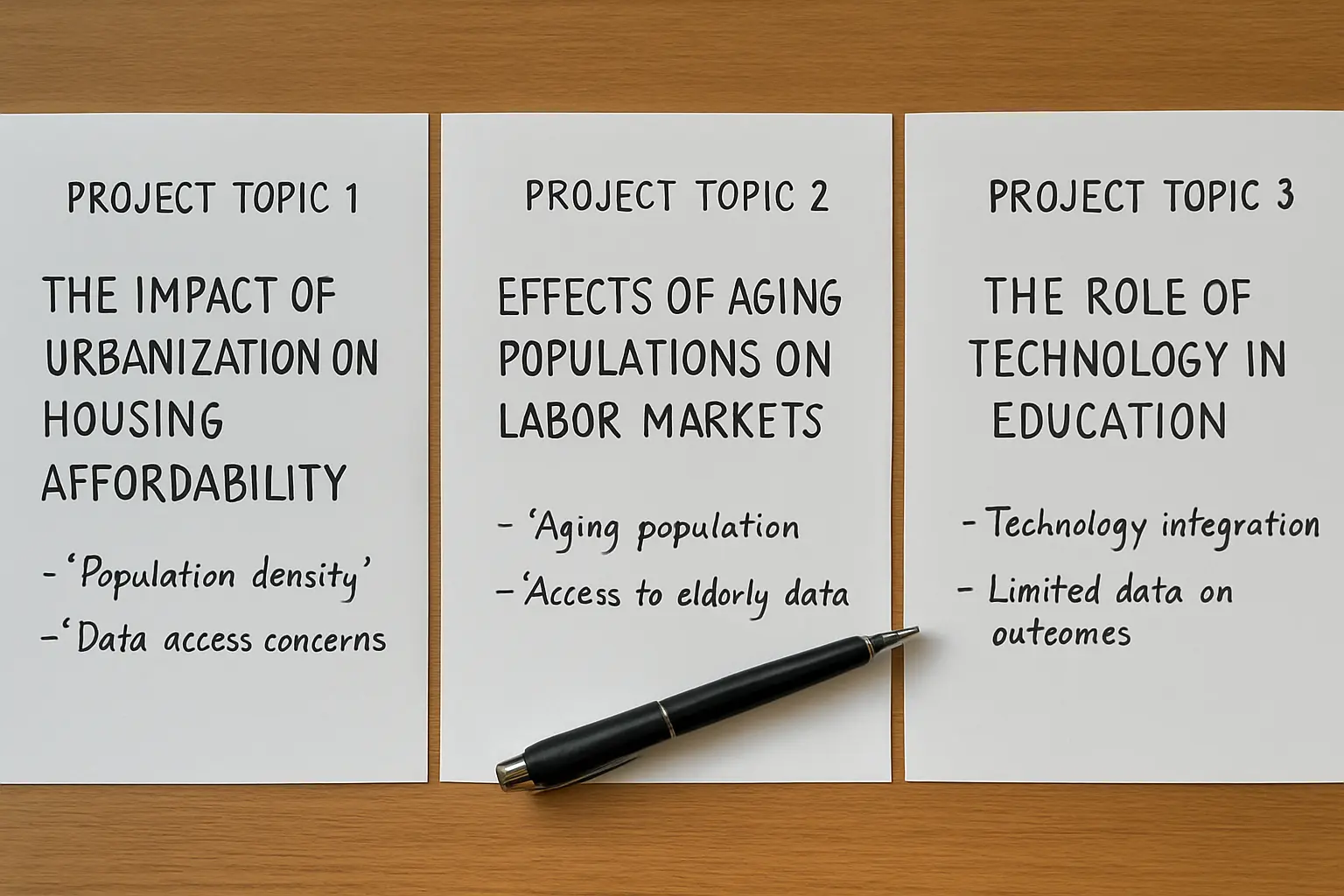
Fault 3: already done — change the substance, not the wording
Departments keep project archives, and a supervisor who has read a hundred projects recognises one immediately.
Rewording does not help and it is transparent. What works is changing one of three things:
- The population. The same question asked of a different group is a different study.
- A variable. Add a moderating or mediating factor the earlier project did not consider.
- The context or period. A study conducted before a major policy or technology change is genuinely a different setting.
Before you resubmit, go to the department’s project archive and look. Ten minutes there prevents the third rejection, and it also gives you your first citations. If your topic is one where you want to know how much has actually been published, the counting method is in the article on whether your project topic has already been studied in Nigeria.
Fault 4: unmeasurable variables
“What are you measuring?” means your topic names concepts that cannot be turned into questionnaire items or observations.
The test: for each variable in your title, can you say in one sentence how it will be measured? “Academic performance” measured as CGPA is fine. “Effectiveness” with no stated measure is not. “Awareness” measured as a score on a set of items is fine; “awareness” on its own is not.
Write the measurement beside each variable before you submit. This is also the exact question a panel asks at the proposal seminar, which is covered in the guide to writing a research proposal for a Nigerian final year project.
Fault 5: outside the department’s area
Sometimes the topic is fine and simply belongs to another department. A supervisor who says “this is not our area” is telling you they cannot examine it, not that it is a bad idea.
Two moves. Re-anchor the same interest inside your discipline — a technology question becomes a management question if the variables are adoption and productivity rather than architecture. Or ask the coordinator whether a supervisor in the relevant subject area is available. Neither takes long, and both are better than a fourth submission of the same thing.
The one-page brief that gets approvals
Stop submitting titles. Submit a page. Supervisors reject titles because a title gives them nothing to approve, and approving it blind is a risk they carry for a whole session.
Bring three candidate topics, each on the same one-page format:
- Working title — with population, location and period in it.
- The problem, in two sentences. What is wrong, and for whom.
- Objectives — three or four, each starting with a verb.
- Population and access — who they are, roughly how many, and how you will reach them. Name the contact or the route.
- Variables and measurement — one line each.
- Method — design, instrument, and roughly how the data will be analysed.
- Three sources — real ones you have opened, showing the area is researched.
Three of those pages is about twenty minutes of a supervisor’s time and it changes the conversation completely. Instead of “is this a good topic?” — a question they answer defensively — you are asking “which of these three should I do?”, which is a question they can answer in five minutes and which makes them a collaborator in the choice.
It also means a rejection of one candidate does not cost you a week. You still have two live.

Do not buy a topic to end this faster
At exactly this point, a vendor selling ready-made project topics and materials starts to look like the sensible option. It is the most expensive shortcut available at this stage, and the reasons are set out in full in the article on what you are actually buying from project topics and materials sites.
The short version, specific to the topic stage: a bought topic comes with a population you have not verified you can reach, variables you did not choose, and often a study your department has already seen. You will still fail faults 2 and 3 — just later, and after paying.
What to do in the next 48 hours
- Read your rejection again and map it to a fault above. If the comment was too short to map, ask one specific question — “was it the scope or the access?” — rather than a general “why?”.
- Go to the department’s project archive and list what has been done in your area in the last three sessions.
- Write three one-page briefs, each with a population you can genuinely reach.
- Book the consultation and take all three.
- The moment one is approved, start Chapter One that day. Approval is not a milestone to celebrate for a week; it is the starting gun.
That last point matters more than any of the others. The weeks lost to topic rejection come out of the analysis stage, not the writing stage, and the analysis stage is where projects actually run out of time.
How Tesify shortens the part that comes next
Once a topic is approved, the constraint changes from decision-making to volume: Chapter One’s sections, a literature review from sources you can actually cite, and a methodology that matches what you promised in the brief.
Tesify takes your approved topic, your population and your sources, and builds the chapters in the structure your department expects — holding the section order, keeping every citation attached to a source you actually opened, and turning your notes into academic prose. The decisions stay with you, which is exactly why the work survives a defence.
Three things it removes from the week after approval:
- Structure. The chapter shape is there before you write a sentence, so you are filling a form rather than inventing one.
- The reference trail. Citations stay attached to their sources instead of being reconstructed at 2 a.m. before submission.
- Restarting. The blank page after each supervisor comment is where most of the lost time actually goes — the same loop described in the article on breaking the Chapter Two correction cycle.
If you have not even reached the topic stage cleanly and are starting from nothing, the week-one system is in the guide to starting your final year project this week.
Get the approval, then move the same day
Tesify structures your project chapter by chapter around your own approved topic, your own respondents and your own sources, and keeps every citation attached to a source you actually opened. Over 9,000 students have used it to write more than 15,000 chapters, and 100 per cent of the work is still written by you. Current pricing, including what you can do before paying anything, is listed on the Tesify site.
Frequently asked questions
Why does my supervisor keep rejecting my project topic?
Almost always for one of five structural reasons: it is too broad, the respondents are not reachable in one session, the study already exists in the department, the variables cannot be measured, or it falls outside the department’s area. Ask which one applies rather than resubmitting a reworded version of the same topic.
How much does Tesify cost in naira?
Payment methods and pricing change, so the reliable source is the Tesify site itself rather than a figure quoted in an article. What you can do before paying anything is listed there too. Nothing about the topic-approval process above requires you to pay for anything.
Is using a tool like this considered cheating?
That depends on your department’s policy, which you should confirm with your supervisor rather than assume. The distinction that matters is authorship: the topic, the population, the design and the interpretation are yours, and a tool that structures and drafts around your decisions is different from one that supplies a study. The full treatment is in the article on whether you can use AI to write your final year project.
Will this raise my similarity score?
Text you write about your own respondents and your own data has nothing to match against and behaves like any other original writing. What raises a score is uncited paraphrase of other people’s work, and what your department’s threshold actually is differs by institution — set out in the article on acceptable plagiarism percentages in Nigerian universities.
How many topics should I submit at once?
Three, each on a one-page brief. One topic asks your supervisor to take a risk; three ask them to make a choice, which is a much easier thing to do quickly. It also means one rejection does not cost you another week.
Can I use a topic from a project topics website?
You can look at one for ideas, but do not submit it as yours. It will usually fail on access or on already having been done in your department, and you will discover that after paying. The risks are covered in the article on project topics and materials in Nigeria.
What if my supervisor gives no reason at all?
Ask one closed question rather than an open one. “Was the problem the scope or the access to respondents?” gets an answer in a corridor; “why was it rejected?” often does not get answered at all.
Should the topic be quantitative or qualitative?
Whichever answers your question, but be aware that the sample-size justification differs sharply and that many Nigerian departments expect a formula. If you are considering a qualitative design, read how to defend the sample first, in the article on how many respondents a qualitative project needs.
How specific should the title be?
Specific enough that a reader knows the variables, the population, the location and the period without asking. If any of those four is missing, expect “narrow it down”.
Does the topic have to be original?
Not original to the world. It has to be bounded, feasible and not a repeat of an existing project in your own department. Changing the population, adding a variable or shifting the context is enough to make an existing question a new study.
What if I lose weeks to this and fall behind?
Compress the stage after approval rather than the analysis stage. Draft Chapter One and the proposal immediately, since both come straight out of the brief you already wrote, and protect the weeks you will need for data collection and analysis. Losing time at the front is recoverable; losing it at the back is not.