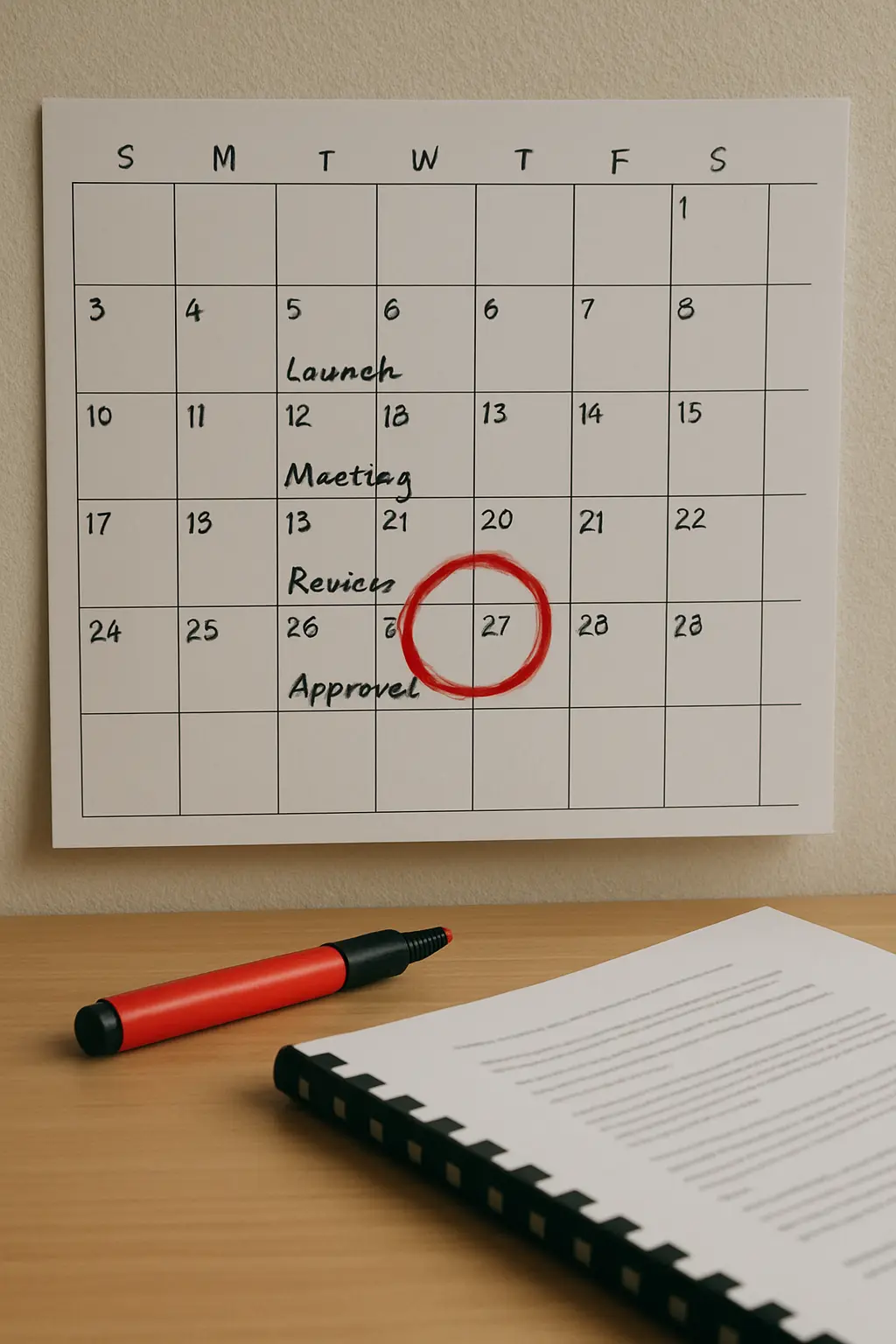
Six weeks is enough. Projects that come apart in the last six weeks almost never come apart on the research — they come apart on sequencing, because the student spent week five polishing Chapter Two and discovered in week six that the binder needs three days and the supervisor travelled.
Here is the order that works, and the reason it is in this order.
First, the two deadlines that are not yours
Before you plan anything, find out two things, today, by asking rather than assuming.
When does your supervisor need the final draft? Not when the defence is — when they need it in hand to sign off. That is usually one to two weeks before submission, and it is the real deadline your writing is working towards.
How long does binding take, and how many copies does the department want? Hardbinding is not instant, the number of copies varies by department, and every final year student in your faculty will be at the same binder in the same week. This is the single most commonly underestimated item in the whole calendar.
Write both dates down and count backwards from them. Everything below assumes you have.
Week 6: finish the analysis
Encode, screen, run every test, produce every table. No prose this week.
If your data is collected but Chapter Four is still blank, that specific paralysis and the four-evening route out of it are covered in what to do when your data is collected and Chapter Four is blank. If your analysis is done, use this week to rebuild any table you are unsure about, because everything downstream depends on the numbers being final.
End of week test: every research question and every hypothesis has exactly one output block, and you have deleted the exploratory runs.
Week 5: write Chapter Four
One table, one paragraph, in the order of your research questions, then the hypothesis sub-sections. The structure and the worked Nigerian tables are in the guide to writing Chapter Four.
Send it to your supervisor at the end of this week even if it is imperfect. A supervisor reading Chapter Four in week five can still shape it; one receiving it in week two cannot.
Week 4: Chapter Five, abstract, and the front matter nobody plans for
Chapter Five is written entirely from Chapter Four and introduces nothing new. Summary of findings, conclusion, recommendations — each recommendation traceable to a specific finding.
Then the parts students forget exist until the week they are due: title page, certification page, dedication, acknowledgements, table of contents, list of tables, list of figures, abstract, references, appendices. The appendices need your questionnaire, and often your output.
The abstract is written last, after Chapter Five, because it summarises the whole document. Write it in one sitting and keep it to the word limit your department states.

Week 3: corrections, the similarity check, and booking the binder
Your supervisor’s comments come back this week. Triage them before editing: presentation fixes are minutes each, interpretation gaps are about an hour each, and anything sending you back to the data file goes first because everything downstream depends on it.
Run your department’s similarity check now rather than after binding. If your institution has a stated acceptable percentage, you need the report in hand while there is still time to fix what it finds — and the fixes are rewriting and citing, not paraphrase tricks.
Book the binder this week. Ask what file format they want, how many days they need, and what the cover text must say.
Week 2: reconcile, then freeze the document
This is a checking week, not a writing week. Five checks, in order:
- One respondent count in Chapter Three, every Chapter Four table note, and the abstract.
- Research questions match sub-sections — same number, same order, same wording as Chapter One.
- Every table and figure numbered and referred to by number in the text.
- Every in-text citation appears in the reference list, and every reference list entry appears in the text.
- Page numbers, margins and line spacing match your department’s format sheet exactly.
Then freeze it. Send to the binder. A document you keep improving is a document that never gets bound, and a late binding is a missed defence.
Week 1: rehearse
Build the slides — usually ten to fifteen: title, background and problem, objectives and research questions, method, findings table by table, conclusion, recommendations. One idea per slide, no paragraphs.
Then rehearse out loud, standing, with a coursemate playing a hostile panel member. The first time you say an answer aloud should not be in the room. Work through the standard question bank in what questions are asked during a project defence and make sure you can answer every one about your study.
Four things to know cold, without looking: your respondent count, your reliability coefficient, why you chose each statistical tool, and what your lowest-scoring item means. Those four cover most of what a panel actually asks.

What to carry on the day
- Your bound copies, plus one working copy you are willing to write in.
- Your data file and your output, on a laptop and on a flash drive. “Let us see your output” is a reasonable request and an unanswerable one if the file is at home.
- Your questionnaire, including the validated copy and the reliability figures for each section.
- Pen and paper, with one group member assigned to write down every correction verbatim and the name of the panel member who asked for it.
That last item matters more than it sounds. Panel members contradict one another, and the written record is what lets your supervisor arbitrate afterwards. The list you walk out of the room with is the deadline you are actually working to next, and reconstructing it from memory three days later never goes well.
The three failures this plan is designed to prevent
Polishing instead of finishing. Rewriting Chapter Two in week two feels productive and is not. Chapters One to Three are approved. Leave them.
Discovering a logistical requirement late. Binding time, copy counts, a certification page that needs two signatures from people who are not both on campus. All of it is knowable in week six by asking.
Waiting for a groupmate. Do the work that cannot wait, keep a written record of who did what, and tell your supervisor the truth if asked. A deadline does not pause for a group chat.
If you are reading this and have not started at all rather than being six weeks out, the earlier problem — a blank document and no system — is the one addressed in final year project writing help.
Six weeks is enough if the structure holds
Tesify keeps your chapters in the structure your department expects and every citation attached to a source you actually opened, so the last six weeks go into finishing rather than reformatting and re-checking. Over 9,000 students have used it to write more than 15,000 chapters, and every word is still written by you.
Frequently asked questions
How do I prepare for a project defence in Nigeria?
Finish the analysis first, write Chapter Four, then Chapter Five and the front matter, act on your supervisor’s corrections, run the similarity check, bind on time, and spend the final week rehearsing aloud against a question bank.
Is six weeks enough to finish a final year project?
Yes, if your data is already collected and Chapters One to Three are approved. It is not enough if you still have to collect data, because respondents and scheduling cannot be compressed.
When should I book the binder?
About three weeks before the deadline, and ask then how many days they need and how many copies your department requires. Binding is the most commonly underestimated item in the whole timeline.
What should I do first if my defence is very close?
Ask your supervisor when they need the final draft and ask your department how many bound copies are required. Both deadlines belong to other people, and everything else is planned backwards from them.
How many slides should my defence presentation have?
Usually ten to fifteen: title, background and problem, objectives, method, findings, conclusion and recommendations. One idea per slide, and never paragraphs of text you will read aloud.
What do I need to know without looking it up?
Your respondent count, your reliability coefficient, why you chose each statistical tool, and what your lowest-scoring item means. Those four cover the majority of what panels ask.
What should I take into the defence room?
Your bound copies plus a working copy, your data file and output on both a laptop and a flash drive, your questionnaire with its reliability figures, and paper for recording corrections as they are spoken.
Should I keep editing after sending the file to the binder?
No. Freeze the document when it goes for binding. A project you keep improving is a project that misses its binding slot, and a late bound copy can cost you the defence date.
What if my supervisor returns corrections very late?
Act on them in order of cost — anything requiring re-analysis first, then interpretation, then formatting. Keep the correction list and tick items off, and send a short note with the resubmission saying what changed.
Do I run the plagiarism check before or after binding?
Before, always. A similarity report that arrives after binding is a report you cannot act on, and the fixes it calls for are rewriting and proper citation rather than quick paraphrasing.
Can I still pass if my findings are not significant?
Yes. You are assessed on whether the research was properly conducted and honestly reported, not on whether the results were interesting. A well-defended non-significant finding is entirely acceptable.