
Tag: research questions

  • Which Nursing Project Topics Get Approved in Nigeria? 30 Topics With Their Research Questions (2026)

    Which Nursing Project Topics Get Approved in Nigeria? 30 Topics With Their Research Questions (2026)

    A nursing project topic gets approved in Nigeria when it names a population you can reach on your clinical posting, an outcome you can measure with an instrument that already exists, and a problem you can justify with a national figure. The thirty topics below are built that way, each with the one-line research question that turns it into a project.

    They are grouped by the areas Nigerian nursing departments supervise: maternal and child health, community and primary health care, medical-surgical nursing, mental health and the nursing workforce, and nursing education and administration. The national figures come from the 2023–24 Nigeria Demographic and Health Survey Key Indicators Report (National Population Commission and ICF, September 2024).

    What makes a nursing project topic approvable in a Nigerian department?

    A BNSc final year project, and the project in a college of nursing, is reviewed twice before anyone reads a chapter: once by the supervisor, who checks feasibility, and once by the Health Research Ethics Committee of the hospital or university where the data will be collected. Both are asking the same four questions, and a topic that answers them on the first page rarely comes back.

    Question the reviewer asks What the topic must contain Example of a failing topic
    Can this student reach the population? A ward, clinic, community or school the student is posted to or can travel to Nurses in all tertiary hospitals in Nigeria
    Can the outcome be measured? A named instrument or a clinical record that already holds the variable Quality of life of patients, with no scale named
    Will ethics approval be granted in time? No intervention on patients, no minors without guardian consent, no identifiable clinical data Effect of a new wound dressing protocol on healing
    Is there a problem to justify? A national or state figure showing the gap the study addresses An appraisal of nursing care in Nigeria

    The regulator matters here for one reason: the Nursing and Midwifery Council of Nigeria, established by Decree No. 89 of 1979 and now the Nursing and Midwifery (Registration etc.) Act, Cap. N143, Laws of the Federation of Nigeria 2004, reports over 250,000 registered nursing and midwifery professionals. A topic about nurses therefore draws its population from a licensed, countable workforce.

    Which national figures should a nursing topic be built on?

    Every topic below can open its background of the study with one of these figures. All are from the 2023–24 NDHS Key Indicators Report; the mortality rates refer to the five years preceding the survey and the care indicators to births in the two years preceding it.

    Indicator (NDHS 2023–24) Figure Topic area it justifies
    Total fertility rate 4.8 children per woman Family planning, maternal health
    Contraceptive prevalence, currently married women 20% Family planning uptake
    Antenatal care from a skilled provider 63% (down from 67% in 2018) Antenatal attendance
    Live births delivered in a health facility 43% Facility delivery, birth preparedness
    Live births attended by a skilled provider 46% Skilled birth attendance
    Postnatal check within 2 days, mothers / newborns 43% / 42% Postnatal care
    Children 12–23 months with no vaccinations 31% Immunisation
    Children under 5 stunted / wasted / underweight 40% / 8% / 27% Child nutrition
    Infants under 6 months exclusively breastfed 29% Infant feeding
    Children under 5 who slept under an ITN 43% Malaria prevention
    Neonatal / infant / under-5 mortality 41 / 63 / 110 per 1,000 live births Newborn and child survival

    What are good maternal and child health nursing topics?

    1. Knowledge and practice of birth preparedness and complication readiness among pregnant women attending antenatal clinic at a named teaching hospital. Research question: what proportion of attendees have a saved fund, an identified facility and a transport plan for delivery?
    2. Factors influencing the choice of home delivery among women of childbearing age in a named rural community. Research question: which of cost, distance, attitude of health workers and family decision-making is most often cited by women who delivered at home?
    3. Uptake of postnatal care within 48 hours of delivery among mothers at a named primary health centre. Research question: what proportion of mothers and newborns received a check within two days, and what predicts it?
    4. Knowledge, attitude and practice of exclusive breastfeeding among nursing mothers attending an immunisation clinic. Research question: does knowledge of the six-month recommendation predict actual exclusive breastfeeding?
    5. Determinants of modern contraceptive use among married women in a named local government area. Research question: how do spousal approval, education and parity relate to current use of a modern method?
    6. Reasons for incomplete immunisation among children aged 12 to 23 months in a named urban slum. Research question: what proportion of children have received no vaccine, and what do their mothers give as the reason?
    7. Nurses’ adherence to partograph use in labour wards of a named state hospital. Research question: what proportion of deliveries in the last three months have a fully completed partograph in the case notes?
    8. Knowledge of danger signs in pregnancy among women attending antenatal clinic in a named general hospital. Research question: how many of the recognised danger signs can the average attendee name, and does parity make a difference?

    What are good community and primary health care nursing topics?

    1. Ownership and use of insecticide-treated nets among households with children under five in a named community. Research question: what is the gap between owning a net and a child sleeping under it the previous night?
    2. Knowledge and practice of intermittent preventive treatment of malaria among pregnant women at a named primary health centre. Research question: what proportion took at least three doses of sulfadoxine-pyrimethamine in their last pregnancy?
    3. Health-seeking behaviour for childhood fever among caregivers in a named market community. Research question: where do caregivers first seek care for a febrile child, and how long after onset?
    4. Knowledge and preventive practices regarding Lassa fever among residents of a named endemic local government area. Research question: which of the rodent-control and food-storage practices recommended by the Nigeria Centre for Disease Control are actually followed?
    5. Nutritional status of under-five children and maternal feeding practices in a named rural community. Research question: what proportion of children are stunted by mid-upper-arm circumference and weight-for-age, and how does it relate to complementary feeding?
    6. Perceived barriers to utilisation of primary health care services among women in a named ward. Research question: which barriers, ranked, keep women from using the nearest primary health centre?

    What are good medical-surgical and clinical nursing topics?

    1. Compliance with hand hygiene among nurses in the surgical wards of a named teaching hospital. Research question: what proportion of the five hand-hygiene moments are observed, and does it differ by shift?
    2. Knowledge and practice of pressure injury prevention among nurses caring for bedridden patients. Research question: is repositioning documented every two hours, and what stops it when it is not?
    3. Medication adherence and its determinants among hypertensive patients attending a named medical outpatient clinic. Research question: what proportion are adherent on a validated adherence scale, and does pill burden or cost explain non-adherence?
    4. Self-care practices among type 2 diabetic patients attending a named endocrinology clinic. Research question: which of diet, foot care, glucose monitoring and medication is least practised, and why?
    5. Knowledge and practice of postoperative pain assessment among nurses in a named surgical unit. Research question: is a pain scale used and recorded at each assessment, and how does that relate to the nurse’s years of experience?
    6. Nurses’ knowledge and practice of standard precautions for infection prevention in a named emergency department. Research question: which precaution has the lowest compliance, and what is the reported reason?
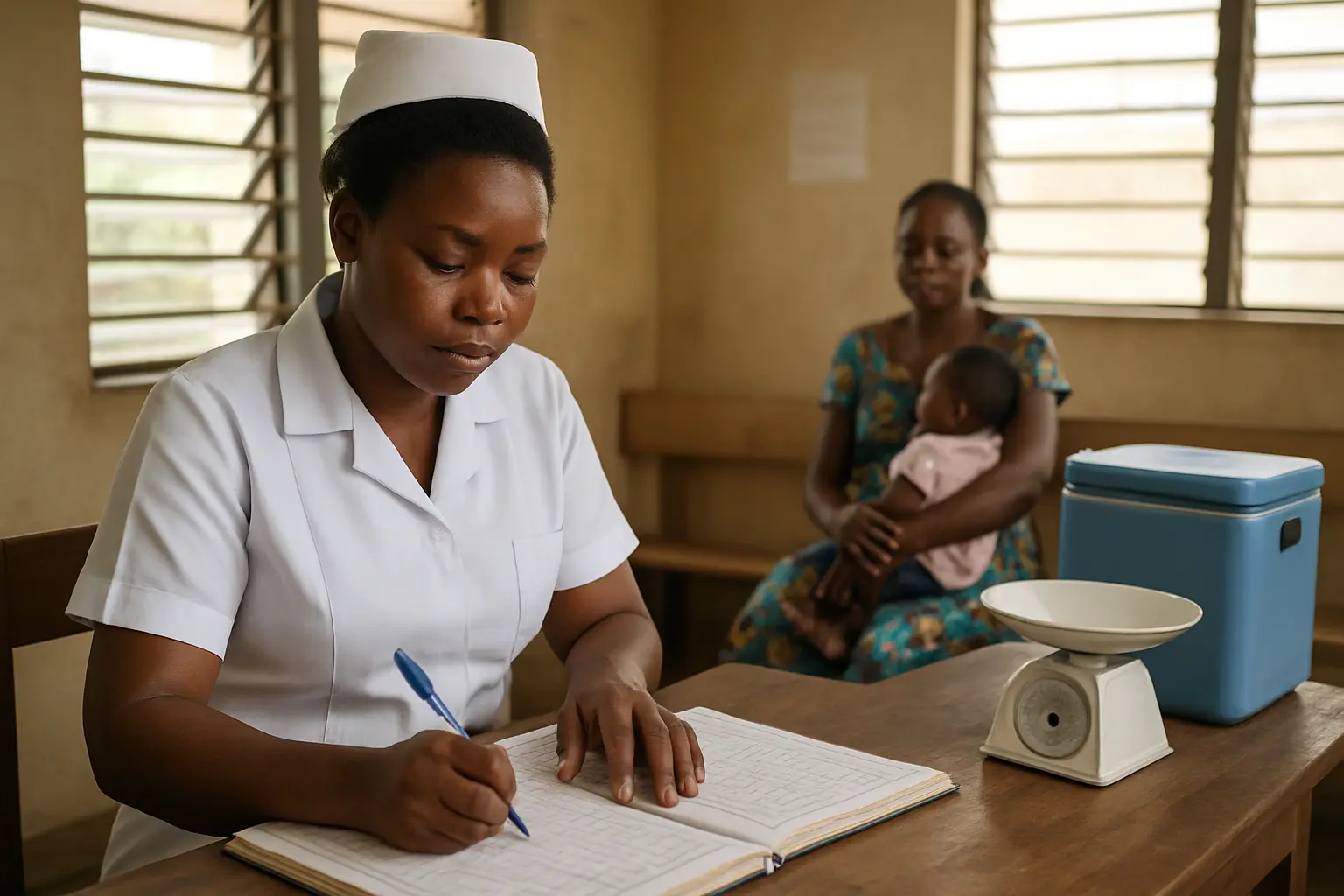
    A Nigerian student nurse checking an immunisation register at a primary health care centre for a final year project
    Registers and case notes at a primary health centre are data you can collect without interviewing a single patient.

    What are good mental health and nursing workforce topics?

    1. Burnout and its correlates among nurses in a named tertiary hospital. Research question: what proportion score high on emotional exhaustion, depersonalisation and reduced personal accomplishment, and does ward or shift pattern predict it?
    2. Intention to migrate and its determinants among final year nursing students of a named university. Research question: what proportion intend to practise abroad within five years of registration, and which push factors rank highest?
    3. Job satisfaction and turnover intention among nurses in a named state hospital. Research question: does satisfaction with pay, supervision and workload predict the intention to leave within a year?
    4. Knowledge and attitude of nurses toward patients with mental illness in a named general hospital. Research question: is stigma toward psychiatric patients lower among nurses with a psychiatric posting?
    5. Prevalence of depressive symptoms and associated factors among nursing students in a named college of nursing. Research question: what proportion screen positive on a validated depression scale, and does academic level or accommodation relate to it?

    Two cautions. The Maslach Burnout Inventory, the standard burnout instrument for human services staff, has 22 items and three subscales, and its publisher states it is not free and must be purchased to administer, so budget for it or choose an open instrument. For depression and stress scales, the comparison of which validated scale fits a Nigerian project covers the free ones, their scoring and their Nigerian validation studies.

    What are good nursing education and administration topics?

    1. Perception of the clinical learning environment among student nurses on posting in a named teaching hospital. Research question: which aspects of supervision and ward atmosphere score lowest, and do they differ between medical and surgical postings?
    2. Factors influencing nurses’ participation in continuing professional development in a named hospital. Research question: what proportion attended a mandatory continuing professional development programme in the last licence cycle, and what stopped the rest?
    3. Documentation practices of nurses and factors affecting the quality of nursing records in a named hospital. Research question: on an audit of fifty case notes, which elements of the nursing process are most often missing?
    4. Nurse-patient ratio and perceived quality of care in the medical wards of a named tertiary hospital. Research question: how does the number of patients per nurse per shift relate to nurses’ self-reported missed care?
    5. Knowledge and utilisation of the nursing process among nurses in a named secondary health facility. Research question: what proportion can state the five steps, and what proportion apply them in the records reviewed?

    Which nursing topics should you avoid?

    Five kinds come back more often than the rest. First, any topic that changes what a patient receives, such as testing a dressing or a health education intervention on admitted patients; an undergraduate rarely gets that approval in time. Second, topics on children, prisoners or psychiatric inpatients without an existing departmental arrangement, because consent is where the timeline breaks. Third, a national or state title carried by a single-ward sample. Fourth, a knowledge, attitude and practice study that repeats five projects already in the departmental library with no new variable; check how many published Nigerian studies already exist on the topic and add the variable none of them measured. Fifth, a topic whose outcome lives in clinical records you have not yet been allowed to see.

    If your first submission has already been returned, the reasons and the repair for each are in the guide to what to do when a project topic is rejected; for nursing the problem is almost always feasibility or ethics, rarely relevance.

    How do you turn the topic into a proposal this week?

    Take the research question in the list and write two more like it on different variables of the same population; those three become the specific objectives. Name the population with the source of its size: the clinic’s attendance register, the hospital’s nursing establishment, or the community’s census projection. For a knowledge and practice study, build the instrument by the ten steps in the guide to designing and validating a questionnaire for a health project. For a topic that needs interviews, such as the reasons for home delivery, the answer to how many respondents a qualitative project needs gives the number and the saturation argument a panel accepts. Then write the ethics application the same week, because the committee’s calendar, not your writing speed, sets the earliest date you can collect data.

    The same logic applied to another faculty is in the list of approvable banking and finance project topics, grouped by data source rather than clinical area.

    Turn the topic into Chapter One before your next supervision

    Paste the topic and its research question into Tesify and it drafts the background of the study around the NDHS figure that justifies it, the statement of the problem, three matched objectives and questions, and the significance section in a nursing panel’s terms. The automatic bibliography formats the NDHS report and your instrument’s validation study in APA. There is a free plan and no card is required.

    Draft your nursing project Chapter One in Tesify

    Frequently asked questions

    How do I choose a nursing project topic in Nigeria?

    Start from the ward, clinic or community you are posted to, pick one measurable outcome in that population, and check that a national figure from the NDHS or a Ministry report shows a gap in it. Write the research question first; if it names the population, the variable and the setting, the topic is ready to submit.

    Do nursing projects in Nigeria need ethics approval?

    Yes. Data collected from patients, clients or health workers in a facility needs approval from that facility’s Health Research Ethics Committee, and many universities require their own committee’s approval as well. Apply as soon as the topic is approved, because committee meeting dates decide when you can start.

    Can I do a nursing project without a questionnaire?

    Yes. Record audits (partograph completion, nursing documentation, hand-hygiene observation) and in-depth interviews are all accepted designs. An observational checklist or an audit tool is described in Chapter Three the way a questionnaire would be, with its validation.

    What is the best source of national health figures for the background of the study?

    The 2023–24 Nigeria Demographic and Health Survey Key Indicators Report, published by the National Population Commission and ICF in September 2024. It gives fertility, family planning, antenatal, delivery, postnatal, immunisation, nutrition, malaria and child mortality figures, most of them by zone and state.

    How many respondents does a nursing project need?

    For a survey, the sample is calculated from the population of the clinic or unit with a formula your department accepts, and a total of 100 to 300 respondents is typical for a single facility. For interview studies, 10 to 20 participants with a saturation argument is the usual range.

    Which nursing topics are most often rejected?

    Intervention studies on admitted patients, studies on children or psychiatric inpatients without an existing arrangement, national titles on single-ward samples, and knowledge-attitude-practice studies that repeat an existing departmental project without a new variable.

    Is the Maslach Burnout Inventory free to use in a student project?

    No. The publisher states that the MBI is not free and requires a licence to administer, so a burnout topic needs a budget for the licence or an alternative open instrument agreed with the supervisor.

    Should the topic name the hospital?

    Yes, in the topic submitted to the department, because the population and the ethics application depend on it; follow the department’s format guide on how the bound copy describes the facility.


  • How Do You Write Research Questions and Hypotheses for a Marketing Project in Nigeria? Worked Examples (2026)

    How Do You Write Research Questions and Hypotheses for a Marketing Project in Nigeria? Worked Examples (2026)

    A marketing project in Nigeria usually tests whether one marketing activity affects one consumer outcome. You write the research questions by turning each specific objective into a question, and the hypotheses by stating, for each question, that no significant relationship or effect exists (H0) and that one does (H1). Three to five matched sets, each naming a measurable variable, is the standard.

    The rest of this page is the worked detail, using the sectors Nigerian marketing projects are actually written about: fast-moving consumer goods, telecoms, banks and the small retailers of Lagos, Onitsha and Kano.

    What does a marketing project in Nigeria usually test?

    Almost every undergraduate marketing project in a Nigerian department is built on one of a small number of relationships between a marketing activity and a consumer response. The activity is the independent variable and the response is the dependent variable:

    Marketing activity (independent variable) Consumer response (dependent variable) Typical setting
    Social media marketing Brand awareness, purchase intention Undergraduates, young consumers in a named university or city
    Sales promotion (discounts, bonus packs, raffles) Consumer patronage, impulse buying Supermarket or open-market shoppers
    Product packaging and labelling Purchase decision Buyers of a named consumer brand
    Service quality (SERVQUAL dimensions) Customer satisfaction, loyalty Bank or telecom customers in a branch or town
    Celebrity endorsement, advertising appeal Buying behaviour, brand preference Users of a named product category
    Pricing strategy Patronage, perceived value Small and medium retailers, market traders
    Corporate social responsibility Corporate image, customer loyalty Host communities, customers of a named firm
    Relationship marketing Customer retention Customers of a named service provider

    The reason this matters for your hypotheses is that a hypothesis needs two variables, and a topic that names only one (“An appraisal of social media marketing in Nigeria”) has nothing to hypothesise. If your topic is still in that shape, it will be sent back before the hypotheses are ever read; the repair is in the piece on getting a project topic approved after a rejection.

    How do you turn a specific objective into a research question?

    Mechanically. Each specific objective in Chapter One begins with a verb of intent (to examine, to determine, to ascertain); the research question restates it as a question about the same two variables, in the same order, with no new words. Take a project titled Effect of social media marketing on the brand awareness of selected fast-moving consumer goods among undergraduates of the University of Lagos:

    Specific objective Research question
    To examine the effect of social media advertising on the brand awareness of selected FMCG brands among UNILAG undergraduates What is the effect of social media advertising on the brand awareness of selected FMCG brands among UNILAG undergraduates?
    To determine the relationship between influencer endorsement and brand recall of the selected brands What is the relationship between influencer endorsement and brand recall of the selected brands?
    To ascertain the extent to which user-generated content influences purchase intention for the selected brands To what extent does user-generated content influence purchase intention for the selected brands?

    The discipline is one objective, one question, same variables, same order. A research question that introduces a variable the objective never mentioned is the first thing a supervisor circles. The section order in which objectives and questions sit inside the chapter is set out in the guide to writing Chapter One section by section.

    How do you write the null and alternative hypotheses?

    Nigerian marketing departments overwhelmingly state hypotheses in the null form, sometimes with the alternative beside it. The null asserts that nothing is going on: no significant effect, no significant relationship, no significant difference. The alternative asserts the opposite. The word “significant” belongs in the hypothesis and nowhere in the research question. For the three objectives above:

    H01: Social media advertising has no significant effect on the brand awareness of selected FMCG brands among UNILAG undergraduates.
    H11: Social media advertising has a significant effect on the brand awareness of selected FMCG brands among UNILAG undergraduates.

    H02: There is no significant relationship between influencer endorsement and brand recall of the selected brands.
    H12: There is a significant relationship between influencer endorsement and brand recall of the selected brands.

    H03: User-generated content does not significantly influence purchase intention for the selected brands.
    H13: User-generated content significantly influences purchase intention for the selected brands.

    Three verbs carry three different shapes, and the shape decides the test later. “Effect” and “influence” imply that one variable changes another, which points to regression. “Relationship” implies that two variables move together without a claim about cause, which points to correlation. If you write “effect” and then run a correlation in Chapter Four, the mismatch will be raised at the defence.

    Which variables go into each hypothesis, and how do you make them measurable?

    A hypothesis is testable only when both variables have an operational definition: a statement of exactly what will be measured and how. Marketing constructs are abstract, so this is where most projects become untestable without anyone noticing until Chapter Four.

    Construct Operational definition for the project Measured by
    Social media advertising Exposure to paid brand posts on Instagram, X, TikTok and Facebook in the last month Five Likert items on frequency and attention, summed to a score
    Brand awareness Ability to recognise and recall the selected brands Unaided recall count plus four Likert items on recognition
    Influencer endorsement Exposure to and trust in brand content from named influencers Four Likert items on exposure and credibility
    Purchase intention Stated likelihood of buying the brand in the next three months Three Likert items on intention

    Keep to two variables per hypothesis. A third variable that changes the strength of the relationship, income or gender for instance, is a moderating variable and gets its own hypothesis (“There is no significant difference in brand awareness between male and female undergraduates”), which is a difference hypothesis and meets a different test. When a construct such as service quality has named dimensions, as SERVQUAL’s tangibles, reliability, responsiveness, assurance and empathy do, you may write one hypothesis per dimension, but say so in the objectives first.

    A Nigerian marketing student writing matched objectives, research questions and hypotheses in three columns on a notepad
    One row per objective. The question restates it; the null hypothesis denies it; the test in Chapter Four decides it.

    Which theory should the hypotheses come from?

    A hypothesis reads as arbitrary unless a theory in Chapter Two predicts it. Nigerian marketing panels expect the hypotheses to be consistent with the theory the study is anchored on, and they ask about it. The theories that fit the relationships above are a small set: the theory of planned behaviour (Ajzen, 1991) for purchase intention; the technology acceptance model (Davis, 1989) for mobile money, online shopping and app adoption; the SERVQUAL model (Parasuraman, Zeithaml and Berry, 1988) for service quality and satisfaction; customer-based brand equity (Keller, 1993) for awareness and image; the AIDA model for advertising effects; and the marketing mix for pricing and promotion topics. Ajzen’s and Davis’s papers are single journal articles with DOIs and were checked against Crossref on 30 August 2026. How to present the theory and write the paragraph that connects it to your variables is covered, for a sister discipline, in the guide to writing the theoretical framework of an education project; the four-move shape is the same in marketing.

    Which statistical test will each hypothesis meet in Chapter Four?

    Deciding the test while you write the hypothesis is the single habit that prevents the Chapter Four crisis, because it forces the variables into a measurable form now.

    Hypothesis shape Wording cue Test for Likert-score data Test for categorical data
    One variable affects another effect, influence, impact Simple or multiple linear regression Chi-square test of independence
    Two variables move together relationship, association Pearson correlation (Spearman if not normal) Chi-square
    Two groups differ difference between male and female, urban and rural Independent samples t-test Chi-square
    Three or more groups differ difference across age groups, income levels One-way ANOVA Chi-square

    The decision rule is stated once in Chapter Three and applied to every hypothesis: reject H0 where the p-value is below 0.05, otherwise fail to reject. The full matching of question shape to test, with the assumption checks and the substitute when an assumption fails, is in the answer to which statistical test to use for a final year project, and the table layout for reporting each result is in the guide to writing Chapter Four.

    How many hypotheses should a marketing project have?

    As many as there are specific objectives, which in a Nigerian undergraduate project means three to five. Fewer than three reads as thin; more than five is rarely completed properly in one session and produces a Chapter Four that runs out of pages. Number them H01 to H0n in the order of the objectives, and keep that order in Chapter Four so the panel can follow objective, question, hypothesis and table down the same numbered line.

    Which faults get the hypotheses returned?

    • A hypothesis that does not match an objective. Every H0 must trace to a numbered objective with the same variables. An orphan hypothesis is the commonest fault.
    • “Significant” in the research question. Research questions ask; hypotheses test. Keep the statistical word in the hypothesis only.
    • A variable nobody can measure. “Brand image” with no operational definition and no items on the questionnaire cannot be tested, and the supervisor knows it before you do.
    • Hypotheses about the company instead of the consumer. “Guinness Nigeria’s promotional budget has no significant effect on its market share” needs internal company data no student can obtain. Hypothesise about respondents you can reach.
    • Directional wording in the null. “Social media marketing has no positive effect” is a one-tailed claim most departments do not expect from an undergraduate. Use “no significant effect” and let the test be two-tailed unless your supervisor asks otherwise.
    • Verb and test that disagree. “Effect” tested with correlation, or “relationship” tested with a t-test. Pick the verb for the test you will run.
    Nigerian undergraduates completing a printed marketing questionnaire on a university campus
    Every hypothesis must be answerable by people you can actually reach with a questionnaire. Company-level data is not reachable.

    A complete worked set for a telecoms service quality project

    Topic: Effect of service quality on customer satisfaction among MTN subscribers in Enugu metropolis. Anchored on the SERVQUAL model, which names five dimensions of service quality, so the objectives are written per dimension and the hypotheses follow.

    Objective 1: To examine the effect of network reliability on customer satisfaction among MTN subscribers in Enugu metropolis.
    RQ1: What is the effect of network reliability on customer satisfaction among MTN subscribers in Enugu metropolis?
    H01: Network reliability has no significant effect on customer satisfaction among MTN subscribers in Enugu metropolis.

    Objective 2: To determine the effect of responsiveness of customer care on customer satisfaction among the subscribers.
    RQ2: What is the effect of responsiveness of customer care on customer satisfaction among the subscribers?
    H02: Responsiveness of customer care has no significant effect on customer satisfaction among the subscribers.

    Objective 3: To ascertain whether customer satisfaction differs significantly between prepaid and postpaid subscribers.
    RQ3: Does customer satisfaction differ between prepaid and postpaid subscribers?
    H03: There is no significant difference in customer satisfaction between prepaid and postpaid subscribers.

    Tests, decided now: H01 and H02 by multiple regression with satisfaction as the dependent variable, H03 by an independent samples t-test, all at the 0.05 level. Each construct is measured by a block of Likert items adapted from the SERVQUAL instrument, which means the Chapter Three instrument section can name its source rather than invent one.

    Generate the matched set from your own topic

    Tesify drafts the objectives, research questions and null hypotheses for your marketing topic as one aligned set, so the variables match row by row and the verb in each hypothesis already points to the test you will run. Rework any row after supervisor corrections without retyping the rest. There is a free plan and no card is required.

    Draft your marketing project hypotheses in Tesify

    Frequently asked questions

    What is the difference between a research question and a hypothesis in a marketing project?

    The research question asks what the relationship between two variables is; the hypothesis states, in a form that can be tested statistically, that no significant relationship exists (null) or that one does (alternative). Every research question should have one hypothesis pair beneath it with the same variables.

    Should I write the null hypothesis or the alternative hypothesis?

    Most Nigerian marketing departments require the null form, and many accept the null alone. Where your departmental format asks for both, state the null first and the alternative directly beneath it, numbered H0 and H1 with the same subscript.

    How many hypotheses should a marketing project have?

    One per specific objective, which usually means three to five. More than five is rarely tested properly in an undergraduate project and produces a Chapter Four that runs out of space.

    What is an example of a null hypothesis for a marketing project?

    Sales promotion has no significant effect on consumer patronage of selected supermarkets in Ibadan. It names an independent variable, a dependent variable, a population and a location, and it can be tested with data collected from shoppers.

    Can a marketing hypothesis be about a company rather than consumers?

    Only if the company data is published or you have written access. Hypotheses about a firm’s internal budget, sales volume or market share usually cannot be tested by an undergraduate, so departments prefer hypotheses about consumers or customers you can reach with a questionnaire.

    Which statistical test is used to test marketing hypotheses?

    It depends on the wording. Effect and influence hypotheses are tested with regression, relationship hypotheses with Pearson or Spearman correlation, difference hypotheses with a t-test or ANOVA, and hypotheses on categorical responses with chi-square, all at the 0.05 significance level.

    What does significant mean in a marketing hypothesis?

    That the effect or relationship observed in the sample is unlikely to have arisen by chance, judged by a p-value below 0.05. It does not mean large or important. A significant effect can be small, which is why the strength of the relationship is reported as well.

    Do research questions and hypotheses have to match the objectives exactly?

    Yes. Same variables, same order, same population. A hypothesis that introduces a variable the objectives never mention is the most common reason the section is returned by a supervisor.

    Which theories are used to support marketing hypotheses in Nigeria?

    The theory of planned behaviour for purchase intention, the technology acceptance model for adoption of digital channels, SERVQUAL for service quality and satisfaction, customer-based brand equity for awareness and image, AIDA for advertising effects, and the marketing mix for pricing and promotion.

  • How to Write Chapter One of a Final Year Project in Nigeria, Section by Section (2026)

    How to Write Chapter One of a Final Year Project in Nigeria, Section by Section (2026)

    How to Write Chapter One of a Final Year Project in Nigeria, Section by Section (2026)

    Chapter One is the chapter supervisors reject most often, and almost always for the same reason: the student wrote a general essay about the topic instead of building a case for one specific study. This guide takes the sections in the order Nigerian departments expect them and shows the actual sentences that do the work.

    One caution before you start. The section list below is the near-universal convention across Nigerian departments, not a national regulation — the five-chapter format itself is a departmental convention. Get your department’s guideline and follow it wherever it differs.

    Flat vector illustration of the opening chapter of a project being built section by section

    The shape of the whole chapter

    Chapter One is a funnel. It starts wide with the general field, narrows to a gap nobody has filled, and ends with the precise study you are about to carry out. Every section moves you further down that funnel, and any sentence that widens it again is doing damage.

    The conventional order is: background to the study, statement of the problem, objectives of the study, research questions, research hypotheses where applicable, significance of the study, scope and delimitation, limitations, and definition of terms. Some departments add an organisation of the study section at the end.

    Step 1: Write the background to the study

    The background establishes that your topic matters and that there is an established body of work around it. It is not a literature review — that is Chapter Two — and it is not a dictionary entry.

    Work from broad to narrow across three or four moves: the general phenomenon, why it matters in the Nigerian context, what is already known about it, and the specific angle you will take. Cite as you go. A background with no citations reads as opinion.

    Worked example, opening move:

    Small and medium enterprises account for a substantial share of employment in developing economies, and their survival is closely tied to their access to short-term credit (Author, 2023). In Nigeria, this relationship has drawn sustained attention as lending conditions have tightened, with studies reporting that access to finance remains among the most frequently cited constraints on small business growth (Author, 2024).

    Notice what that does. It states a general position, localises it, and attributes both. It does not open with “Since the beginning of time, business has been important to man” — a sentence pattern that appears in thousands of Nigerian projects and signals to an examiner that the writer has nothing specific to say.

    Step 2: Write the statement of the problem

    This is the section that decides whether your supervisor approves the chapter. It is also the section most students get wrong, because they describe a topic rather than state a problem.

    A problem statement has three parts: what should be happening, what is actually happening, and what it costs that the gap exists. Then, crucially, the research gap: what previous studies have not addressed.

    Worked example:

    Although several studies have examined the relationship between credit access and small business performance in Nigeria, most have focused on urban enterprises in the south-west and have relied on aggregate lending data. Consequently, little is known about how credit access affects enterprises operating outside these settings, and enterprise-level evidence remains limited. This gap leaves policymakers without the enterprise-level evidence needed to target support, and it is the gap this study addresses.

    Three tests your problem statement must pass. It must name a specific gap, not a general shortage of research. It must be a gap your study can actually close in one academic session. And it must be recognisable as a problem to someone who does not already care about your topic.

    Step 3: Set the objectives of the study

    Objectives state what you will do. Begin each with a verb that describes an action you can complete and evidence: examine, determine, assess, compare, evaluate. Avoid verbs you cannot demonstrate having done, such as “understand” or “explore the nature of”.

    Convention is one broad objective followed by three to five specific ones. Keep them parallel in structure and keep them in the same order throughout the whole project, because Chapter Four will be organised by them and any reordering will show.

    The broad objective of this study is to examine the effect of access to short-term credit on the performance of small and medium enterprises in [location]. The specific objectives are to: (i) determine the level of access to short-term credit among the enterprises studied; (ii) examine the relationship between credit access and turnover growth; (iii) assess the constraints enterprises face in obtaining credit.

    Step 4: Derive the research questions

    Research questions are your objectives rewritten as questions. That is not laziness; it is the alignment your examiner is checking. If you have three specific objectives, you should have three research questions, in the same order, addressing the same things.

    Objective: determine the level of access to short-term credit among the enterprises studied. Question: What is the level of access to short-term credit among the enterprises studied?

    If a question appears that has no matching objective, either the objective is missing or the question does not belong. Fix it here, in Chapter One, rather than discovering it in Chapter Four when your results have nowhere to sit.

    Flat vector illustration of a broad research background narrowing to a single problem statement

    Step 5: State the hypotheses, if your study needs them

    Hypotheses belong in quantitative studies that will test relationships statistically. A purely descriptive or qualitative study does not need them, and inventing hypotheses you will never test is a visible weakness rather than a sign of rigour.

    State them in the null form unless your department requires otherwise, and number them to match the research questions they correspond to.

    H01: There is no significant relationship between access to short-term credit and turnover growth among the enterprises studied.

    Every hypothesis you state here must be tested in Chapter Four, and every test in Chapter Four must trace back to a hypothesis stated here. Nothing appears in one and not the other.

    Step 6: Significance, scope, limitations and definitions

    Significance of the study names who benefits and how. Be specific and be modest: name the groups — policymakers, practitioners in the sector, future researchers — and state what each gains. An undergraduate project that claims it will transform national policy loses credibility in one sentence.

    Scope and delimitation states the boundaries you chose: the population, the location, the time period, the variables included. These are deliberate decisions, and stating them protects you at defence, because a boundary you declared is a design choice while a boundary you did not declare is an oversight.

    Limitations are the constraints you did not choose — a smaller sample than planned, incomplete records, a low response rate. Declaring them honestly strengthens your work. Panel members already know your study has limits; what they are assessing is whether you know.

    Definition of terms should be operational, not dictionary definitions. Define each key term as it is used and measured in your study. “Small enterprise: for the purpose of this study, an enterprise employing between ten and forty-nine persons” is operational. Copying a general definition from a dictionary is not, and it also imports text that will match other documents in any similarity check — see our guide to what the published policies say about acceptable plagiarism percentages.

    Step 7: Check the chapter against itself before you submit it

    1. Read the problem statement alone. Does it name a gap a stranger would recognise?
    2. Line up objectives and research questions side by side. Same number, same order, same subjects.
    3. Check every hypothesis has a matching research question and that your study can actually test it.
    4. Confirm every claim in the background carries a citation.
    5. Check the scope matches what you will really do, not what you hoped to do in September.
    6. Read your definitions and ask whether each one is measurable as written.
    7. Confirm the chapter narrows throughout and never widens back out.

    Frequently asked questions

    How long should Chapter One be?

    There is no national page count. Length follows content, and your department may set its own limit — ask rather than copying a figure from another institution’s project.

    What is the most important section of Chapter One?

    The statement of the problem. It is where approval is won or lost, because everything after it exists to address the gap it names.

    Do I need hypotheses in my project?

    Only if your study tests relationships statistically. Descriptive and qualitative studies usually do not, and unnecessary hypotheses weaken rather than strengthen a chapter.

    What is the difference between scope and limitations?

    Scope is the boundary you chose deliberately. Limitations are constraints imposed on you. Declaring both protects you at defence.

    Should research questions match objectives exactly?

    Yes, in number and order. A mismatch is one of the first things a panel notices.

    Can I write Chapter One before collecting data?

    Yes — it is written first, before data collection. Expect to revise the scope and limitations afterwards to match what you actually did.

    How many citations should the background have?

    Enough that every factual claim carries one. There is no target number; there is a standard, which is that unsupported assertions do not appear.

    Should I define terms from a dictionary?

    No. Definitions should be operational — how the term is used and measured in your study specifically.

    My supervisor rejected Chapter One twice. What now?

    Ask which single section is the problem rather than resubmitting the whole chapter. Nine times in ten the answer is the statement of the problem, and rewriting that fixes everything downstream.

    Get the first chapter out of the way

    Chapter One is short, structured and entirely writable in a week once you stop trying to write it as an essay. Every section has a job, and the job is the same for every project in the country.

    Tesify gives you that structure as a working outline and drafts into it section by section, so the blank page problem never starts — 100% written by you, alongside 9,000+ students and 15,000+ chapters.

    Draft your Chapter One with Tesify