Blank Chapter One, Defence Date Approaching: How to Start Your Final Year Project This Week
Your topic was approved weeks ago. The document is still open on your laptop with a title and nothing under it. Every time you sit down you read the title, feel the size of the thing, and close it again. Meanwhile the defence date moves closer and the guilt makes opening the file harder than the writing ever was.
Start your Chapter One with Tesify
The problem is not that you cannot write
You have written essays, tests and seminar papers for four years. What has changed is not the writing. It is that for the first time nobody has told you what the first sentence is supposed to do.
An essay question defines its own shape. A project does not. You have been handed a topic, a supervisor and a deadline, and the structure is assumed to be obvious — five chapters, “everybody knows”. So you sit down to write “Chapter One” as a single undifferentiated object, which is an impossible task, and conclude that you are the problem.
You are not. The task was never “write Chapter One”. It is a sequence of eight or nine short, defined sections, and each one is small.
The first move: stop writing and lay out the sections
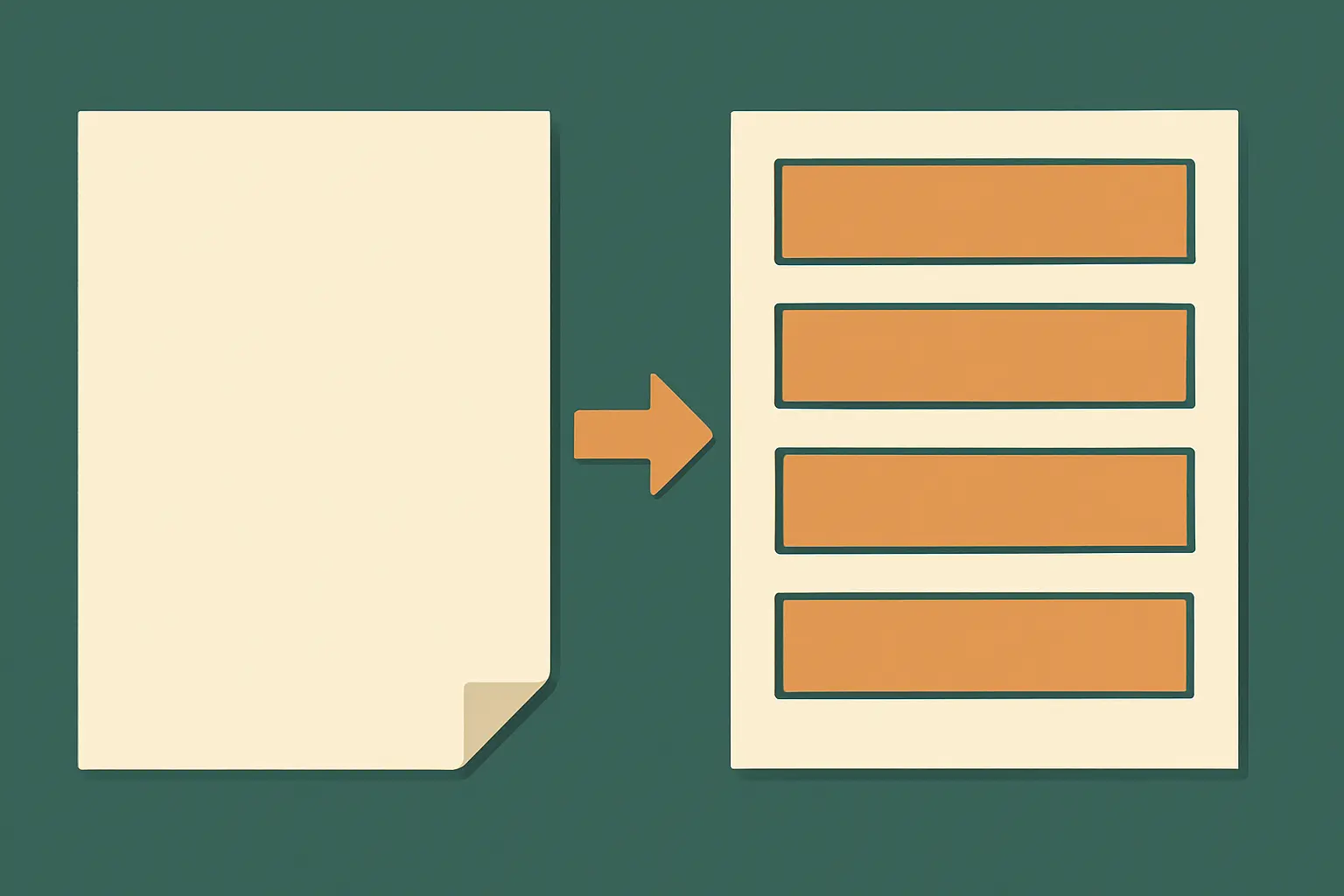
Before you produce a single sentence of prose, put the headings in the document. Background to the study. Statement of the problem. Objectives. Research questions. Hypotheses, if your study needs them. Significance. Scope and delimitation. Limitations. Definition of terms.
That takes four minutes and changes the task completely. You are no longer facing a blank page. You are facing nine small boxes, and you can fill any of them in any order. Most students discover they can write the significance section immediately, because they know why their topic matters — and once anything is written, the document stops being blank and the resistance drops.
Then write the statement of the problem, because it is the section that decides whether your supervisor approves the chapter, and everything else in the project points back at it. Our section-by-section guide to Chapter One shows the sentences each section needs.
Why the blank page wins so often
It is worth understanding the mechanism, because knowing it makes it much easier to beat.
Starting is expensive and finishing is cheap. When you open a document containing nothing, your mind has to hold the entire project at once — topic, argument, structure, standard, deadline — before it can produce a single word. That is genuinely hard, and it is hard in a way that has nothing to do with how well you write. When you open a document containing a heading called “Definition of terms” with two entries already under it, you only have to hold the next entry. The cost collapses.
This is why “I will start when I have read more” never works. More reading does not reduce the cost of starting; it raises it, because now there is more to hold. The only thing that reduces it is putting something imperfect on the page and letting the document carry the structure instead of your memory.
What a realistic week looks like
This assumes an approved topic and no data collected yet.
- Day 1. Lay out the headings. Write the significance section and the definition of terms. Both are short and neither requires deep reading. End the day with something written.
- Day 2. Draft the statement of the problem badly on purpose. A rough complete version is workable; a perfect half-version is not.
- Day 3. Read enough to support the background. Cite as you go — never leave a claim uncited “for later”.
- Day 4. Write the background from those sources, moving from the general field to your specific angle.
- Day 5. Write objectives and research questions together, in matching order and number, and add hypotheses only if you will actually test them.
- Day 6. Write scope, delimitation and limitations. Read the whole chapter once and check it narrows throughout.
- Day 7. Send it to your supervisor. Do not polish it for another week first.
That is a chapter in seven ordinary days, without heroics, and none of those days requires more than a couple of focused hours.
What waiting actually costs
It is worth being specific, because the cost stays invisible until it lands all at once.
Your supervisor’s time is not on demand. A chapter sent in week two gets comments and a second draft. The same chapter sent in week ten gets whatever attention is left in a period when every other final year student is submitting too.
Signatures take longer than writing. Published guidelines can require a certification page signed by the supervisor, a co-supervisor where applicable, the head of department and the provost. That is four people’s availability, and it is not something you can compress by working harder the night before.
Rushed work is where integrity problems begin. Nearly every genuine case starts as a passage pasted in a panic with the citation left for later. The policies that govern this vary by institution — one Nigerian university publishes a 20% maximum and states that plagiarism discovered after a degree is awarded attracts immediate withdrawal of the degree. Time pressure is the single biggest driver of that risk.
A repeated year is the real price. Not finishing does not cost you a chapter. It costs another session.
Where Tesify fits
Tesify exists for the exact moment described at the top of this page: you have the topic, you have the time blocked out, and you cannot start.
- It gives you the structure as a working document. The five-chapter shape with the sections already laid out, so every session opens onto a defined box rather than a blank page. This removes the single largest source of stalling.
- It drafts section by section, with you. You bring the topic, the argument and the sources; the tool removes the cold-start cost of turning an empty section into a first paragraph you can then fix.
- It keeps citations attached as you write, which removes the end-of-project scramble to reconstruct where a claim came from — the scramble that produces uncited passages.
- It keeps your reference list in one consistent style, which matters more than students expect given that Nigerian institutions do not share a single required referencing style.
The work stays yours. It is 100% written by you, and 9,000+ students and 15,000+ chapters have gone through the same process. What the tool removes is overhead, not authorship — and overhead is precisely what a student with a deadline cannot afford to spend attention on.
Frequently asked questions
What does Tesify cost?
Pricing is published on the Tesify site and changes, so check it there rather than trusting a figure quoted in an article. You can open the editor and see how the workflow fits your project before deciding anything.
Is using an AI writing tool cheating?
That depends on your institution’s rules, which are the only ones that bind you, and many Nigerian institutions have been revising them. Tesify is built around work that remains written by you — the boundary that matters is whether the argument, the analysis and the words are yours, and whether you disclose tool use where your department requires it. Read your own department’s policy and follow it.
Will it raise my similarity score?
Similarity comes from matching text, most often uncited quotation and reused material. Drafting your own argument with citations attached as you write is what keeps that number honest. Note also that Turnitin itself states its similarity score does not determine whether plagiarism has occurred — a human makes that judgment.
Do I still need to do my own research?
Yes. No tool collects your data, chooses your design or decides what your findings mean. Those are the things you are examined on.
My supervisor has not approved my topic yet. Should I start?
You can draft the background reading, but do not write the statement of the problem until the topic is settled, because that section defines everything downstream.
How long does a final year project take?
There is no national figure and any specific number you see quoted is somebody’s estimate. Plan by sections completed rather than by weeks elapsed.
Can I write it all in the final month?
Some students do and it shows. The bigger risk is procedural: signatures, corrections and departmental checks all take time you cannot compress.
What if my English is not strong?
Write the argument first in whatever words come, then improve the expression. Weak structure fails a project; imperfect phrasing rarely does.
Should I buy a completed project instead?
No. Beyond the integrity consequences, downloaded and purchased material is the most heavily indexed text in existence and among the easiest to match — and you will still have to defend it in front of a panel that asks how you chose your sample.
I have lost weeks already. Is it too late?
Almost certainly not, but the answer depends on your submission date rather than on how bad you feel. Work out how many weeks remain, tell your supervisor honestly where you are, and start the first section today rather than building a recovery plan you will not follow.
The next hour decides this
You are not going to find a week with fewer demands in it. The project gets written in ordinary hours by tired people, and the only thing standing between you and a first chapter is a document with nine headings in it instead of one.
Put the headings in. Write the easiest section. Then keep going.