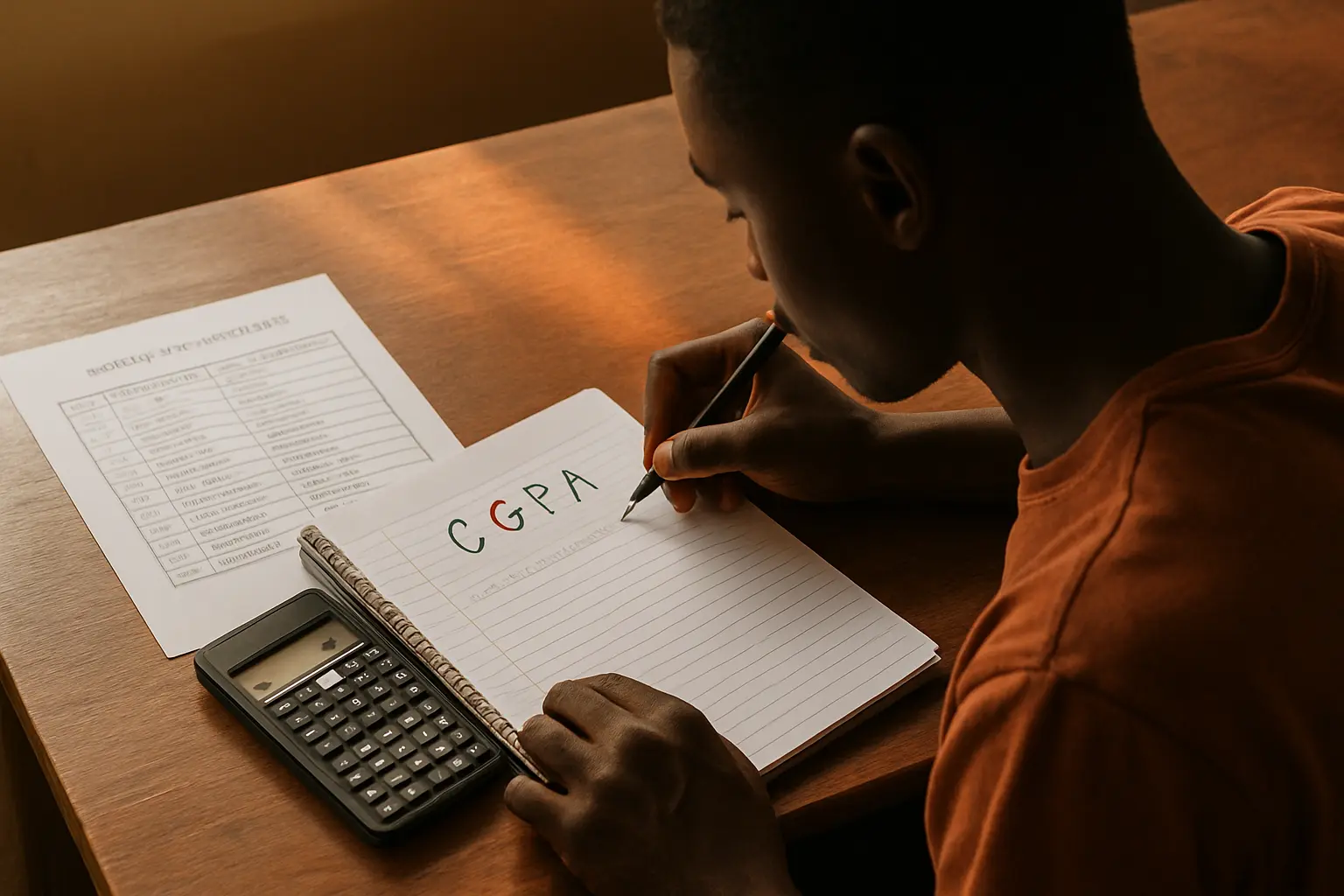
There is no national mark scheme for a Nigerian final year project. What the National Universities Commission does fix is the number of credit units your project carries — and that number is 3, 4 or 6 depending on your programme, written into the NUC’s own curriculum document. Once you know it, the effect on your CGPA is arithmetic: a 6-unit project can move a 120-unit degree by up to 0.25 grade points, which is more than the width of some class boundaries.
What the NUC actually fixes
The Core Curriculum and Minimum Academic Standards (CCMAS), published by the National Universities Commission and downloadable per discipline from its website, sets three things that bear directly on your project mark.
First, the grade point scale. All courses are graded out of 100 and converted as follows:
| Mark % | Letter grade | Grade point |
|---|---|---|
| 70 – 100 | A | 5 |
| 60 – 69 | B | 4 |
| 50 – 59 | C | 3 |
| 45 – 49 | D | 2 |
| 40 – 44 | E | 1 |
| 0 – 39 | F | 0 |
Source: NUC CCMAS, Social Sciences discipline, Table 1.2.
Second, the class of degree. Your cumulative grade point average maps to a class:
| CGPA | Class of degree |
|---|---|
| 4.50 – 5.00 | First Class Honours |
| 3.50 – 4.49 | Second Class Honours (Upper Division) |
| 2.40 – 3.49 | Second Class Honours (Lower Division) |
| 1.50 – 2.39 | Third Class Honours |
| 1.00 – 1.49 | Pass |
Source: NUC CCMAS, Social Sciences discipline, Table 1.4.
Third, the size of the degree. The minimum for the award of a degree is 120 credit units for UTME entrants and 90 for direct entry. Every course counts: the CCMAS states that grades in all courses, “whether compulsory or optional and whether passed or failed”, must be included in the computation, and that where a course is repeated, the grades at each and all attempts are included.
How many units is your project worth?
This is the question that decides everything else, and it has no single answer — not because nobody knows, but because the NUC deliberately sets it per programme. Within the Social Sciences discipline alone, the CCMAS assigns:
| Programme | Course code | Units | Practical hours |
|---|---|---|---|
| Sociology | SOC 408 Research Project | 6 | 270 |
| Economics | ECO 499 Research Project / Original Essay | 6 | 270 |
| Social Work | SWK 402 Research Project | 6 | 270 |
| Demography and Social Statistics | DES 401 Research Project | 6 | 270 |
| Political Science | POL 407 Research Project | 4 | 180 |
| Psychology | PSY 406 Research Project | 4 | 180 |
| Criminology and Security Studies | CSS 401 Research Project | 4 | 180 |
| Philosophy, Politics and Economics | PPE 499 Long Essay | 4 | 180 |
Computing is structured differently again. The CCMAS splits it into two separate 3-unit courses across two semesters — CSC 497 Final Year Project I and CSC 498 Final Year Project II, at 135 practical hours each — and the same 3 + 3 pattern is used for Cybersecurity (CYB 497/498), Data Science (DTS 497/498) and Information and Communication Technology (ICT 497/498). If you are in one of those programmes you receive two project grades, in two different semesters, and a weak first half is still recoverable in the second.
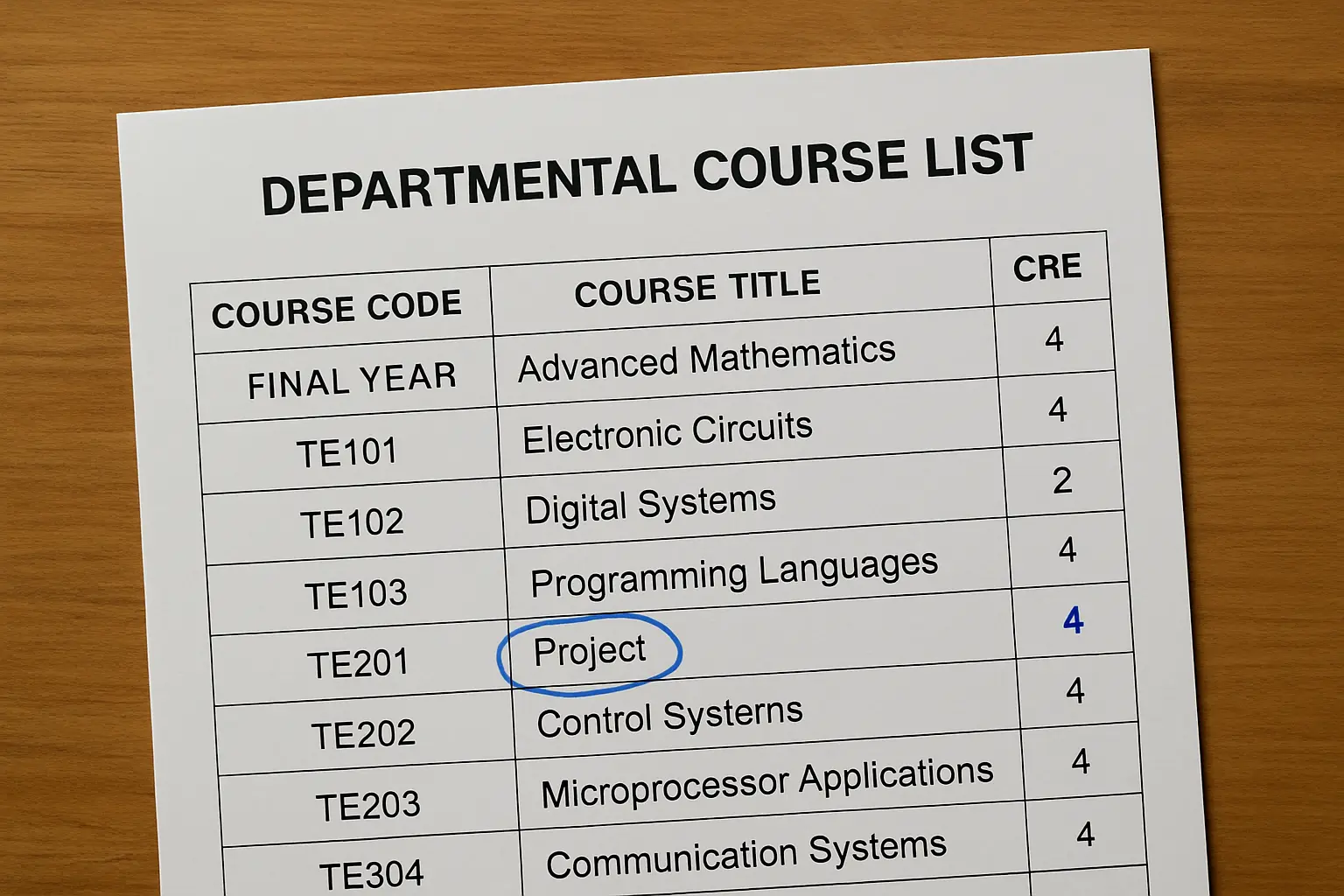
So the honest answer to “how many units is a final year project in Nigeria” is: look up your own programme. Your departmental course list carries the code and the unit figure on the same line, and the national document behind it is free to download.
What do the practical hours mean?
The CCMAS defines a credit precisely: “One credit is equivalent to one hour per week per semester of 15 weeks of lectures or three hours of laboratory/studio/workshop work per week per semester of 15 weeks.”
A project is counted in the second category, which is why a 6-unit project is listed at 270 hours — 6 units × 3 hours × 15 weeks. That figure is not a target anybody polices, but it is a useful sanity check on your own planning. 270 hours is roughly eighteen hours a week across a fifteen-week semester. Students who budget two weekends for the whole project are not being lazy so much as working from a wrong estimate of what the curriculum assumes.
The arithmetic: how much does the project actually move your CGPA?
Take a student on a 120-unit degree with a 6-unit project, whose other 114 units have averaged a CGPA of 3.45 — just under the Second Class Upper boundary of 3.50.
| Project grade | Grade point | Final CGPA | Class |
|---|---|---|---|
| A (70–100) | 5 | 3.53 | Second Class Upper |
| B (60–69) | 4 | 3.48 | Second Class Lower |
| C (50–59) | 3 | 3.43 | Second Class Lower |
| D (45–49) | 2 | 3.38 | Second Class Lower |
| E (40–44) | 1 | 3.33 | Second Class Lower |
Computed as (114 × 3.45 + 6 × grade point) ÷ 120.
For that student the project is the whole difference between a 2:1 and a 2:2, and an A rather than a B is what does it. That is the strongest honest case for taking it seriously — not that the project decides your degree in general, but that it lands last, when your CGPA is already close to a boundary and nothing else is left to move it.
The maximum swing, in general terms:
| Project size | Degree size | A instead of C | A instead of E |
|---|---|---|---|
| 6 units | 120 units (UTME) | +0.10 | +0.20 |
| 4 units | 120 units (UTME) | +0.07 | +0.13 |
| 6 units | 90 units (direct entry) | +0.13 | +0.27 |
| 4 units | 90 units (direct entry) | +0.09 | +0.18 |
Two things fall out of this table. Direct entry students carry more risk and more upside, because the same project is a larger share of a 90-unit degree. And if you carried more than the minimum number of units, the effect is proportionally smaller than the figures above — use your own total, not 120, if you know it.
What the CCMAS does not say — and why that matters
We read the curriculum documents looking for a national rule on how a project’s 100 marks are divided between the supervisor and the defence panel. There is none. The CCMAS fixes credit units, the grade point scale and the degree classification, but it does not prescribe an internal mark breakdown for a project, and it does not set a national pass mark for the defence separately from the course.
That matters because a confident split — “60% supervisor, 40% panel” — circulates widely online and is presented as a national standard. It is not one. It may well be your department’s rule, and if it is, your department’s rule governs you. But it is a departmental decision, and the only way to know yours is to read your project handbook or ask your supervisor. This is the same pattern documented for similarity thresholds in the guide to acceptable plagiarism percentages in Nigerian universities: a number invented by content farms, repeated until it sounds official, and contradicted by the institutional documents themselves.
One thing the CCMAS does state is that external examiners from other universities are “a crucial quality assurance requirement for all courses in Nigerian University System”, and that their role should go beyond moderating questions to examining scope and depth against curricular expectations. In practice this is why a final year project is frequently seen by someone who has never met you — and why the internal politics of your supervisor relationship matter less to the mark than students assume.
So what actually earns the marks?
Since the breakdown is departmental, the reliable guide is what panels test, and that is consistent across Nigerian departments even where the mark schemes differ.
- Internal consistency. The number of research questions in Chapter One, the number of tables in Chapter Four and the number of conclusions in Chapter Five should match in number and order. This costs nothing to fix and is checked first.
- One respondent count everywhere. The sample size in Chapter Three, the analysed N in your tables and the figure in your abstract must agree.
- A method you can justify. Naming the tool is not enough; you have to say which research question it answers, as set out in choosing the statistical test for your project.
- Sources that are real and correctly formatted, in the style your department mandates — see how to reference the way your university requires.
- Being able to speak to your own work. The question bank is in what is asked during a project defence, and a student who cannot discuss their own methodology loses marks no formatting can recover.
Notice what is absent from that list: length, binding quality, and the number of references. Those are the three things students optimise hardest and the three that move a mark least.
Where to find your own numbers, in ten minutes
- Your project’s units. Open your departmental course list for the final year and find the project course code. The unit figure is on the same line.
- Your national curriculum. Download your discipline’s CCMAS document free from the NUC website and search it for your course code. It gives the units, the practical hours and the official course description.
- Your current CGPA and total units. From your transcript or student portal.
- Do the arithmetic. Multiply your units-so-far by your current CGPA, add (project units × the grade point you are aiming at), and divide by your expected total units.
- Your department’s mark breakdown. Ask, because it is not published nationally.
If step four puts you within about a tenth of a class boundary, you now know exactly how much the next few weeks are worth, which is a better basis for planning than anxiety. The five-chapter structure those weeks have to fill is itself a departmental convention rather than a national rule, and the CCMAS confirms this indirectly: Social Work’s course description is one of the few that spells the five chapters out explicitly, which tells you the others leave it to the department.
The units are fixed. The grade is not.
Tesify keeps your chapters in the structure your department expects and holds your research questions, tables and conclusions in one connected document — so the alignment a panel checks first is something you can see rather than rebuild by hand the night before. Start on the free plan, alongside 9,000+ students and 15,000+ chapters, with every word still written by you.
Frequently asked questions
How is a final year project graded in Nigeria?
It is graded out of 100 like any other course and converted to a grade point on the NUC’s five-point scale, where 70–100 is an A worth 5 points. It then enters your CGPA weighted by its credit units. How the 100 marks are split between your supervisor and the defence panel is set by your department, not nationally.
How many credit units is a final year project?
Three, four or six, depending on your programme. The NUC CCMAS assigns 6 units to Sociology, Economics, Social Work and Demography, 4 units to Political Science, Psychology and Criminology, and splits Computing programmes into two 3-unit courses across two semesters. Check your own departmental course list.
Does the final year project affect your CGPA?
Yes, in proportion to its units. On a 120-unit degree a 6-unit project scoring an A rather than a C raises your CGPA by 0.10, and an A rather than an E raises it by 0.20. That is frequently enough to cross a class boundary, because the project is marked last.
What CGPA do you need for a 2:1 in Nigeria?
3.50 on the five-point scale. The NUC classification runs 4.50–5.00 First Class, 3.50–4.49 Second Class Upper, 2.40–3.49 Second Class Lower, 1.50–2.39 Third Class and 1.00–1.49 Pass.
Can a good project raise my class of degree?
Only if you are already close to the boundary. A 6-unit project cannot move a 120-unit CGPA by more than 0.25 even in the extreme case, so it decides borderline cases rather than transforming a mid-range result. Whether you are borderline is something you can calculate exactly rather than guess.
Is the project mark split between the supervisor and the panel?
Usually, but the split is departmental. There is no national rule in the NUC’s curriculum documents, so any specific percentage you read online is somebody’s departmental practice presented as a standard. Ask your supervisor for yours.
What is a good mark for a final year project?
Seventy or above earns an A and the full 5 grade points, and that threshold is national. Below 40 is a fail and scores zero points, which still enters your CGPA.
Do direct entry students’ projects count more?
Proportionally, yes. The minimum for a direct entry degree is 90 units rather than 120, so the same 6-unit project is a larger share of the total and can move the CGPA by up to about 0.27 instead of 0.20.
What happens if I fail my project?
It scores zero grade points and, being a compulsory course, must be passed for the degree to be awarded — the CCMAS requires all compulsory courses to be completed and passed. The failed attempt also stays in the CGPA computation alongside the repeat, because grades at each and all attempts are included.
Where can I find the official curriculum for my programme?
The NUC publishes the CCMAS by discipline on its website as free PDF downloads, one document per discipline. Search yours for your project’s course code to see the units, the practical hours and the official course description.
Does the length of my project affect the mark?
Not directly, and no national rule sets a page count. Panels examine alignment, method and whether you can defend the work. A long project that contradicts itself scores below a short one that does not.
Do the practical hours mean I have to log my time?
No. The 270 or 180 hours is how the curriculum converts credit units into workload, not a record anybody collects. Treat it as an estimate of what the project is expected to take — roughly eighteen hours a week over a semester for a 6-unit project.