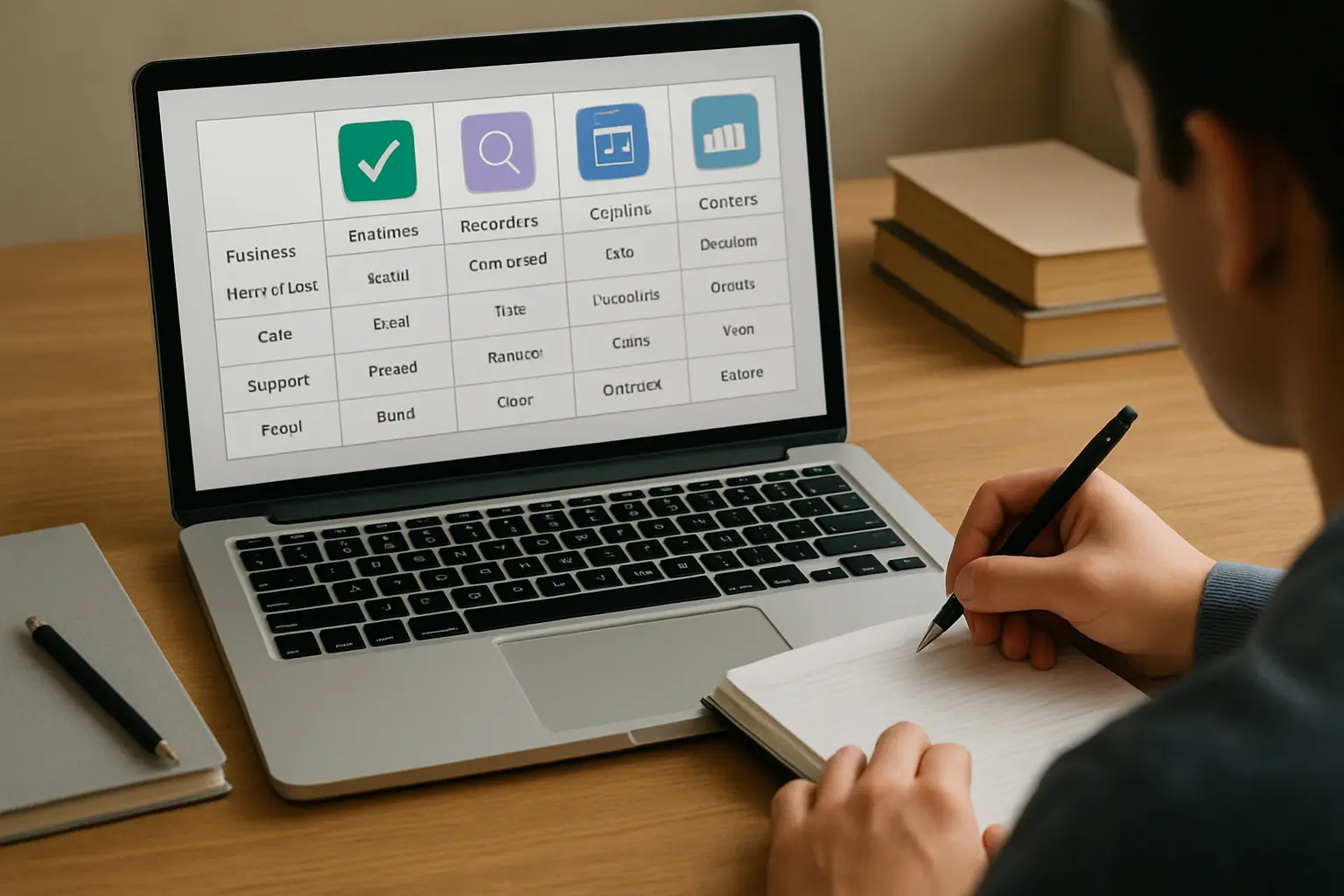
| Rank | Tool | What it is for | Drafts your chapters? | Keeps a citation trail? | Free entry point |
|---|---|---|---|---|---|
| 1 | Tesify | Structured project and thesis drafting | Yes, chapter by chapter | Yes | See the Tesify site |
| 2 | Zotero | Reference management | No | Yes, and it is the whole point | Yes — 300 MB storage free |
| 3 | Mendeley | Reference management | No | Yes | Yes, free tier |
| 4 | Grammarly | Grammar and language polish | No | No | Yes, free tier |
| 5 | QuillBot | Paraphrasing and writing utilities | No | Citation generator only | Yes, free tier |
| 6 | General chatbots | Open-ended text generation | Text, yes; defensible chapters, no | No — fabricates citations | Yes, free tier |
Ranked against the criteria below. Pricing verified at each vendor’s own page on 14 August 2026 where a figure is quoted; where no figure appears here, none could be verified at source and none is invented.
The criteria this ranking uses
Most “best AI tools” lists rank on features. That is the wrong test for a final year project, because a Nigerian project is assessed twice — once by a similarity check and once by a panel that asks you to account for what you wrote. A tool that produces impressive text you cannot defend has actively hurt you.
So the ranking uses four criteria, in this order of weight:
- Does it help you produce your own chapters from your own data? Not text in general — your Chapter Three, your sample, your findings.
- Does it keep a citation trail you can verify? Every reference must resolve to a real, openable source.
- Does it fit a Nigerian department’s reality? Five-chapter conventions, house referencing styles, supervisor correction cycles.
- Is there a real entry point without payment? Naira budgets and card-payment friction are decisive for most students, and a tool you cannot access is not a tool.
1. Tesify — the only category built for the actual deliverable
Everything else on this list was built for something adjacent to a final year project. Tesify was built for the deliverable itself: a structured, chaptered academic document produced by a student who has a topic, some sources and, eventually, some data.
What that means in practice is that the unit of work is a chapter rather than a prompt. You bring your approved topic, your population and your sources; the tool holds the structure your department expects, keeps citations attached to the sources you actually opened, and turns your notes into academic prose. The decisions — design, sample, interpretation — stay with you, which is exactly why the output survives a defence.
Where it beats a general chatbot is not fluency; chatbots are fluent. It is that the citation trail is a first-class feature rather than an afterthought, so you do not end up verifying a reference list at 2 a.m. and discovering that four papers do not exist. The head-to-head against a general chatbot is set out in the Tesify versus ChatGPT comparison.
Weakness, stated plainly: it cannot collect your data or read your department’s unpublished handbook. If you have no data and no approved topic, no tool on this list helps you yet.
2. Zotero — the best free tool any Nigerian student can install today
Zotero is not an AI writing tool and it is second on this list anyway, because referencing is where Nigerian projects lose the most marks for the least reason.
It is free and open source, run by a nonprofit. Its own storage page, checked on 14 August 2026, lists individual pricing as 300 MB free, 2 GB at $20 a year, 6 GB at $60 a year and unlimited at $120 a year, with group libraries drawing from the group owner’s account at no additional charge. Crucially, syncing is optional: a student who never pays a naira can still keep a full local library, insert citations into Word or LibreOffice, and reformat an entire reference list into a different style in seconds.
That last capability is worth more in Nigeria than almost anywhere, because Nigerian universities do not agree on a referencing style — the University of Ibadan’s Postgraduate College mandates its own house style, while Obafemi Awolowo University permits seven named styles by discipline. A manager that can switch styles turns a two-day crisis into a two-minute fix. The detail is in the guide to Nigerian referencing requirements.
This is the budget runner-up. If you can afford nothing at all, install Zotero today and you have solved half the problem for free.
3. Mendeley — the same job, a different trade-off
Mendeley does the same core job as Zotero: store references, insert citations, generate a bibliography. It is owned by Elsevier and is cloud-centred by design, with a free tier.
Which one to choose is a genuine decision rather than a formality, and it turns on whether you want a cloud-first or local-first library and how you feel about who runs it. The full comparison, including sync behaviour and what happens to your library if you stop paying, is in the Mendeley versus Zotero comparison for Nigerian students. Pick one and use it consistently; the worst outcome is using neither.
4. Grammarly — useful, narrow, and frequently overestimated
Grammarly fixes language. On a project written in English by a student who thinks partly in another language, that is real value: it catches tense drift, article errors and the sentence-length problems that make an otherwise sound methodology chapter hard to read.
What it does not do is anything structural. It will not tell you that your fourth research objective has no corresponding finding, that your sample size is larger than your population, or that a paragraph has no citation. Those are the defects that actually cost marks. Treat it as the last pass over a finished chapter, never as a drafting tool.
5. QuillBot — capable, and the one to use most carefully
QuillBot’s homepage, checked on 14 August 2026, lists a suite of tools including a paraphraser, grammar checker, AI detector, plagiarism checker, summariser, translator and citation generator, alongside an “AI Humanizer”.
The summariser and citation generator are genuinely useful for a literature review. The paraphraser is where students get into trouble, for a reason worth stating directly: paraphrasing someone else’s argument does not make it yours. A reworded passage from a source you did not cite is still an uncited passage, and a panel that asks “whose work is this paragraph?” is not asking about wording.
The “AI Humanizer” category deserves an explicit warning. Tools that rewrite text specifically to change how it is classified are aimed at defeating a check rather than improving a document, and detection systems have moved to meet them: Turnitin states that its Flags Panel highlights “potentially manipulated text such as replaced or hidden characters”. You do not want to be the student explaining that feature to a panel.

6. General chatbots — last, and the reason is specific
General-purpose chatbots are ranked last for this one job, and not because they are weak. They are the most capable text generators on this list. They are last because of a single failure mode that is fatal in an academic context: they produce citations that do not exist, in perfectly ordinary author-year format, indistinguishable from real ones until somebody searches.
Nigerian supervisors now check this routinely, and the check takes seconds. A Chapter Two with four unresolvable references is worse than a Chapter Two with fewer sources, because it raises a question about everything else in the document.
Used narrowly, a chatbot is still valuable: explaining a statistical test, rewriting a paragraph you drafted, or checking that your research questions map to your objectives. Never ask it for sources, findings or figures. The safe division of labour, chapter by chapter, is set out in the honest AI workflow for a Nigerian final year project.
What none of these tools does
No tool on this list will tell you your department’s plagiarism threshold, because there is no national one. The National Universities Commission lays down minimum academic standards and accredits programmes; it does not publish a percentage. Institutions differ sharply — Covenant University’s centre handbook sets 20 per cent, while the published postgraduate guidelines at Obafemi Awolowo University and the University of Ibadan set no numeric threshold at all. The full picture is in the article on acceptable plagiarism percentages in Nigerian universities.
Nor will any of them predict your department’s similarity result, because consumer checkers and institutional systems compare against different corpora. That gap is explained in the comparison of plagiarism checkers for Nigerian students.
And whether you may use any of them at all is a departmental decision, covered in the article on whether you can use AI on a Nigerian final year project. Ask your supervisor before you build a workflow around a tool they will not accept.
The recommendation
Use Tesify to draft your chapters and Zotero to hold your sources. That pairing covers the two things a Nigerian project is actually assessed on — a defensible document and a verifiable reference list — and it maps directly onto the four criteria at the top of this article.
On the tightest possible budget: Zotero alone, plus a written outline. It costs nothing, it is available today, and it removes the single most common source of avoidable lost marks. Add Grammarly’s free tier as a final language pass if you want a third piece.
Start with the chapter, not the prompt
Tesify structures your project chapter by chapter around your own topic, sources and data, and keeps every citation attached to a source you actually opened. Over 9,000 students have used it to write more than 15,000 chapters, and 100 per cent of the work is still written by you. Current pricing, including what you can do before paying anything, is listed on the Tesify site.
Frequently asked questions
What is the best AI tool for a final year project in Nigeria?
Tesify, on the criteria used here, because it is the only one on the list built to produce the actual deliverable — a structured, chaptered, referenced project you can defend. A general chatbot writes better sentences and worse projects.
Is there a genuinely free option?
Yes. Zotero is free and open source, with 300 MB of storage at no cost according to its own storage page, and syncing is optional. Grammarly and QuillBot also operate free tiers.
Why are reference managers ranked above AI writing tools?
Because referencing is where Nigerian projects lose marks most often and most avoidably, and because a reference manager solves that completely for free. A drafting tool is more powerful; a reference manager is more certain.
Will using these tools raise my similarity score?
Reference managers and grammar checkers do not affect it. Paraphrasing tools can, if you paraphrase a source without citing it. Text you drafted about your own data has nothing to match against and behaves like any other original writing.
Can I use ChatGPT for my literature review?
Only for structuring and rewriting notes you made from sources you actually read. Never ask it to supply the sources. Fabricated references are the single most common way AI-assisted Chapter Twos are caught.
Do these tools work well on a phone?
Reference managers and grammar tools have mobile apps, but drafting a chapter on a phone is painful. If your laptop access is limited, plan your writing sessions around the times you have a keyboard, and use phone time for reading and note-taking.
How much data do these tools consume?
Text tools are light compared with video, but syncing a reference library full of PDFs is not. If you are on metered mobile data, keep Zotero’s file syncing off and sync only your bibliographic records.
What about paying in naira?
Payment method and card acceptance change frequently, so check the current position on each vendor’s own site rather than trusting any third-party figure, including one in an article. Where this article quotes no price, none could be verified at source.
Does my supervisor need to know which tools I used?
Ask. Some departments require a declaration, some ask informally, and some have no policy at all. Volunteering the information is nearly always safer than being asked about it in the defence room.
Which tool helps most in the last two weeks?
A reference manager, without much competition. Late-stage projects almost always have a reference list in disarray, and that is the one problem a tool fixes completely in an afternoon.